
Can lipoic acid improve muscle repair during sleep?
Alpha-lipoic acid may support muscle repair and circadian rhythm in older adults through converging animal and mechanistic evidence, but human data directly linking it to overnight muscle recovery remain absent. This article examines what the research actually shows and where the gaps lie.
If muscle loss and sleep are both getting worse with age, a lipoic acid supplement for muscle repair during sleep sounds attractive for one simple reason: nighttime is when the body is supposed to shift toward repair, not merely rest. The question is whether alpha-lipoic acid has shown that it improves that overnight repair in older adults, or whether it only touches biological systems that make the idea worth studying.
At this point, the honest answer is narrower than most supplement labels would like. Alpha-lipoic acid has interesting animal evidence involving circadian rhythm and muscle preservation, and one older-adult human study found 600 mg/day reasonably well tolerated. But no human trial has shown that it improves overnight muscle protein synthesis, sleep-based muscle repair, sarcopenia outcomes, or day-to-day function in adults over 60.

Why Sleep Matters To Aging Muscle
Muscle maintenance is not just a gym issue in later life. It shows up when someone pushes up from a low chair, steadies on the first stair, or hesitates before walking across a dark room at night. The body’s repair systems still operate with age, but they run against lower reserve, more inflammation, more medication burden, and often lighter, more fragmented sleep.
Sleep is relevant because growth hormone release is tied to sleep-stage control. A UC Berkeley study reported that GHRH and somatostatin neurons in the hypothalamus regulate growth hormone release differently during NREM and REM sleep, helping explain why sleep architecture can matter for muscle and bone repair biology rather than simply for feeling rested.[1]
That does not mean any supplement taken at bedtime becomes a muscle-repair supplement. The useful question is more specific: does alpha-lipoic acid improve the aging body’s nightly repair conditions enough to preserve muscle in people who are actually losing strength? The evidence starts with a circadian finding, not with a strength test.
The Circadian Finding Is The Most Sleep-Relevant Clue
The most distinctive alpha-lipoic acid finding for this question comes from aged mice. Linus Pauling Institute researchers reported that lipoic acid fed to aged mice helped restore circadian rhythm function in the liver by resynchronizing clock-gene expression. In a Sleep Review summary of the work, lead researcher Tory Hagen said, “This could be a breakthrough in understanding why lipoic acid is so important.”[2]
That is a meaningful clue because circadian rhythm is not just a sleep schedule on the wall. Peripheral tissues, including liver and muscle, use clock-gene timing to coordinate metabolism, repair, and energy handling across the day-night cycle. When those rhythms flatten with age, the body may still perform repair tasks, but with poorer timing and less coordination.
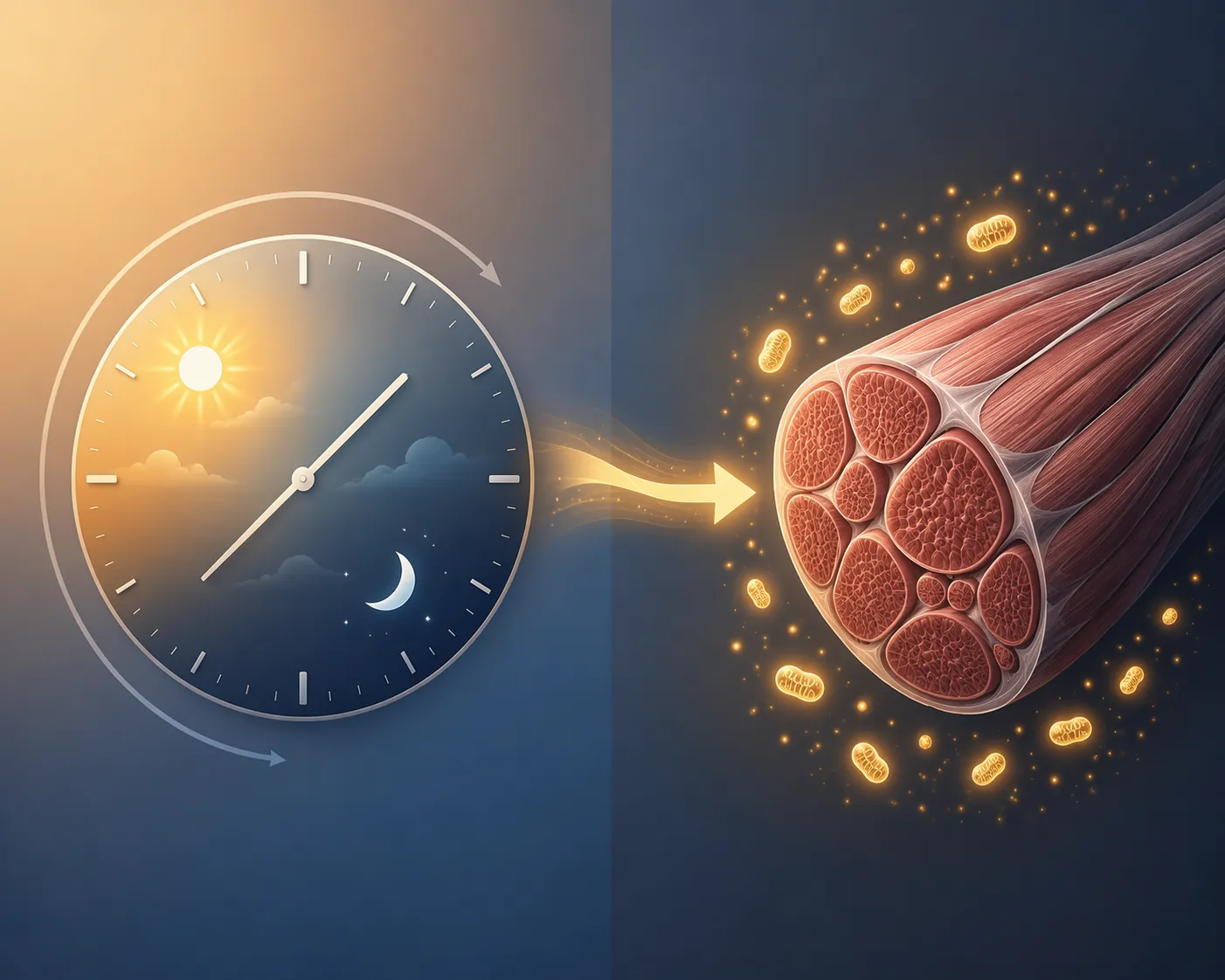
Still, the study does not show that an older person taking alpha-lipoic acid will sleep better, rebuild thigh muscle overnight, or walk farther the next morning. It studied aged mice and liver clock-gene rhythms. Liver timing matters, and the result is biologically coherent, but it is not the same endpoint as human muscle protein synthesis during sleep. It also does not establish the dose, timing, tissue response, or clinical benefit needed to call alpha-lipoic acid a sleep-time muscle repair treatment.
The Muscle-Preservation Evidence Comes From A Different Animal Model
The muscle evidence is also preclinical, but it points in a direction worth noticing. In a rat model of type 2 diabetes, 13 weeks of oral alpha-lipoic acid at 50–200 mg/kg significantly increased soleus muscle weight and muscle fiber length compared with untreated diabetic rats.[3]
The soleus matters because it is a postural muscle. It helps with standing and steady movement, the kind of quiet work that becomes very important when an older adult is trying not to fall. But the model was diabetic rats, not older adults with sarcopenia, so the result should be read as a muscle-preservation signal under metabolic stress rather than a direct aging trial.
The pathway details help explain why the finding belongs in this conversation. The study reported that alpha-lipoic acid suppressed the TNF-α/JNK pathway, which is associated with inflammatory signaling, and enhanced PI3K/AKT signaling, a pathway involved in anabolic muscle processes. It also increased expression of MyoD, mTOR, and MyHC, markers related to muscle formation, protein synthesis signaling, and muscle fiber structure.[3]
Put plainly, the animal data do not merely say “antioxidant.” They suggest alpha-lipoic acid may push against inflammatory muscle wasting while supporting signals that help muscle maintain structure. That is more relevant to aging muscle than a generic free-radical claim, especially when inflammation, insulin resistance, and inactivity often travel together in later life.
| Evidence | What It Shows | What It Does Not Show |
|---|---|---|
| Aged-mouse circadian study | Lipoic acid resynchronized liver clock-gene expression in aged mice | Improved sleep quality or overnight muscle repair in older humans |
| Diabetic-rat muscle study | ALA preserved soleus muscle weight and fiber length through inflammatory and anabolic pathways | Prevention or treatment of sarcopenia in adults over 60 |
| Older-adult tolerability study | 600 mg/day was tolerated well in adults aged 65+ in an ophthalmology setting | Better strength, mobility, sleep, or muscle protein synthesis |
| Young male athlete recovery trial | Closest human recovery analog, but in a small young athletic sample | Generalizable benefit for sarcopenic older adults |
Why The Mechanism Fits Together, And Where It Stops
Alpha-lipoic acid sits at an interesting intersection. The Linus Pauling Institute describes it as a mitochondrial cofactor, a compound involved in recycling glutathione, an inhibitor of NF-κB signaling, and a compound that can enhance glucose uptake.[4] Those are not small claims, but they are mostly biochemical functions and mechanisms, not proof of a particular clinical outcome.
For an older adult, the appeal is understandable. Mitochondria affect energy availability. Inflammatory signaling affects tissue breakdown and repair. Glucose handling affects metabolic stress. Circadian timing affects when tissues carry out repair and metabolic tasks. A compound that touches all of those systems deserves careful study in age-related muscle loss.
But plausibility is not the same as a measured repair benefit. A nightly repair claim would need human evidence showing that older adults taking alpha-lipoic acid have better overnight muscle protein synthesis, better preservation of lean mass, improved strength, fewer functional losses, or better recovery after illness or inactivity. The animal studies make that trial worth imagining. They do not replace it.
This distinction matters because older adults are often sold the endpoint when the study only measured the pathway. “Clock genes changed” is not “you will sleep more deeply.” “Soleus fibers were preserved in diabetic rats” is not “your stair climbing will improve.” The bridge between those statements has to be built in human trials.
The Older-Adult Human Data Are Mainly About Tolerability
The most directly relevant human study for age is not a muscle study. Sarezky and colleagues tested escalating alpha-lipoic acid doses in adults aged 65 and older in an age-related macular degeneration context. At 600 mg/day, all subjects tolerated the dose well. At 800–1,200 mg/day, 3 of 14 subjects had intolerable gastrointestinal side effects, and all three were not taking gastrointestinal prophylaxis with proton-pump inhibitors or H2 blockers.[5]
That is useful information, but it should stay in its lane. The participants were not selected because they had sarcopenia, poor sleep, frailty, or impaired overnight recovery. The study does not tell us whether 600 mg/day improves muscle mass, muscle strength, sleep architecture, growth hormone patterns, or next-day mobility.
It does give a practical safety foothold. If alpha-lipoic acid is studied in older adults for circadian aging or muscle preservation, 600 mg/day has some population-specific tolerability support. Higher doses deserve more caution, especially in people who already struggle with appetite, reflux, bowel changes, or medication schedules.
The Closest Human Recovery Trial Is Not An Aging Trial
There is a human recovery study that sometimes gets pulled into this discussion, but it should not carry more weight than it can bear. Isenmann and colleagues studied alpha-lipoic acid in 17 young male athletes, using 300 mg/day for 6 days.[6] That makes it a closer human analog than the animal studies in one sense, because it involved people and recovery-related outcomes.
It is still a long way from the reader who is 68, sleeping poorly, losing leg strength, taking blood pressure medication, and trying to avoid the next fall. Young trained men recover differently from sarcopenic or pre-frail older adults. A short athletic protocol cannot be treated as evidence that alpha-lipoic acid repairs aging muscle during sleep.
Safety And Timing Questions For Adults Over 60
Alpha-lipoic acid is often discussed casually because it is sold over the counter, but older adults rarely have a casual medication list. The Linus Pauling Institute notes that alpha-lipoic acid can enhance glucose uptake, and the research brief flags a practical concern: it may enhance the effects of glucose-lowering drugs.[4] Anyone using insulin or diabetes medication should treat that as a clinician-level question, not a bedtime experiment.
Timing can also matter. Alpha-lipoic acid has a short plasma half-life, roughly 30–90 minutes, and is best absorbed on an empty stomach. It is also commonly advised to separate it from thyroid medication. For an older adult who eats dinner early, takes evening prescriptions, or wakes overnight with reflux, the “just take it before bed” version may not fit cleanly.
- Check glucose-lowering medications first, especially insulin or diabetes drugs.
- Separate from thyroid medication unless a clinician gives different instructions.
- Consider gastrointestinal tolerance, particularly above 600 mg/day.
- Do not use athletic recovery data as proof for sarcopenia or frailty.
- Watch whether the intended outcome is measurable: strength, walking, stairs, falls, sleep quality, or muscle mass.
The Australian Institute of Sport classifies alpha-lipoic acid as Group C, a category for supplements with limited evidence or unclear benefit in sport settings.[7] That classification is not written for older-adult sarcopenia care, but it is a useful brake on recovery claims. If the sports-performance evidence is not strong enough for confident performance use, it should not be inflated into a stronger claim for medically complex older adults.
What Would Better Evidence Need To Measure?
A useful older-adult trial would not stop at oxidative stress markers. It would need to ask whether alpha-lipoic acid changes outcomes that matter when muscle loss and sleep problems meet in real life: overnight muscle protein synthesis, lean mass, grip or leg strength, gait speed, stair ability, post-illness recovery, sleep architecture, and adverse events.
It would also need the right population. Adults over 60 with sarcopenia, poor sleep, insulin resistance, or frailty risk are not interchangeable with young athletes or laboratory animals. Dose and timing would need to be tested against medication schedules and food timing, not assumed from supplement-label convenience.
A Calibrated Answer
Alpha-lipoic acid has a stronger biological story than many supplements aimed at older adults. Aged-mouse data connect it to circadian clock restoration. Diabetic-rat data connect it to preservation of muscle weight and fiber structure through inflammatory and anabolic pathways. Older-adult human data suggest 600 mg/day can be tolerated reasonably well in at least one clinical context.
That combination is enough to take the idea seriously, but not enough to recommend it as a proven answer for muscle repair during sleep. The missing piece is the one older adults and caregivers most need: human evidence showing that taking alpha-lipoic acid actually improves overnight repair or preserves function in the people at risk of losing it.
References
- Sleep strengthens muscle and bone by boosting growth hormone levels, UC Berkeley researchers discover how. UC Berkeley News. 2025.
- Lipoic Acid Helps Restore Circadian Rhythms. Sleep Review Magazine. 2014.
- Alpha-lipoic acid ameliorates skeletal muscle atrophy in high-fat diet and streptozotocin-induced type 2 diabetic rats. Food Science & Nutrition. 2023.
- Lipoic Acid. Linus Pauling Institute, Oregon State University.
- Tolerability and pharmacokinetics of oral alpha lipoic acid in patients with age-related macular degeneration. Clinical Ophthalmology. 2016.
- Effects of alpha-lipoic acid on muscle recovery after exercise. 2020.
- Alpha-lipoic acid: Summary of supporting evidence. Australian Institute of Sport.
Safety & eligibility read
Cross-check against other interventionsExplore the mechanism
Next step
Spot an error or have clinical feedback?
Because this article covers clinical, medication, or safety information, we use a moderated correction channel instead of open public comments. Let us know if something about “Can lipoic acid improve muscle repair during sleep?” needs a closer look.
Send feedback on this article