
How to Lower Blood Pressure for Better Sleep in Perimenopause
Learn how perimenopause disrupts the normal nighttime blood pressure dip and what specific steps you can take to restore it, improving both sleep quality and cardiovascular health.
The frustrating pattern often shows up before anyone gives it a name: a night of 3 a.m. waking, heat surges, restless drifting in and out of sleep, then a morning blood pressure reading that looks higher than it “should.” If you are trying to understand how to lower blood pressure for better sleep in perimenopause, the missing concept is usually not another generic bedtime rule. It is the normal nighttime blood pressure dip.
Blood pressure is not meant to stay flat across 24 hours. In healthy sleep, it usually falls overnight by about 10–15%. That drop is part of the cardiovascular rest period. When the dip is blunted, absent, or replaced by a rise, the heart and blood vessels spend the night under more pressure than expected. In perimenopause, that can happen for reasons that are specific to this life stage: changing estrogen exposure, stiffer blood vessels, hot flashes, insomnia, and a nervous system that keeps acting as if the body is still on alert.
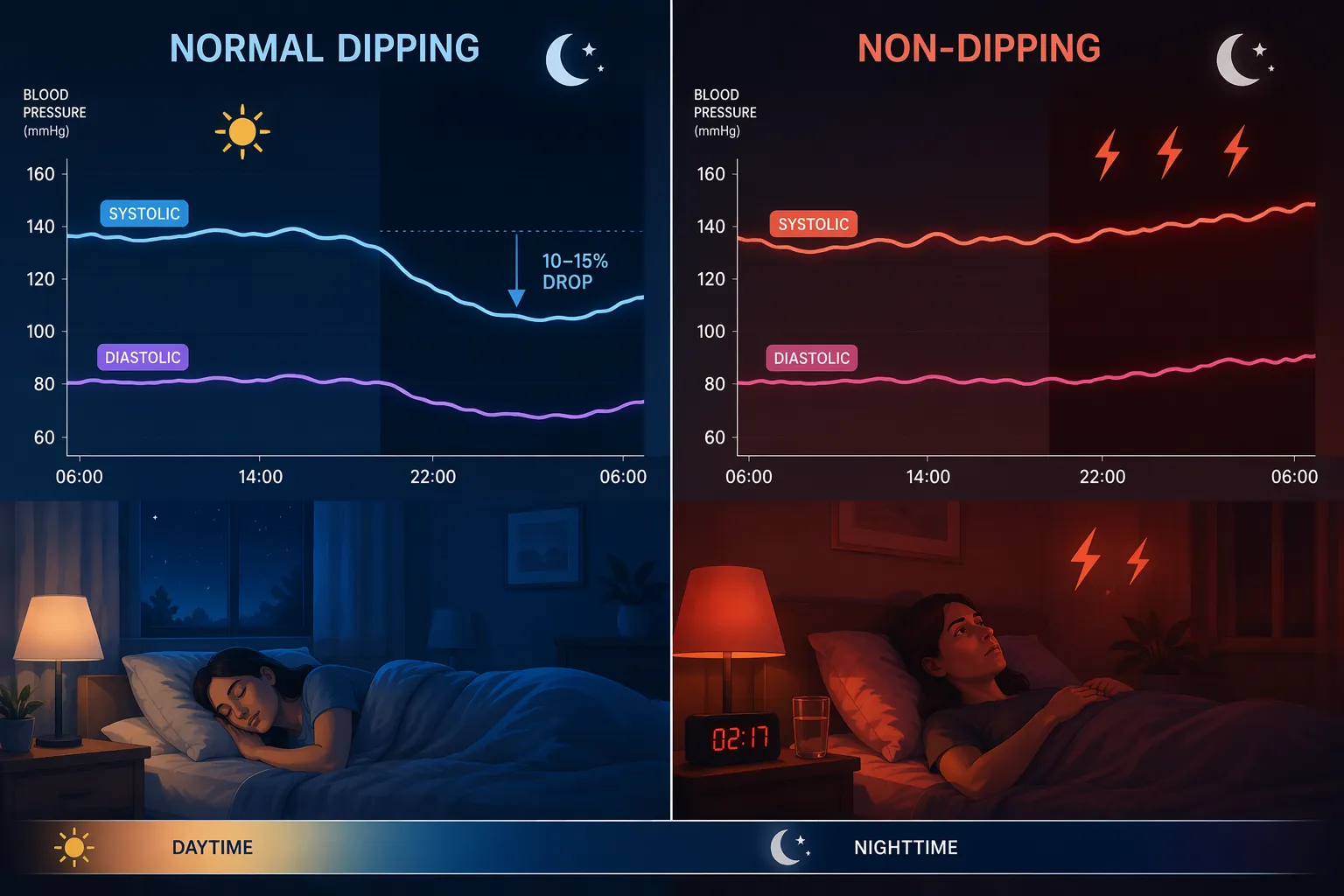
The nighttime dip is the part most BP conversations skip
A home cuff captures a moment. It does not show the full overnight curve. That matters because the curve may be the problem.
One small but unusually useful study followed women in the menopausal transition overnight and compared those with insomnia disorder with controls. The striking finding was not just that the insomnia group slept worse. Their systolic blood pressure rose 4–6 hours after lights-out, while the control group maintained lower nocturnal blood pressure. The study was small, with 23 participants, and it excluded women with diagnosed hypertension, so it should not be treated as a population-wide estimate. Its value is more precise than that: it shows a plausible overnight pattern that many women with perimenopausal insomnia will recognize in their own symptoms, even if they cannot see it on a standard morning reading. [1]
That pattern changes the practical question. The goal is not only “How do I lower today’s blood pressure number?” It is also “How do I help my body return to a normal sleeping-state drop?”
Why perimenopause can erase the dip
The perimenopausal body is not simply “stressed.” It is moving through a hormonal transition that can affect vascular tone and temperature regulation at the same time.
Estrogen helps influence how blood vessels relax and respond. As estrogen levels fluctuate and decline, some women appear to develop more arterial stiffness. Verywell Health’s reporting on perimenopause and blood pressure cites findings that perimenopausal women can show both increased arterial stiffness and a lower incidence of normal night dipping even without diagnosed hypertension. That is an important distinction: the problem may begin before a clinician labels someone hypertensive. [2]
Then sleep disruption adds a second pressure. Hot flashes and repeated awakenings can keep the sympathetic nervous system—the body’s alerting system—more active at night. A hot flash is not just an annoyance that interrupts a dream. It can be a physiologic arousal: heat, sweating, heart pounding, wakefulness, and then the work of trying to fall asleep again. If that cycle repeats, the night becomes less of a cardiovascular recovery period.
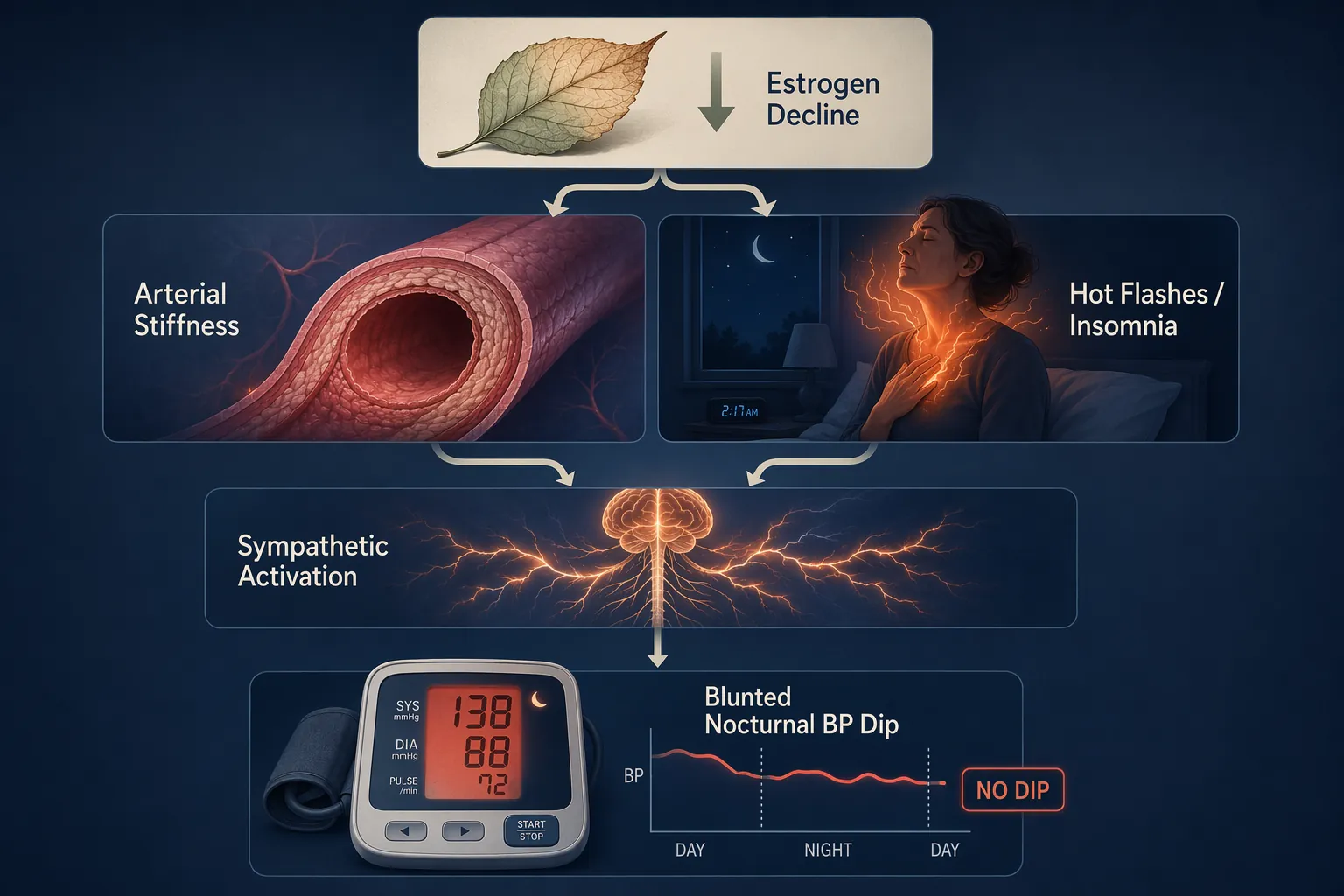
This is where the usual advice to “wind down before bed” becomes too thin. A relaxing routine may help at the edges, but it does not fully explain a body that is waking from heat surges or spending the second half of the night with blood pressure climbing instead of dipping. The mechanism is more specific: stiffer vessels make pressure regulation less forgiving, while insomnia and vasomotor symptoms keep arousal signals alive during the hours when blood pressure should fall.
This is common enough to take seriously, but not automatic
Midlife sleep disturbance is not rare. In the SWAN Sleep Study, 37% of women ages 40–55 reported difficulty sleeping, and poor sleep was identified as an independent predictor of hypertension risk in midlife women. That does not prove that every bad night causes hypertension. It does mean that sleep belongs in the blood pressure conversation for this age group, rather than being treated as a side complaint. [3]
The cardiovascular context is also sobering. Harvard Health reported on a Menopause journal study of 2,924 women ages 42–52 in which only 20% had optimal cardiovascular health scores; poor sleep was independently associated with higher risks for cardiovascular events, heart attack, and stroke. Again, this is not a personal prophecy. It is a reason to stop dismissing fragmented sleep as a quality-of-life problem only. [4]
Blood pressure also tends to become a bigger issue after the menopause transition. Verywell Health notes that postmenopausal women have a four-times greater incidence of hypertension compared with their premenopausal years. That statistic should be handled carefully: it does not mean a given woman is destined to develop hypertension, and it does not tell you whether your own morning reading came from salt intake, medication timing, sleep apnea, a hot-flash-heavy night, or something else. It does say the trend is large enough to warrant measurement and medical attention. [2]
A home cuff can show patterns, not diagnose the night
A standard home blood pressure monitor cannot prove whether you are dipping normally at 2 a.m. or 4 a.m. That usually requires ambulatory blood pressure monitoring, which measures blood pressure repeatedly over a day and night. Still, a careful home log can give you and your clinician a more useful starting point than a handful of anxious, isolated readings.
For several typical weeks, consider tracking the pattern rather than chasing one number:
- A bedtime blood pressure reading, taken after you have been sitting quietly.
- A morning blood pressure reading, before caffeine or a rush of activity when possible.
- Whether you woke repeatedly, had hot flashes, sweated through sleepwear, or spent long stretches awake.
- Alcohol, late meals, intense evening exercise, stressful evening events, and medication timing.
- Symptoms such as morning headaches, unusual fatigue, palpitations, chest discomfort, or shortness of breath.
The useful question is not whether every morning number matches your mood. It is whether higher readings cluster after nights with repeated awakenings, hot flashes, short sleep, or long wake periods. If they do, the log gives your clinician something concrete to interpret: not “I sleep badly sometimes,” but “my BP readings tend to rise after disrupted nights, and the disruption often looks like this.”
| What you notice | What it may suggest | What to do with the information |
|---|---|---|
| Morning BP is often higher after hot-flash-heavy nights | Vasomotor symptoms may be contributing to nighttime arousal | Bring the log to a clinician and discuss hot flash treatment options |
| Bedtime BP is high before sleep and remains high in the morning | Daytime or evening BP control may need review | Ask whether medication timing, ambulatory monitoring, or hypertension evaluation is appropriate |
| Morning BP is higher after nights of long wakefulness without obvious hot flashes | Insomnia itself may be keeping the alerting system active | Ask about evidence-based insomnia treatment, including CBT-I |
| You wake unrefreshed, have morning headaches, or feel exhausted despite enough time in bed | Sleep apnea or another sleep disorder could be involved | Ask whether sleep apnea screening or a sleep study is warranted |
Restoring the dip starts with treating sleep as cardiovascular work
The practical target is to reduce the nighttime arousals that keep blood pressure from settling. That may include ordinary sleep habits, but in perimenopause it often needs to go further than dim lights and fewer screens.
Control the triggers that keep the nervous system awake
Alcohol is a common trap because it can make sleepiness arrive faster while making the second half of the night more fragmented. A late heavy meal can do something similar for some people. Evening overheating—too-warm bedding, a warm room, heavy sleepwear—can make vasomotor symptoms harder to ride out. These are not moral failures; they are inputs into a nervous system that may already be more reactive than it was a decade ago.
A useful experiment is to change one variable at a time and watch both sleep and morning BP. For example, if wine reliably precedes 3 a.m. waking and higher morning readings, the issue is not whether alcohol is “bad” in the abstract. The issue is whether your own overnight physiology shows a repeatable response.
Treat hot flashes as a BP-relevant sleep disruption
Night sweats and hot flashes deserve more than sympathy if they are repeatedly breaking sleep. They are one of the clearest perimenopause-specific routes from hormonal change to nighttime arousal. If your log shows that blood pressure is higher after nights with vasomotor symptoms, that is a reasonable reason to ask about treatment options rather than simply buying lighter pajamas.
Hormone therapy may come up in that conversation, but it should not be reduced to “hormones lower blood pressure.” Route, formulation, personal cardiovascular risk, migraine history, clotting risk, uterus status, age, and time since menopause all matter. Mayo Clinic notes the connection between menopause and higher blood pressure risk, but the decision to use hormone therapy is individualized and belongs with a clinician who can weigh symptom control against risk. [5]
Use CBT-I thinking when insomnia has become self-sustaining
Once insomnia has been going on for a while, the body can start treating the bed as a place for effort: monitoring, calculating, waiting, checking the clock, worrying about tomorrow’s reading. Cognitive behavioral therapy for insomnia, or CBT-I, is designed for that loop. It works on sleep timing, conditioned arousal, and the behaviors that keep insomnia going. For a perimenopausal woman with rising BP, that is not merely a mental-health add-on. It may be part of reducing the repeated nighttime activation that blunts the dip.
If a clinician or sleep specialist recommends CBT-I, expect it to be more structured than “relaxation.” It may involve adjusting time in bed, changing how you respond to prolonged wakefulness, and rebuilding a stronger association between bed and sleep. Those details are best handled with guidance, especially if you have bipolar disorder, seizure risk, severe daytime sleepiness, or other medical complexity.
Do not miss sleep apnea just because the story does not sound stereotypical
Sleep apnea can also blunt nocturnal dipping and raise morning blood pressure. In midlife women, it may not announce itself with the classic image of loud snoring and witnessed pauses. Fatigue, restless sleep, morning headaches, insomnia-like awakenings, mood changes, or waking unrefreshed can be part of the picture. A narrative review of sleep disturbance and perimenopause notes that sleep-disordered breathing becomes more relevant across the menopause transition, which makes it a condition worth screening for when BP and sleep worsen together. [6]
This is one of the places where home tracking has a hard limit. You can observe that you feel wrecked in the morning and your BP is higher. You cannot diagnose oxygen drops or breathing events with a cuff. If the pattern fits, ask directly about sleep apnea evaluation.
When this stops being a self-management project
Lifestyle experiments are reasonable when readings are mildly elevated and you feel well, but persistent or high readings need medical review. So do symptoms that could suggest cardiovascular strain, such as chest pain, fainting, severe shortness of breath, neurologic symptoms, or a sudden severe headache. Those are not sleep-hygiene problems.
It is also worth involving a clinician if your home log repeatedly shows higher morning BP after disrupted nights, if readings are trending upward over weeks, if you have diabetes, kidney disease, pregnancy possibility, a history of preeclampsia, migraine with aura, or a strong family history of early cardiovascular disease, or if you are considering hormone therapy or changing blood pressure medication timing.
The clinician may want standardized office readings, lab work, medication review, ambulatory blood pressure monitoring, sleep apnea screening, or treatment for vasomotor symptoms and insomnia. That is not a failure of home monitoring. It is the point of it: to bring a clearer pattern into a setting where the overnight physiology can be evaluated safely.
The grounded takeaway
In perimenopause, sleep and blood pressure can travel together because the night is supposed to be a cardiovascular recovery period. When estrogen changes, vascular stiffness, hot flashes, insomnia, and sympathetic activation converge, the usual 10–15% blood pressure dip may be reduced or lost. Improving sleep in this context is not just about feeling rested the next day. It may help restore the normal nocturnal BP pattern that protects cardiovascular health.
Evidence note: this article relies on observational research, population sleep studies, and a small mechanistic overnight blood pressure study. It is intended for education and should not replace individualized medical evaluation. Last reviewed: July 28, 2026.
References
- Altered nocturnal blood pressure profiles in women with insomnia disorder in the menopausal transition — de Zambotti et al., Menopause, 2017
- What Happens to Your Blood Pressure During Perimenopause — Verywell Health
- Sleep and risk for high blood pressure and hypertension in midlife women: the SWAN Sleep Study — Matthews et al., Sleep Medicine, 2014
- Poor sleep raises risk of heart problems in menopausal women — Harvard Health, August 2025
- Menopause and high blood pressure: What's the connection? — Mayo Clinic
- Sleep Disturbance and Perimenopause: A Narrative Review
Explore the mechanism
Next step
Spot an error or have clinical feedback?
Because this article covers clinical, medication, or safety information, we use a moderated correction channel instead of open public comments. Let us know if something about “How to Lower Blood Pressure for Better Sleep in Perimenopause” needs a closer look.
Send feedback on this article