
How to Structure Your Maternity Leave to Protect Your Sleep
Maternity leave has distinct phases that each require different sleep strategies. This guide helps new moms plan their rest based on leave length, partner availability, and feeding method, so they can maximize recovery before returning to work.
The most useful maternity leave sleep tips for new moms start with the calendar, not with a fantasy version of newborn nights. A 12-week leave, a 6-week unpaid leave, and a return after a few days at home are not the same sleep problem. A partner who is also on leave changes the math. So does exclusive breastfeeding, pumping, formula feeding, a night doula, a nearby parent, or a job that expects you alert at 8 a.m. on the first Monday back.
The early postpartum sleep problem also changes over time. In a small SLEEP 2025 conference presentation of 41 first-time mothers, average daily sleep was 4.4 hours in the first week, with the longest sleep stretch averaging 2.2 hours. By weeks 8 to 13, total sleep rose to 7.3 hours, but the longest stretch was still only 4.1 hours.[1] That is not a definitive population norm; the sample is small and the finding was presented as a conference abstract. But it captures something clinicians hear constantly: the first weeks are about sheer sleep loss, and the later weeks are often about sleep that looks adequate on paper but is still broken into pieces.
Start With The Leave You Actually Have
Before building any night schedule, write down the fixed facts: your leave length, your partner’s leave dates, the week any outside helper arrives or leaves, the feeding plan you are starting with, and the date you must be functional outside the home. This is not administrative busywork. It prevents the common mistake of spending the first month surviving randomly and then discovering, two weeks before work, that no one has practiced the morning routine, the baby has never taken a full feed from another caregiver, and the mother has not had a protected sleep block longer than a nap.
U.S. leave can be short, unpaid, fragmented, or nonexistent. A phase-based plan is easiest to apply when there is at least some leave and some modifiable support, and that is not every family’s reality. If your return is very early, compress the framework: protect the biggest sleep block possible immediately, reduce visitors aggressively, and rehearse workday logistics sooner. The principle still holds, but the timeline becomes less forgiving.
| Leave structure | Sleep planning implication |
|---|---|
| Both parents home at the same time | Use the overlap for recovery, feeding setup, and daytime naps; do not spend the whole overlap hosting visitors. |
| Partner returns before the mother | Build a night plan that protects the working partner enough to function while still giving the recovering parent at least one defended sleep block. |
| Staggered parental leave | Daytime help may last longer, which can make structured shifts and recovery naps feasible beyond the first weeks. |
| Limited or no outside help | Cut nonessential household tasks early; sleep protection has to come from boundaries and task reduction, not extra hands. |
| Return to work before 12 weeks | Move Phase 3 preparation earlier instead of waiting for the final week. |
Community-sourced parental leave advice often favors staggering leave because it extends the period when one parent is available during the day, rather than concentrating all adult availability into a short early window.[2] That is practical experience, not clinical trial evidence. Still, it is the kind of planning distinction that matters at 3:17 a.m., when the question is not whether a schedule is elegant, but who is actually awake.
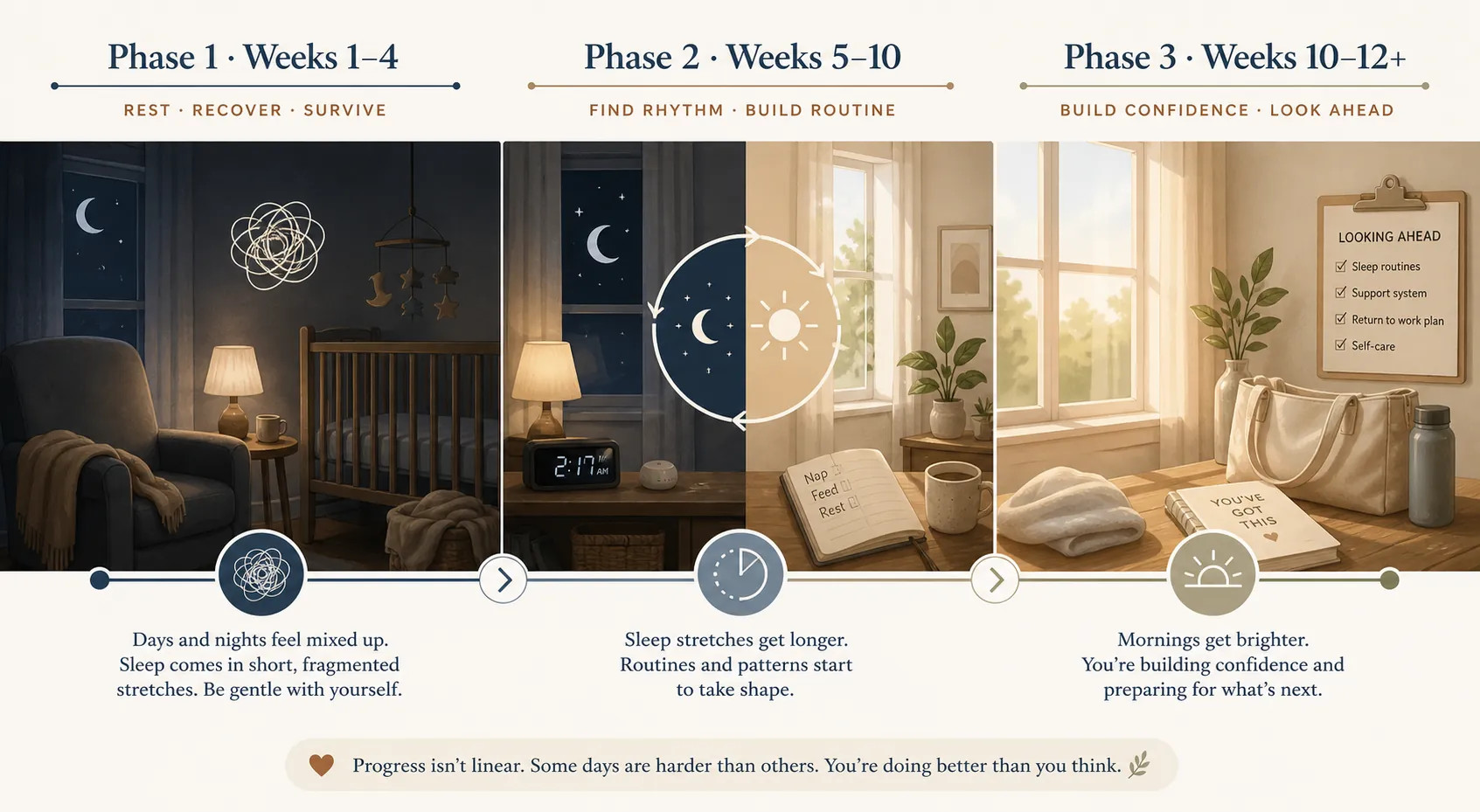
Weeks 1–4: Treat Fragmentation As The Starting Condition
The first month is not the time to prove that nights can be optimized. The body is recovering, feeding is being established, the baby’s rhythms are immature, and the mother may be sleeping in fragments that are too short to feel restorative. In the SLEEP 2025 data, the first-week average longest stretch was just 2.2 hours.[1] That number is useful because it pushes planning away from vague reassurance and toward damage control.
In this phase, the goal is to limit cumulative loss. That means removing jobs from the mother’s day, not asking her to become more efficient at doing them. Meals, laundry, dishes, pet care, older-child logistics, pharmacy runs, thank-you notes, and visitor coordination should move to other adults whenever possible. If help is offered, give it a task. “Hold the baby while I shower and sleep” is better than “come meet the baby” when the mother is running on a two-hour stretch.
Daytime sleep is not decorative here. It is part of the treatment plan. The Sleep Health Foundation advises new mothers to minimize other responsibilities in the first three months, nap when opportunities appear, and use a sign such as “Mother and baby asleep” to protect rest from interruptions.[3] A door sign is not sentimental. It saves the recovering person from having to negotiate every knock, text, and cheerful delivery at the exact moment she has finally fallen asleep.
- Put a visible sign on the door during naps and feeding-to-sleep periods.
- Set visitor windows around maternal sleep, not around other people’s convenience.
- Keep one early-afternoon rest period protected whenever the day allows.
- Let helpers do standing tasks before they hold the baby.
- Avoid scheduling nonurgent appointments or social plans in the mother’s best nap window.
If you are breastfeeding, the first weeks may not allow long separation from the baby. That does not mean the partner has no night role. The non-feeding adult can handle diaper changes, burping, resettling, water, snacks, pump parts, bottle washing, medication reminders, and the morning baby handoff. For a deeper feeding-specific schedule, use How to Build a Night Shift System That Fits Your Feeding Method rather than trying to force one universal shift plan onto every feeding arrangement.
There is one clinical line to watch even in the chaos: exhaustion and insomnia are not identical. A mother who is desperate to sleep but repeatedly cannot sleep when protected opportunities exist needs different support than a mother who is simply never being given enough opportunity. If that distinction feels familiar, read Is It Postpartum Insomnia or Just New Mom Exhaustion? and raise it with a clinician.
Weeks 5–10: Engineer One Longer Block Before You Polish The Whole Night
By the middle of leave, total sleep may be improving while the mother still feels oddly un-restored. That mismatch is not weakness. Fragmented sleep behaves differently from consolidated sleep. In the SLEEP 2025 trajectory, total sleep rose by weeks 8 to 13, but the longest stretch averaged only 4.1 hours.[1] This is the point where the family should stop asking only “How many hours did you get?” and start asking “What was the longest protected block?”
For the physiology behind that distinction, Protect Uninterrupted Sleep Blocks for Better Postpartum Rest explains why uninterrupted sleep matters. New Parent Sleep Deprivation Isn’t About Total Hours goes further into the fragmentation problem. Here, the practical move is simpler: pick the most realistic four-hour block and defend it.
Four hours is not a magic cure, but it is a useful planning unit. Corewell Health recommends four-hour shifts and, when possible, sleeping in separate rooms so the off-duty parent is not half-awake through the whole night.[4] Separate rooms can feel emotionally abrupt to families who imagined everyone together, but it often works because it removes the low-grade monitoring that destroys the off-duty adult’s chance of real sleep.
Choose Shifts Around People, Not Around A Perfect Template
Commercial parenting guides can be too tidy, but some offer concrete examples that are useful when treated as starting points. Huckleberry describes split-night schedules such as one parent covering roughly 8 p.m. to 1 a.m. and the other covering 1 a.m. to 8 a.m., along with alternating-night models and task-based divisions for breastfeeding families.[5] Postpartum Support International also recommends taking chronotype into account: a natural night owl may be better suited to the first shift, while an early riser may handle the pre-dawn stretch more safely.[6]
| Situation | Likely starting point |
|---|---|
| Formula feeding or full bottle availability | Use true split shifts so each adult gets an off-duty block. |
| Exclusive breastfeeding | Keep the feeding parent’s wake time as short as possible; assign the partner setup, diapering, burping, resettling, and early-morning baby care. |
| Exclusive pumping | Protect pump timing while shifting bottle feeds, washing, labeling, and storage to the partner when possible. |
| Combo feeding | Place the bottle feed where it buys the mother the longest continuous sleep block. |
| Partner working early | Give the working partner a protected pre-work block, then compensate the mother with a protected daytime nap or early-night block. |
What to Expect separates sample night-shift schedules by formula feeding, combo feeding, exclusive pumping, and exclusive breastfeeding, which is the right distinction to make because feeding method changes what can actually be handed off.[7] The error is not needing different schedules. The error is pretending the same schedule can serve every feeding plan.
A middle-window plan should name the handoff, the room, and the rescue rule. “You sleep first” is too vague. “From 8 p.m. to 1 a.m., you are off duty in the bedroom with earplugs; I bring the baby only if there is a feeding I cannot cover” is a plan. So is “I breastfeed, then you take the baby for diapering and resettling while I go straight back to bed.” The difference is that no one has to renegotiate the system while half-awake.
This is also the point to refine daytime sleep rather than taking random naps only when the household collapses. The Sleep Health Foundation specifically points to an early-afternoon siesta window for new mothers.[3] That window will not work every day, and babies do not respect calendars, but it gives the household a default: do not schedule visitors, errands, or “quick calls” over the most likely recovery nap.
Use The Baby’s Emerging Pattern, But Do Not Serve It At The Mother’s Expense
Around this middle stretch, many families begin noticing a little more pattern in the baby’s day. That can help with maternal sleep, but only if the adult plan stays visible. If the baby reliably gives one longer early-evening stretch, decide whether that stretch belongs to chores, visitors, pumping, couple time, or the mother’s sleep. In a depleted household, sleep should have first claim more often than culture admits.
For aligning the household with the baby’s developing rhythms, use How New Parents Handle Baby Sleep Routines. The mother’s recovery remains part of that routine, not an optional leftover after everyone else’s needs have been served.
Weeks 10–12 And Beyond: Rehearse Work Conditions Before Work Starts
The pre-return phase is where many families accidentally spend all their remaining energy on childcare logistics and almost none on sleep logistics. The crib sheets are labeled, the bottles are packed, the daycare form is signed, and the mother is still waking three times a night before a job that requires judgment, driving, patient care, teaching, client calls, or a commute.
A return-to-work guide from RESTED Co recommends tactics such as morning dress rehearsals, full-day trial runs with the new caregiver, and going to bed when the baby does during the first two weeks back.[8] This is not clinical evidence, and it comes from a commercial source, but the advice is practically sound because it tests the actual bottlenecks: who wakes the baby, who feeds, who packs, who leaves, who absorbs the delay, and whether the mother has any chance of sleeping early enough to survive the morning.
- Introduce the new caregiver before the first workday, not on it.
- Practice one complete morning with alarms, feeding, pump parts, bottles, clothing, commute timing, and handoff.
- Run at least one longer childcare trial so the mother can see where pumping, naps, and recovery actually fit.
- Move bedtime earlier before the return instead of waiting for exhaustion to force it.
- Keep the first weeks back socially boring; this is not the time to prove normalcy.
The phrase “sleep when the baby sleeps” becomes irritating when it is offered as a universal solution in week one, especially to someone recovering, feeding, bleeding, and managing a household. It becomes more useful as a temporary pre-return and early-return rule: when the baby gives an early night stretch, the mother goes down too. Chores can wait. Streaming can wait. The body that has to report to work gets priority.
There is a reason to take this seriously even if total sleep has improved. A 2026 Mothair article cites research showing that neurobehavioral performance measures such as reaction time and vigilance can remain significantly impaired beyond the six-week mark, despite improvement in sleep.[9] That source is a secondary article, so it should not be stretched into a precise prediction for every mother. It does, however, match the clinical concern: social permission to be “back” often arrives before the brain and body have fully recovered.
If Your Leave Is Short, Move The Middle And Return Steps Earlier
Not every mother has 10 to 12 weeks to move through these phases. If leave is six weeks, the middle-window work cannot wait until week five. Start protecting a four-hour block as soon as feeding and medical recovery make it feasible. If leave is two weeks or less, the plan becomes more severe: fewer visitors, fewer chores, earlier caregiver practice, and a night schedule designed around the mother’s safest possible work return.
If a partner has leave, decide whether simultaneous or staggered leave buys more sleep. Simultaneous leave can be valuable during a surgical recovery, a complicated delivery, feeding problems, or an older child’s transition. Staggered leave can preserve daytime help later, when the mother may be trying to build longer blocks and prepare for work. Neither structure is morally better. The question is where the family’s highest-risk weeks are likely to fall.
| If this is true | Prioritize this |
|---|---|
| The mother had a difficult physical recovery | Use early overlap for hands-on care, meals, medication timing, and protected daytime sleep. |
| The partner returns to work quickly | Create a sustainable split that does not leave the mother on duty for the entire night and day. |
| A relative can help only briefly | Schedule that help during the most depleted phase or during the work-transition rehearsal, not automatically during the easiest week. |
| The mother returns before sleep has consolidated | Treat the longest sleep block as a safety issue, especially with driving, clinical work, machinery, or high-stakes decisions. |
| Feeding plans change | Rebuild the shift system instead of treating the original plan as a contract. |
The plan should also change when reality changes. A baby who starts taking one bottle opens a different shift option. A partner whose work schedule changes may become better suited to the early shift than the late shift. A mother who cannot fall asleep despite protected opportunity needs screening for insomnia, anxiety, depression, pain, or other postpartum complications. A good plan is not rigid; it is observable.
What A Good Maternity Leave Sleep Plan Actually Protects
A useful maternity leave sleep plan protects three things: enough total sleep in the acute crash, at least one longer block as the weeks progress, and a rehearsed morning before work resumes. The tactics are ordinary on purpose: a door sign, a nap window, a named shift, a separate room, a bottle placed at the right feed, a partner who knows whether they are responsible from 8 p.m. to 1 a.m. or from 1 a.m. to morning.
That is less glamorous than promises about getting your life back. It is also more respectful of the body doing the recovering. Maternity leave is a finite recovery window under uneven conditions, not time off. The sleep strategy should move with the phase of leave, the partner’s availability, the feeding reality, and the return-to-work date. One timetable will not hold. A phase-aware system has a better chance.
References
- Profound Postpartum Sleep Discontinuity in First-Time Mothers, SLEEP 2025
- Advice on How to Structure Parental Leave, Park Slope Parents
- Sleep Tips for New Mothers, Sleep Health Foundation
- Sleep Strategies, Corewell Health
- Parent Sleep Schedule: Night Shift System With Newborn, Huckleberry, Apr 2026
- Sleep in the Postpartum Period: What to Expect and Signs That It’s Time to Seek Help, Postpartum Support International, Dec 2025
- Creating a Night Shift System for Your Newborn Baby, What to Expect
- Returning to Work After Maternity Leave: The Night Before Preparation Strategy, RESTED Co
- Maternal Sleep Recovery After Birth: How Long Does It Really Take, Mothair, 2026
Explore the mechanism
Next step
Spot an error or have clinical feedback?
Because this article covers clinical, medication, or safety information, we use a moderated correction channel instead of open public comments. Let us know if something about “How to Structure Your Maternity Leave to Protect Your Sleep” needs a closer look.
Send feedback on this article