
How to Tell If Subpotent Thyroid or Perimenopause Is Ruining Your Sleep
Perimenopause, subpotent thyroid medication, and overtreatment each produce a distinct sleep disruption pattern. This guide helps you identify which signature matches your symptoms so you can bring targeted observations to your prescriber.
One woman falls asleep normally, then wakes hard at 3:15 a.m., hot, alert, and annoyed that her body has staged another little revolt. Another sleeps nine hours and wakes as if the night never paid her back. A third cannot get to sleep at all because her heart feels too fast after a recent thyroid dose change. All three may say, accurately enough, “I have insomnia.” But for a prescriber, those are not the same night.
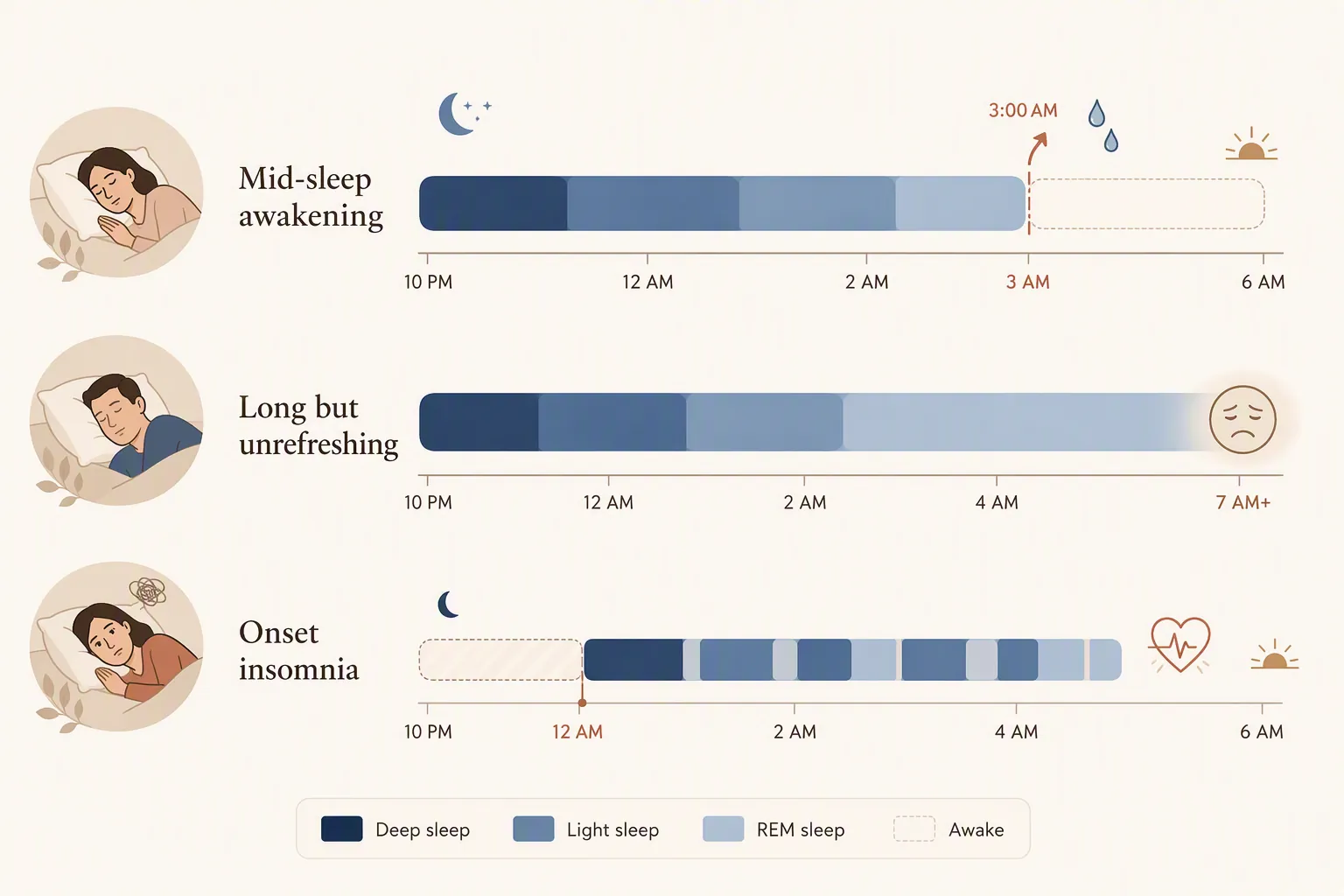
The useful question is not whether perimenopause can ruin sleep, or whether thyroid medication can affect sleep. Both can. The more useful question is which sleep signature you are seeing often enough to report clearly: mid-sleep awakening, long but unrefreshing sleep, or sleep-onset insomnia with racing-heart symptoms.

The three sleep signatures to separate first
| Pattern you notice | Sleep signature | Associated clues | What it may point toward |
|---|---|---|---|
| You fall asleep normally, then wake abruptly between about 2 a.m. and 4 a.m. | Mid-sleep awakening | Night sweats, feeling suddenly hot, trouble returning to sleep | Perimenopause pattern |
| You sleep a long time, often 8 to 10+ hours, but wake unrefreshed | Long non-restorative sleep | Daytime fatigue, central body coldness, sluggishness | Insufficient thyroid effect or undertreated hypothyroidism |
| You cannot fall asleep, especially after a dose change or inconsistent dosing | Sleep-onset insomnia | Palpitations, fast heartbeat, anxiety, tremor, heat intolerance | Possible thyroid over-treatment or excess thyroid effect |
Jerilynn Prior, MD, of the Centre for Menstrual Cycle and Ovulation Research at the University of British Columbia, draws a clinically helpful distinction: perimenopause commonly shows up as waking from sleep, often around 2 a.m. to 4 a.m., while hypothyroid sleep is more likely to be long and unrefreshing, with the person still tired after sleeping enough or even too much.[1] That distinction is not a home diagnostic test. It is expert clinical pattern recognition, and it is useful precisely because it gives the next appointment something better than a single blurred word.
Population research supports taking the thyroid-sleep connection seriously, though it does not prove that every poor night in a thyroid patient is dose-related. In a 2019 study of 14,846 people in China, subclinical hypothyroidism was significantly associated with poorer sleep quality, longer sleep latency, and shorter sleep duration; the reported odds ratios were 1.12 for poorer sleep quality, 1.16 for longer sleep latency, and 1.15 for shorter sleep duration, with female sex also identified as an independent risk factor at 1.28.[2] That study is not a direct study of “subpotent medication,” and its population may not generalize perfectly to U.S. perimenopausal women taking levothyroxine. Still, it makes dismissal harder to justify.
What “subpotent thyroid medication” means here
The word “subpotent” can mean a manufactured medication lot that contains less active ingredient than expected. That is a real pharmacy and regulatory concept, and it occasionally appears in recall notices. But in this context, the more practical question is often whether the body is receiving too little thyroid effect: the dose may be insufficient, absorption may be inconsistent, timing may be interfering, or the thyroid condition may have changed.
Here, “subpotent” mainly means functional under-treatment: the lived situation in which prescribed thyroid replacement is not producing enough thyroid effect for that patient. Sleep patterns can raise that question. They cannot answer it by themselves.
Start with the first hour of the night
Sleep onset is often the cleanest first branch. If you are sleepy at bedtime, fall asleep in your usual way, and then wake abruptly in the middle of the night, the night is behaving differently than it does when you lie awake wired from the start. Perimenopause often enters the story after sleep has already begun. Excess thyroid effect often announces itself before sleep can settle.
That does not mean every delayed bedtime is thyroid over-treatment. Pain, alcohol, stress, late caffeine, sleep apnea, restless legs, and medication schedules can all interfere. But when sleep-onset insomnia travels with a fast heartbeat, palpitations, tremor, anxiety, or heat intolerance, it deserves prompt clinician review rather than another round of generic sleep hygiene. Ubie describes nighttime heart racing and insomnia as symptoms that may occur when levothyroxine is too high, and GoodRx also lists insomnia, nervousness, tremor, sweating, and fast heart rate among symptoms of excess levothyroxine.[3][4]
The NHS similarly warns that taking too much levothyroxine can cause symptoms such as a racing heartbeat, chest pain, sweating, anxiety, and sleep problems.[5] Chest pain, severe shortness of breath, fainting, or a sustained very fast or irregular heartbeat is not a “track it for two weeks” situation. Those symptoms need urgent medical advice.
Then look at the wake-up time
A wake-up at 2 a.m. to 4 a.m. is not automatically perimenopause, but it is worth naming. The CeMCOR/UBC distinction is especially helpful here because many women can fall asleep, then wake in a wave of heat, sweat, alertness, or agitation and stay awake long enough to feel punished by the clock.[1] They do not necessarily need more advice about dark rooms. They need someone to hear that the problem is not sleep initiation; it is sleep maintenance.
This is also where differential thinking matters. A mid-sleep awakening can come from hot flashes or night sweats, but it can also come from snoring-related breathing events, reflux, pain, alcohol rebound, blood sugar swings, caregiving interruptions, or anxiety. If your awakenings include gasping, witnessed pauses in breathing, morning headaches, or heavy snoring, the question widens beyond hormones. A related differential is covered in Sleep Apnea or Perimenopause? How to Spot the Difference.
The practical observation is simple: write down whether you were able to fall asleep, what time you woke, whether you were hot or sweaty, whether your heart was pounding, and how long it took to return to sleep. A single night may be noise. A repeated timing pattern is worth bringing in.
Long sleep that does not restore you points in a different direction
The undertreated-thyroid pattern is less dramatic than waking drenched or feeling your pulse pound. It can look like sleeping “well” by the clock and still being flattened. Eight, nine, or ten hours pass, but morning arrives with no sense of having been repaired. The accompanying clues matter: central body coldness, heavy fatigue, slowed energy, constipation, dry skin, low mood, or a sense that the body is conserving rather than revving.
WebMD describes the thyroid-sleep link in both directions: too little thyroid hormone can be associated with fatigue and feeling cold, while too much can contribute to nervousness and insomnia.[6] That broad framing fits the bedside distinction: the low-thyroid side often feels like depletion, while the excess-thyroid side often feels like activation.
For someone in perimenopause, this distinction can be easy to lose. Hormonal fluctuation can produce fatigue. Poor sleep from night sweats can produce fatigue. Life at midlife can produce fatigue. But “I sleep nine hours and wake cold and unrestored” gives a prescriber a different starting point than “I wake hot at 3 a.m. after falling asleep normally.” Neither sentence diagnoses you. Each sentence points the review in a different direction.
A better sleep log is shorter than you think
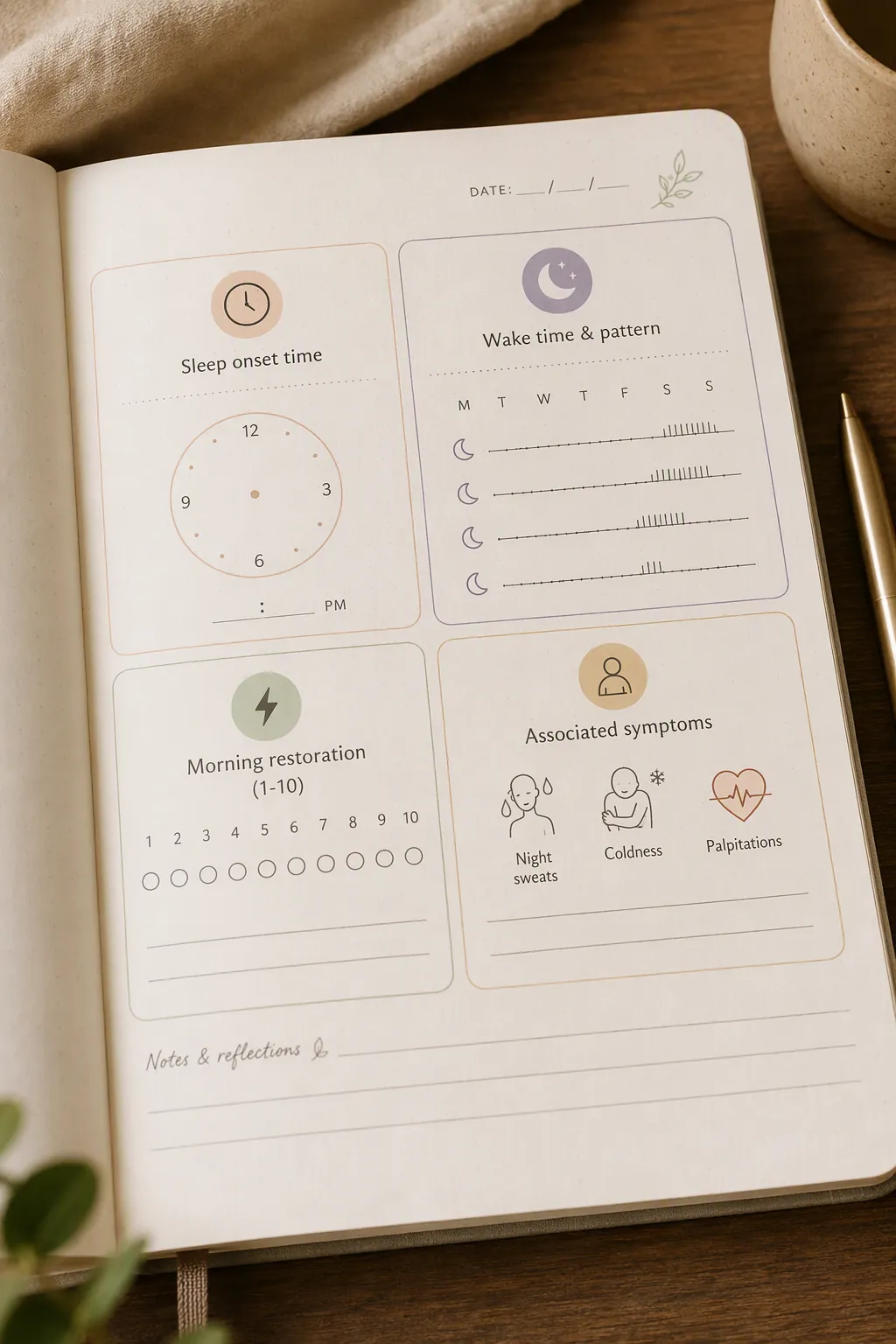
A useful log is not a moral inventory of everything you did right or wrong. It is a pattern-finding tool. If you are already exhausted, do not build a spreadsheet you will abandon after three nights. Track the few details that change the medical conversation.
- Sleep onset: Did you fall asleep normally, or were you wired, anxious, hot, or aware of your heartbeat?
- Wake timing: If you woke, what time was it, and did the timing repeat across nights?
- Total sleep: Did you sleep a short night, a normal-length night, or an unusually long night?
- Morning restoration: Did you wake refreshed, mildly tired, or as if you had not slept?
- Body signals: Note night sweats, heat intolerance, coldness, palpitations, tremor, anxiety, constipation, or unusual daytime fatigue.
- Medication context: Record dose changes, missed doses, brand or generic switches, new supplements, and whether you took thyroid medication differently than usual.
Wearables can help if they reduce the burden rather than increase it. A device-estimated sleep duration or wake time is not a diagnosis, but it can support a pattern you are already noticing. If you use a Samsung device, the practical limits of that approach are discussed in Galaxy Watch sleep tracking during perimenopause.
What to bring to your prescriber
A short appointment is not the place to recite a month of bad nights in chronological order. Bring the pattern first, then the context. The goal is to help your clinician decide what to check next: thyroid labs, dose timing, absorption issues, medication interactions, perimenopause symptoms, cardiac symptoms, or another sleep disorder.
Useful appointment language sounds like this:
- “I usually fall asleep, then wake between 2 and 4 a.m. with sweating and trouble returning to sleep.”
- “I am sleeping 9 hours but waking unrefreshed, cold, and fatigued during the day.”
- “Since the dose change, I am having trouble falling asleep and noticing palpitations at night.”
- “I have not changed the dose myself, but I would like to review whether my thyroid replacement is too low, too high, or not being absorbed consistently.”
- “Can we review when to check labs and whether any supplements, medications, foods, or timing habits could be interfering?”
That last sentence matters. Thyroid replacement is not just a pill strength; it is also how consistently the medication reaches you. Calcium, iron, some stomach medications, missed doses, pharmacy switches, and irregular timing are common enough to be worth reviewing with the clinician or pharmacist. The right answer may be a lab check, a timing change, a formulation discussion, a dose change, or a completely different sleep workup. It should not be a solo experiment.
Do not let perimenopause become the stop sign
Perimenopause is common, and sleep disruption during the transition is common enough to deserve respect. Frank-Raue and Raue report that up to 67% of perimenopausal women report sleep disorders, and they also note that thyroid dysfunction is present in 12% to 20% of women over 60.[7] Those numbers do not say that your sleep problem is thyroid-related. They say overlap is ordinary enough that a second look is reasonable.
The mistake is treating perimenopause as an all-purpose explanation and stopping there. It is equally unhelpful to blame every bad night on thyroid medication. A woman in her late 40s or early 50s can have vasomotor symptoms, an undertreated thyroid state, over-replacement symptoms, sleep apnea, anxiety, medication effects, and ordinary life stress in the same calendar year. The sleep pattern does not sort all of that perfectly. It helps decide which door to open first.
The line between useful observation and unsafe adjustment
If the pattern looks like under-treatment, the temptation may be to take a little extra. If it looks like over-treatment, the temptation may be to skip a dose. Both moves can muddy the evidence your prescriber needs and can be unsafe, especially if you have heart rhythm symptoms, osteoporosis risk, pregnancy possibility, or other endocrine conditions. Sleep clues are not dose instructions.
A safer threshold is this: if insomnia arrives with palpitations, chest discomfort, tremor, heat intolerance, severe anxiety, or a recent thyroid medication change, contact the prescribing clinician promptly. If the pattern is long sleep with persistent cold fatigue, ask for a guided review rather than waiting indefinitely. If the pattern is repeated 2 a.m. to 4 a.m. waking with sweating, bring it as a perimenopause sleep-maintenance pattern while still naming any thyroid context.
You cannot determine the correct thyroid dose from sleep patterns alone. You can stop presenting the problem as generic insomnia. “I wake hot at 3 a.m.,” “I sleep nine hours and wake cold and unrefreshed,” and “I cannot fall asleep because my heart is racing” are three different clinical conversations. Bring the one that is actually happening.
References
- Perimenopause and Thyroid Problems—Common and Confusing, Centre for Menstrual Cycle and Ovulation Research, University of British Columbia.
- The relationship between thyroid function and the risk of sleep disorders, Risk Management and Healthcare Policy, 2019.
- Thyroid Rx’s and heart racing at night: why levothyroxine, Ubie Doctor’s Note.
- Levothyroxine side effects, GoodRx.
- Side effects of levothyroxine, NHS.
- Thyroid Problems and Sleep, WebMD.
- Thyroid Disorders in Women, Deutsches Ärzteblatt International, 2023.
Safety & eligibility read
Cross-check against other interventionsExplore the mechanism
Next step
Spot an error or have clinical feedback?
Because this article covers clinical, medication, or safety information, we use a moderated correction channel instead of open public comments. Let us know if something about “How to Tell If Subpotent Thyroid or Perimenopause Is Ruining Your Sleep” needs a closer look.
Send feedback on this article