
Match Your Pregnancy Sleep Problem to the Right Remedy
Pregnancy sleep disruption isn't one problem—it changes by trimester. Learn which specific causes drive insomnia in each stage and how to choose the remedy that matches your body's actual physiology right now.
If the usual advice has started to feel strangely irrelevant, that may be because the problem has changed underneath you. Remedies for pregnancy sleep problems work best when they are matched to the thing that is waking you now: nausea, reflux, bladder pressure, restless legs, breathing changes, anxiety, or true insomnia. A pillow can help one of those. It will not fix all of them.
Pregnancy insomnia is often described as if it were one condition that simply gets louder over nine months. It is more useful to treat it as a moving target. In the first trimester, many people are exhausted, sleep longer, and still feel as if the sleep was poor. In the second trimester, the body is changing enough that the old setup may stop working. In the third trimester, several different sleep disruptors can pile up at once, and some deserve more than another round of sleep hygiene.

Start With the Current Driver, Not the Generic Tip
A practical first question is not “What helps pregnancy insomnia?” It is “What is actually waking me this week?” The answer can shift by trimester, and sometimes within the same trimester.
| Stage | What often changes | What the first remedy should target |
|---|---|---|
| First trimester | Hormonal sleepiness, nausea, more time in bed but lower sleep efficiency | Nausea timing, naps that do not dilute night sleep, CBT-I if insomnia pattern persists |
| Second trimester | Declining nighttime sleep, growing mechanical discomfort, fetal movement, emerging reflux | Position support, reflux timing, adjusting the sleep setup as the abdomen grows |
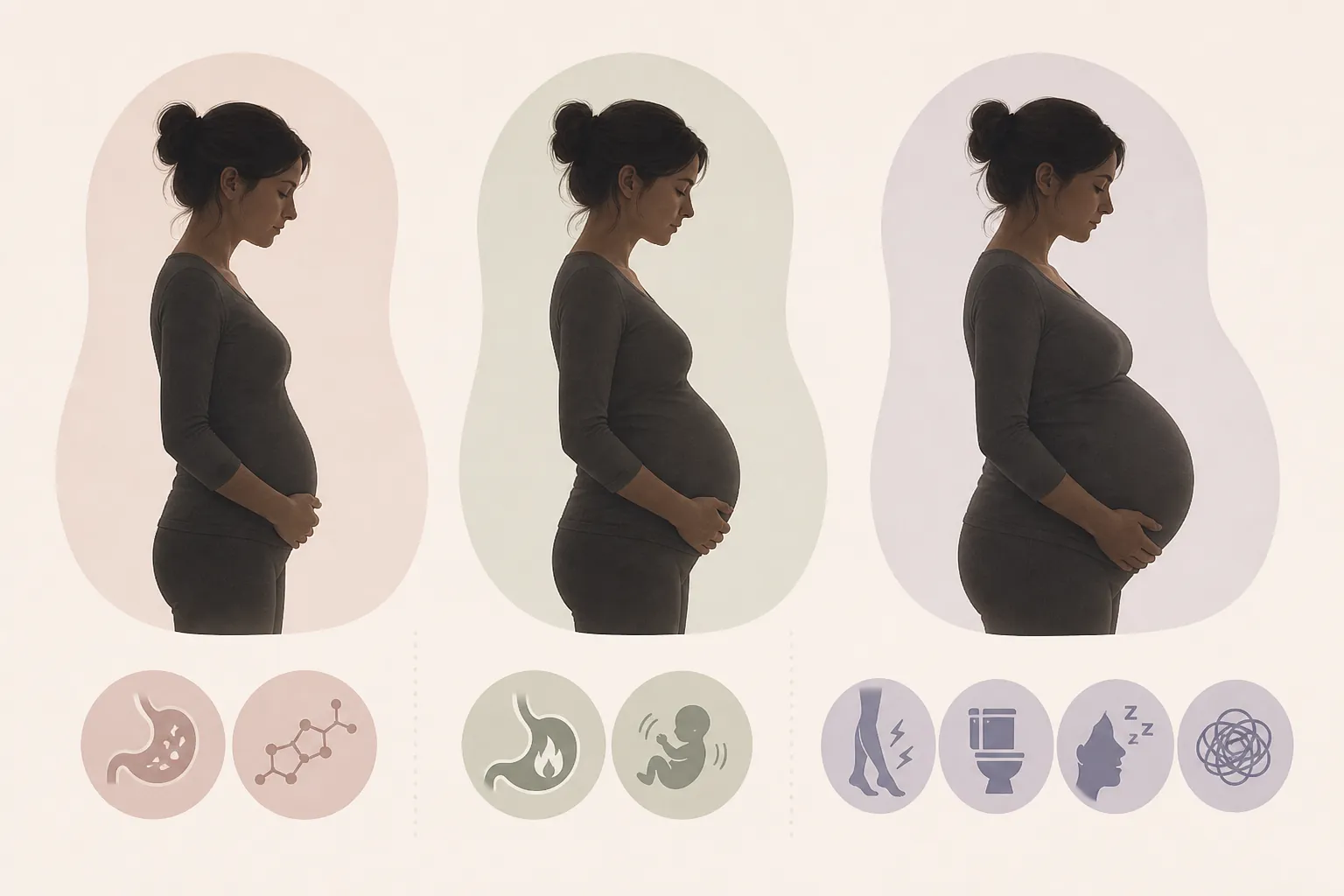
| Third trimester | Discomfort, nocturia, restless legs, snoring or possible sleep-disordered breathing, anxiety | Differentiate ordinary discomfort from RLS, possible OSA, severe insomnia, or symptoms needing clinician input |
The numbers are validating, but they need careful handling. Cleveland Clinic describes pregnancy insomnia as affecting about 25% of people in the first trimester and increasing as pregnancy progresses, with rates reported as high as 80% in the third trimester depending on how insomnia is defined and measured.[1] That wide range matters. A questionnaire about poor sleep, a formal insomnia diagnosis, and a pregnant person saying “I am up all night” are related, but they are not identical measures.
The goal is not to normalize you into silence. It is to separate the common from the ignorable. Waking because your hips hurt is different from waking with an urge to move your legs that eases only when you move. Snoring is not the same thing as obstructive sleep apnea, but new or worsening snoring in late pregnancy should not be waved away.
First Trimester: Exhausted, Sleeping More, Still Not Rested
The first trimester can feel unfair because the body asks for more sleep while making sleep less satisfying. Cleveland Clinic notes that progesterone rises sharply across pregnancy and reaches about 10 times the menstrual peak by week 36. In early pregnancy, women average about 0.7 more hours of sleep, yet report lower sleep efficiency, meaning more time in bed does not necessarily translate into better sleep.[1]
That is the paradox many early-pregnancy patients recognize immediately: sleepy all day, awake at odd hours, then disappointed by sleep that should have been enough. The driver is often not poor discipline around bedtime. It may be progesterone-related drowsiness, nausea, breast tenderness, early urinary frequency, or a body clock thrown off by survival naps.
If nausea is the main disruptor, the remedy should aim at nausea timing rather than at insomnia in the abstract. A small bland snack before bed, avoiding a completely empty stomach overnight, and keeping something tolerable at the bedside can be more relevant than another reminder to turn off screens. If morning sickness is actually middle-of-the-night sickness, the sleep plan has to acknowledge it.
If daytime sleepiness is pulling you into long or late naps, the remedy is not “never nap.” It is to protect the pressure to sleep at night. Shorter naps earlier in the day are often less likely to steal from nighttime sleep than a long late-afternoon collapse. The point is not perfection; it is to avoid turning hormonal fatigue into a shifted sleep schedule.
If the pattern is less about nausea and more about lying awake, clock-watching, worrying, or spending more and more time in bed trying to force sleep, then the strongest supported treatment is cognitive behavioral therapy for insomnia, or CBT-I. A multicenter randomized controlled trial published in Obstetrics & Gynecology found that CBT-I significantly reduced prenatal insomnia.[3] Digital CBT-I also showed benefit in a JAMA Psychiatry trial, although access, follow-through, and fit vary from person to person.[4]
CBT-I deserves that prominence because it treats insomnia as a learned and physiological pattern, not as a character flaw. It may include sleep scheduling, stimulus control, cognitive work around wakefulness, and reducing the amount of time spent awake in bed. That is different from telling a nauseated pregnant person to relax harder.
Second Trimester: The Setup That Worked Last Month May Stop Working
The second trimester is often presented as the easier stretch, and for some people it is. Sleep may improve when nausea settles. But it is also the transition point where nighttime sleep begins to decline, fetal movement becomes more noticeable, and reflux can emerge as the growing uterus increases abdominal pressure.[2]
This is where the remedy often becomes more mechanical. If you are waking because your back, hips, or abdomen feel unsupported, a pillow is no longer a decorative sleep-hygiene suggestion. It is a tool for reducing strain. Side support between the knees, under the abdomen, or behind the back can reduce the amount of muscular work your body does to hold a comfortable position.
If reflux is the problem, more pillows under the head may help some people, but the target is acid movement and stomach pressure. Earlier evening meals, smaller portions near bedtime, avoiding known personal triggers, and elevating the upper body are more mechanism-matched than simply changing sides again and again. Sleep Foundation identifies heartburn and gastroesophageal reflux as common pregnancy sleep disruptors, especially as pregnancy progresses.[2]
If fetal movement is waking you, the fix is usually not to stop the movement; it is to stop building an entire anxious night around each episode. Some movement at night is expected. A clinician should advise you about changes in fetal movement patterns, but ordinary nighttime awareness often needs a lower-stimulation response: adjust position, keep lights low, avoid checking the time repeatedly, and return to the sleep routine without turning every wake-up into an assessment session.
The second trimester is also a good time to notice whether the problem is becoming persistent insomnia rather than a series of body discomforts. Non-pharmacological approaches, including sleep hygiene, position therapy, and behavioral interventions, have been reviewed as options for improving sleep quality in pregnancy.[5] The useful distinction is whether the intervention matches the disruption. A reflux plan will not treat conditioned wakefulness. CBT-I will not make a compressed stomach empty faster.
Third Trimester: Sort the Wake-Ups Before You Choose the Remedy
By the third trimester, sleep disruption is common enough that people are sometimes told to expect it and move on. That is not good enough. The third trimester is exactly when the causes multiply: bigger mechanical load, more bladder pressure, reflux, painful positioning, restless legs syndrome, snoring or possible sleep-disordered breathing, and anxiety about birth or the baby. The remedy depends on which one is actually in front of you.
If Pain or Pressure Is Waking You
For hip pain, pelvic pressure, or abdominal pulling, position support is still reasonable. Use pillows to reduce torque: one between the knees, one supporting the abdomen if it feels like it is pulling downward, and one behind the back if you keep rolling into an uncomfortable position. The best pillow setup is the one that removes a specific strain. It does not need to look like anyone else’s arrangement.
Nocturia is different. If you are waking mainly to urinate, the remedy is not to dehydrate yourself. It is to shift fluids earlier when possible, reduce large fluid loads close to bed, and ask about symptoms such as burning, urgency, fever, or pelvic pain that could suggest something beyond ordinary bladder pressure. Late pregnancy bladder wake-ups are common; painful or concerning urinary symptoms deserve medical advice.
If Your Legs Feel Unbearable at Rest
Restless legs syndrome is not the same as being generally restless because you are uncomfortable. The classic pattern is an urge to move the legs, usually worse at rest and in the evening or night, with relief when you move. That distinction matters because the next step may be a lab discussion, not another pillow.
Consensus guidelines report that restless legs syndrome affects about 1 in 5 pregnant women in Western populations, tends to worsen across pregnancy, and is linked with iron and folate status. The same guidelines recommend considering iron supplementation when ferritin is below 75 ng/mL, but that threshold is guideline-based rather than proven by a pregnancy-specific randomized trial.[6]
That means the practical remedy is to ask your clinician whether symptoms fit RLS and whether ferritin or iron studies should be checked. Do not assume a standard prenatal vitamin has solved the issue. Also do not add iron casually without guidance; iron can cause side effects, and the right dose depends on your labs and pregnancy care plan.
If Snoring, Gasping, or Breathing Changes Have Appeared
Snoring is not a diagnosis. It is also not a meaningless pregnancy sound effect. A Chest review reports that snoring affects up to one-third of women by the third trimester, and obstructive sleep apnea prevalence rises from about 2% in non-pregnant women to roughly 10% to 25% during pregnancy.[7]
The more concerning pattern is loud new snoring, witnessed pauses in breathing, gasping or choking awake, morning headaches, marked daytime sleepiness, or high blood pressure concerns. Screening for obstructive sleep apnea in pregnancy is not yet universal, so a patient often has to name the symptom clearly before it is evaluated. Side sleeping and head elevation may reduce some positional snoring, but suspected sleep apnea belongs in a clinical conversation.
If Anxiety Has Taken Over the Night
Late pregnancy can turn the bed into a planning room: birth, feeding, leave, finances, symptoms, fetal movement, hospital bags, older children, and every appointment still to come. If the wake-up starts with a thought and then becomes two hours of mental rehearsal, the remedy should target the arousal loop.
A written worry window earlier in the evening, a next-day list outside the bedroom, and a consistent low-light response to awakenings can help some people reduce the reinforcement of nighttime rumination. When anxiety is intense, persistent, or paired with panic, hopelessness, intrusive thoughts, or inability to function, it deserves clinical care. Pregnancy is not a reason to under-treat mental health.
Where CBT-I Fits When the Driver Is Insomnia Itself
CBT-I is most relevant when insomnia has become its own pattern: long sleep latency, prolonged awakenings, dread of bedtime, more time in bed with less sleep, or a growing set of rituals that make sleep feel fragile. It can sit alongside pregnancy-specific fixes, but it should not be confused with them. If reflux wakes you, treat reflux. If RLS wakes you, evaluate RLS. If insomnia continues after the obvious physical driver is addressed, CBT-I becomes more central.
The evidence is stronger here than for most pregnancy sleep hacks. The prenatal CBT-I randomized trial showed meaningful insomnia improvement, and digital CBT-I offers a wider-reach option for people who cannot find a trained clinician nearby.[3][4] The limitation is real: programs require time, attention, and adherence at a stage of life when all three may be scarce.
For a more lived-in view of how common and stubborn pregnancy insomnia can be, Restful Ground’s pregnancy insomnia strategies essay may be useful. The clinical point remains the same: insomnia treatment works best when it is aimed at the pattern keeping you awake, not just the fact that you are pregnant.
When Sleep Loss Becomes a Reason to Escalate
There is no benefit in panicking at 3 a.m. because you read that sleep matters. There is also no benefit in pretending severe sleep disruption is trivial. A 2024 Endocrine Society release described a study of 7,059 mother-child pairs from three hospitals in China in which short sleep duration during pregnancy, defined as less than 7 hours, was associated with neurodevelopmental delays in offspring, especially in boys.[8]
That finding deserves caution. It is an association, not proof that one parent’s short night caused a developmental outcome. The study population may not generalize neatly to pregnant people in the United States. Still, it supports a common-sense clinical stance: persistent short sleep in pregnancy is worth addressing, especially when the cause is treatable.
Escalate beyond self-adjustments when sleep loss is severe, when you cannot function during the day, when you suspect restless legs syndrome, when snoring comes with gasping or witnessed pauses, when anxiety or mood symptoms feel unmanageable, or when you are considering medication. Medication decisions should be individualized with your pregnancy clinician; if that is the next question, use a pregnancy-specific safety discussion such as Pregnancy Sleep Aids: An Evidence-Tiered Safety Guide or Which Sleep Aids Are Safe During Pregnancy? rather than borrowing a non-pregnancy sleep-aid hierarchy.
Over-the-counter sleep aids can look deceptively simple because they are easy to buy. Easy access is not the same as the right match. If you are comparing OTC options, start with whether the sleep problem is nausea, itching, pain, reflux, RLS, suspected apnea, anxiety, or insomnia; then bring that question to your clinician. A general OTC comparison such as Which Over-the-Counter Sleep Aid Is Best for Your Sleep Problem? can help frame the category, but pregnancy changes the safety conversation.
The Useful Standard Is Better Matching, Not Perfect Sleep
Some pregnancy wake-ups will remain, even with a thoughtful plan. The standard is not eight perfect hours on command. The standard is a remedy that fits the current driver and does not create a new problem.
In early pregnancy, that may mean managing nausea and protecting nighttime sleep pressure. In the second trimester, it may mean changing the physical setup and treating reflux instead of assuming the old routine should still work. In the third trimester, it often means sorting ordinary discomfort from RLS, sleep-disordered breathing, severe insomnia, or anxiety that needs more support. The body keeps changing. The sleep plan is allowed to change with it.
References
- Pregnancy Insomnia: Causes, Diagnosis & Treatment. Cleveland Clinic.
- Pregnancy & Sleep: Common Issues & Tips for Sleeping. Sleep Foundation.
- CBT for Prenatal Insomnia: A Randomized Controlled Trial. Obstetrics & Gynecology, 2019.
- Digital CBT-I During Pregnancy. JAMA Psychiatry, 2021.
- Non-pharmacological Interventions for Improving Sleep Quality in Pregnancy. PMC, 2023.
- Consensus guidelines for RLS in pregnancy and lactation. Sleep Medicine Reviews, 2015.
- Sleep Pharmacotherapy for Common Sleep Disorders in Pregnancy and Lactation. Chest, 2020.
- Pregnant women who sleep less than 7 hours a night may have children with developmental delays. Endocrine Society, 2024.
Explore the mechanism
Next step
Spot an error or have clinical feedback?
Because this article covers clinical, medication, or safety information, we use a moderated correction channel instead of open public comments. Let us know if something about “Match Your Pregnancy Sleep Problem to the Right Remedy” needs a closer look.
Send feedback on this article