
How to Sleep Safely Without Power Until Restoration
This guide explains how perimenopausal women, pregnant people, older adults, and adults with ADHD can sleep safely during a power outage, with specific countermeasures for each population's physiological vulnerabilities and a checklist for when to leave home.
The power is out, bedtime is close, and the question is not simply whether you can sleep in a quiet, dark room. Sleeping without power until restoration is a different problem depending on which body is trying to get through the night.
For many households, a short outage is a one-night discomfort problem. Most power outages last about 2–5 hours, which usually means the first job is preserving safe temperature, safe movement, medication access, and enough routine to sleep or rest until the lights return.[1] But if the outage is tied to a hurricane, wildfire shutoff, ice storm, grid emergency, or a utility estimate that keeps moving outward, the plan has to change before exhaustion makes decisions sloppy. Regional outage patterns can stretch far beyond a single night, including hurricane-related outages in the Southeast lasting 14 or more days in severe cases, Texas grid outages reported in the 4–5 day range, California public-safety shutoffs in the 2–5 day range, and large rural-versus-urban disparities in restoration time.[1][2]
First sort the night: discomfort, risk, or relocation
Before rearranging the whole bedroom in the dark, make three quick checks: the room temperature, the person’s medical dependencies, and the likely length of the outage. A healthy adult in a mild room may only need a flashlight, water, and lighter bedding. A pregnant person in a hot upstairs bedroom, an older adult using refrigerated medication, or someone whose CPAP has stopped is not in the same situation.
- If restoration is expected within hours and the room can stay safe, focus on cooling or warming the body, preventing falls, and preserving the bedtime sequence.
- If the room is already too hot or too cold for the person’s risk profile, do not wait for midnight to discover the plan failed.
- If medication, oxygen, CPAP, mobility equipment, medical alerts, or caregiver communication depends on power, treat the outage as a continuity-of-care problem, not a sleep inconvenience.
- If the person has ADHD and the usual sleep sequence disappeared with Wi-Fi, lights, sound machines, reminders, or smart-home cues, rebuild a low-power sequence before bedtime rather than waiting for sleep pressure to solve it.
The four groups below do not need the same advice. Perimenopause makes heat swings harder to tolerate. Pregnancy narrows the margin for heat exposure. Older adulthood stacks temperature, fall, medication, hearing, and device risks. ADHD turns a power outage into a collapse of sleep cues and decision scaffolding.
Perimenopause: when the fan stops, the hot flash threshold moves closer
Perimenopause is not just “feeling warm.” As estrogen declines, the thermoregulatory zone narrows, meaning the body has less room between feeling too cold and triggering heat-dissipation responses such as sweating and vasodilation.[3] In a powered bedroom, air conditioning, a fan, breathable bedding, and a quick shower can widen the practical margin. In a blackout, several of those supports vanish at once.
That is why outage heat can turn a manageable night-sweat pattern into repeated wake-ups. The room warms, air movement stops, the body reaches its trigger point sooner, and the person may wake drenched, chilled, and alert. The sleep threat is not only the first hot flash; it is the cycle of sweating, throwing off covers, cooling too far, re-covering, and repeating.
What to do before lying down
- Move to the coolest safe room before bedtime, not after the third wake-up. Lower floors usually hold less heat than upstairs bedrooms.
- Use one thin, easily removable layer instead of heavy bedding. The goal is to make adjustments small enough that one sweat episode does not fully wake you.
- Keep a towel, spare sleep shirt, and water within reach so a night sweat does not become a long, light-filled reset.
- If you have battery-powered cooling, aim it at the body rather than trying to cool the whole room.
- If you use CPAP, confirm the battery plan before sleep; do not assume the machine has internal backup power.
Red flags are not the same as ordinary discomfort. Change the plan if the room keeps heating, sweating is repeated and you cannot cool down between episodes, you feel weak or unsteady when getting up, or your sleep apnea equipment cannot run safely. For a deeper heat-specific vasomotor symptom triage, use Restful Ground’s guide to sleeping through a heat wave with perimenopause night sweats.
Pregnancy: a hot blackout bedroom deserves earlier escalation
Pregnancy changes heat tolerance. The CDC’s clinical overview notes that pregnant people are more likely to get heat exhaustion, heat stroke, or other heat-related illness because the body must work harder to cool both the pregnant person and the developing baby. The CDC also reports that even one day of high heat, defined in that material as above the 95th percentile, has been linked with increased risk of adverse birth outcomes, including preterm birth.[4]
That evidence is about heat exposure generally, not a study of blackout bedrooms. Still, the practical translation is clear enough to matter: if the power outage removes air conditioning and the bedroom keeps warming, passive coping has a shorter trial period in pregnancy. The goal is not to prove that one bad night will cause harm. The goal is to avoid spending hours in a heat load you can no longer reduce.
Comfort measures are useful only while they are working
Start with the lowest-risk changes: move to the coolest room, loosen sleepwear, use a damp cloth on the neck or chest, sip water, and reduce the bedding to what is needed for modesty and comfort. If windows can be opened safely and outdoor air is cooler than indoor air, cross-ventilation may help. If outdoor air is hotter, smoky, unsafe, or humid enough that the room does not cool, opening windows may not solve the problem.
Do not spend the whole night testing whether the room might improve. In pregnancy, “wait and see” can be too casual. If you are still overheated after moving rooms and using passive cooling, if you cannot keep fluids down, if you feel faint, confused, or unusually unwell, or if you have pregnancy symptoms that would normally prompt an after-hours call, follow your obstetric clinician’s urgent guidance or leave for a cooled, safer location.
Pregnancy sleep is already carrying reflux, pressure, frequent urination, and positional discomfort for many people. A blackout does not need to be made heroic. The safer question is simple: can this room remain cool enough for this pregnant body to rest, or is another location safer tonight? For more on trimester-specific sleep physiology, see Restful Ground’s pregnancy insomnia remedies by trimester.
Older adults: temperature, darkness, medication, and devices stack together
An older adult may not feel a dangerous room becoming dangerous as quickly as a younger adult would. PowerOutage.us advises keeping older adults’ indoor environment above 68°F to reduce hypothermia risk and below 80°F to reduce heat-related risk, while also warning that medications can degrade when storage temperatures are not maintained.[5] Those two numbers change the decision. They turn “a little chilly” and “a little stuffy” into measurable thresholds.
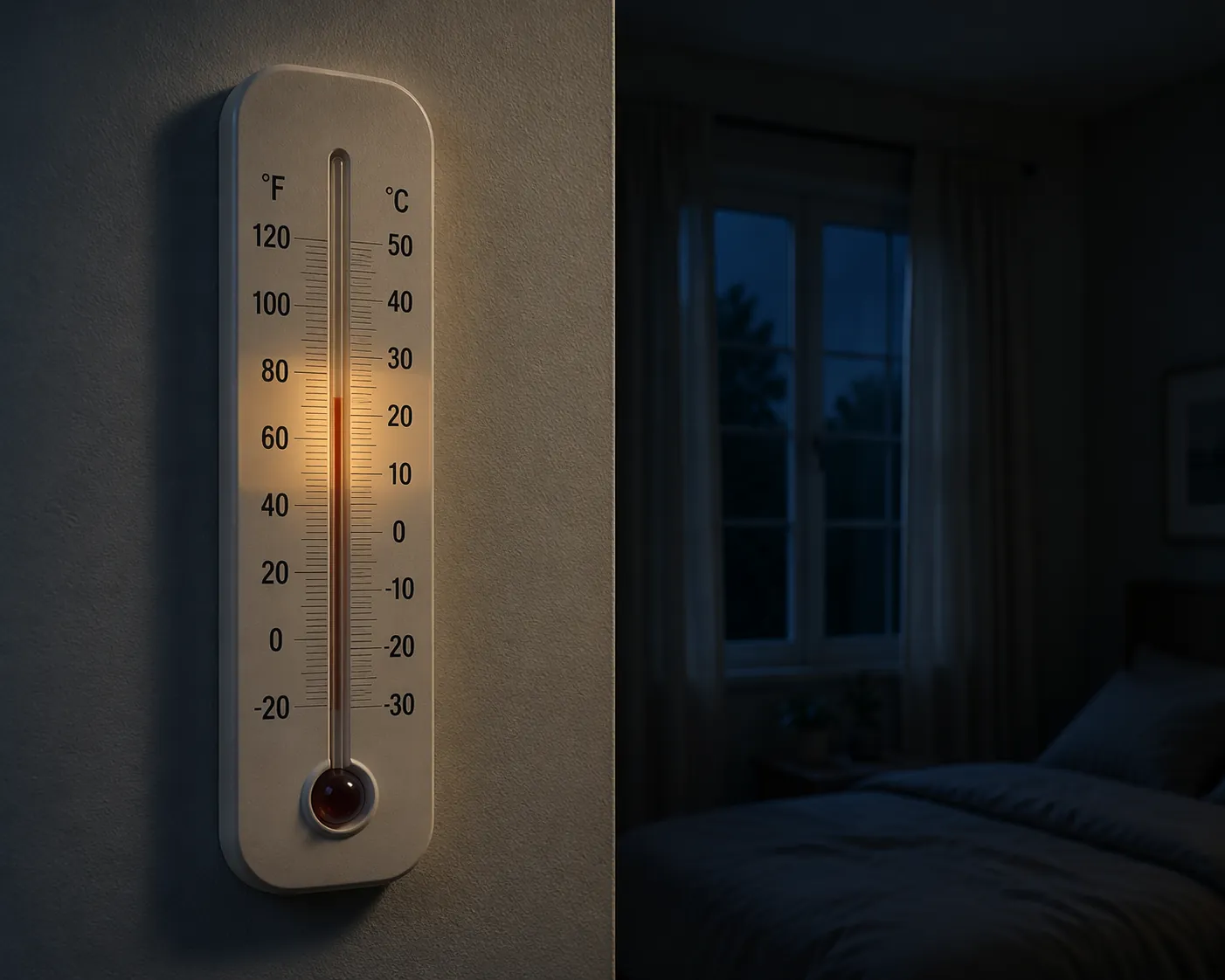
Use an actual thermometer if one is available. If the room is drifting below 68°F or above 80°F and the person cannot be moved to a safer room, warmed safely, cooled safely, or checked frequently, the problem is already larger than sleep.[5]
Make the room boringly safe before bedtime
Darkness is a medical risk when balance, vision, urgency to use the bathroom, or sedating medication is involved. Medical Guardian highlights fall risk during outages, including hazards created when older adults move through a dark home, and notes that some older adults may not hear alerts reliably.[6] PowerOutage.us gives the hearing-loss context: hearing loss affects 22% of adults ages 65–74 and 55% of adults 75 and older.[5]
- Place a battery lantern within arm’s reach, not across the room.
- Clear the path from bed to bathroom before sleep: shoes, cords, throw rugs, pet bowls, and furniture edges matter more during an outage.
- Put glasses, cane, walker, phone, medications, and water in consistent, reachable locations.
- If alerts are sound-based, add a visual or vibration backup when possible, or arrange human check-ins.
- Avoid candles in the sleep area. A sleepy trip to the bathroom should not include open flame.
Medication storage is not an afterthought
If a medication is temperature-sensitive, the question is not whether the person can tolerate a bad night. It is whether the medication can. PowerOutage.us warns that medication degradation is part of outage planning for older adults.[5] Check the medication label, pharmacy instructions, or prescriber guidance; do not guess based on how the bottle feels. If refrigeration is required and the refrigerator has been without power long enough that storage conditions are uncertain, call the pharmacy, clinician, or local health line for instructions before using or discarding it.
CPAP and powered devices need a real runtime plan
Many people discover the most important fact too late: most CPAP machines do not have an internal battery. ResMed states that most CPAP devices are designed to be plugged into a power source and that using battery power while turning off heated humidification can extend runtime by more than 50%.[7] That is useful, but it is still manufacturer guidance, and real runtime depends on pressure settings, humidification, battery age, mask leak, and the specific battery.
If an older adult uses CPAP, oxygen equipment, a powered bed, a lift, a nebulizer, a medical alert base station, or any device that makes sleeping or breathing safer, check it before bedtime. How many hours of battery are actually available tonight? Is there a car adapter, backup battery, neighbor, generator, or alternate location? If the device cannot run and skipping it is medically unsafe for that person, staying home is no longer the default plan. Restful Ground’s medical-device power outage guide goes deeper on device and medication continuity.
Caregiver check-ins should happen before the dangerous part of the night
The most useful check-in is not “Are you okay?” It is specific: What is the room temperature? Do you have light within reach? Can you get to the bathroom safely? Are tonight’s medications available and stored correctly? Is your phone charged? Is your medical alert working? Do you know where you will go if the room passes 80°F, drops below 68°F, or the device battery runs out?
For an older adult living alone, especially one with hearing loss, mobility limitations, cognitive impairment, temperature-sensitive medication, or powered equipment, schedule the next check-in rather than leaving it vague. A morning call is not enough if the unsafe window is midnight to 4 a.m.
ADHD: rebuild the sleep sequence before the night loses its edges
For adults with ADHD, the outage may remove the very cues that make sleep possible: the timed lamp, the phone charger by the bed, the white-noise machine, the shower routine, the evening playlist, the medication reminder, the thermostat drop, the “one more episode” boundary enforced by Wi-Fi or a device schedule. Without those anchors, bedtime can turn into a string of decisions made by a tired brain in an abnormal environment.
This is not a character problem. It is a cue problem. Restful Ground’s discussion of unequal circadian burden and ADHD is useful here because an outage also disrupts light cues, timing cues, and the external structure that helps the brain start and stop.
Shrink the number of bedtime decisions
- Choose the sleep location early and stop revisiting it unless temperature or safety changes.
- Set one physical bedtime cue: lantern dimmed, eye mask on pillow, paper book open, or a specific blanket placed on the bed.
- Use a battery alarm or phone alarm if the phone has enough charge, then put the phone where it will not become the whole night’s activity.
- Replace powered sound with a low-tech sensory cue: earplugs, a familiar hoodie, a weighted blanket if the room is not hot, or a simple breathing count.
- Write the next three actions on paper: bathroom, water, bed. The paper matters because it stops the brain from renegotiating the sequence every few minutes.
The next-day plan matters too. If the outage ruins one night, do not let recovery become a punishment project. Keep wake time reasonably anchored if safety allows, get outdoor light when it is safe, reduce the number of evening choices the next night, and avoid turning the blackout into proof that your sleep is permanently broken. The damage control is practical: preserve enough rhythm that one disrupted night does not become the start of a spiral.
Prepare for what actually fails during sleep
A useful outage sleep kit is not a pile of emergency objects. It is a replacement plan for the systems that normally protect sleep while you are unconscious or half-awake.
| What fails | What to prepare | Who needs extra attention |
|---|---|---|
| Cooling or warming | Room thermometer, light bedding, warm layers, damp cloths, battery fan if appropriate, plan for the coolest or warmest safe room | Pregnant people, perimenopausal women with night sweats, older adults |
| Light and safe movement | Lantern at bedside, clear path to bathroom, shoes or slippers, glasses and mobility aids within reach | Older adults, pregnant people with nighttime bathroom trips, anyone unsteady after waking |
| Medication and device continuity | Medication storage instructions, cooler plan if needed, charged power bank, device battery, CPAP settings plan, clinician or pharmacy phone numbers | Older adults, CPAP users, people using oxygen, powered beds, lifts, nebulizers, or refrigerated medication |
| Communication and alerts | Charged phone, written emergency contacts, neighbor or caregiver check-in schedule, visual or vibration backup when hearing alerts is unreliable | Older adults living alone, people with hearing loss, pregnant people needing after-hours clinician access |
| Routine cues | Paper bedtime sequence, battery alarm, low-tech sensory cue, non-screen wind-down item, morning light plan | Adults with ADHD and anyone whose sleep depends on timed lights, sound, reminders, or device schedules |
If you are preparing before storm season or wildfire season, size the kit to your local restoration reality rather than to the most frightening national example. A short urban outage and a rural multi-day outage do not require the same sleep plan. The point of knowing the longer regional patterns is not panic; it is deciding when a one-night bedroom workaround is no longer an honest plan.[1][2]
When staying home stops being the safer choice
Staying home is reasonable for many short outages if the person can maintain a safe room temperature, move safely in the dark, keep medication and devices usable, communicate if symptoms change, and preserve enough sleep structure to rest. It becomes unsafe when those supports fail for the specific person in the room.
- Leave or seek a cooled location for pregnancy if the room remains hot despite passive cooling, you feel overheated or unwell, or your obstetric guidance would normally tell you to call or be evaluated.
- Leave or arrange supervised care for an older adult if indoor temperature is moving below 68°F or above 80°F and cannot be corrected, if fall risk cannot be controlled, if medication storage is uncertain, or if powered medical equipment cannot run safely.
- Leave or find backup power for CPAP, oxygen, or other required equipment if the available battery will not cover the sleep period and skipping the device is not medically safe.
- For perimenopause, leave a dangerously hot room rather than trying to outlast repeated night sweats, weakness, or inability to cool down between episodes.
- For ADHD, relocate if the environment is unsafe or unmanageable, but if the room is physically safe, focus first on reducing decisions and rebuilding cues rather than treating wakefulness as a personal failure.
The threshold is not the same for every household. A mild, short outage may be managed with a lantern, water, safe footing, and a simplified bedtime routine. A hot upstairs bedroom in pregnancy, an older adult’s room outside the 68°F–80°F range, a dead CPAP battery, or medication that can no longer be stored correctly changes the answer. At that point, sleeping somewhere else is not overreacting; it is the sleep plan that still protects the body until restoration.
References
- How Long Do Power Outages Last? — PowerOutage.us.
- Blackout Statistics 2026 — SunergyHub.
- Menopause and Sleep — Sleep Foundation.
- Clinical Overview of Heat and Pregnant Women — CDC.
- Power Outage Preparedness for Seniors & Elderly — PowerOutage.us.
- How Power Outages Affect Older Adults — Medical Guardian.
- Should I Get a CPAP Battery? — ResMed.
Explore the mechanism
Next step
Spot an error or have clinical feedback?
Because this article covers clinical, medication, or safety information, we use a moderated correction channel instead of open public comments. Let us know if something about “How to Sleep Safely Without Power Until Restoration” needs a closer look.
Send feedback on this article