
Menopause nighttime skin care that protects your sleep
Menopause changes skin and sleep at the same time, and a routine built for only one can make the other worse. The fix is a sleep-first routine: barrier-repair ingredients without heat trapping or fragrance irritation, a practical 3 a.m. night-sweat reset, and clear signs that it's time to talk to a clinician.
At 3 a.m., a menopause nighttime skin care routine for better sleep is not an anti-aging ceremony. It is triage. Your neck is damp, your cheeks feel tight or itchy, the pillowcase may be wet, and the cream that felt comforting at 10 p.m. may now feel like a warm film you want to scrape off.
That is the right place to start, because menopause can disturb the body’s heat regulation and the skin barrier at the same time. In a 2024 American Academy of Sleep Medicine survey of 2,006 adults, 50% of U.S. women aged 45–64 reported menopause-related sleep disruption; a 2023 meta-analysis put postmenopausal sleep-disorder prevalence at 51.6%, with a 95% confidence interval of 44.6% to 58.5%.[1][2] The useful takeaway is not one perfect statistic. It is that night waking, sweating, and trouble returning to sleep are common enough that a skin routine should be built around them, not around a fantasy of eight uninterrupted hours under a thick night mask.
The skin side is just as real. The American Academy of Dermatology says women lose about 30% of skin collagen in the first five years of menopause, then about 2% each year for the next 20 years; it also notes that skin can become drier, thinner, more easily irritated, and less tolerant of fragrance as pH changes with age.[3] A small 60-woman study also found chronic poor sleep quality was associated with more signs of intrinsic skin aging and poorer barrier function, though that study should be treated as supportive evidence rather than proof that one sleep or skin intervention will reverse the process.[4]
So the evening goal is modest and important: reduce avoidable sting, itch, heat trapping, and decision-making. A good routine can help the skin feel calmer and make the night easier to recover from. It cannot make a persistent vasomotor symptom disappear by being richer, more active, or more expensive.
What products can reasonably do at night
For menopausal skin that is waking you up, the most useful products are usually boring: a mild non-soap cleanser, a light hydrating layer if you tolerate one, and a fragrance-free moisturizer that reduces tightness without making your face feel sealed under plastic. The AAD specifically points to mild non-soap cleansing, moisturizers with hyaluronic acid or glycerin, and fragrance-free moisturizer for easily irritated skin.[3]
| Nighttime choice | Why it belongs or does not belong in a sleep-first routine | Evidence tier |
|---|---|---|
| Mild non-soap cleanser | Useful when sweat, sunscreen, or the day’s residue needs removing without stripping already dry skin. | Dermatology guidance from AAD.[3] |
| Glycerin or hyaluronic acid | Humectants can make skin feel less tight when layered under a simple moisturizer, especially if applied to slightly damp skin. | Dermatology guidance from AAD.[3] |
| Fragrance-free moisturizer | Best default for skin that stings, itches, or flushes easily at night. | Dermatology guidance from AAD.[3] |
| Heavy occlusive night cream or sleeping mask | May be useful for some dry skin in other settings, but near bedtime it can feel hot, sticky, or smothering during a night sweat. | Practical sleep-first synthesis; not a single-study claim. |
| Fragrance, essential oils, mentholated or warming products | Can irritate sensitive skin or create sensory stimulation when the goal is to stay sleepy. | AAD flags fragrance as a common irritant; the sleep-stimulation concern is practical synthesis.[3] |
| Retinoids, exfoliating acids, scrubs | Not automatically forbidden, but they are poor choices on nights when the skin is already sweaty, itchy, flushed, or stinging. | Practical risk management based on irritation potential. |
This is also where beauty language gets unhelpful. “Overnight repair” often means more layers, stronger actives, heavier textures, and a little theater. A menopause sleep routine needs the opposite kind of confidence: fewer sensations, less heat, less rubbing, and products that still feel acceptable when your body temperature surges.
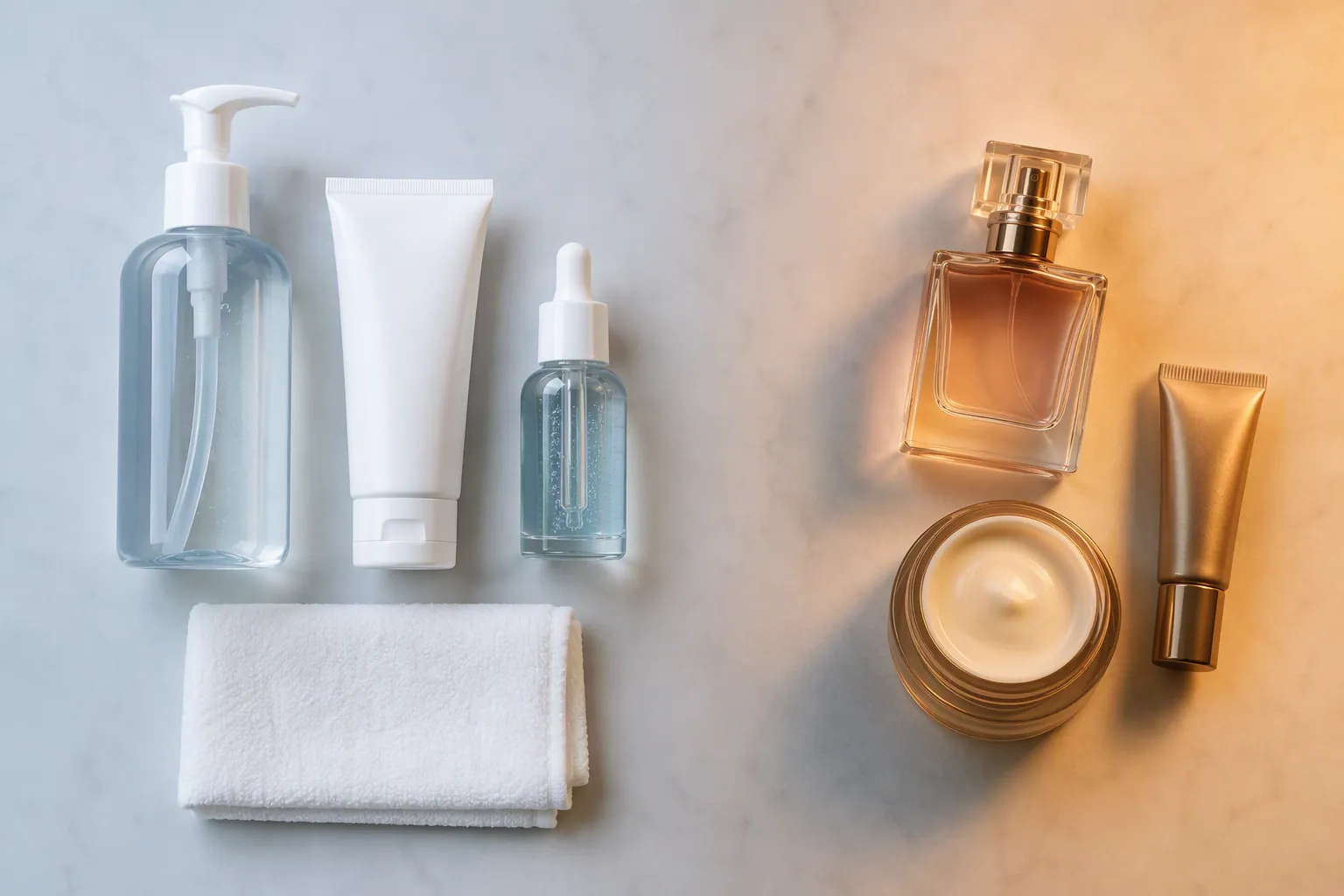
Build the routine before you are exhausted
Do the skin care earlier in the wind-down, not as the final dramatic act before lights-out. That recommendation is practical rather than study-proven: it gives your face time to stop feeling damp or tacky, lets you notice immediate stinging while you are still awake enough to fix it, and keeps the bathroom from becoming the place where bedtime stretches longer than it needs to.
- Set up the cooling environment first. Put cold water within reach, keep a cloth ready if you use one, and choose bedding or sleepwear that can be removed in layers. Johns Hopkins menopause specialist Wen Shen, MD, describes hot flashes as bursts lasting about 30 seconds to 5 minutes, with night sweats being the same event during sleep; first-line measures include cooling the back of the neck, layered natural-fiber bedding, and cold water.[5]
- Cleanse only as much as the day requires. If you wore sunscreen or makeup, use a mild non-soap cleanser and cooler or lukewarm water. If you are bare-faced and dry, a full cleanse may not be necessary every single night. HealthPartners notes that menopause-related itching can be worse at night because skin loses water through the day and night sweats add irritation, and it emphasizes cooler water and gentle products as first-line care.[6]
- Apply hydration while the skin is still slightly damp. A simple humectant layer, such as glycerin or hyaluronic acid if your skin tolerates it, can reduce the tight feeling that makes you want to keep touching your face.
- Seal with the thinnest comfortable layer of fragrance-free moisturizer. The test is not whether the product sounds restorative. The test is whether your face feels calmer without feeling warmer.
- Keep stimulating products out of the default bedtime lane. If you use a retinoid or exfoliating product, treat it as a separate tolerance decision, not as the backbone of a night-sweat routine. On flushed, itchy, or recently irritated nights, skip it.
- Do not add a hot face massage, steamy washcloth, fragrant balm, or warming mask because the routine feels too plain. Comfort is allowed. Heat and irritation are not required for comfort.
If the room itself is the main problem, do not try to solve it with skin care. For cooling order, bedding adjustments, and heat-wave planning, use this perimenopause heat-sleep guide. For bedroom microclimate and bedding choices outside extreme heat, see the cooler-weather sleep guide. If caffeine timing is still crowding the evening, the caffeine and perimenopause sleep guide belongs earlier in the troubleshooting path than another serum.
The 3 a.m. night-sweat reset
A night-sweat reset should be almost boring enough to do half-asleep. The more light, checking, rubbing, and product assessment you add, the more awake you become. This is practical sleep-first guidance, not a claim that a single technique treats vasomotor symptoms.
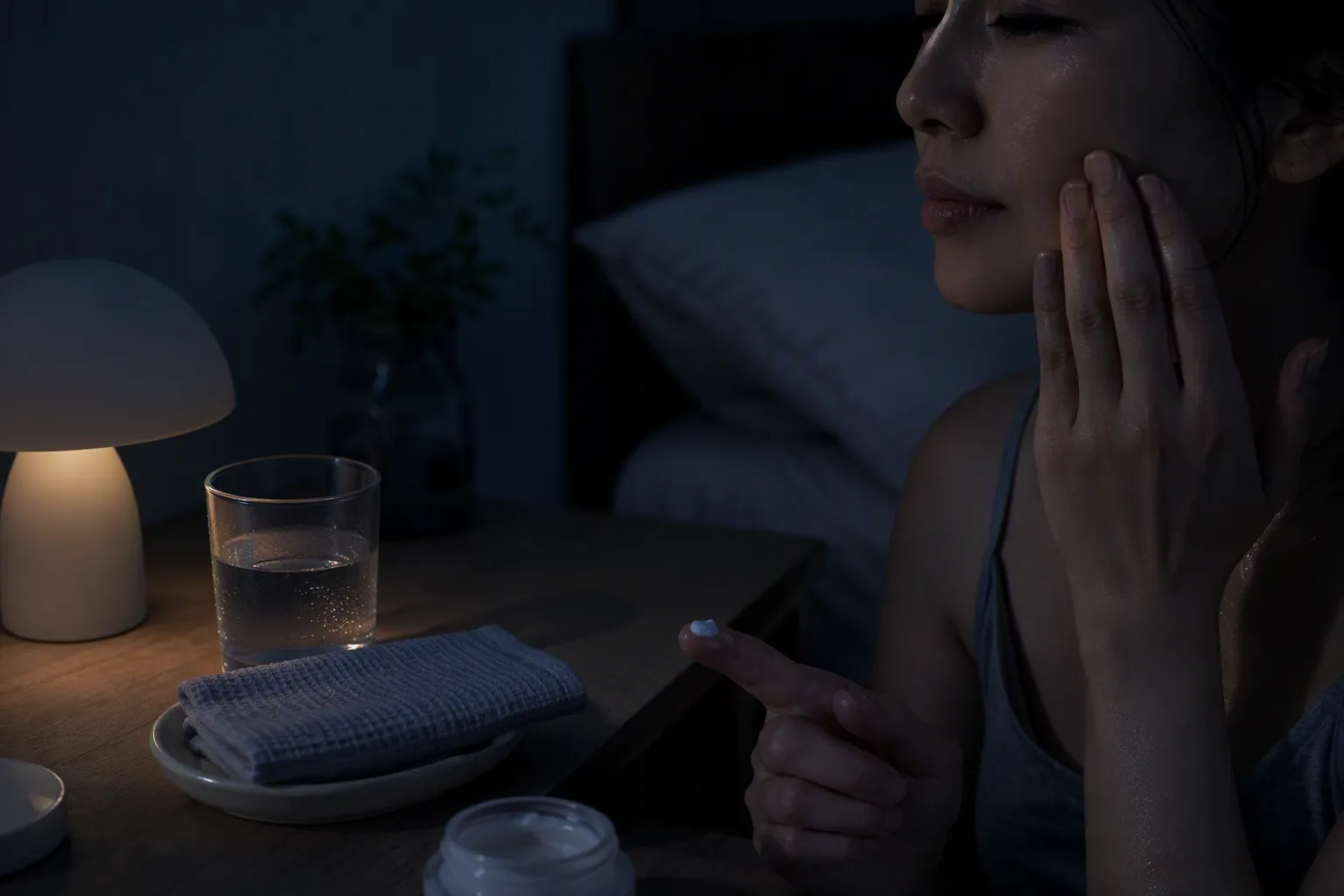
- Keep the light low. Use the smallest light that lets you move safely. The goal is to solve the sweat problem without telling your brain the day has started.
- Pat, do not rub. Sweat, salt, and friction are a bad combination on dry or itchy menopausal skin. Press a soft cloth to the face, neck, and chest rather than scrubbing.
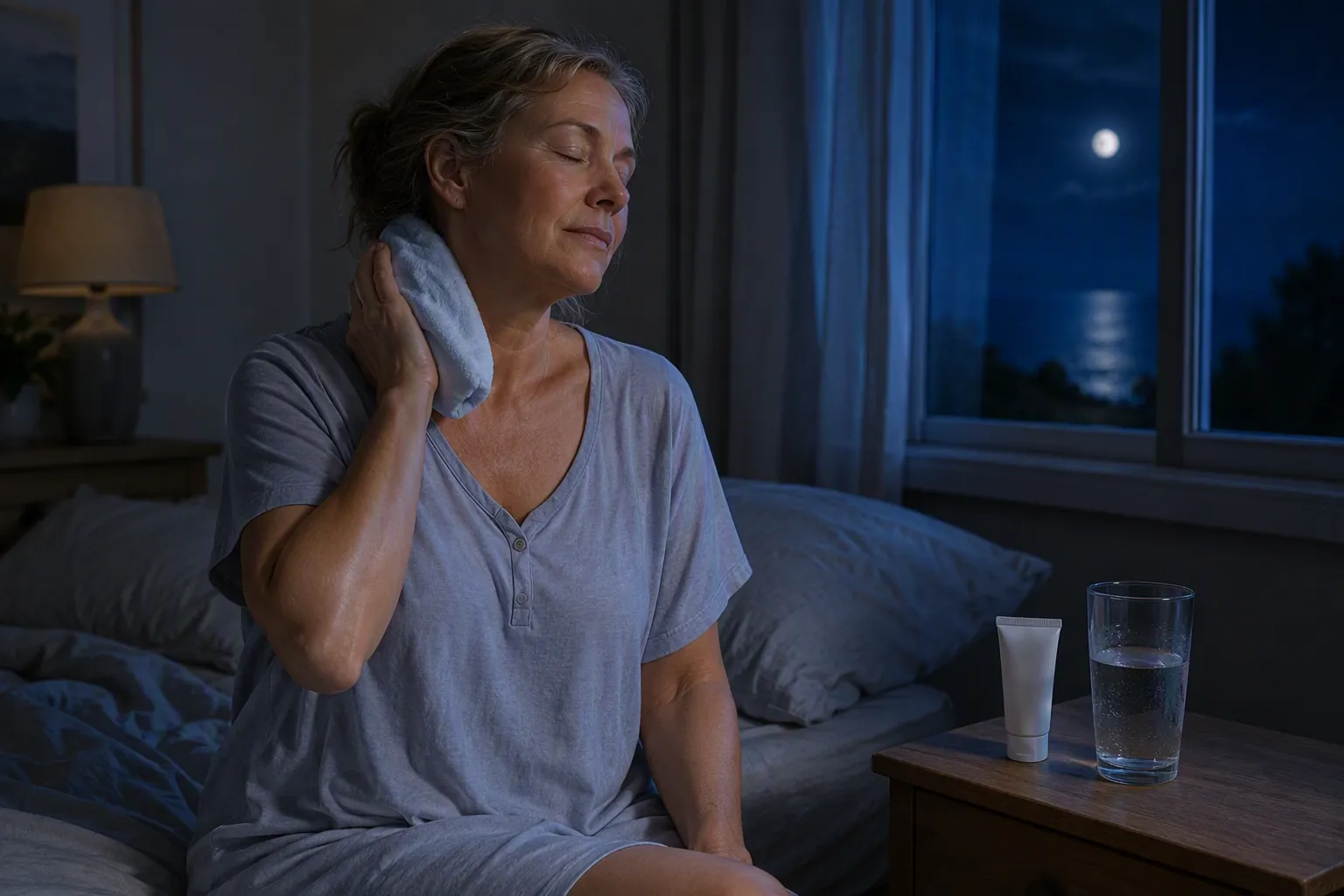
- Cool the back of the neck. This is one of the simple first-line measures Johns Hopkins recommends for hot flashes and night sweats.[5]
- Use a pre-cooled cloth or gentle wipe only if it helps. If wipes sting, leave residue, or smell perfumed, they do not belong in the reset.
- Change only what is wet enough to keep you awake. A pillowcase, sleep shirt, or top sheet may need replacing. A full bed remake usually does not.
- Avoid a full face rewash unless you truly need it. If the skin is just damp, patting is usually kinder. Rewashing can mean more friction, more water loss, and more time under bright bathroom light.
- Reapply the minimum comfort layer. If the skin feels tight or salty after patting, use a tiny amount of fragrance-free moisturizer on the irritated areas only. This is not the moment to redo the full routine.
- Drink cold water if it feels useful, then stop troubleshooting. Do not open a shopping app, compare ingredients, or inspect your face in the mirror. Those are morning tasks.
The reset works best when it has been staged before bed: cloth ready, water poured, moisturizer within reach, clean pillowcase nearby if needed. The person cleaning up the night should not also have to design a protocol while sweating through it.
Where retinoids, richer creams, and pleasure fit
There is room for a nighttime ritual to feel comforting. Dry, thinner, more reactive skin can make a face feel unfamiliar, and a calm routine may help you feel less at war with it. The line is crossed when comfort depends on fragrance, heat, sting, elaborate layering, or a texture that becomes unbearable during a sweat.
If you already tolerate a retinoid, you may not need to abandon it forever. But it does not deserve priority over sleep on nights when you are flushing, itching, peeling, or waking soaked. Put actives in the optional category. Put barrier comfort and a quiet return to sleep in the essential category.
For readers still in the transition stage and trying to understand how skin, sleep, and perimenopause started changing together, the broader companion piece is How perimenopause rewrites your beauty sleep routine. This article stays narrower: what to put on at night when the current problem is menopause-related waking, sweating, and irritated skin.
When a cream is no longer the next step
If fragrance-free barrier care, cooler application timing, lighter bedding, and a low-stimulation reset still leave you repeatedly awake from night sweats, the problem has moved beyond nighttime skin care. That does not mean the routine failed. It means the routine has done what products can do: reduce avoidable skin irritation and stop the cleanup from becoming more activating than necessary.
A clinician can assess whether the awakenings fit menopausal vasomotor symptoms, whether another medical issue is contributing, and whether menopause-specific treatment belongs in the discussion. Depending on your health history, that conversation may include hormone therapy or nonhormonal prescription options such as fezolinetant, elinzanetant, gabapentin, SSRIs, or clonidine. This article is informational only and does not recommend a product, brand, supplement, or prescription.
The boundary is simple: skin care can make the night less irritating. Persistent hot-flash awakenings may need menopause-specific medical care.
References
- “Menopause and midnight mayhem: 50% of women aged 45-64 report disrupted sleep,” American Academy of Sleep Medicine, 2024.
- “The global prevalence of sleep disorders during menopause: a meta-analysis,” PMC, 2023.
- “Skin care during menopause,” American Academy of Dermatology.
- “Does poor sleep quality affect skin ageing?,” PubMed, 2015.
- “Managing Hot Flashes: Tips From a Menopause Expert,” Johns Hopkins Medicine.
- “Menopause and itchy skin: Causes and relief,” HealthPartners.
Safety & eligibility read
Cross-check against other interventionsExplore the mechanism
Next step
Spot an error or have clinical feedback?
Because this article covers clinical, medication, or safety information, we use a moderated correction channel instead of open public comments. Let us know if something about “Menopause nighttime skin care that protects your sleep” needs a closer look.
Send feedback on this article