What the Buck Moon Means for Your Perimenopause Night Sweats
The July Buck Moon amplified sleep disruption for perimenopausal women by combining lunar melatonin suppression with hormone-driven night sweats. This article explains why it hit harder and how to prepare for future full moons with strategies that address both triggers.
If the last few nights felt out of proportion — hotter, lighter, more wakeful, harder to recover from — the timing is at least plausible. The July Buck Moon peaked on July 29, 2026, at 10:36 a.m. EDT and appeared full for roughly two nights on either side, which means July 31 is not too late to still be feeling the aftereffects of that bright, broken-sleep window.[1]
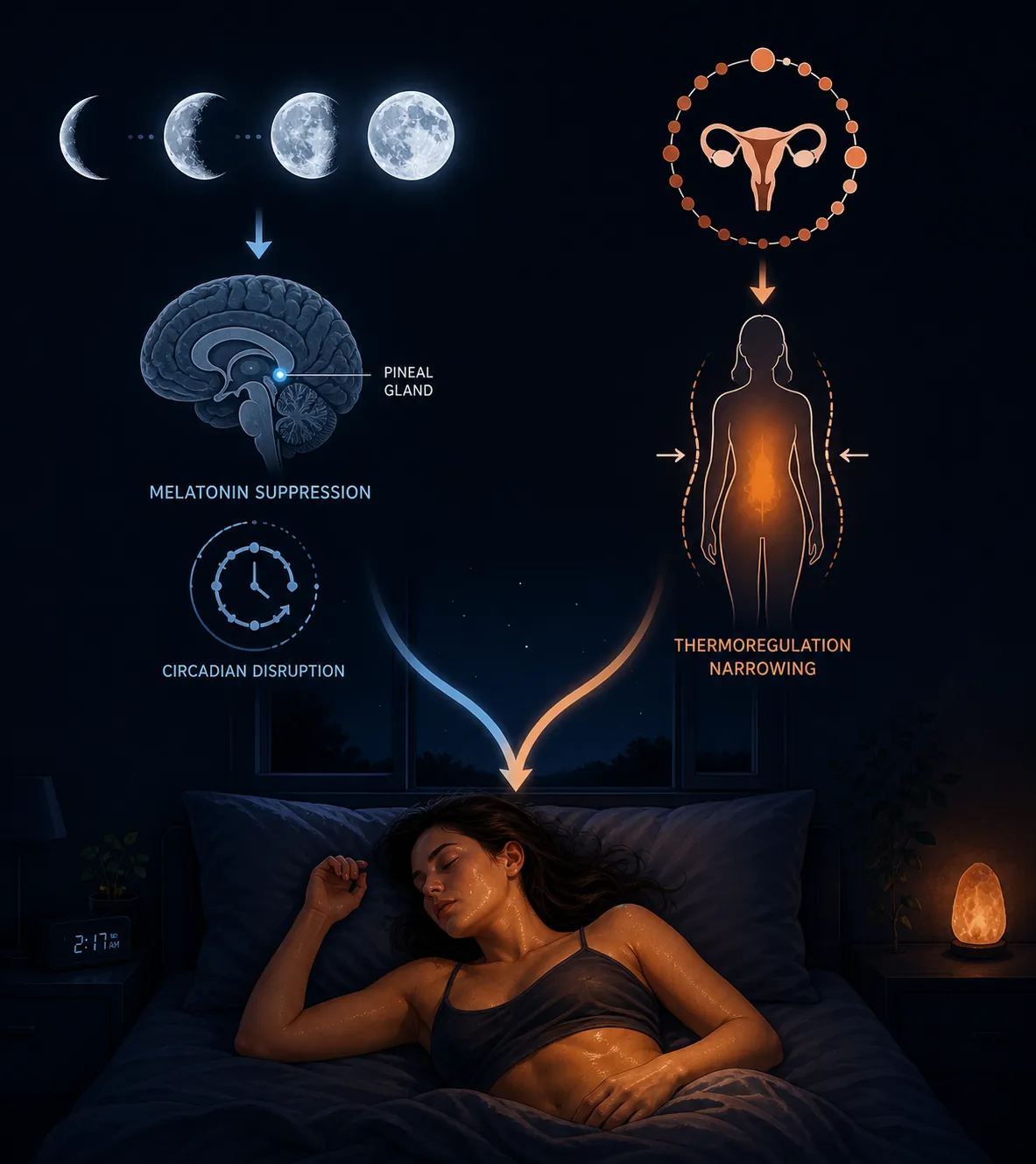
That does not make the Buck Moon a diagnosis. It does make it worth taking seriously, especially in perimenopause, when sleep is already easier to knock off balance. The more useful explanation is not “the moon caused your night sweats.” It is that two separate burdens may have landed at once: full-moon-related circadian disruption on one side, and hormone-related thermoregulation instability on the other.
Why the Buck Moon Window Could Have Felt Worse
The first clue is the timing. A large field study led by Horacio de la Iglesia and Leandro Casiraghi found that sleep changes tended to show up in the three to five nights before a full moon, with participants sleeping about 20 to more than 90 minutes less and falling asleep about 30 to 80 minutes later, depending on the group studied.[2] That puts the sharper Buck Moon sleep window around July 26 through July 31, not only on the calendar date of the full moon itself.
That matters because many people look for a single “full moon night” and then dismiss the pattern if the worst sleep came earlier. The sleep literature does not require the disruption to wait politely until moonrise on the exact date. In Casiraghi’s study, the shift appeared before the full moon, when evening moonlight is more likely to extend into the hours when the body is supposed to be dimming down.[2]
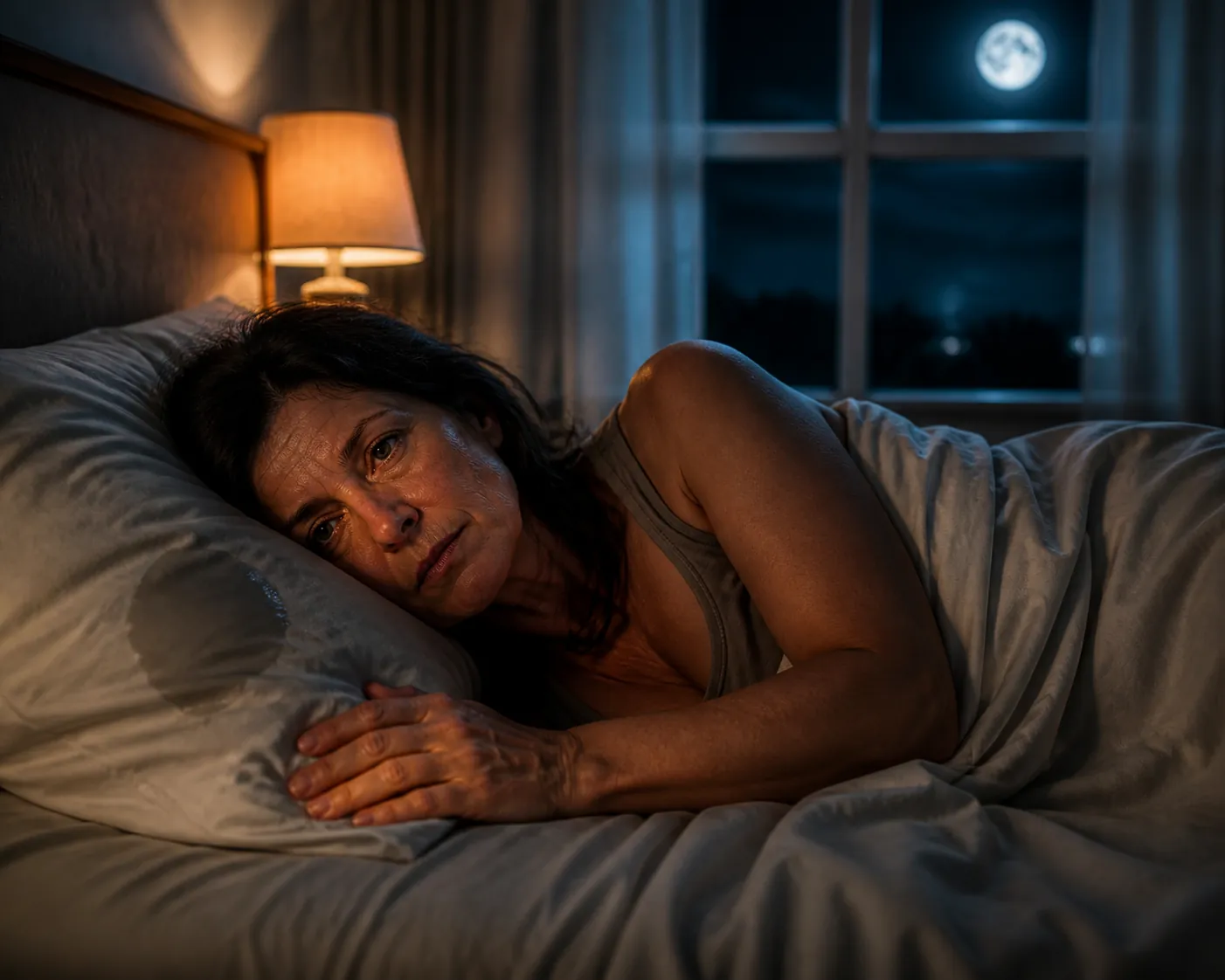
For a perimenopausal sleeper, that later sleep onset can be enough to set off a cascade. You go to bed already a little delayed, the room is warmer than ideal, the bedding holds heat, and then a vasomotor episode wakes you soaked. Once awake, the full-moon brightness, the clock, and the unpleasant job of changing clothes or flipping the pillow all make it harder to return to sleep.
What Is Known, and What Is Inferred
The strongest way to read the evidence is in layers. One layer concerns lunar phase and sleep. In a controlled sleep-lab study, Cajochen and colleagues reported diminished endogenous melatonin during full-moon nights, along with poorer sleep measures.[3] A lab study cannot tell you what happened in every bedroom this July, but it gives the moonlight question a biological doorway: melatonin is part of the sleep-timing system, and lower melatonin is not a trivial finding.
Casiraghi’s later field study adds a different kind of evidence. It did not put people in a laboratory; it tracked sleep timing across communities with different access to electric light. The study found the same broad pattern — less sleep and later sleep onset before the full moon — across indigenous and urban populations.[2] That does not prove every individual is moon-sensitive. It does make it harder to wave away the timing as only folklore.
A reader-friendly synthesis from Verywell Health describes full-moon sleep effects in similar terms, including reports of about 20 to 25 minutes less sleep and roughly 30% less deep sleep during full moons.[4] Those figures should be treated as a general full-moon sleep signal, not as a perimenopause-specific estimate.
The second layer concerns perimenopause itself. Harvard Health reports that about 35% to 50% of perimenopausal women experience hot flashes or night sweats, and about 40% have sleep problems.[5] Coborn and colleagues, writing in The Journal of Clinical Endocrinology & Metabolism, reported sleep disturbance in about 56% of women in perimenopause.[6] These numbers describe a population whose sleep is already more fragile before the moon enters the conversation.
The mechanism is not mysterious in the way it is sometimes made to sound. Cleveland Clinic describes night sweats and hot flashes as vasomotor symptoms linked to changes in the body’s temperature regulation, including a narrowed thermoneutral zone.[7] When that comfortable temperature band narrows, smaller changes in core temperature, room temperature, bedding, alcohol, stress, or timing can produce a much larger wake-up event.
There is also a circadian piece inside perimenopause, not only a heat piece. Pines has described declining melatonin production during perimenopause, as cited in a clinical synthesis on circadian rhythm and sleep in perimenopause.[8] That makes the full-moon melatonin question more relevant, but it still does not turn the intersection into a proven causal chain.
The caveat is important: Casiraghi’s study did not isolate perimenopausal women as a subgroup, and there is no direct study that tests full moon × perimenopause × night sweats as one combined exposure. The most honest conclusion is narrower. Full-moon sleep disruption has evidence. Perimenopausal night sweats and sleep disturbance have evidence. Their overlap during the Buck Moon is a reasonable inference from separate mechanisms, not a confirmed diagnosis.
July Heat Makes the Signal Messier
July adds a problem that is easy to underestimate: it confounds the evidence in your own body. If you woke drenched during the Buck Moon, you cannot cleanly separate moonlight, bedroom heat, perimenopause, late daylight, bedding, and ordinary stress from one another. They all press on sleep through overlapping routes.
That ambiguity does not make the experience imaginary. It means your response plan should not depend on proving which trigger “won.” If moonlight may delay melatonin, manage light. If perimenopause narrows the thermoneutral zone, lower the thermal load. If July warmth keeps the room from cooling overnight, treat the room itself as part of the intervention rather than blaming your willpower at 3 a.m.
For a deeper look at the combined perimenopause-and-full-moon mechanism, Why Perimenopause Makes Full Moon Sleep Disruption Worse is the more focused companion piece. If your main issue this week was heat piling onto hot flashes, the cooling framework in How to Cool Both Heat Waves and Hot Flashes for Sleep is the more practical next stop.
A Remedy Plan That Matches the Two Triggers
The mistake is to answer a two-pathway problem with one vague sleep tip. A warmer bath, a calming tea, or a reminder to “relax” may be pleasant, but they do not directly address the two loads suggested by the evidence: light-sensitive circadian timing and unstable temperature regulation.
| Likely burden | What it can do | Remedy target |
|---|---|---|
| Full-moon light and circadian timing | Delay sleep onset, weaken the usual melatonin rise, make wake-ups brighter and more alerting | Strict darkness and evening light discipline |
| Perimenopause thermoregulation | Trigger sweating, heat surges, bedding changes, and long awakenings | Active cooling and night-sweat preparation |
| July bedroom heat | Amplify both the light problem and the sweat problem | Pre-cool the room and reduce retained heat |
For the lunar and circadian side: make the room boringly dark
Start three to five nights before the next full moon, not on the night itself. That timing follows the Casiraghi window and is especially important if you noticed the Buck Moon trouble beginning before July 29.[2]
- Close blackout curtains before the room begins to brighten with moonlight or late evening sky glow.
- Remove direct light from the bed line: phone screens, bright alarm clocks, hallway spill, bathroom lights, and uncovered windows.
- Use the dimmest warm light that lets you move safely if you wake sweating and need to change clothes.
- Keep wake-up logistics close to the bed so a night-sweat episode does not become a fully lit household errand.
The point is not to fear moonlight. It is to stop adding light at the exact moment your sleep system is trying to recover. The general full-moon sleep protocol covers this part in more detail.
For the perimenopause side: prepare for sweat before it happens
Night-sweat preparation is not defeatist. It is what keeps one vasomotor episode from costing the rest of the night. If the thermoneutral zone is narrowed, the goal is to reduce retained heat and shorten the cleanup.
- Use lighter, layered bedding so you can remove warmth without fully waking yourself.
- Keep a dry sleep shirt, towel, or pillowcase within reach during the full-moon window.
- Pre-cool the bedroom earlier in the evening instead of waiting until you are already overheated.
- Avoid trapping heat under heavy comforters, foam toppers, or non-breathable sleepwear during the vulnerable nights.
- If you use a fan or cooling device, aim for steady cooling rather than a blast that leaves you chilled after the sweat passes.
The best setup is the one that lets you handle a sweat episode in the dark, with the least movement and the least frustration. A dry layer within arm’s reach can matter more at 2:40 a.m. than an elaborate bedtime routine you cannot execute once you are awake.
If you woke wired but not sweaty, check the differential
Not every full-moon wake-up in perimenopause is a night sweat. Some women wake hot and drenched. Some wake alert, hungry, shaky, or anxious. Some wake because they finally cooled down after sweating and now feel cold. The remedy changes depending on the pattern.
| What you noticed | More likely emphasis | What to adjust first |
|---|---|---|
| Damp clothes, wet hairline, soaked pillow or sheets | Night-sweat and thermoregulation load | Cooling, bedding, dry layers, room temperature |
| Wide-awake feeling after seeing light or checking the clock | Circadian/light load | Blackout, dim navigation light, no bright screen exposure |
| Hungry, shaky, or adrenaline-like waking | Possible blood-sugar contribution | Evening meal timing and overnight stability |
If the pattern feels more like a blood-sugar wake-up than a sweat-driven one, use the guidance in Prevent Nighttime Blood Sugar Spikes for Better Sleep in Perimenopause rather than forcing every wake-up into the Buck Moon explanation.
How to Use This Before the Aug. 28 Sturgeon Moon
The next full moon is the Sturgeon Moon on Aug. 28, 2026. If the Buck Moon was rough, do not wait until Aug. 28 to make changes. Mark the three to five nights before it as the higher-risk window, then treat those nights as a short experiment rather than a referendum on whether the moon controls your sleep.
- On Aug. 23 or 24, set the bedroom up for darkness: curtains closed, light leaks covered, dim night navigation ready.
- On the same day, set the bedroom up for heat: lighter bedding, breathable sleepwear, dry layers within reach, cooling device tested.
- During the window, track only a few useful variables: bedtime, wake time, sweat episode, room heat, visible light, and how long it took to fall back asleep.
- After the full moon, look for the pattern that would change your next step: earlier sleep delay, hotter awakenings, light-triggered alertness, or another cause entirely.
That small log is not about proving the Buck Moon was guilty. It is about making the next intervention less generic. If strict darkness helps sleep onset but not sweat episodes, cooling needs more attention. If cooling helps the sweating but you are still wide awake after any light exposure, the circadian side still needs tightening.
For planning beyond August, the 2026 full moon calendar gives the upcoming dates. For a more skeptical evidence review, including what the full-moon studies can and cannot prove, read Does the full moon actually affect perimenopause sleep?.
The Buck Moon did not have to be magical to be miserable. A bright pre-full-moon sleep window, a July bedroom, and perimenopausal thermoregulation can be enough. The useful response is not to argue with the timing after the fact, but to make the next full-moon window darker, cooler, and easier to recover from.
References
- July Full Moon 2026, Space.com.
- Moonstruck sleep: Synchronization of human sleep with the moon cycle under field conditions, Science Advances, 2021.
- Evidence that the lunar cycle influences human sleep, Current Biology, 2013.
- Does a Full Moon Affect Sleep?, Verywell Health, 2026.
- Perimenopause: Rocky road to menopause, Harvard Health.
- Sleep Disturbance Across the Menopause Transition in Women With Premenstrual Dysphoric Disorder, The Journal of Clinical Endocrinology & Metabolism, 2022.
- Night Sweats, Cleveland Clinic.
- Circadian rhythm and sleep in perimenopause, TārāMD.
Explore the mechanism
Next step
Spot an error or have clinical feedback?
Because this article covers clinical, medication, or safety information, we use a moderated correction channel instead of open public comments. Let us know if something about “What the Buck Moon Means for Your Perimenopause Night Sweats” needs a closer look.
Send feedback on this article