
How to sleep through heat wave night sweats in perimenopause
When a heat wave meets perimenopause, night sweats intensify because the same hormonal shift that narrows your body's temperature tolerance zone makes you more vulnerable to external heat. This guide explains why generic cooling tips fall short and offers evidence-ranked interventions — from active cooling devices to medication timing — so you can sleep through the next hot night.
A heat-wave night sweat in perimenopause can feel wildly out of proportion to the room. The thermostat is only a few degrees higher, the fan is running, the sheets are light, and then your body behaves as if someone flipped an internal emergency switch. That mismatch is the point: in perimenopause, the problem is not only the hot room. It is the hot room landing on a temperature-control system that has become easier to trip.
As estrogen fluctuates and declines, hypothalamic thermoregulation becomes less stable. KNDy neurons in the hypothalamus are part of that temperature-control pathway, and the thermoneutral zone — the range in which your body does not need to launch a heat-loss response — narrows. A rise in body heat that once stayed inside the safe zone can now cross the threshold into flushing, sweating, and a full awakening.[1]
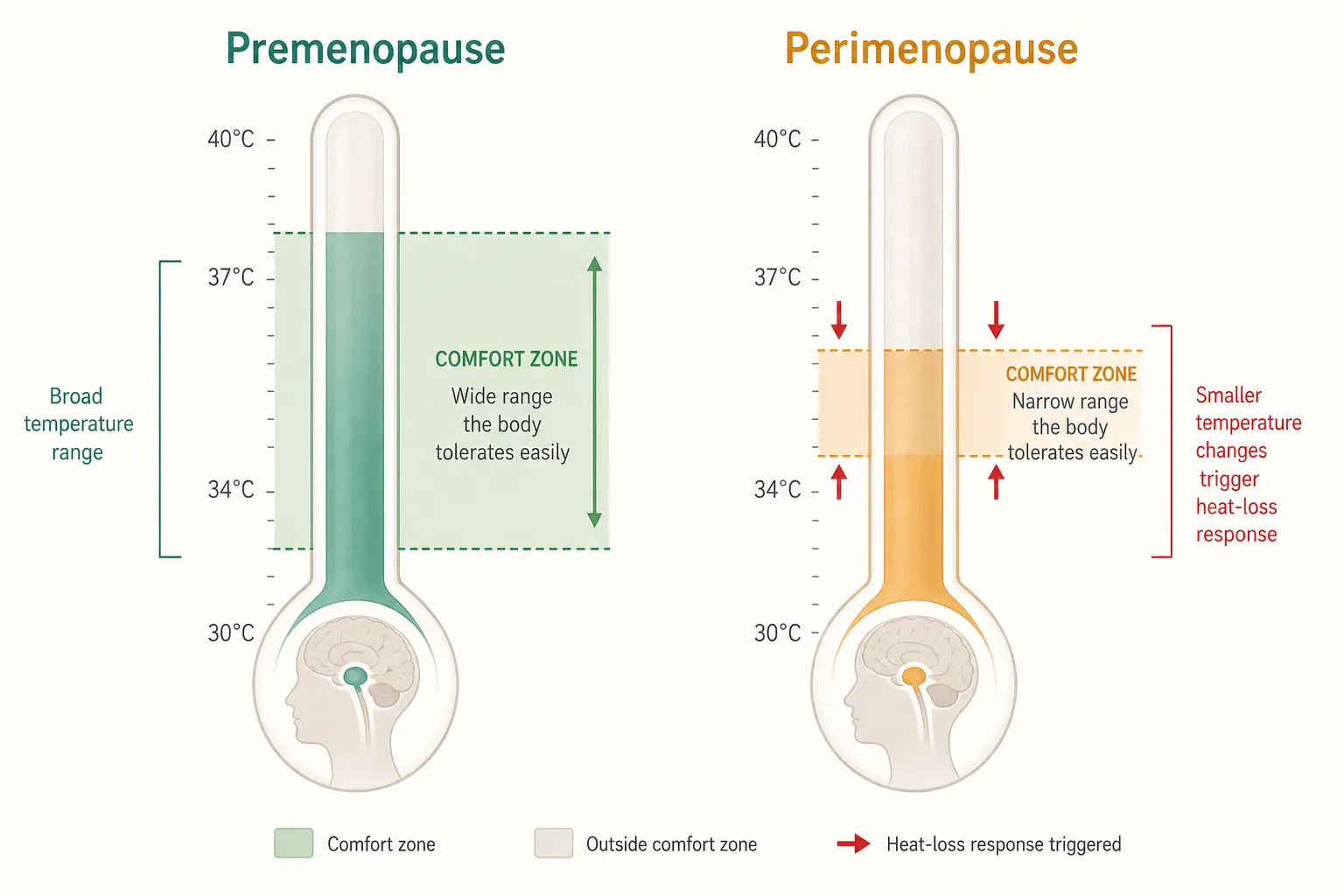
That is why standard heat advice can feel insulting when you are changing clothes at 3 a.m. The advice is not wrong; a cooler room helps. It is just incomplete. During a heat wave, external heat and humidity add load from the outside while perimenopause lowers the internal margin for error. Humidity matters because sweat cools the body by evaporating; when the air is already moisture-heavy, that cooling step works less efficiently.[1]
Population data support the seasonal pattern, though not in the exaggerated way heat-wave headlines sometimes imply. In the SWAN Menstrual Calendar substudy, hot flashes had 66% greater odds at the July seasonal peak than at the January trough, and night sweats had 50% greater odds.[2] That does not prove that one specific heat-wave night causes one specific night sweat. It does show that summer conditions are associated with a measurable increase in vasomotor symptoms.
If you want a deeper mechanism discussion in a heat-specific setting, Miami Heat Worsens Perimenopause Sleep by Narrowing Your Thermostat follows the same thermoneutral-zone problem in more detail. Here, the practical question is what to do when the forecast is already bad and your body is already reactive.
Start by lowering the heat load tonight
Tonight’s goal is not perfect sleep hygiene. It is to keep your body from crossing the sweat-trigger threshold as often, and to make the episode shorter if it happens anyway.
| Move | Why it fits heat-wave perimenopause night sweats | Decision burden |
|---|---|---|
| Pre-cool the bedroom before bed, then keep air moving overnight | Reduces the external heat sitting on top of a narrowed thermoneutral zone | Low |
| Use lighter layers and keep a dry change of sleepwear nearby | Does not prevent vasomotor symptoms, but reduces the amount of time spent fully awake after one | Low |
| Take a lukewarm shower about 90 minutes before bed | May help shift heat toward the skin and support the normal pre-sleep drop in core temperature | Low |
| Try active bed cooling if symptoms recur during hot periods | Targets the sleep surface directly instead of relying only on room air | Medium to high |
| Discuss vasomotor treatment if night sweats are recurrent, severe, or sleep-disrupting | Addresses the internal instability rather than only the room | Medical decision |
The low-cost version is still worth doing: close blinds before the room heats up, run air conditioning or a fan before bedtime rather than waiting until you are already overheated, and avoid trapping heat under a heavy comforter. If you share a bed, this is also the moment to stop treating the room temperature as a preference dispute. For the person having vasomotor symptoms, a few degrees can be the difference between staying asleep and waking drenched.
A dry shirt, a towel on the nightstand, and a spare pillowcase are not cures. They are damage control. But damage control matters because the second injury is often the long wake-up afterward: lights on, sheets changed, partner disturbed, body cooling too slowly, mind fully alert. Set up the room so recovery from an episode takes minutes, not half the night.
A lukewarm shower about 90 minutes before bed is reasonable when the heat is forecast to linger overnight. The shower should not be cold enough to make you shiver; shivering is heat production. The aim is a gentle pre-sleep cooling assist, not a shock treatment.
Active cooling deserves more attention than another fabric list
Breathable pajamas and linen sheets can help with comfort, but they are passive. They do not remove much heat once your body has already launched a vasomotor episode. Active cooling is different because it can change the thermal environment at the sleep surface itself.
The most relevant recent evidence is preliminary, but it points in the right direction. In a small Eight Sleep Pod study presented at SLEEP 2025 and covered by MedPage Today, 38 perimenopausal and postmenopausal women using an active cooling mattress system had nighttime hot flash frequency fall by 54%, from 1.78 to 0.75 per night.[3] That is not a settled clinical guideline. It was a small, industry-funded, conference-presented study, not a large peer-reviewed trial. Still, the intervention fits the mechanism better than many generic bedding swaps.
A separate pilot study of a passive cooling mattress pad in 15 women found a 52% reduction in hot flashes.[4] The sample was small, so it should not be read as proof that a specific product will halve symptoms for every user. Taken with the active cooling data, it supports a narrower and useful conclusion: cooling the sleep surface may be worth considering when heat-wave nights repeatedly intensify perimenopause night sweats.
The buying decision should be based on frequency and consequences, not on panic after one bad night. If you have one heat-wave week a year, a fan, air conditioning, lighter bedding, and recovery supplies may be enough. If summer means repeated awakenings, wet sheets, and next-day impairment, a bed-cooling system moves from luxury gadget toward targeted symptom management. Readers comparing broader heat-wave tactics can also use California Heat Wave Sleep Tips for Pregnancy and Perimenopause for a wider life-stage view.
When symptoms keep returning, treat the vasomotor problem too
Environmental cooling reduces the outside load. It does not necessarily fix the internal instability that made the heat so disruptive in the first place. If night sweats are recurrent, severe, or sleep-disrupting outside a single unusual hot spell, the next step is a clinician conversation about vasomotor symptom treatment.
Menopausal hormone therapy remains the most effective first-line treatment for vasomotor symptoms for appropriate candidates, and the labeling landscape has changed recently: the FDA removed boxed warnings from systemic menopausal hormone therapy products in 2025–2026, according to Yale Medicine and other menopause-focused summaries.[5][1] That does not make hormone therapy automatic or risk-free. It means the discussion should be individualized rather than shut down by outdated fear.
Timing can matter, especially if symptoms cluster overnight. Do not move, split, or increase hormone therapy on your own, but do tell your clinician when the sweats occur: early night, 3 a.m., near waking, only during hot weather, or all summer. That pattern may influence dose timing, formulation, or whether another treatment is a better fit.
Non-hormonal prescription options can also be part of the conversation. Fezolinetant is one of them, but the safety caveat belongs next to the option, not buried later: the FDA added a boxed warning in December 2024 for rare but serious liver injury, so liver monitoring and eligibility matter.[5] Other non-hormonal medications may be considered depending on health history, other medications, and symptom pattern.
The threshold for seeking help is not whether the symptom is “normal.” Many perimenopause symptoms are common and still worth treating. A 2025 AASM Sleep Prioritization Survey cited by Midi found that 35% of women ages 45–64 reported night sweats disrupting sleep.[6] If you are losing sleep repeatedly, the clinical issue is the disruption, not whether you can technically survive another night with a towel and a fan.
Use the forecast to choose the level of response
For a one-night heat spike, the plan can stay simple: cool the room early, keep air moving, reduce layers, take a lukewarm shower before bed, and set up a fast-change station so one episode does not become a 90-minute wake period.
For a multi-day heat wave, add repetition to the plan. Pre-cool the bedroom every evening. Wash and rotate lighter sleepwear. Keep the same recovery supplies in the same place. If you use air conditioning, prioritize the first half of the night and the hours when symptoms usually hit. If humidity is high, air movement alone may feel less effective because sweat is not evaporating as well.
For a summer pattern — repeated hot-weather night sweats, regular sheet changes, or next-day exhaustion — consider whether passive measures are asking too much of a body with a narrowed threshold. That is where active cooling and medical treatment become more rational to discuss. The broader seasonal guide, Heat Wave Sleep Tips for the Super El Niño by Life Stage, may help if your household is managing heat risk across different ages or health needs.
The useful answer is not “just keep the room cool.” It is to reduce the external heat burden while also recognizing when the internal vasomotor trigger needs treatment. A fan may still belong in the room. It just should not be the whole plan when the body in that room is no longer working with the same temperature margin it had five years ago.
References
- Are hot flashes worse in summer?, SingleCare
- Factors associated with the occurrence and frequency of hot flashes and night sweats in the SWAN Menstrual Calendar substudy, Menopause, 2020
- Cooling Mattress Pad May Turn Down the Heat for Menopausal Women, MedPage Today
- A pilot study of the effects of a cooling mattress pad on vasomotor symptoms and sleep in women during the menopausal transition, Menopause, 2022
- Hot Flashes: What They Are and How to Treat Them, Yale Medicine
- Menopause Statistics, Midi
Explore the mechanism
Next step
Spot an error or have clinical feedback?
Because this article covers clinical, medication, or safety information, we use a moderated correction channel instead of open public comments. Let us know if something about “How to sleep through heat wave night sweats in perimenopause” needs a closer look.
Send feedback on this article