
Miami Heat Worsens Perimenopause Sleep by Narrowing Your Thermostat
Understand why the same summer heat that mildly bothered you five years ago now triggers intense night-sweat awakenings during perimenopause, and what the physiology of a narrowed thermoneutral zone has to do with it.
A Miami summer night used to mean annoyance: kick off the sheet, turn the pillow, maybe point the fan more directly at the bed. Then, somewhere in perimenopause, the same kind of night starts behaving differently. You wake soaked, not just warm. The fan is still running. The room may not feel dramatically hotter than it did years ago. But your body has already treated the night as an emergency.
That is the central problem with Miami heat and sleep quality in perimenopause: the room did not have to become unbearable for your sleep to fall apart. Your threshold changed.
Sleep disturbance is common during the menopausal transition; one review reports that about 40% to 60% of perimenopausal women experience sleep problems.[1] That number is useful because it cuts through the private suspicion that you are somehow failing at summer. But the more useful question is narrower: why does heat that once woke you briefly now set off sweating, irritation, and a long wait for your body to settle back down?
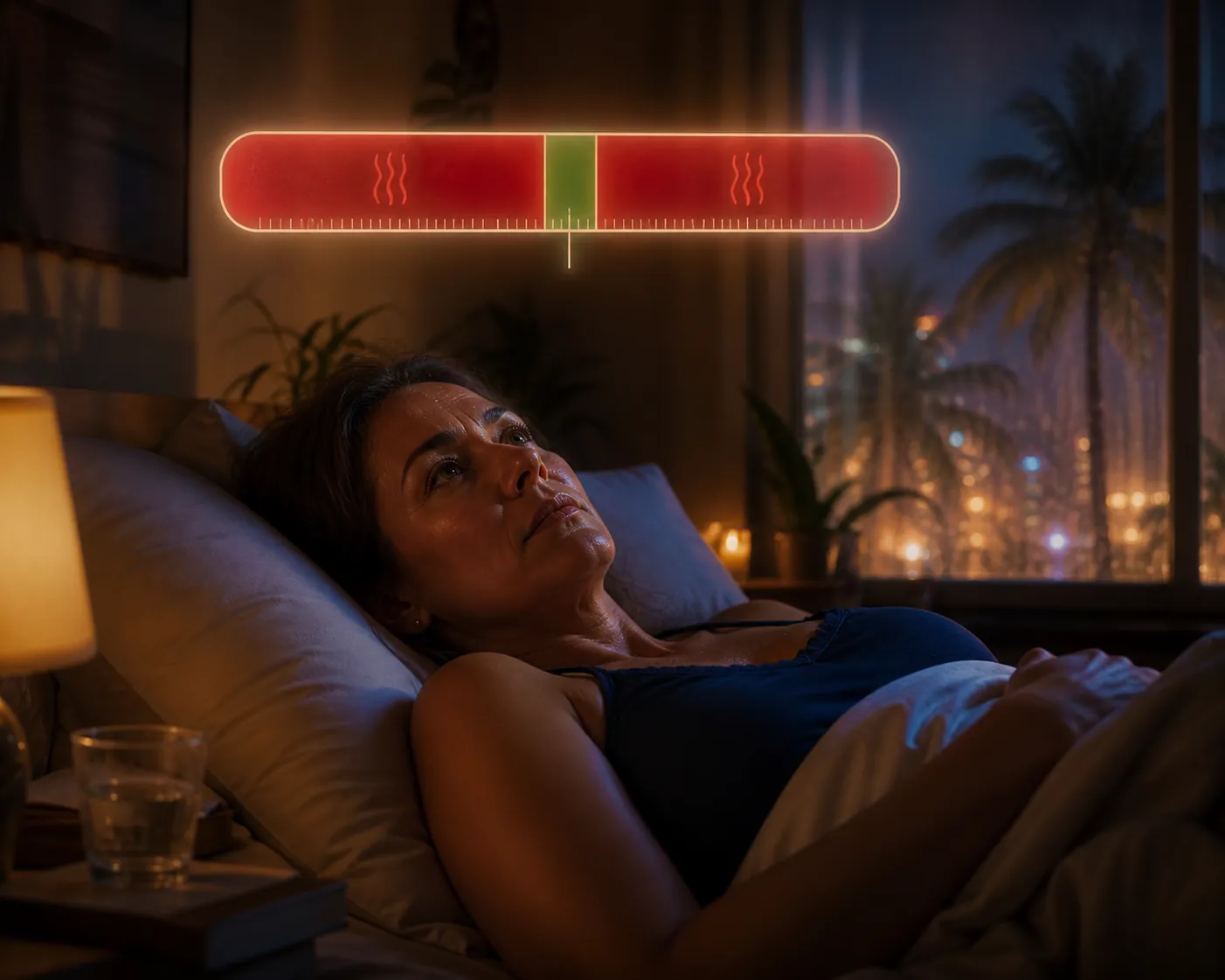
The thermostat gets less forgiving
The body does not wait until you feel consciously overheated before it reacts. Deep in the brain, the hypothalamus helps regulate core temperature. It works within a thermoneutral zone: a tolerated range where the body does not need to launch major heat-loss or heat-conservation responses.
During perimenopause, that zone can narrow. The point is not that your bedroom suddenly becomes hotter than every bedroom you have survived before. The point is that the space between “fine” and “too hot” becomes smaller. A modest rise in core temperature that might once have passed quietly can now trip heat-loss reflexes: blood vessels widen, heat moves toward the skin, sweating begins, and sleep may break open.
Some popular medical blogs attach a precise percentage to this narrowing, but that exact figure should be treated cautiously unless it is traced back to primary thermoregulation research. The mechanism itself is the part that matters for the woman awake at 3 a.m.: the margin for error has shrunk.
This is also why standard comfort advice can feel insulting when it is technically reasonable. Lighter pajamas, a fan, a glass of water, and a lower thermostat may help at the edges. They do not change the fact that your brain may now interpret a smaller temperature shift as a reason to trigger a full cooling response. For a deeper physiology walk-through, Restful Ground’s guide to why your body overheats during perimenopause sleep sits underneath this Miami-specific problem.
A hot flash is not just sweat
“Night sweats” is a convenient phrase, but it compresses several different events into one messy symptom. Ambient heat is the temperature around you. Core temperature is the temperature your body is defending internally. Sweating is the body’s attempt to move heat out. Evaporation is the part that actually cools you. Wake-after-sleep-onset is the measurable sleep time lost after you have already fallen asleep.
Those distinctions matter because a person can sweat heavily without cooling efficiently. She can also wake because the hot flash has disturbed sleep, then remain awake because the room and bedding make recovery slow. The sweat is visible. The failed recovery is the part that ruins the night.
In one study discussed in a menopause sleep review, hot-flash-associated wake accounted for about 27% of objective wake-after-sleep-onset in perimenopausal women.[1] That does not mean 27% of your own wake time comes from hot flashes. It means researchers could measure a pathway that many women recognize from experience: the heat event and the awakening are not merely coincidental.
Miami adds the second problem: sweat cannot finish the job
Sweat cools the body when it evaporates. In a dry room, moisture can leave the skin more readily, carrying heat with it. In humid air, the air is already carrying so much moisture that sweat lingers. It beads, pools, soaks fabric, and keeps the skin feeling wet without delivering the same cooling payoff.
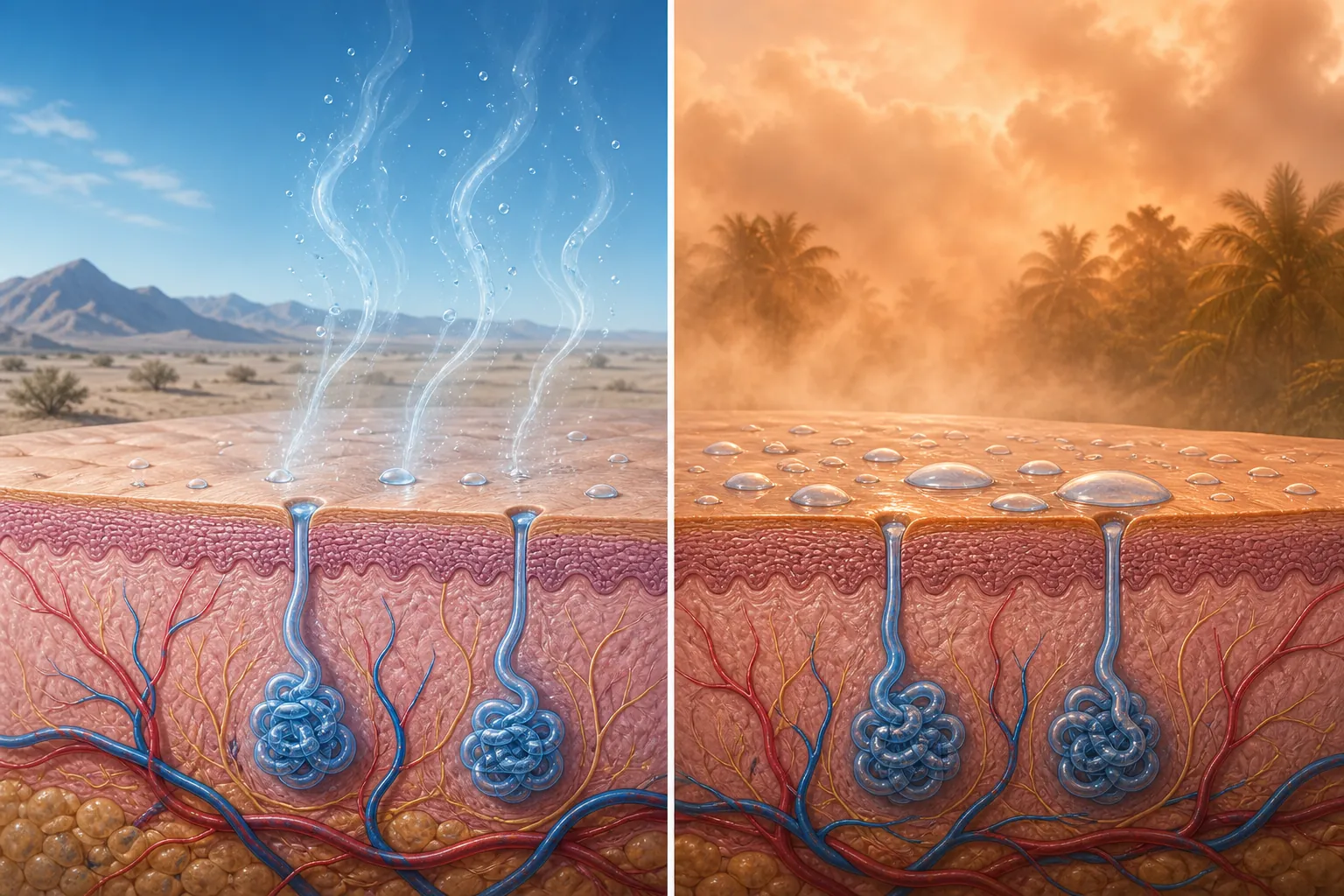
That is where Miami becomes more than a scenic detail. On hot, humid nights, passive air movement may make the room feel less stagnant, but it cannot always create enough evaporation to help the body recover quickly. A fan can move saturated air across damp skin all night. If the moisture is not leaving, the cooling response drags on.
A clinical blog on perimenopause night sweats describes humidity above 70% as a condition that impairs sweat evaporation and can prolong night-sweat episodes.[2] That humidity threshold should not be treated as a perfect personal cutoff; bodies, rooms, bedding, medications, and air-conditioning patterns differ. But the physical principle is not vague. Evaporation is the cooling step, and humid air interferes with it.
This is why the usual summer calculation changes in perimenopause. Before, you may have been able to sweat lightly, roll over, and return to sleep. Now the narrowed thermoneutral zone starts the cascade earlier, and humidity makes the recovery phase slower. The wake-up is not simply hotter. It is longer.
The bedroom number may be useful, but it is not a moral standard
Some sleep-temperature guidance for menopausal women points to a bedroom range of 15°C to 19°C, or about 60°F to 67°F.[3] As a contrast, that range is clarifying. It tells you how far many hot-humid bedrooms are from an ideal sleep environment when outdoor heat, indoor humidity, older insulation, upstairs rooms, or shared thermostat politics are involved.
But that range should not be turned into a scolding target for a Miami bedroom in July. A woman who cannot afford to run the air conditioner aggressively, who shares a bed with someone who sleeps cold, or who lives in a building that never fully dries out the indoor air does not need another perfect number thrown at her. She needs to understand why “cooler” and “drier” are doing different jobs.
| What Changes | What It Means At Night |
|---|---|
| Narrower thermoneutral zone | A smaller core-temperature rise can trigger heat-loss reflexes. |
| Hot, humid air | Sweat may stay on the skin instead of evaporating efficiently. |
| Damp bedding and clothing | The body keeps receiving warm, wet sensory signals after the flash starts. |
| Repeated wake-after-sleep-onset | Sleep becomes fragmented even if total time in bed looks adequate. |
Why repeated wake-ups feel so punishing
The damage is not only the dramatic 3 a.m. awakening. It is the fragmentation that follows repeated temperature-triggered arousals. Sleep architecture depends on being able to stay asleep long enough to move through stages, including slow-wave sleep, the deep restorative stage that is easiest to lose when the night keeps breaking into pieces.
Slow-wave sleep is not a luxury add-on after you have logged enough hours. It is part of why sleep feels restorative. When hot flashes, damp fabric, and delayed cooling keep pulling you upward into lighter sleep or full wakefulness, the next day can feel disproportionate to the clock. You may have been in bed for seven or eight hours and still wake up as if the night never consolidated.
Broader reviews of heat and sleep connect elevated ambient temperatures with disrupted sleep, including more wakefulness and poorer sleep continuity.[4] For perimenopause, that general heat burden lands on a system already operating with less thermal slack.
Passive cooling often cannot carry the whole load
A fan is not useless. Lighter bedding is not useless. Moisture-wicking sleepwear is not useless. The problem is asking passive cooling to do active cooling’s job in a humid climate while your hypothalamic threshold is narrower than it used to be.
Passive air movement can help sweat evaporate when the surrounding air can accept more moisture. It is less effective when the air is already heavy and the bedding is holding heat and dampness. In that setting, the cooling plan has to address both temperature and moisture: remove heat, reduce humidity when possible, and keep the sleep surface from becoming a warm wet compress.
That is where practical planning belongs, but it should not be reduced to one gadget or one thermostat setting. A cooling mattress pad, dehumidification, pre-cooling the room, changing the timing of showers or exercise, choosing faster-drying bedding, and using targeted cooling can all matter depending on the room. The right sequence depends on what is failing first: room temperature, humidity, bedding heat retention, or recovery after the flash has already started.
For step-by-step protocols, use Restful Ground’s guide to sleeping in extreme heat during perimenopause. If humidity is the dominant problem, the monsoon-focused guide to sleep tips for humid heat and storms in perimenopause is useful even outside monsoon regions because the evaporation problem is similar.
What to take seriously before buying another solution
Before changing everything at once, separate the links in the chain. If you wake hot but dry, the room or bedding may be raising core temperature before sweating begins. If you wake drenched and stay wet, evaporation and humidity are likely part of the problem. If the room is cool but the flash still arrives, the narrowed thermoneutral zone may be driving the event even without obvious environmental heat. If rain or storm-heavy nights make symptoms worse, humidity and pressure shifts may deserve a closer look; Restful Ground’s piece on why heavy rain disrupts perimenopause sleep follows that branch.
- Track whether you wake hot, wet, or both; those are different clues.
- Notice whether the bed surface stays damp after the flash; that points to evaporation failure.
- Separate thermostat temperature from humidity control; a cool room can still feel clammy.
- Judge fans by recovery time, not by whether moving air feels pleasant at bedtime.
- Escalate from passive to active cooling when wake-ups are prolonged or repeated.
The changed response is not weakness, and it is not irrational. Perimenopause narrows the temperature range your brain tolerates before it starts defending against heat. Miami-style humidity gives sweat less room to evaporate. The result is a body that can start the cooling cascade sooner and take longer to recover from it. Sleep planning has to match that physiology: not just more air moving around the room, but cooling that actually helps heat and moisture leave the body.
References
- Sleep Problems During the Menopausal Transition: Prevalence, Impact, and Management Challenges, PMC
- Perimenopause Night Sweats Sleep Tips, Concierge Medicine of South Shore
- How Does Bedroom Temperature Impact Sleep Quality for Menopausal Women?, Dream Sleep
- Impact of climate change on sleep: A systematic review, ScienceDirect
Explore the mechanism
Next step
Spot an error or have clinical feedback?
Because this article covers clinical, medication, or safety information, we use a moderated correction channel instead of open public comments. Let us know if something about “Miami Heat Worsens Perimenopause Sleep by Narrowing Your Thermostat” needs a closer look.
Send feedback on this article