
Why Your Body Overheats During Perimenopause Sleep
Understand why perimenopause narrows the brain's thermoneutral zone, turning small temperature shifts into full awakenings. This article explains the biological mechanism behind night sweats and why cooling the room alone may not stop the fragmentation.
The confusing part is not waking hot. It is waking hot after you did the reasonable things: lighter pajamas, a fan, a cracked window, a thermostat setting that makes the room feel almost too cold before bed. In perimenopause, the more useful question is not only why the room feels warm. It is why the brain starts treating a small temperature shift like an emergency.
That is the center of how heat affects sleep during perimenopause. Sleep normally depends on a controlled cooling process: as bedtime approaches, core body temperature drops, and that decline helps the brain move toward sleep. Reviews of menopausal sleep physiology describe a nightly fall of about 1 to 2°F as part of normal sleep onset, with heat loss through the skin helping that drop happen.[1] When perimenopause changes the brain’s temperature-control system, the bedroom can be cool and the body can still behave as if it needs to dump heat fast.
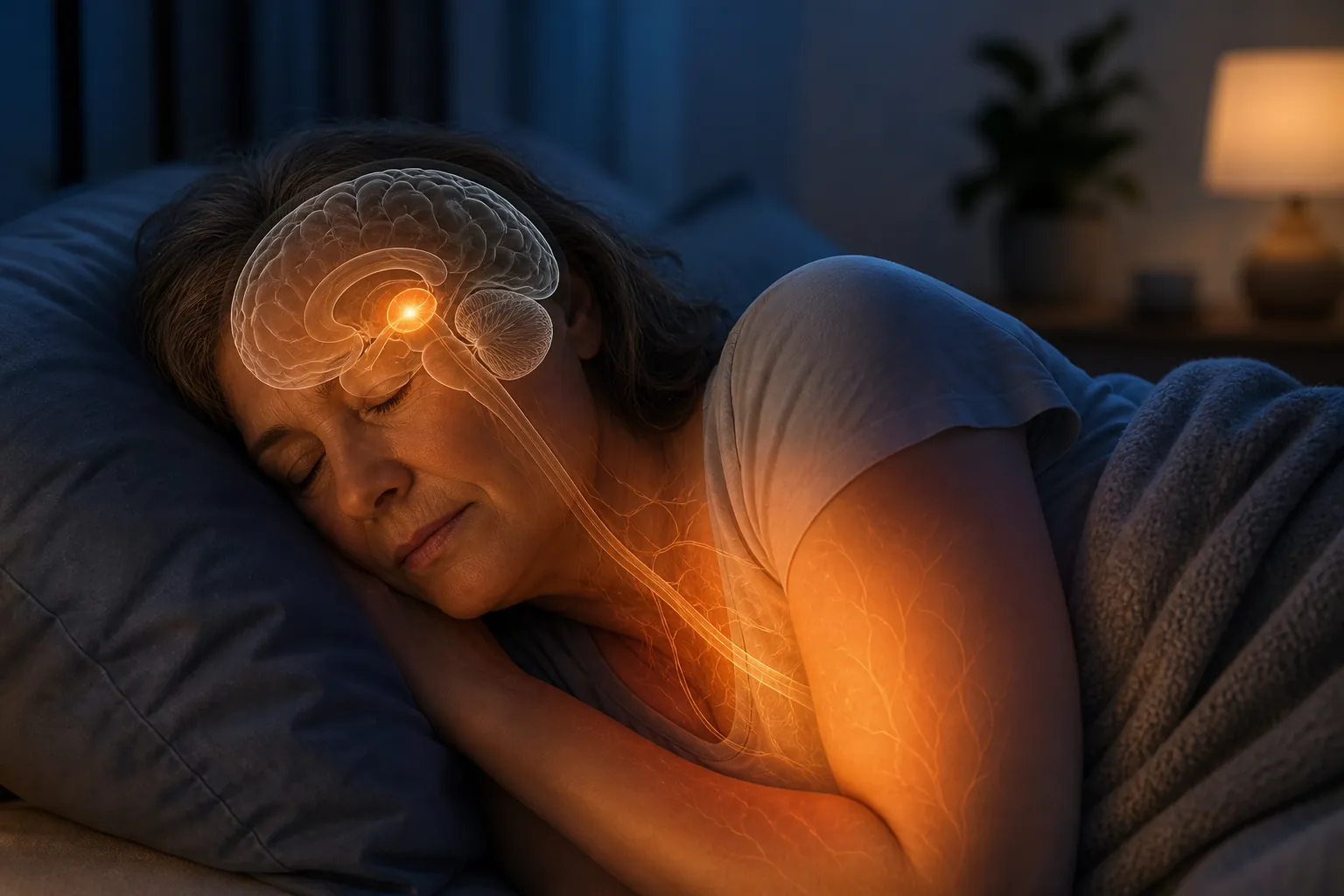
The Sleep Temperature Drop Is Supposed to Be Quiet
Before sleep, the body does not simply become passive. It redistributes heat. Blood vessels in the skin, especially in the hands and feet, help move warmth away from the core. The result is a lower core temperature and a body state that is more compatible with sleep.
When this system is working smoothly, you do not notice much. You may feel pleasantly drowsy, maybe a little cooler after lying still, and then sleep takes over. The process is active, but it is not dramatic.
Perimenopause can make that same system noisy. A small change in core temperature that used to stay inside the safe zone can now cross a threshold. Once that threshold is crossed, the body does not respond with a minor adjustment. It launches a heat-loss response: blood vessels widen, skin temperature rises, sweating begins, and sleep is interrupted.
The Brain Thermostat Has Less Room to Work
The key structure is the hypothalamus, the brain region that helps regulate body temperature. One useful way to understand its job is through the thermoneutral zone: the temperature range in which the body does not need to defend itself by shivering or sweating.
In a wider thermoneutral zone, small internal temperature movements are tolerated. The body can drift a little warmer or cooler without setting off alarms. During the menopause transition, estrogen withdrawal is thought to narrow that zone, so the threshold for heat-loss responses sits closer to ordinary nightly fluctuations.[1]
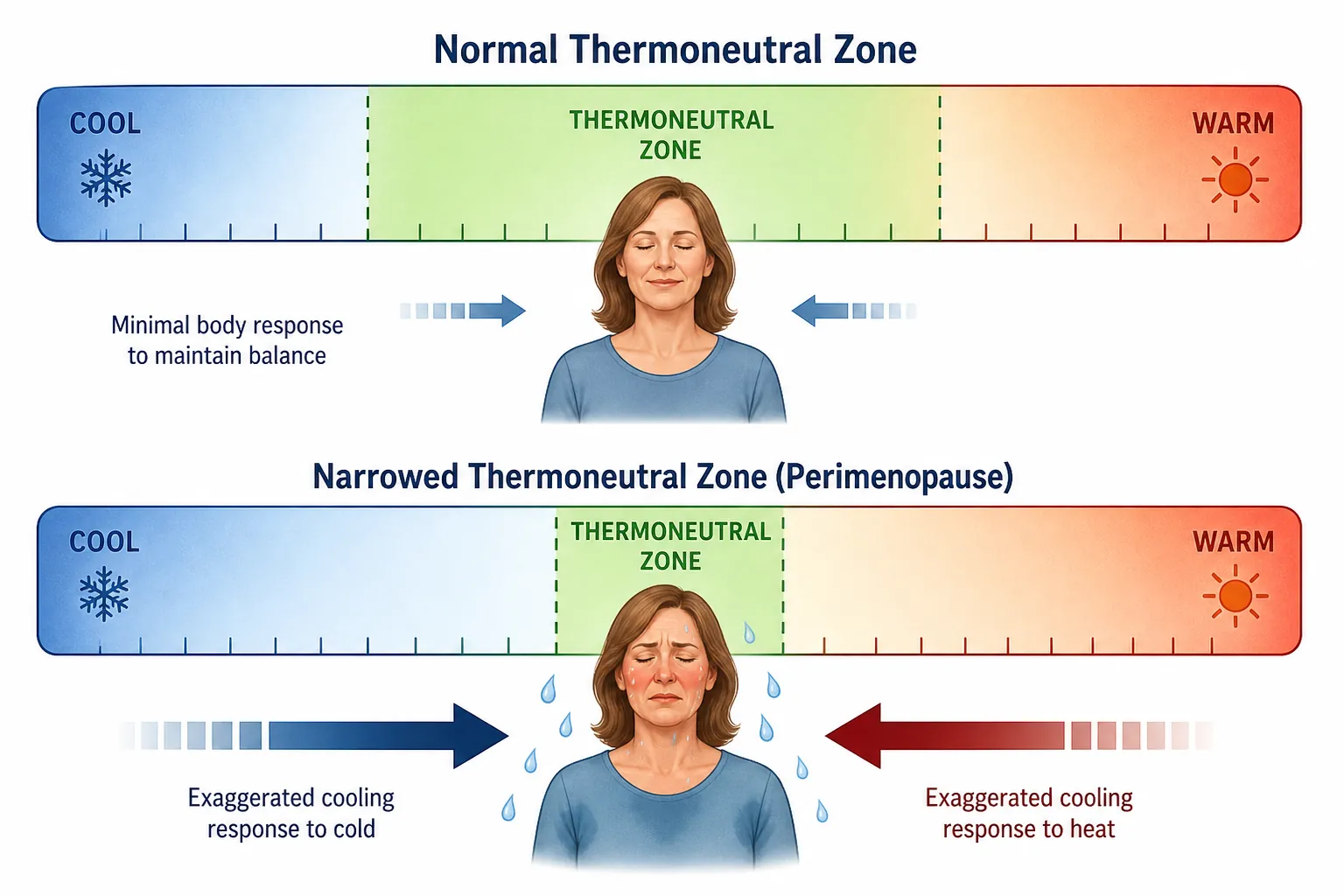
This is why “keep the room cool” can be both sensible and incomplete. A cooler room reduces the external heat load. It may make it easier for the body to lose heat. But it does not fully widen the brain’s narrowed tolerance zone. If the internal threshold has shifted, the trigger can still come from inside.
The sequence can be blunt: a small rise in core temperature reaches the narrowed upper boundary; the hypothalamus initiates heat loss; blood vessels dilate; sweating starts; the sleeper becomes aware of heat, damp bedding, or a racing, alert feeling; then wakefulness expands. The heat is real, but it is not the whole explanation. The reset threshold is doing much of the damage.
A Hot Flash Is Not Just a Memory of Bad Sleep
It is tempting to treat night sweats as subjective reports: a woman wakes, remembers feeling hot, and assumes the heat caused the awakening. Polysomnography makes the relationship harder to dismiss. In a laboratory study of midlife women, 69% of physiological hot flashes coincided with PSG-verified awakenings, and hot-flash-attributed wake time accounted for about 27% of total wake after sleep onset on average.[2]
That matters because wake after sleep onset is not a minor sleep metric. It is the time spent awake after initially falling asleep. When a substantial share of that wake time is tied to hot flashes, the problem is no longer just discomfort. It is sleep fragmentation with a measurable physiological companion.
The obvious pathway is easy to picture. Sweating soaks a shirt or pillowcase. Skin feels hot, then chilled. Bedding becomes irritating. The body is awake enough to notice the mess, and the mind has an opening to start working. A hot flash that lasts minutes can leave behind a much longer period of alertness.
The more nuanced possibility is that the brain event involved in a hot flash may disturb sleep before, or partly apart from, the conscious sensation of heat. de Zambotti and colleagues discuss evidence consistent with awakenings occurring close to the physiological hot-flash event, raising the possibility that central nervous system changes involved in initiating the flash may contribute to waking.[2] That does not prove every 3 a.m. awakening is secretly a hot flash. It does mean the felt heat may not be the only part capable of fragmenting sleep.
Why It Can Feel So Personal When It Is So Common
Vasomotor symptoms are common enough that a woman should not have to interpret them as a private failure of discipline. SWAN reports that up to 80% of women experience vasomotor symptoms during the menopause transition, and the median duration is 7.4 years.[3] Those numbers do not tell any one person how severe her nights will be, but they do remove the idea that she is unusually fragile because fans and cotton sheets did not solve the problem.
Prevalence also should not flatten the experience. A mild daytime hot flash and a 3 a.m. drenching episode are not equivalent just because both sit under the same symptom category. During sleep, the timing is part of the harm. The episode arrives when the brain is supposed to be maintaining stable sleep, and the aftermath can train the bed to feel unpredictable.
Cooling Helps the Load, Not Always the Trigger
A cool room still has a place. Heavy bedding, warm air, alcohol, late heat exposure, and trapped body heat can all make it harder for the body to complete its normal nighttime cooling. Removing those burdens is reasonable.
The mistake is treating the bedroom as the only therapeutic target. If estrogen withdrawal has narrowed the hypothalamic thermoneutral zone, then the body may launch a sweat response at a lower internal threshold than before. In that situation, colder air can reduce one source of pressure, but it cannot guarantee that the internal alarm will stay quiet.
That distinction changes the tone of the advice. The woman who wakes soaked in a cool room is not necessarily overheating her environment. She may be living with a thermostat that has become more reactive. The consequence is practical: if night sweats have started to create conditioned wakefulness, dread of bedtime, or long alert periods after the sweating ends, the next question is not simply which cooling product to buy. It is how to address the sleep fragmentation that has formed around the heat.
For that next layer, CBT-I strategies for perimenopause night sweats are a better fit than another list of fabric and fan adjustments. Treatment choices for vasomotor symptoms themselves belong in clinician-reviewed guidance, especially when symptoms are severe, new, or disruptive. But the mechanism is already useful: the heat matters, and the brain’s narrowed temperature tolerance matters more.
References
Explore the mechanism
Next step
Spot an error or have clinical feedback?
Because this article covers clinical, medication, or safety information, we use a moderated correction channel instead of open public comments. Let us know if something about “Why Your Body Overheats During Perimenopause Sleep” needs a closer look.
Send feedback on this article