
How to Sleep in Extreme Heat During Perimenopause
Learn why extreme heat waves hit harder during perimenopause—when hormonal changes narrow your body's temperature tolerance—and get a layered, evidence-based protocol for cooling your bedroom, calming your nervous system, and breaking the hot-flash-insomnia loop.
The cruel part of trying to sleep in extreme heat during perimenopause is that the heat is coming from both directions. Outside, the bedroom may be holding onto the day’s temperature, especially if humidity is high. Inside, the body’s temperature-control system is more easily tipped into a hot flash. By 3 a.m., the advice to “keep your room cool” can feel almost insulting, because the room is only one side of the problem.
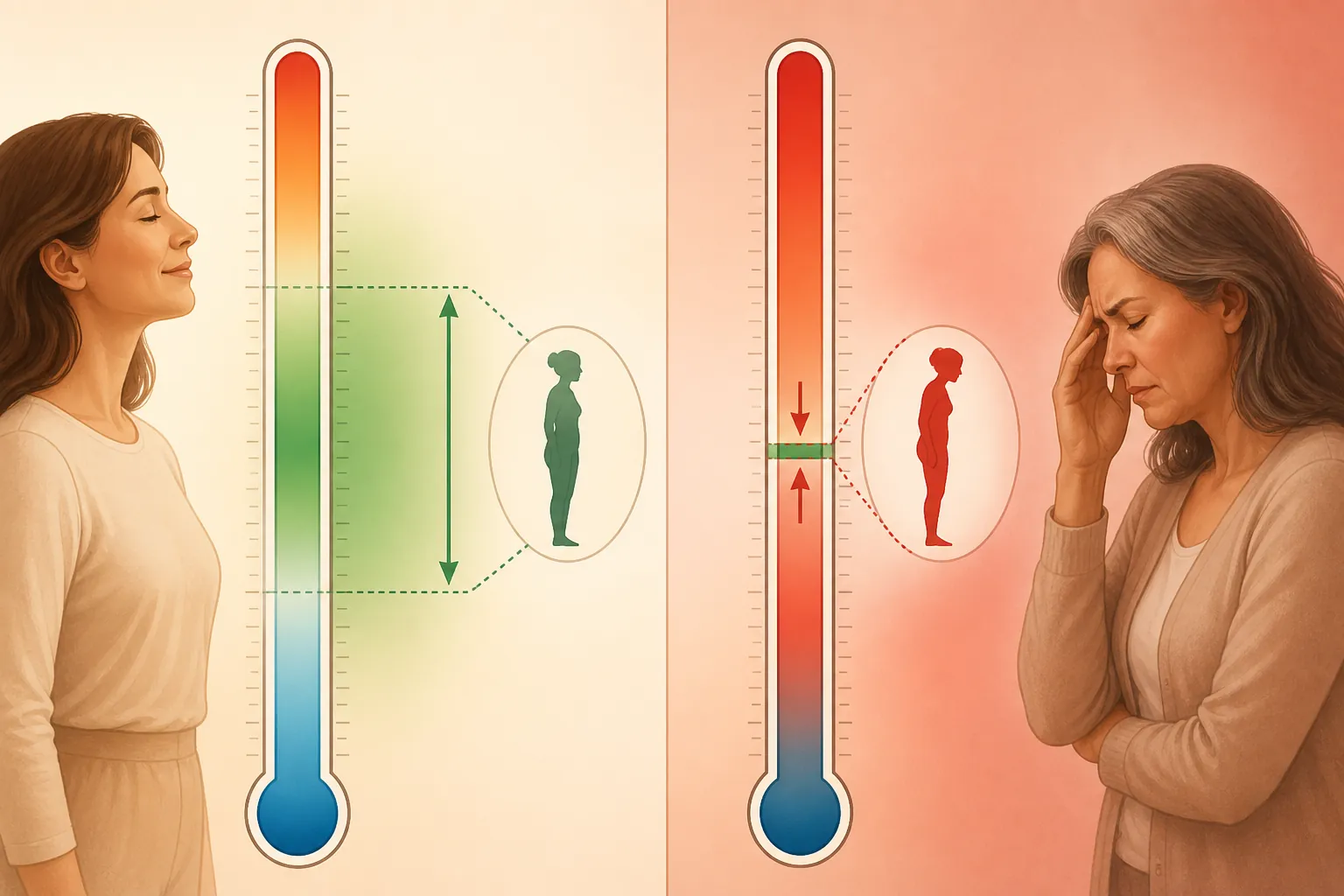
There is a physiological reason a small change now feels like a full alarm. In classic thermoregulation research, postmenopausal women with hot flashes had a thermoneutral zone narrowed from 0.4°C to 0.0°C, meaning there was essentially no buffer between “comfortable enough” and the sweating, flushing, heat-dissipation response.[1] The original measurement was in postmenopausal women, not a perimenopause-only sample, so it should not be overstated as a direct perimenopause trial. Still, the mechanism matters across the menopausal transition because fluctuating estrogen is part of what destabilizes the body’s heat-control system.
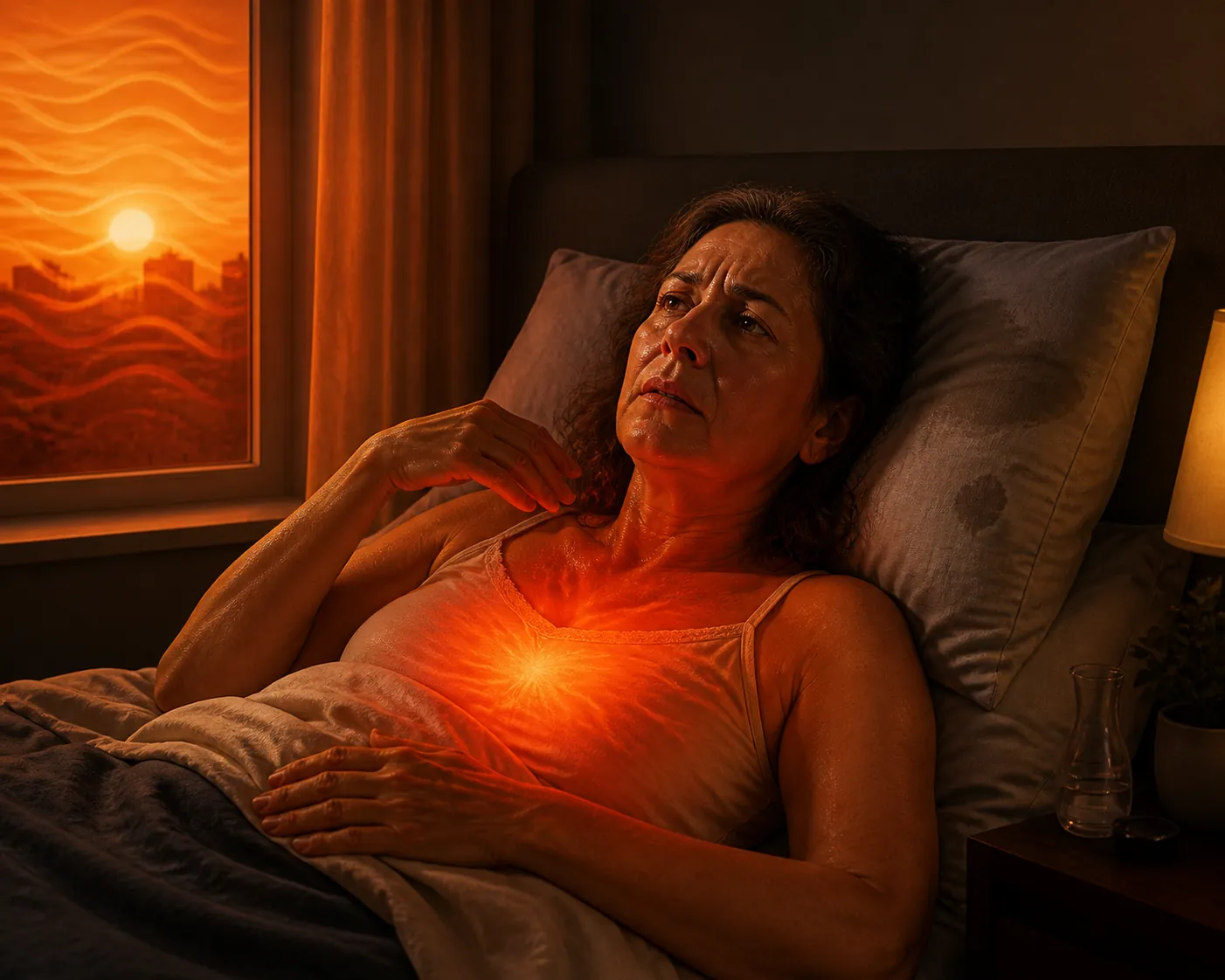
That is why a heat wave can make perimenopause sleep feel suddenly unmanageable. A warm room raises the starting load. A hot flash raises core temperature further. Sweat should cool the skin, but humid air slows evaporation, so heat stays trapped against the body instead of leaving it.[2] Then fragmented sleep makes the second half of the night more vulnerable: hot flashes have been observed to occur after REM-sleep awakenings, not only as the thing that wakes a person up.[3]
The evening deserves special attention. Hot flashes have shown a circadian peak around 18:25, so the pre-bed period is not just “wind-down time”; it is a high-risk window for heat buildup and autonomic activation.[4] If dinner, chores, alcohol, a hot shower, a warm bedroom, and damp air all stack into that window, the first part of the night may begin with the body already close to its trigger point.
For more on the physiology, this companion guide on why heatwaves wreck perimenopause sleep more than they used to stays with the mechanism. Here, the question is more immediate: how do you reduce enough load tonight that the loop does not keep feeding itself?
Start With The Room, But Do Not Stop There
The bedroom is still the first layer because it determines how much heat your body has to dump before it can sleep. But during perimenopause, “cooler” is too vague. The better target is a bedroom micro-climate that helps sweat evaporate, keeps heat from collecting around the torso, and gives you a way to cool one layer without chilling the whole bed.
| Tonight's layer | What to change | Why it matters |
|---|---|---|
| Air movement | Use a fan to move air across the bed or toward an open doorway/window when outdoor air is cooler. | Moving air helps sweat evaporate instead of sitting on the skin. |
| Humidity | If the room feels damp, prioritize dehumidification or air conditioning over simply adding more fan speed. | Humid air blocks evaporative cooling, which is the cooling mechanism you most need during a hot flash. |
| Bedding | Remove heat-trapping layers; keep a light cover available rather than sleeping under one heavy layer. | Hot flashes and post-flash chills often require fast adjustment. |
| Surface cooling | Use a cooling pad, cool pack wrapped in cloth, or cool pillow surface as a targeted tool. | Localized cooling can reduce the heat load without requiring the whole room to become cold. |
| Pre-bed timing | Move heat-producing chores, exercise, and hot showers earlier in the evening. | The evening is already a higher-risk window for hot flashes. |
Humidity is the detail many generic sleep lists underplay. A fan can feel good, but if the air is heavy with moisture, sweat does not evaporate efficiently. In that situation, dehumidifying or running air conditioning long enough to pull moisture from the room may matter more than chasing a lower number on the thermostat. Readers dealing with coastal or subtropical nights may want the more specific discussion in how Florida heat and humidity make night sweats worse.
Bedding is worth adjusting, but it should not be treated as the cure. A breathable sheet, a lighter blanket, and a pillowcase you can swap without fully waking all reduce friction in the middle of the night. A cooling mattress pad may help some people: in a small Wake Forest pilot randomized trial, a cooling mattress pad was associated with up to a 50% reduction in hot flash severity and a 30% improvement in sleep scores.[5] That is encouraging, not definitive. The study was small and manufacturer-funded, so the result belongs in the “reasonable tool” category, not the “buy this and the problem is solved” category.
If bedding is your main bottleneck, a more product-specific discussion is available in the IKEA mattress combo that helps perimenopause hot flashes. Just keep the hierarchy clear: bedding can lower external heat load. It cannot correct vasomotor instability by itself.
Use The Pre-Bed Window To Lower, Not Spike, Heat Load
A shower can help, but the temperature and timing matter. Stanford Lifestyle Medicine recommends a lukewarm shower about 90 minutes before bed because it dilates surface blood vessels and supports the body’s natural cooling process; a cold shower can be counterproductive if it provokes the body to conserve heat afterward.[6] The point is not to shock the system. It is to move heat outward before you are lying under covers with a nervous system already on alert.
The same logic applies to the last two hours of the evening. Heavy chores, late exercise, hot kitchens, alcohol, and very spicy meals are not morally bad sleep choices; they are heat-load choices. During a mild spring week, they may be irrelevant. During a humid heat wave in perimenopause, they can be enough to push a narrowed thermoneutral zone into repeated alarms.
A practical evening sequence looks like this: cool the room before bedtime rather than waiting until you are overheated; take a lukewarm shower early enough for the body to shed heat; set bedding in removable layers; keep a dry sleep shirt or pillowcase within reach; and decide before bed what you will do if you wake hot. The less decision-making required at 2 a.m., the less likely one awakening becomes a long insomnia episode.
For nights when the outdoor temperature is extreme, the companion piece on sleep tips for 108°F weather and menopause hot flashes goes further into room-by-room tactics. In this article, the key is to make those tactics serve the perimenopause problem: lower the external burden so the internal trigger is less likely to fire.
Add A Nervous-System Tool Before The Night Goes Sideways
Paced respiration is one of the few low-risk behavioral tools with a plausible role in hot flashes. In research summarized by Freedman, slow paced breathing at about six breaths per minute reduced objectively measured hot flash frequency by about 50% and had no reported side effects.[7] The caution is that much of this evidence comes from Freedman’s lab, with limited independent replication. That makes it worth trying, not worth overselling.
- Practice before you are already drenched; it is harder to learn the rhythm during a full hot flash.
- Aim for slow, comfortable breathing near six breaths per minute rather than forcing a dramatic inhale or exhale.
- Use it during the evening hot-flash window, at lights-out, and after a wake-up before reaching for your phone.
- Stop if it makes you dizzy, panicky, or air-hungry; the goal is downshifting, not endurance.
The value of paced breathing is partly mechanical and partly practical. It gives the body a non-heating response to the first surge of alertness. Instead of throwing off covers, checking the time, calculating tomorrow’s fatigue, and escalating the wake-up, you have one action that can be done in the dark.
When The Hot Flash Becomes An Insomnia Loop
Night sweats and insomnia can start to train each other. A hot flash wakes you. Then you anticipate the next one. Then the bed becomes a place where the body rehearses heat, vigilance, and frustration. Once that loop is established, cooling the room may still be necessary, but it may no longer be sufficient.
Cognitive behavioral therapy for insomnia has stronger evidence than most sleep-hygiene advice in this situation. In the MsFLASH trial published in JAMA Internal Medicine, CBT-I significantly reduced insomnia severity in perimenopausal and postmenopausal women with vasomotor symptoms, and benefits were maintained at six months.[8] That does not mean hot flashes are “all in your head.” It means insomnia has its own learned physiology once sleep becomes repeatedly disrupted.
This is also where mood deserves attention. Persistent sleep loss can narrow patience, deepen anxiety, and worsen low mood. If that is becoming part of the pattern, the issue is no longer just a sweaty pillowcase. The related guide on why insomnia and depression spike in perimenopause is a better next read than another list of cooling products.
The Medical Layer Is Not A Last Resort For Severe Nights
There is a point where continuing to improvise alone becomes the less sensible choice. If hot flashes and night sweats are frequent, drenching, or repeatedly breaking sleep despite environmental changes, that pattern deserves a clinician conversation. Heat-linked sleep loss is not automatically a mattress problem, and it is not a character flaw.
Hormone therapy is commonly described by menopause clinicians as the most effective treatment for vasomotor symptoms and related sleep disruption, in part because it raises the sweating threshold rather than merely cooling the surface after a hot flash has started.[9] Whether it is appropriate depends on personal risk factors, age, time since menopause, medical history, and preferences. That is exactly why it belongs in a medical conversation rather than a shopping-cart decision.
Non-hormonal options also exist. Fezolinetant, sold as Veozah, is a non-hormonal neurokinin 3 receptor antagonist approved by the FDA in 2023 for moderate to severe vasomotor symptoms; safety information was updated in 2024 with a boxed warning for rare but serious liver injury, so liver monitoring and prescribing judgment matter.[10] Low-dose paroxetine is another non-hormonal option used for vasomotor symptoms, though it also requires attention to side effects, drug interactions, and individual fit.[10]
A useful appointment note is simple: track room conditions if you can, bedtime timing, hot-flash frequency, night-sweat severity, awakenings, and next-day impairment for several nights. The clinician does not need a perfect spreadsheet. They need to see that this is a recurring vasomotor-sleep pattern, not an occasional bad night.

What To Try Tonight, And What To Stop Carrying Alone
The most honest plan is layered. Tonight, lower the bedroom’s heat and moisture load before you get into bed. Make air move across the sleeping surface. Remove heat-trapping bedding and keep dry replacements within reach. Take a lukewarm shower about 90 minutes before sleep rather than a cold one. Use paced breathing in the evening and after the first wake-up, before the night turns into a calculation of how little sleep is left.
Over the next few nights, track the pattern rather than judging yourself by one brutal night. Notice whether humidity is the main enemy, whether wake-ups cluster in the second half of the night, whether evening overheating predicts worse symptoms, and whether cooling plus breathing reduces intensity even if it does not eliminate every flash.
The phrase used by women in a 2026 Israeli qualitative study, “heat within, heat without,” captures the lived experience well, though the study’s 40 participants and specific context make it thematic evidence, not prevalence data.[11] It is still a useful description. Perimenopause plus extreme heat is not one problem. It is an internal thermostat firing too easily while the outside world makes heat harder to release.
If the pattern continues despite a serious environmental and behavioral reset, bring it to a clinician. The goal is not to guarantee a cool, uninterrupted night on command. It is to reduce the number and intensity of triggers until sleep can stabilize again—and to recognize when the vasomotor part of the loop needs treatment, not another desperate 3 a.m. experiment.
References
- Effects of estrogen on the thermoneutral zone in postmenopausal women with hot flashes, American Journal of Obstetrics & Gynecology, 1999
- Menopause and thermoregulation, PMC
- Experimental study of the effect of nocturnal hot flashes on sleep, Menopause, 2006
- Circadian rhythm of menopausal hot flashes, 1995
- A randomized controlled pilot study of a cooling mattress pad for sleep and hot flashes, Menopause, 2022
- Lukewarm shower timing and sleep, Stanford Lifestyle Medicine
- Menopause and thermoregulation, PMC
- Telephone-based cognitive behavioral therapy for insomnia in perimenopausal and postmenopausal women with vasomotor symptoms, JAMA Internal Medicine, 2016
- Hormone therapy for menopause symptoms, Yale Medicine
- Nonhormonal treatments for menopause symptoms, Cleveland Clinic
- Heat within, heat without, Journal of Women & Aging, 2026
Explore the mechanism
Next step
Spot an error or have clinical feedback?
Because this article covers clinical, medication, or safety information, we use a moderated correction channel instead of open public comments. Let us know if something about “How to Sleep in Extreme Heat During Perimenopause” needs a closer look.
Send feedback on this article