
Prevent Nighttime Blood Sugar Spikes for Better Sleep in Perimenopause
This article explains how hormonal shifts in perimenopause can cause blood sugar dips that trigger cortisol-driven night waking, and provides targeted dietary and lifestyle steps to stabilize glucose and improve sleep quality.
The 3 AM version is usually specific: you are suddenly awake, too alert for the hour, with your heart thudding as if something happened. Sometimes your neck or chest is clammy. Sometimes there is a hollow, urgent hunger that feels strange because dinner was normal, or even generous. You are not diabetic. You may not have eaten anything obviously dramatic. And still your body is acting as if an alarm has gone off.
In perimenopause, one possible alarm is a blood sugar dip after an earlier evening spike. That does not mean every night waking is “really blood sugar,” and it does not mean anxiety is imaginary. It means the racing heart may be the second event, not the first: the brain detects too little available fuel, releases stress hormones to protect you, and you wake into the adrenaline.

Sleep disruption is common in the menopause transition; one review reports that 39% to 47% of perimenopausal women experience sleep disruption, and a meta-analysis cited in the same paper estimated a global prevalence of 51.6%.[1] Those numbers explain why the complaint is familiar. They do not explain why your body keeps choosing the same early-morning hour.
The Blood Sugar Pathway Behind a 1–4 AM Wake-Up
The useful question is not simply whether glucose goes “high” at night. For many women, the more disruptive sequence is high, then low. A high-glycemic dinner, dessert, sweetened drink, or alcohol can push glucose up after the evening meal. The body releases insulin to move that glucose out of the bloodstream. If the response overshoots, glucose may fall later in the night. The brain is not relaxed about falling fuel availability, especially during sleep. It can call in cortisol and adrenaline, both of which are excellent at waking a person who would rather stay asleep.
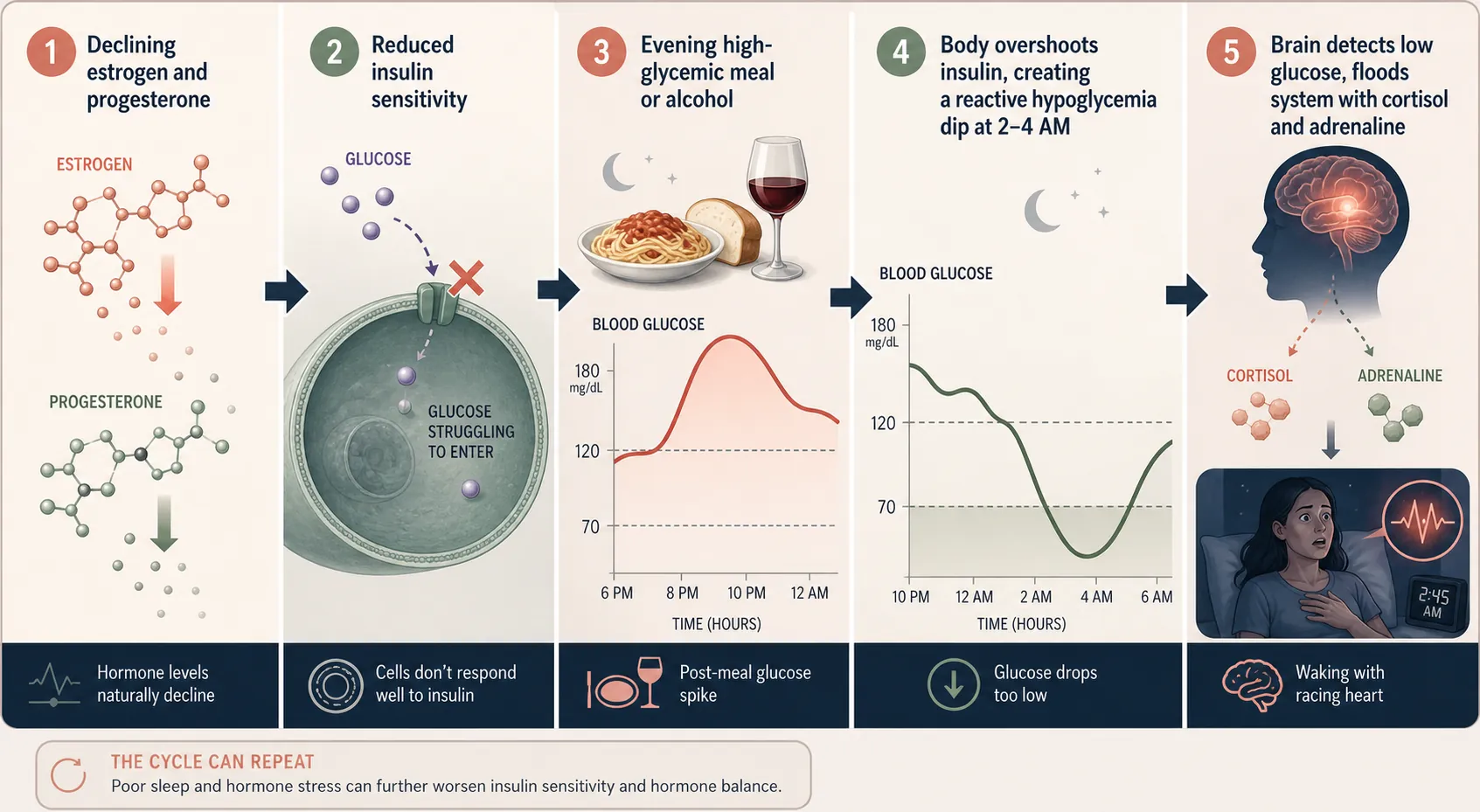
Perimenopause makes this sequence more plausible because estrogen and progesterone are not only reproductive hormones. They also interact with insulin sensitivity, body composition, appetite, and where the body stores glucose. In the ZOE PREDICT analysis published in eBioMedicine, postmenopausal women had significantly higher fasting glucose, HbA1c, and post-meal glucose responses than premenopausal women.[2] That is a stronger finding for postmenopause than for perimenopause; the perimenopausal subgroup in the study was small. Still, it gives a credible metabolic backbone to what many midlife women describe: foods or drinks that once felt harmless begin to produce a different overnight body.
This is not diabetes advice pasted onto midlife sleep. It is about reducing the evening glucose rise that can set up the later dip. The spike may not wake you. The correction may.
Diet-sleep evidence points in the same direction, though not perfectly. A Harvard Health discussion of a Women’s Health Initiative analysis reported that high-glycemic diets and added sugars were associated with insomnia risk among more than 50,000 postmenopausal women, while whole fruits and vegetables appeared protective.[3] That study does not prove that a 47-year-old in perimenopause wakes at 3 AM because of her dinner. It does support a cautious, reasonable experiment: change the evening glucose load before assuming the only answer is sedation.
How to Tell Whether Your Pattern Fits
A blood-sugar-driven waking pattern tends to have a recognizable cluster. The timing is often early morning rather than immediately after lights-out. The wake-up feels abrupt. The heart may pound. There may be shakiness, sweating, clamminess, or a need to eat. Some women describe it as “anxiety,” but the sensation begins in the body before the thoughts arrive.
| Clue | What it may suggest |
|---|---|
| Waking between roughly 1–4 AM with hunger, shakiness, or clamminess | Possible reactive glucose dip with stress-hormone arousal |
| Waking after pasta, white rice, dessert, sweet drinks, or a larger late dinner | Evening glucose spike may be part of the pattern |
| Waking after wine, cocktails, or late alcohol | Alcohol may be disrupting overnight glucose regulation and sleep architecture |
| Waking hot, flushed, and drenched without hunger | Vasomotor symptoms such as hot flashes may be more likely |
| Waking gasping, choking, with morning headaches or heavy snoring | Sleep apnea deserves evaluation |
The food log does not need to be elaborate. For one week, write down dinner time, alcohol, dessert or refined carbohydrates, bedtime, waking time, whether you felt hungry or sweaty, and whether eating helped. Add pulse if you track it easily. The pattern matters more than a single dramatic night.
Do not force the theory. If the wake-up is mainly heat flooding upward, soaked sheets, and a wave-like flush, read it as a possible hot flash pattern, not automatically a glucose problem. If the wake-up comes with dread after a bereavement, panic symptoms, medication changes, thyroid symptoms, or loud snoring, that deserves a different lane. Midlife bodies can have more than one alarm system.
The Evening Reset: Make the Spike Smaller
The first experiment is not a supplement cabinet. It is dinner. A steadier evening meal gives insulin less of a mountain to manage, which makes an overnight dip less likely.

Build Dinner Around Protein, Fiber, and Slower Carbohydrates
A more stable plate usually starts with protein, then adds high-fiber plants and a slower carbohydrate if you want one. That might mean fish, eggs, tofu, poultry, beans, lentils, Greek yogurt, or another protein source; vegetables that require chewing; and carbohydrates such as beans, lentils, quinoa, oats, barley, or a modest serving of intact whole grains rather than a large white-flour or sugary base.
Menopause nutrition reviews support this general direction: adequate protein, fiber-rich foods, and Mediterranean-style patterns are repeatedly discussed as useful for metabolic health during the menopause transition.[4] The point is not to make dinner joyless. It is to stop asking a plate of refined starch plus wine to carry you through the cortisol-sensitive hours before dawn.
Control the Refined Carbohydrate Load at Night
The most common dinner problem is not “carbs.” It is naked, fast carbohydrate late in the day: white pasta with little protein, cereal as dinner, sweetened yogurt, dessert after a low-protein meal, a big bowl of rice without enough fiber or fat, or toast and jam because you were too tired to cook. These meals can be easy to digest but hard on overnight stability.
- If you want pasta, add protein and vegetables and reduce the portion of refined pasta rather than eating it as the center of the meal.
- If you want rice, consider beans, lentils, vegetables, eggs, fish, tofu, or chicken alongside it.
- If you want dessert, notice whether dessert nights are the same nights you wake hungry or sweaty.
- If you eat very lightly at dinner, notice whether under-eating is also causing a 3 AM hunger alarm.
The goal is not the lowest possible glucose curve. Going to bed underfed can backfire. The better target is a dinner that digests gradually enough that your brain is not startled awake later.
Be More Strict With Alcohol Than You Think You Need to Be
Alcohol earns special attention because it can look like it helps sleep at 10 PM and then sabotage it at 3 AM. It may make sleep onset easier while worsening sleep quality later, and it can interfere with overnight glucose regulation. Practical medical guidance on preventing nighttime glucose spikes commonly includes limiting evening alcohol, pairing carbohydrates with protein and fiber, and avoiding large late meals.[5]
For a clean experiment, avoid alcohol for one to two weeks rather than merely switching from wine to a cocktail or moving the drink earlier. If the pounding-heart wake-ups ease, you have learned something useful. If they do not, you have still removed one noisy variable.
Use Timing as a Tool, Not a Rulebook
Many clinicians and dietitians suggest leaving a few hours between dinner and bed, often in the two-to-four-hour range, especially if reflux, large meals, or glucose swings are part of the picture. That timing window is a consensus-based habit, not a perimenopause-specific randomized trial result. It is still worth testing because it is simple and low-risk for most people.
The bedtime snack question is more individual. A small protein-and-fiber snack may help some women who wake with clear hunger after an early or light dinner. For others, late snacks keep digestion active and worsen sleep. Try one variable at a time: first stabilize dinner; then, if hunger persists, test a small snack such as plain Greek yogurt, nuts, nut butter on whole-grain toast, or hummus with vegetables. Treat the result as personal data, not a universal formula.
Strength Training Is the Longer Game
Dinner changes are the near-term lever. Muscle is the longer-term capacity builder. Skeletal muscle is a major site for glucose storage, and improving muscle mass and insulin sensitivity gives the body more room to handle carbohydrates without such sharp peaks and corrections.
This is not a promise that lifting weights tonight will prevent tonight’s 3 AM wake-up. It is a reason to stop treating strength training as only a body-composition project. In perimenopause, two to three weekly sessions of progressive resistance work, scaled to your joints and current fitness, can be part of the sleep plan because it changes the metabolic background in which sleep is happening.
When a CGM Can Be Useful
A continuous glucose monitor is not required for most women to begin. A paper log can reveal plenty. But if the pattern is stubborn, confusing, or you want to see whether the 3 AM wake-up follows a rise-and-fall glucose curve, a short CGM trial can make the invisible visible. Patient-facing menopause guidance on CGM frames it as a way to observe individual food, sleep, and hormonal patterns rather than as a diagnosis by itself.[6]
Use the device, if you use one, to answer narrow questions: What happens after wine? What happens after pasta plus protein versus pasta alone? Is the wake-up preceded by a glucose drop, or is glucose steady while heat, snoring, or panic is doing the waking? Numbers without a question can become another source of 3 AM worry.
Do Not Miss the Other 3 AM Culprits
Hot flashes can wake a woman with a racing heart too. The distinguishing feature is often the heat wave: sudden warmth spreading through the chest, neck, or face, flushing, and sweating that feels thermal more than hungry. Blood-sugar waking more often carries hollow hunger, shakiness, clamminess, or a wired feeling that improves after eating. The overlap is real, which is why a log should include heat and hunger separately.
Sleep apnea deserves more attention in midlife women than it often gets. It does not always present as the stereotype of loud snoring in an older man. Waking with gasping, choking, dry mouth, morning headaches, unrefreshing sleep, or a partner’s report of breathing pauses should move the conversation toward screening.
Thyroid disease, medication effects, panic disorder, grief, trauma, arrhythmias, reflux, and night sweats from other medical causes can also sit behind early-morning waking. Seek medical care promptly for chest pain, fainting, severe shortness of breath, unexplained weight loss, persistent drenching night sweats, new irregular heartbeat, or symptoms that are escalating rather than settling.
Women with diabetes, a history of hypoglycemia, eating disorders, pregnancy, adrenal or endocrine disorders, or glucose-lowering medications should not experiment aggressively with fasting, carbohydrate restriction, or bedtime snacks without clinician guidance. For context, a 2025 survey of women with type 1 diabetes found that 67.4% perceived glucose regulation changes after menopause, but that population is not the same as non-diabetic perimenopausal women.[7]
A One-Week Test That Is Specific Enough to Mean Something
If your pattern includes 1–4 AM waking with a pounding heart, hunger, shakiness, or clamminess, especially after refined carbohydrates or alcohol, try a focused week before adding another sleep product.
- Keep dinner consistent for seven nights: protein, fiber-rich plants, and a slower carbohydrate if desired.
- Remove alcohol for the week so you can actually read the pattern.
- Avoid making refined starch or dessert the main evening glucose load.
- Leave a few hours between dinner and bed when possible, without going to bed hungry.
- Record waking time, hunger, sweat or heat, pulse if available, and whether eating changes the symptoms.
If the wake-ups become less frequent or less dramatic, you have a useful metabolic lead. If nothing changes, that is useful too; it argues for looking harder at hot flashes, apnea, anxiety physiology, thyroid status, medications, or another medical driver.
For the woman waking at 3 AM with a racing heart, hunger, or clamminess after high-GI dinners or alcohol, stabilizing evening glucose is a more targeted first experiment than reaching immediately for sedatives or another generic sleep hygiene list. It is not the whole sleep story of perimenopause. It is one body-based explanation worth testing carefully.
References
- Sleep Disturbances During the Menopausal Transition, Nature and Science of Sleep, 2018
- Menopause is associated with postprandial metabolism, metabolic health and lifestyle: The ZOE PREDICT study, eBioMedicine, 2022
- Menopause and insomnia: Could a low-GI diet help?, Harvard Health Publishing, 2020
- Nutrition in Menopausal Women: A Narrative Review, Nutrients, 2023
- Habits That Help Prevent Blood Sugar Spikes at Night, Verywell Health, 2025
- How Continuous Glucose Monitoring Can Help During Menopause, Levels
- The Impact of Menopause on Glucose Regulation in Women with Type 1 Diabetes: A Dutch Survey Study, Diabetologia, 2025
Explore the mechanism
Next step
Spot an error or have clinical feedback?
Because this article covers clinical, medication, or safety information, we use a moderated correction channel instead of open public comments. Let us know if something about “Prevent Nighttime Blood Sugar Spikes for Better Sleep in Perimenopause” needs a closer look.
Send feedback on this article