
How to Eat for Better Sleep and Sharper Memory in Perimenopause
Discover a unified dietary approach to address both sleep disruption and brain fog during perimenopause. This article explains how the same nutrients—tryptophan, B vitamins, magnesium, omega‑3s, and low‑glycemic carbohydrates—can support verbal memory and sleep quality simultaneously.
The frustrating part of perimenopause is how often the symptoms arrive as a pair. You wake at 3 a.m., spend the next day reaching for ordinary words, then wonder whether you now need one plan for sleep and a separate one for memory. The better question is narrower and more useful: which dietary changes to improve sleep and memory in perimenopause make sense because the two problems already overlap?
That overlap is not just a convenient wellness story. A systematic review on sleep and brain function at menopause found that verbal learning and verbal memory are among the cognitive functions most negatively affected during perimenopause, and that sleep disruption is independently associated with those deficits.[1] A separate review of cognitive problems in perimenopause describes evidence that depression, sleep problems, and vasomotor symptoms are each independently associated with cognitive difficulties, rather than one symptom simply explaining all the others.[2]
That matters because many women do not describe this as abstract “cognitive change.” They describe losing the thread mid-sentence, reading the same paragraph twice, forgetting a familiar name, or feeling less verbally quick at work. The RICAM longitudinal cohort data, discussed in the menopause sleep-and-brain review, identified a profile in which perimenopausal women with greater sleep disturbance showed weaknesses in verbal learning and memory.[1] In other words, the next-day word-finding problem is worth taking seriously, especially when it follows broken sleep.
The sleep side is common enough that it deserves validation without drama. A 2025 meta-analysis reported that 72.2% of perimenopausal women had sleep disorders, and hot flashes were significantly associated with sleep disorders, with an odds ratio of 2.70.[3] The Study of Women’s Health Across the Nation has also tracked how sleep problems during the menopausal transition affect daytime functioning and health-related quality of life.[4]
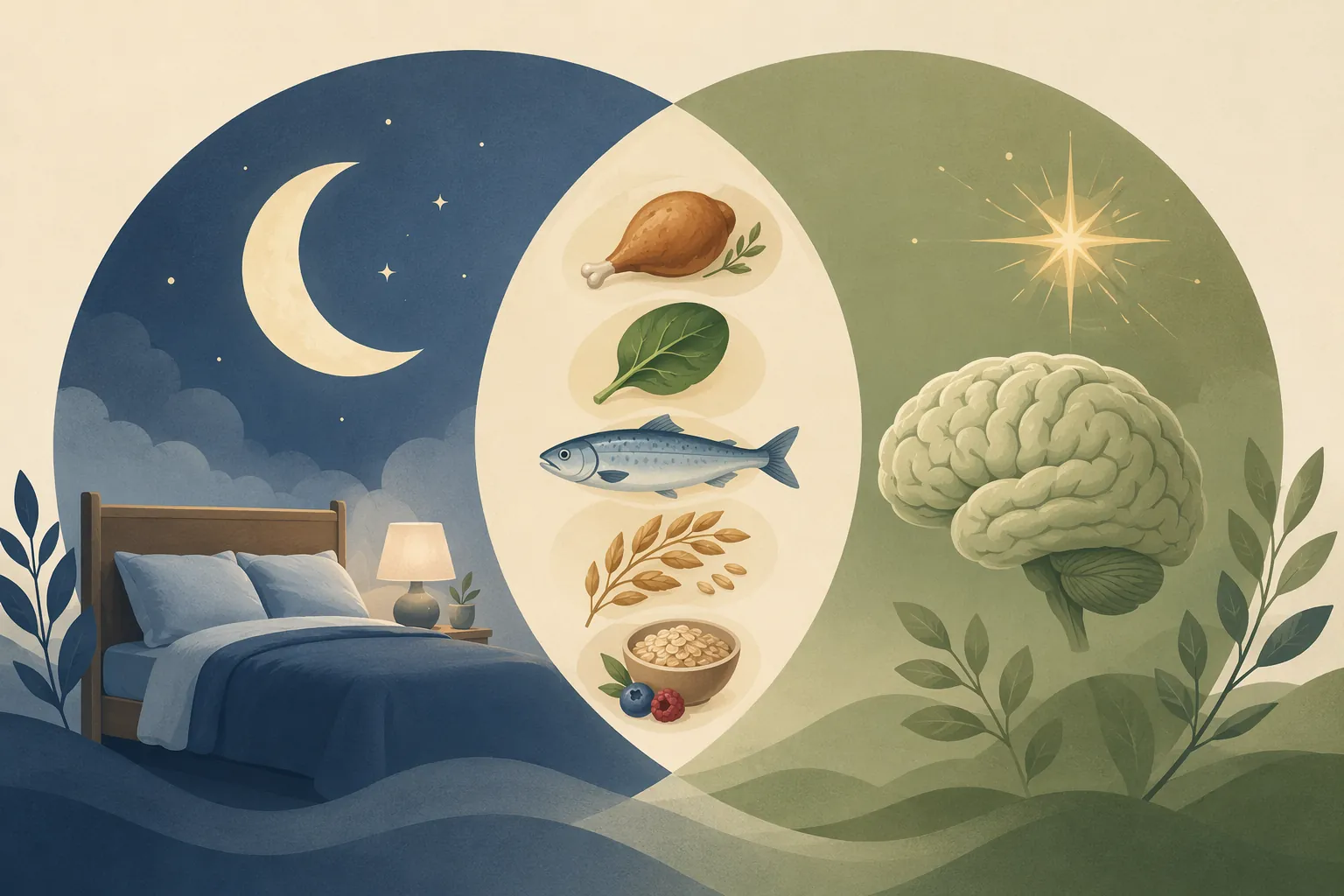
The shared target: steadier nights, steadier brain function
No large randomized trial has tested one perimenopause diet and proven that it improves both insomnia and memory. The evidence is more modest: observational studies, systematic reviews, and nutrition research that point toward overlapping mechanisms. That is still useful if the goal is not a cure, but a repeatable eating pattern that reduces avoidable strain on sleep and cognition.
The most relevant overlap sits in a few dietary areas: tryptophan and melatonin-rich foods, B vitamins, magnesium, zinc, omega-3 fatty acids, and lower-glycemic carbohydrates. A menopause and perimenopause nutrition review discusses omega-3s, B vitamins, magnesium, and phytoestrogens as nutrients of interest during this life stage.[5] The practical value is not that each nutrient becomes a separate project. It is that a meal pattern can bring several of them together at the same time.
| Food pattern to emphasize | What it is trying to support |
|---|---|
| Protein foods that provide tryptophan, such as eggs, dairy, poultry, fish, beans, lentils, tofu, nuts, and seeds | Sleep-related neurotransmitter pathways and steady evening satiety |
| Melatonin-containing or sleep-supportive plant foods, such as tart cherries, nuts, and some grains | Sleep timing support, without treating food as a sedative |
| Magnesium- and zinc-containing foods, such as pumpkin seeds, nuts, legumes, whole grains, seafood, and leafy greens | Nervous-system regulation and nutrient adequacy |
| B-vitamin-rich foods, such as fish, eggs, dairy, legumes, leafy greens, and fortified foods | Energy metabolism and cognitive function, including nutrients relevant to brain health |
| Omega-3-rich foods, especially fatty fish, plus plant sources such as walnuts, chia, and flax | Brain and cardiometabolic support during the menopause transition |
| Low-glycemic carbohydrates, such as oats, barley, beans, lentils, intact whole grains, berries, and vegetables | More stable overnight glucose patterns and lower insomnia risk associations |
Start with carbohydrates, because “cut carbs” is the wrong shortcut
The carbohydrate question is where many sleep-and-diet articles become too blunt. Perimenopausal sleep does not call for a generic war on carbohydrates. The more precise issue is glycemic impact: how quickly a carbohydrate-heavy food raises blood glucose, and what happens afterward.
Harvard Health summarized findings from a Women’s Health Initiative study of more than 50,000 postmenopausal women, reporting that a lower-glycemic-index diet was associated with a lower risk of developing insomnia.[6] That does not prove that switching to low-GI foods will resolve insomnia in perimenopause. The study population was postmenopausal, and the finding is an association. Still, it is one of the more practical clues available because it points toward a food pattern you can build without turning dinner into a supplement schedule.
A low-glycemic pattern usually means keeping carbohydrates, but changing their form and company. Oats with nuts and berries behaves differently from a sweet pastry eaten alone. Beans, lentils, barley, intact whole grains, vegetables, and fruit tend to bring fiber, minerals, and slower digestion. When they are paired with protein and fat, they are less likely to create the sharp rise-and-fall pattern that can be unhelpful overnight.
For the tired reader, the simplest version is this: include a modest, fiber-rich carbohydrate at dinner, but avoid making refined starch or sweets the center of the evening meal. A bowl with salmon, lentils, greens, olive oil, and roasted vegetables is a different sleep bet than grazing on crackers and chocolate because dinner felt like too much work.
Build meals around sleep onset, night waking, and verbal memory
Tryptophan often gets reduced to a turkey-at-Thanksgiving cliché, but its more useful role is as one piece of the serotonin and melatonin pathway. In real meals, that means including enough protein across the day rather than hoping one bedtime snack will overpower hot flashes, stress, alcohol, or an irregular schedule.
Breakfast is a good place to begin because it sets the day’s protein and glucose pattern. Eggs with whole-grain toast and berries, Greek yogurt with oats and walnuts, or tofu with vegetables and brown rice all bring protein plus slower carbohydrates. That combination is not glamorous, but it helps avoid the under-fueled morning that becomes a high-sugar afternoon and a restless night.

Magnesium and zinc belong in the same conversation because they are less about a dramatic bedtime effect and more about nervous-system adequacy. Pumpkin seeds, nuts, legumes, seafood, leafy greens, and whole grains can quietly raise the nutrient density of meals that already support sleep. This is where the unified approach becomes less work: the same lentil bowl that contributes low-glycemic carbohydrates also contributes magnesium; the same fish dinner that provides protein can provide omega-3s and B vitamins.
B vitamins deserve particular attention for women who have reduced animal foods, have absorption issues, or eat erratically during stressful weeks. Folate, B6, and B12 are commonly discussed in relation to brain health, and the menopause nutrition review includes B vitamins among nutrients relevant to this stage.[5] Food-first sources include fish, eggs, dairy, legumes, leafy greens, and fortified foods. If B12 status is uncertain, especially with a vegan or near-vegan diet, that is a lab-and-clinician question rather than a guessing game.
Omega-3s are another case where the useful advice is simpler than the marketing. Fatty fish such as salmon, sardines, trout, and mackerel bring long-chain omega-3s along with protein and other nutrients. Walnuts, chia, and flax can help round out the pattern, though they are not identical to fish sources. The point is not to promise sharper recall after one salmon dinner; it is to make brain-supportive fats part of the default weekly menu.
A practical day of eating for both complaints
A dual-benefit diet works best when it is boring enough to repeat. The goal is to make the sleep-supporting and memory-supporting choices show up in ordinary meals, not to add a complicated ritual to a life stage that may already feel crowded.
| Meal | What to build | Why it fits the sleep-memory overlap |
|---|---|---|
| Breakfast | Eggs, avocado, berries, and whole-grain toast; or Greek yogurt with oats, walnuts, and berries | Combines protein, B vitamins, slower carbohydrates, and brain-supportive fats |
| Lunch | Lentil soup with greens and olive oil; or a bean-and-vegetable bowl with fish, tofu, or poultry | Adds low-glycemic carbohydrates, magnesium, folate, and steady energy |
| Snack | Pumpkin seeds and fruit; yogurt; nuts; or hummus with vegetables | Prevents the late-day crash that can lead to high-sugar grazing |
| Dinner | Salmon or tofu with barley, lentils, or roasted sweet potato plus greens | Pairs protein with fiber-rich carbohydrates and minerals for overnight stability |
| Evening option | Tart cherries, warm milk, or a small yogurt-and-berry bowl if genuinely hungry | Supports a sleep-oriented routine without turning snacking into a cure |
The evening option is intentionally small. A bedtime snack can help some people who wake hungry or who ate too little at dinner, but it can backfire if it becomes a large, sugary second dinner. If night sweats are the main reason you wake, food may only be one part of the picture.
The grocery pattern
- Choose two protein anchors for the week: eggs, Greek yogurt, fish, poultry, tofu, tempeh, beans, or lentils.
- Choose two low-glycemic carbohydrates: oats, barley, beans, lentils, intact whole grains, berries, or vegetables.
- Add one omega-3 plan: fatty fish if you eat it, or walnuts, chia, and flax as plant-based supports.
- Keep magnesium-rich add-ons visible: pumpkin seeds, nuts, legumes, leafy greens, and whole grains.
- Make the easy meal the supportive meal: soup, yogurt bowls, egg plates, bean bowls, and leftovers count.
What to limit, without making food the enemy
The foods most likely to interfere with this plan are not surprising, but the reason matters. Large evening portions of refined carbohydrates, sweets, and alcohol can worsen the very patterns this approach is trying to steady: overnight waking, temperature discomfort, and next-day fogginess. Caffeine timing also matters; a morning coffee is not the same as an afternoon rescue coffee after a poor night.
This does not require a brittle rule that no dessert or wine can ever appear. It does require noticing whether certain choices reliably show up before a bad night. In perimenopause, the margin for disrupted sleep can become smaller. A food or drink that seemed harmless at 35 may be more disruptive at 48, especially when hot flashes, stress, and cycle changes are already pressing on sleep.
What this diet can and cannot promise
A nutrient-dense, low-glycemic, protein-adequate diet can support sleep quality and verbal memory during perimenopause. It may reduce avoidable glucose swings, improve nutrient adequacy, and make it easier to maintain the daily rhythms that sleep and cognition depend on. It should not be sold as a proven treatment protocol for perimenopausal insomnia or cognitive change.
The evidence base has limits. Several studies combine perimenopausal and postmenopausal women, which means findings may not apply equally across the whole menopause transition. Much of the diet-and-sleep evidence is observational. The cognitive literature supports a relationship among sleep disruption, vasomotor symptoms, mood, and cognitive difficulties, but it does not prove that a specific menu will restore verbal memory.[1][2][6]
There is also a medical boundary. The North American Menopause Society does not recommend hormone therapy for cognitive complaints at any age during the menopause transition.[7] At the same time, diet should not be used as a substitute for care when insomnia is persistent, hot flashes are moderate to severe, mood symptoms are significant, or cognitive changes are substantial enough to affect work, safety, finances, or daily functioning.
For mild to moderate sleep disruption and word-finding fog, a dual-benefit diet is a sensible foundation: steady carbohydrates, enough protein, omega-3-rich foods, B vitamins, magnesium, zinc, and a calmer evening pattern. If the symptoms keep escalating despite that foundation, the next step is not more self-experimentation with food. It is a clinician who can look at sleep disorders, vasomotor symptoms, mood, medications, thyroid status, iron or B12 issues, and other causes that deserve a proper evaluation.
References
- Sleep and Brain Function at Menopause, PMC.
- Cognitive Problems in Perimenopause: A Review of Recent Evidence, PMC.
- Factors influencing sleep disorders in perimenopausal women: a meta-analysis, Frontiers in Neurology, 2025.
- Effects of Sleep Problems, Study of Women’s Health Across the Nation.
- The Importance of Nutrition in Menopause and Perimenopause—A Review, PMC.
- Menopause and insomnia: Could a low-GI diet help?, Harvard Health Publishing, January 17, 2020.
- The 2022 hormone therapy position statement of The North American Menopause Society, The North American Menopause Society, 2022.
Explore the mechanism
Next step
Spot an error or have clinical feedback?
Because this article covers clinical, medication, or safety information, we use a moderated correction channel instead of open public comments. Let us know if something about “How to Eat for Better Sleep and Sharper Memory in Perimenopause” needs a closer look.
Send feedback on this article