
What to eat for better sleep and memory in menopause
This guide explains how a single set of nutrient-dense food choices focused on magnesium, omega-3s, B vitamins, and tryptophan can address both sleep disruption and brain fog during menopause by supporting the neurochemical pathways affected by estrogen decline.
If your sleep has started breaking apart at the same time your memory feels less reliable, you do not need two separate diets. The more useful answer to what to eat for better sleep and memory in menopause is a single food pattern that supports the same neurochemical systems being strained by hormonal change: magnesium-rich foods, omega-3 sources, B-vitamin foods, and tryptophan-containing foods paired with steady carbohydrates.
That matters because the symptoms often arrive together. Sleep disturbances affect 40–60% of menopausal women, insomnia prevalence is reported as 56% higher than before menopause, and hot flashes affect about 75% of menopausal women, often becoming the thing that turns a normal night into a 2 or 3 a.m. negotiation with the ceiling [1]. For more on the hot-flash side of that pattern, see this guide to hot-flash-related insomnia in perimenopause.

Why Sleep And Memory Can Falter Together
Menopause does not create a tidy border between “sleep problems” and “brain fog.” Estrogen interacts with serotonin, melatonin, and GABA, which are involved in mood, sleep timing, sleep depth, and cognitive function. When estrogen declines, the body is not simply missing one hormone; it is adjusting across systems that help you cool down, fall asleep, stay asleep, concentrate, and retrieve words.
That is why a food strategy built around these pathways makes more sense than one list for sleep and another for memory. Magnesium is relevant because it supports GABA-related calming activity. Omega-3 fats, especially DHA, are relevant because they support serotonin signaling and neuronal membrane structure. B vitamins help with the conversion chain from tryptophan to serotonin to melatonin. Tryptophan matters because it is the starting material for that chain, although food-level tryptophan is not a sedative in disguise.
This is a pathway argument, not a promise that dinner will override vasomotor symptoms, chronic stress, grief, medication effects, sleep apnea, or years of short sleep. If your insomnia has several contributors, nutrition is one layer. This is also where context matters: overlapping causes of insomnia in perimenopause can make food changes helpful but incomplete.
The Plate Pattern That Covers Both Systems
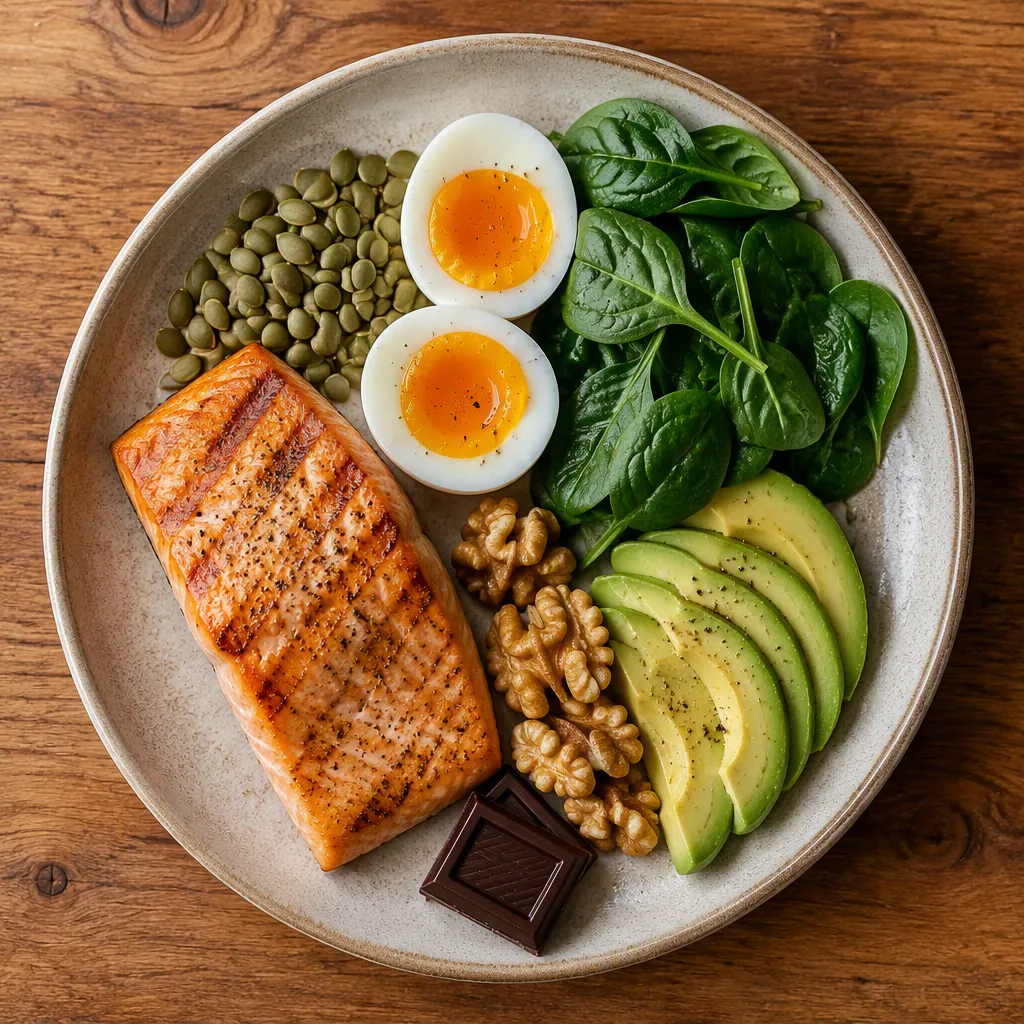
The practical pattern is not exotic: fatty fish or another omega-3 source; leafy greens, legumes, eggs, or whole grains for B vitamins; pumpkin seeds, spinach, almonds, avocado, or dark chocolate for magnesium; and a moderate, steady carbohydrate source to help make tryptophan more usable. The point is the combination.
| Nutrient focus | Main pathway | Food sources | Why it belongs in a sleep-and-memory plate |
|---|---|---|---|
| Magnesium | GABA-A receptor activity | Spinach, pumpkin seeds, almonds, avocado, dark chocolate | Supports inhibitory signaling involved in sleep regulation; RCT evidence cited in a narrative review links magnesium with better sleep efficiency and total sleep time in people with insomnia [2]. |
| Omega-3 fatty acids, especially DHA | Serotonin receptor signaling and neuronal membrane support | Salmon, sardines, mackerel, walnuts, flaxseed | DHA has a plausible dual role: sleep signaling support and structural support for brain regions involved in memory; RCT evidence has linked higher omega-3 intake with longer sleep duration and fewer nocturnal awakenings [2]. |
| B6, folate, and B12 | Tryptophan to serotonin to melatonin conversion; homocysteine metabolism | Eggs, leafy greens, legumes, whole grains | These vitamins help the conversion pathway and are discussed in menopause nutrition literature for cognitive support, including through homocysteine reduction [3]. |
| Tryptophan | Serotonin and melatonin precursor | Pumpkin seeds, turkey, dairy, soy, eggs | Useful when part of a meal pattern, especially with a sensible carbohydrate pairing that supports transport across the blood-brain barrier [2]. |
Magnesium Deserves More Than A Footnote
Among single nutrients in the available material, magnesium has the clearest sleep signal. A narrative review reports that magnesium enhances GABA-A receptor activity, and cites randomized controlled trial evidence in which magnesium improved sleep efficiency and total sleep time in people with insomnia [2]. That does not mean magnesium foods are a menopause insomnia treatment. It does mean spinach, pumpkin seeds, almonds, avocado, and even a small square of dark chocolate have a better rationale than the usual vague “relaxing foods” language.
The menopause-specific leap should stay modest. The trial evidence is about insomnia, not a combined intervention for menopausal sleep disruption and memory complaints. Still, if a woman is already dealing with lighter sleep, more awakenings, and daytime concentration problems, it is reasonable to make magnesium-rich foods a routine part of dinner or an evening snack rather than treat them as an occasional wellness garnish.
DHA Is Where The Sleep And Brain Argument Tightens
Omega-3 advice often gets flattened into “eat salmon for your brain,” which is true enough to be boring and too broad to be useful. The sharper point is that DHA is involved in serotonin receptor signaling, while also serving as a structural component of neuronal membranes and supporting hippocampal plasticity relevant to memory [2]. In the sleep literature summarized in the same narrative review, randomized trials have linked higher omega-3 intake with longer sleep duration and fewer nocturnal awakenings [2].
That makes fatty fish one of the more efficient choices on the plate. Salmon, sardines, and mackerel bring DHA and EPA directly. Walnuts and flaxseed can still belong in the pattern, but they should not be presented as identical to fish; they are plant omega-3 sources, and the clinical sleep-and-DHA discussion is strongest around DHA itself.
B Vitamins And Tryptophan Work Best As A Team
B6, folate, and B12 are not bedtime ingredients in the dramatic sense. Their value is quieter: they help the conversion of tryptophan into serotonin and then melatonin, and menopause nutrition literature also discusses adequate B-vitamin intake in relation to cognitive support through homocysteine reduction [3]. Eggs, leafy greens, legumes, and whole grains are the ordinary foods that make this pathway less theoretical.
Tryptophan needs the same restraint. Turkey, dairy, soy, eggs, and pumpkin seeds contain it, but the amount in food is modest compared with supplement doses. The more useful habit is pairing tryptophan-containing foods with a sensible carbohydrate, because carbohydrate co-consumption can facilitate tryptophan transport across the blood-brain barrier [2]. In practice, that can mean eggs with whole-grain toast, Greek yogurt with oats, tofu with brown rice, or pumpkin seeds over a small bowl of oatmeal.
How To Combine These Foods Without Making A Second Job
The easiest way to build meals is to stop assigning one ingredient one job. A salmon dinner can cover omega-3s, magnesium if it includes spinach or pumpkin seeds, B vitamins if it includes leafy greens or whole grains, and tryptophan support if paired with a steady carbohydrate. The meal is not “for sleep” or “for memory.” It is for the shared machinery underneath both.
- Dinner option: salmon with spinach, roasted sweet potato, avocado, and pumpkin seeds.
- Egg-based option: soft-boiled eggs over whole-grain toast with sautéed greens and a side of avocado.
- Plant-forward option: tofu or soy foods with brown rice, leafy greens, walnuts, and pumpkin seeds.
- Evening snack option: plain yogurt or milk with oats, or oatmeal topped with pumpkin seeds.
- Simple add-on: a small portion of dark chocolate earlier in the evening, not as a late caffeine-adjacent habit if you are sensitive.
The carbohydrate piece is often where advice gets needlessly moral. A carbohydrate pairing is not an invitation to a high-sugar bedtime routine. It is a way to make tryptophan chemistry more favorable while keeping blood sugar steadier. Whole grains, oats, legumes, and starchy vegetables are doing different work than a large late dessert or a bowl of refined cereal.
Timing also matters, though it does not need to become a clock-watching ritual. A heavier, spicy, or alcohol-containing meal close to bed can collide with a body already prone to heat surges and wake-ups. If evening habits are part of the problem, food choices sit alongside light exposure, screens, stress, and cognitive arousal; this piece on binge-watching and perimenopause sleep is useful for that wider evening pattern.
What Can Undermine The Same Pathways
The foods to limit are not moral categories. They are friction points. Alcohol can reduce REM sleep. Caffeine blocks adenosine signaling, which is one of the body’s sleep-pressure systems. High-GI carbohydrates can create blood-sugar volatility that makes the night less stable. Spicy foods can worsen thermoregulatory discomfort, which is not a small issue if hot flashes are already waking you.
For some women, the change that helps most is not eliminating these completely but moving them. Caffeine earlier. Alcohol less often or not on nights when sleep is already fragile. Refined carbohydrates away from bedtime and paired with protein or fat when they do appear. Spicy meals at lunch instead of late dinner if they seem to trigger heat or reflux.
This is also why “just eat healthy” is too blunt. A salad with no protein, no fat, and no steady carbohydrate may be virtuous-looking and still leave you hungry at 10 p.m. A late glass of wine may feel like it gets you to sleep and still make the second half of the night more broken. The consequence matters more than the label.
What The Evidence Can And Cannot Say
The strongest claim is not that this diet cures menopause insomnia or reverses memory problems. The strongest claim is that magnesium, omega-3 fatty acids, B vitamins, and tryptophan-containing foods map onto sleep and cognitive pathways affected by estrogen decline, and that several parts of this pattern have supporting evidence from insomnia trials, narrative reviews, and menopause nutrition literature [2][3].
There is an important missing trial: no clinical study cited here directly tests a combined sleep-and-memory dietary intervention specifically in menopausal women. This recommendation is therefore a synthesis, not a menopause-specific protocol proven as a package. The magnesium and omega-3 sleep findings are stronger than the claim that any single named meal will improve both sleep and memory for every woman.
That limitation should not make the pattern useless. It makes it appropriately sized. If you are waking hot, sleeping lightly, losing words, and trying to function the next day, a plate built around fatty fish or soy, leafy greens, eggs or legumes, pumpkin seeds, whole grains, and steady carbohydrates is a reasonable, low-drama way to support the same serotonin, melatonin, and GABA pathways involved in both sleep and memory.
References
- Sleep disturbances in menopause, Journal of Mid-life Health, 2025.
- Dietary nutrients and sleep, 2025.
- Nutrition in Menopause, Nutrients, 2023.
Safety & eligibility read
Cross-check against other interventionsExplore the mechanism
Next step
Spot an error or have clinical feedback?
Because this article covers clinical, medication, or safety information, we use a moderated correction channel instead of open public comments. Let us know if something about “What to eat for better sleep and memory in menopause” needs a closer look.
Send feedback on this article