
How to Sleep After a Scary Movie in Perimenopause
Perimenopause amplifies horror-movie sleep disruption through cortisol hypersensitivity and already-compromised sleep architecture. This article explains the hormonal mechanisms and provides a targeted cool-down protocol to help you fall asleep faster after watching a scary movie.
The credits rolled an hour ago. The house is quiet. You know the killer, ghost, demon, or suspiciously cheerful doll is fictional. Still, your heart is beating too fast for bedtime, your ears are scanning the hallway, and your body is acting as if it missed the part where the movie ended.
If you are searching for how to sleep after watching a scary movie and you are in perimenopause, the useful answer is not “stop watching scary movies.” It is also not a random pile of calming tips. The better question is why the same movie-night habit that used to cost you a few goosebumps now costs you two hours of wide-awake, overheated, jumpy alertness.
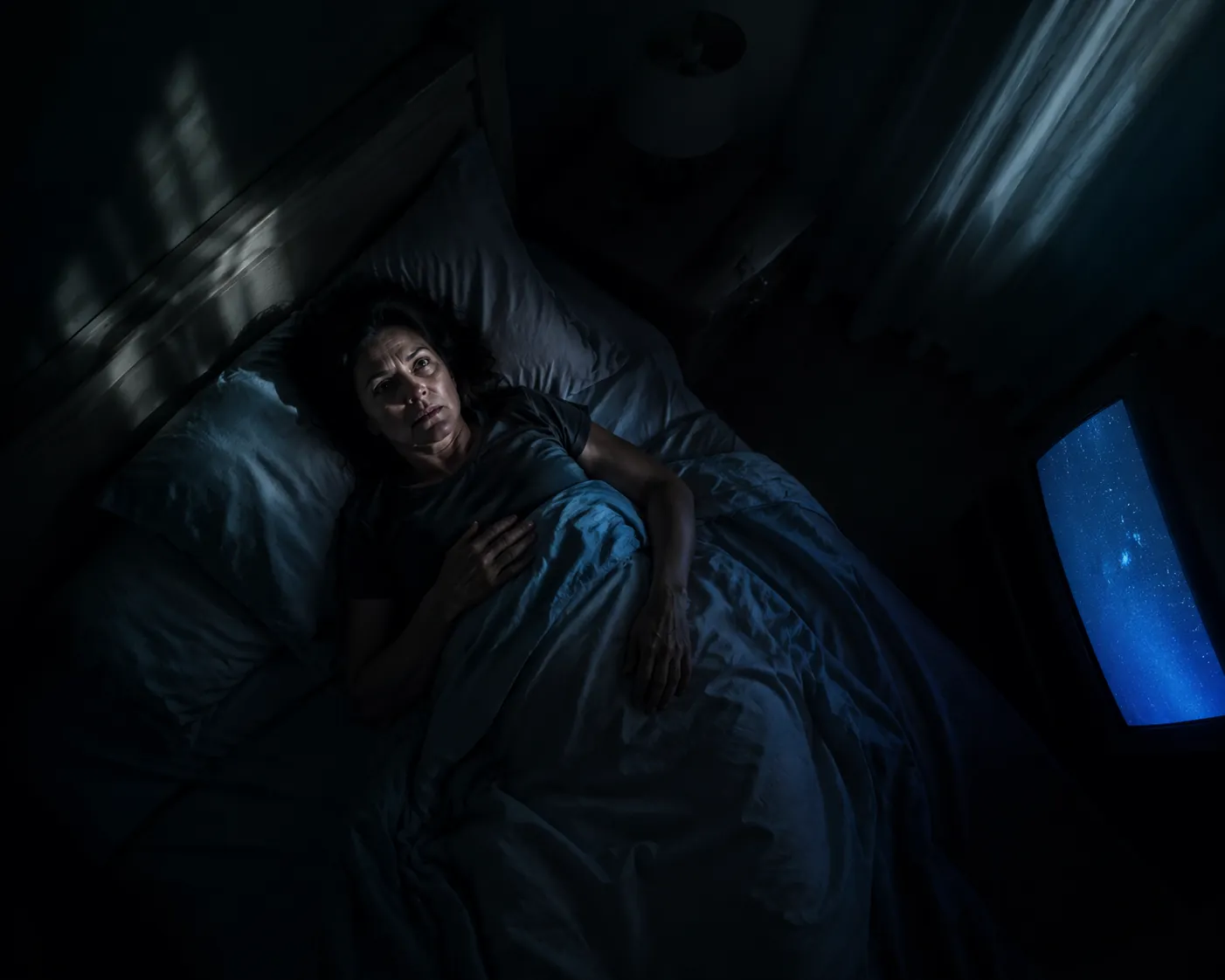
There is nothing especially fragile about having a body that reacts to horror. In a review of empirical research on scary films, 46% of general-population viewers reported sleep disturbances after a frightening film, and the author noted that the research base uses varied film stimuli, samples, and methods rather than one uniform test of “horror sleep loss” [1]. That is enough to say the effect is real for many viewers, while still being careful about how far we stretch the evidence.
Perimenopause adds a second layer: sleep is often already easier to disturb. A 2025 narrative review reports that 40% to 60% of perimenopausal women report sleep disturbance, and that peri- and postmenopausal women are up to twice as likely to report sleep problems as premenopausal women [2]. So when a horror movie drops a stressor into the evening, it is often landing on sleep architecture that is already lighter, hotter, and less forgiving than it used to be.
Why it can hit harder now
No study directly tests “horror movie stress response in perimenopausal women trying to sleep.” That matters. The best-supported explanation is a synthesis: horror reliably provokes fear arousal in many people; perimenopause is associated with more sleep disruption; and estrogen changes can alter stress-system regulation. Put together, the mechanism is plausible and clinically useful, but it is not the same as a dedicated trial.
The sequence usually looks like this: the film gives your nervous system a threat cue; adrenaline and cortisol rise; your heart rate, muscle tone, attention, and threat-scanning increase; then your body has to stand down. The awkward part is that “standing down” is not simply a decision. You can know you are safe before your stress hormones, temperature regulation, and sleep drive have all caught up.
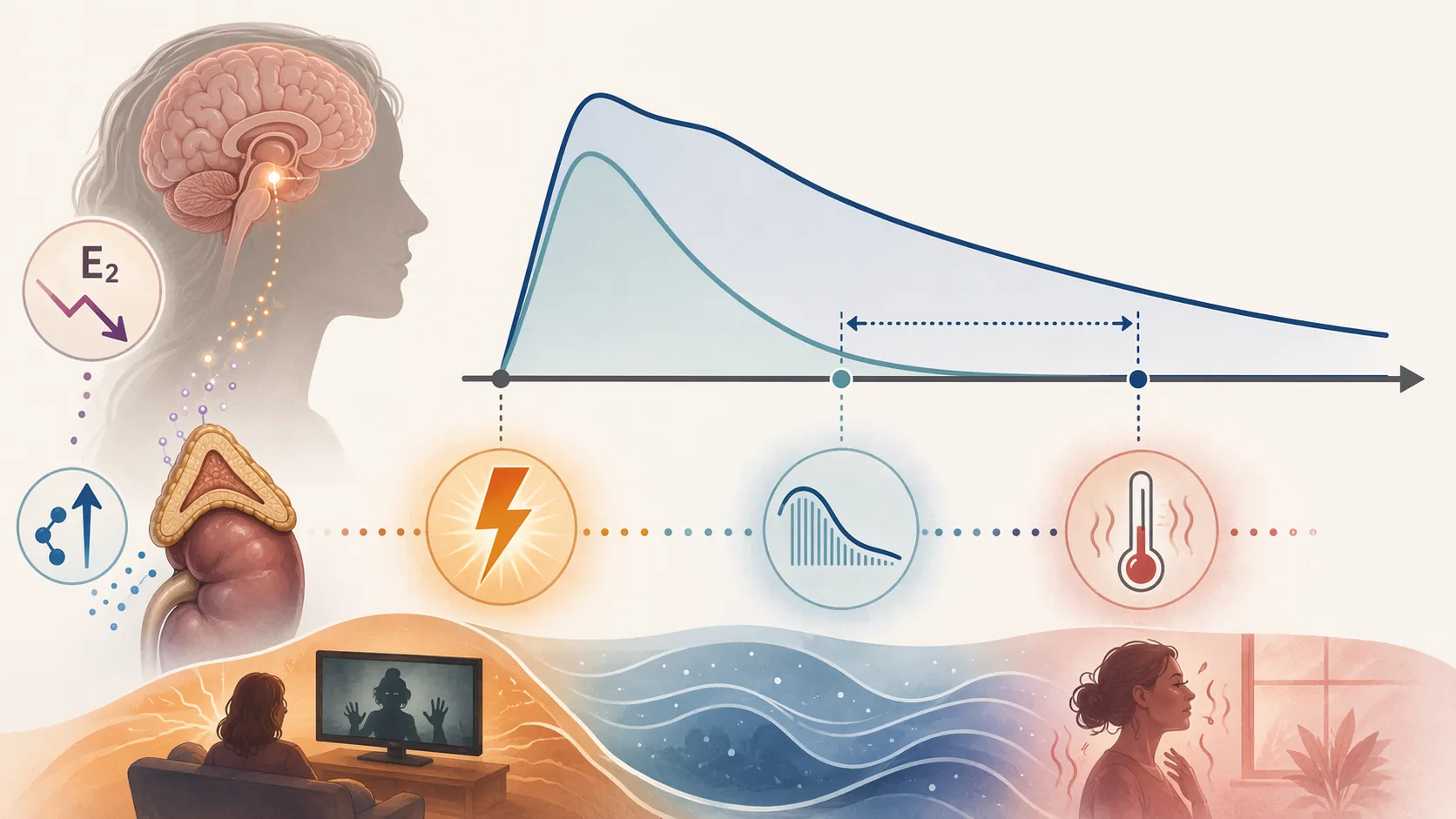
Estrogen is not a sleep switch, but it does participate in the systems that help regulate stress response, body temperature, and sleep continuity. As estrogen fluctuates and trends downward through perimenopause, cortisol regulation may become less smooth. That does not mean every frightening scene causes an extreme hormone surge. It means that after a strong fear cue, the recovery curve may be less tidy than it was in your 30s.
This is the same reason acute real-world stress can feel metabolically “sticky” in midlife sleep. If you have noticed that conflict, family worry, emergency alerts, or evacuation stress keeps you wired long after the immediate event passes, the pattern overlaps with what we see after fictional fear: the stressor ends before the recovery process is finished. For a fuller look at that stress-recovery pattern, see how perimenopause changes sleep during wildfire evacuation stress.
Startle research also helps explain why one person shrugs off a movie while another stays alert in bed. Fear-potentiated startle has been found to persist longer in people with higher anxiety sensitivity and in women, which supports the idea that lingering arousal varies across bodies rather than reflecting a lack of willpower [3]. If your nervous system keeps replaying the hallway scene, the problem may be less “I am being ridiculous” and more “my threat system has not fully powered down.”
The post-horror problem is timing
Most generic sleep advice arrives too late. It assumes you are already in bed, already trying to sleep, and just need a calming nudge. After a scary movie in perimenopause, the better target is the recovery window between “movie ended” and “I expect my body to sleep.”
The practical window is about 20 to 60 minutes after the fear exposure, reflecting the time course used here for stress-hormone recovery after the stimulus ends [4]. That does not mean you must perform a perfect 60-minute bedtime ritual. It means you should not go directly from final jump scare to teeth-brushing to bed and then feel betrayed when your pulse is still up.
| When | What to do | Why it matters in perimenopause |
|---|---|---|
| First 5 minutes | Do not rewatch clips, read theories, or scroll horror edits. Turn off the source of the stimulus. | Your threat system needs the cue to stop repeating. |
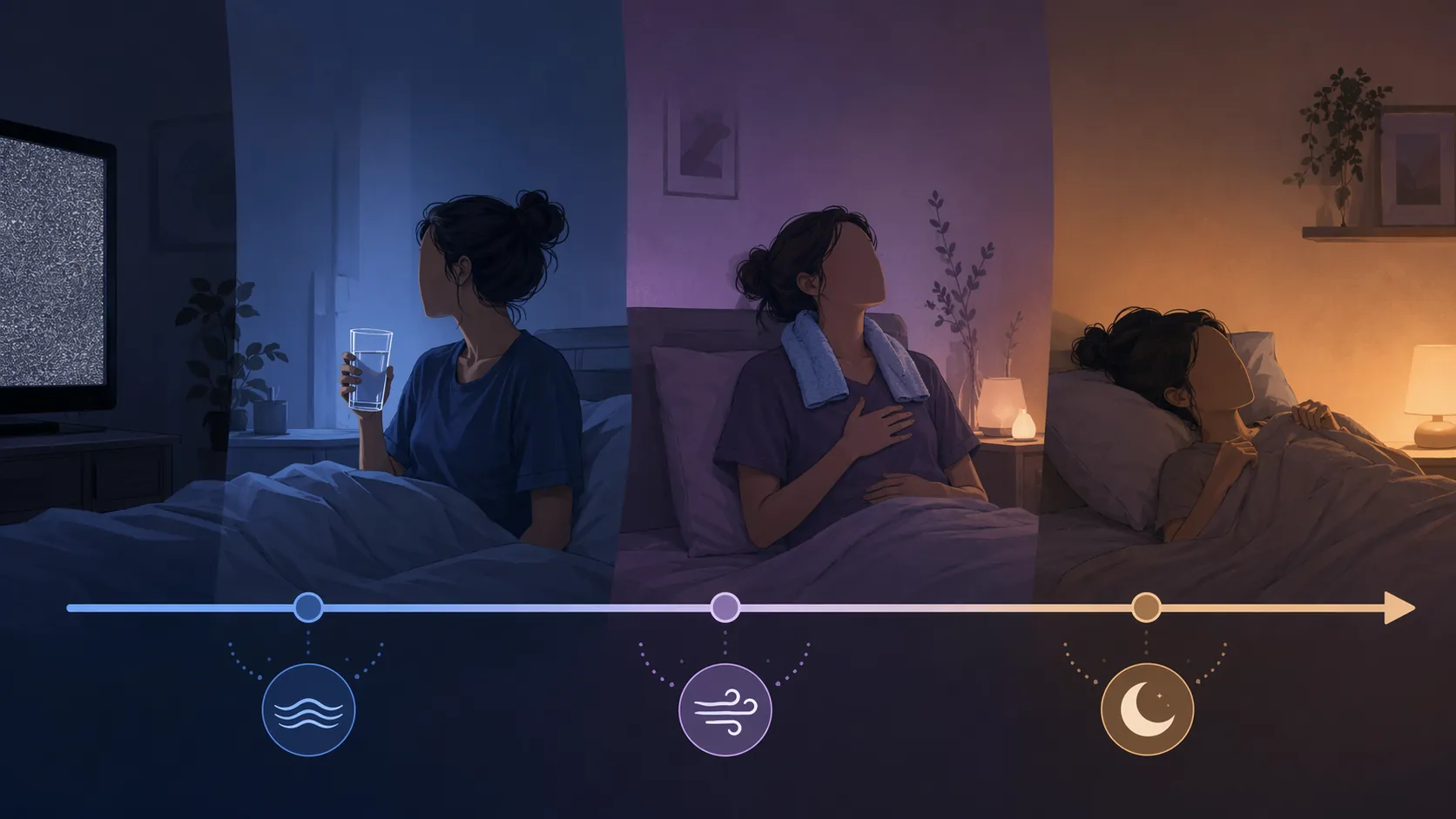
| Minutes 5–20 | Change sensory context: brighter neutral room, ordinary sounds, water, light movement. | The body needs proof that the environment has changed, not just reassurance that the movie was fake. |
| Minutes 20–45 | Cool the body and slow the exhale: light layers, cool neck or face, paced breathing. | Stress arousal and vasomotor symptoms can feed each other. |
| Minutes 45–60 | Move toward bed only if your body is trending down: less scanning, slower pulse, less heat. | Sleep onset is easier when the stress curve is falling rather than peaking. |
A cool-down protocol that matches the physiology
Start the cool-down when the movie ends, not when panic has already followed you under the covers. The point is to give your stress system a clean exit ramp.
1. Cut off the fear loop
The movie ending is not always the end of the stimulus. Trailers, ending explained videos, cast interviews with creepy thumbnails, comment threads, Reddit theories, and “one more clip” can keep the fear loop open. If your body is already keyed up, do not ask it to distinguish between the original film and a phone-sized aftershock.
- Turn off the TV or close the app instead of letting the platform autoplay related horror content.
- Put the phone face down or out of the bedroom for the first part of the cool-down.
- If you want to talk about the movie, keep it ordinary: plot, acting, costumes, practical effects. Do not keep replaying the scariest scene.
This is not moral panic about screens. It is stimulus control. If your nervous system is still interpreting the evening as threat-rich, repeated images matter more than the device itself.
2. Change the room before you change your mind
Trying to think your way out of fear can backfire because it keeps attention locked on the fear. A faster move is environmental: make the room look and feel unlike the movie-watching setup. Turn on a normal lamp. Take the blanket off your shoulders. Stand up. Rinse a glass. Let your body register that it is now in a kitchen, bathroom, or boring hallway—not in the dark, still, suspenseful posture it held for the last two hours.
Light movement helps here because it gives adrenaline somewhere harmless to go. You are not “working out” at midnight. You are walking around the room, stretching your calves, rolling your shoulders, or putting the mugs in the dishwasher. The action should be dull enough that it does not become a second wind.
3. Treat heat as part of the fear response
This is where perimenopause changes the usual advice. A warm bath may be soothing for some people on some nights, but after a scary movie it can be the wrong direction if you are already flushed, sweating, or waking with night heat. Fear arousal can raise sympathetic activation; perimenopause can narrow the comfort zone for temperature regulation. Add heavy bedding, a warm drink, or a too-hot room, and the body may read bedtime as another physiological problem to solve.
Use cooling that is gentle rather than shocking:
- Sip cool water.
- Place a cool cloth on the back of the neck, upper chest, or face for a few minutes.
- Switch to breathable sleepwear.
- Layer bedding so you can remove warmth quickly without fully waking yourself later.
- If you tend toward night sweats, cool the room before you get into bed rather than waiting until you wake overheated.
Temperature is not a decorative sleep tip in this context. It is part of preventing a stress spike from turning into a hot-flash-and-wake-up cycle. For more on recovery after heat disrupts perimenopausal sleep, see when sleep returns after a heat wave ends.
4. Use breathing as a brake, not as a performance
Breathing advice can become irritatingly vague, so keep the job simple: lengthen the exhale. A longer exhale nudges the body toward parasympathetic recovery. You do not need a perfect method or an app voice telling you to imagine a lake.
Try this for three to five minutes while sitting up, not while demanding sleep from yourself:
- Inhale through the nose for a comfortable count.
- Exhale slightly longer than the inhale.
- Let the shoulders drop on the exhale.
- If counting makes you tense, stop counting and simply make the out-breath slower.
The point is not to prove you can relax on command. It is to give the cardiovascular and respiratory parts of the fear response a repeated downshift cue during the window when they are already trying to recover.
5. Go to bed when the curve is falling
Do not make bedtime the test you can fail. Before getting under the covers, check for trend rather than perfection. Is your pulse less loud? Are you scanning the room less? Has the heat eased? Do you feel bored, heavy, or a little annoyed instead of intensely alert? Good. That is often enough.
If you get into bed and the fear loop restarts, leave the bed briefly and repeat a low-stimulation version of the protocol. Sit in dim light, cool your neck, lengthen the exhale, and avoid all movie-related content. Bed should not become the place where your brain rehearses the last scene for an hour.
Where the mattress survey fits—and where it does not
A 2025 Talker Research survey commissioned by Avocado Green Mattress found that, among 2,000 adults surveyed, 28% said they were more likely to wake during the night after horror, and 22% reported lower-quality sleep after watching it [5]. That is useful color because it matches what many people report in real life. It should not carry the argument by itself, because it is a brand-commissioned survey and it does not isolate perimenopause.
The stronger case comes from the convergence of independent findings: frightening films disrupt sleep for many viewers; perimenopausal sleep is commonly more vulnerable; and stress recovery, startle persistence, and temperature regulation can all shape whether a fear response fades or keeps you awake.
What to change before the next scary movie
If horror is a pleasure, plan for recovery instead of treating the pleasure as the mistake. The easiest adjustment is timing: finish the movie earlier than you used to. Not because midlife requires fun to end at 8 p.m., but because your stress system may need a longer runway before sleep.
A few practical choices make the night less brittle:
- Watch earlier when possible, leaving a real 20-to-60-minute cool-down before bed.
- Choose the room setup with recovery in mind: lights you can raise afterward, a non-horror show queued if you want neutral background, and a cooler bedroom ready before the movie starts.
- Avoid pairing horror with alcohol if alcohol already fragments your sleep; sleep recovery and stress-hormone regulation are harder when the night is physiologically unstable.
- If you are in a hot-flash-prone stretch of your cycle, treat temperature management as nonnegotiable.
- Do not stack horror on top of an already high-stress day unless you are willing to build in extra recovery time.
For readers noticing that movie nights are only one piece of a wider sleep shift, the pattern may belong to the larger perimenopause sleep picture. Strength training, metabolic changes, alcohol, medications, hot flashes, and stress load can all change the baseline your bedtime lands on. Related guides on weight training for perimenopause sleep, GLP-1 weight loss and perimenopause sleep, and what happens to sleep when you quit alcohol can help separate a one-night horror hangover from a broader sleep architecture problem.
When it is more than a bad movie night
An occasional wired night after a brutal horror movie is annoying, not automatically a medical problem. The threshold changes when the pattern spreads: trouble falling asleep, staying asleep, waking too early, or feeling unrefreshed becomes recurring; daytime functioning suffers; fear arousal starts showing up after milder content; or hot flashes, night sweats, mood symptoms, palpitations, or anxiety are repeatedly involved.
That is the point to talk with a clinician. The conversation should not be framed as “I guess I cannot handle scary movies anymore.” Frame it more accurately: “My stress response and sleep have changed in perimenopause, and I am having recurring insomnia or sleep disruption.” That opens the door to evaluating vasomotor symptoms, anxiety, medications, thyroid issues, sleep apnea risk, and treatment options instead of simply subtracting every interesting thing from your evenings.
The goal is not to ban the fun thing. It is to stop pretending a perimenopausal nervous system, temperature system, and sleep system recover exactly like generic adult sleep hygiene says they should.
References
- Why Do You Like Scary Movies? A Review of the Empirical Research on Psychological Responses to Horror Films — Frontiers in Psychology, 2019
- Sleep Disturbance and Perimenopause: A Narrative Review — PMC, 2025
- Fear-potentiated startle persists longer in individuals with higher anxiety sensitivity and in women — Yartz & Hawk, 2002
- Stress hormone half-life: adrenaline and cortisol circulating recovery window — General physiology reference
- Horror Movie Sleep Survey — Talker Research / Avocado Green Mattress, September 2025
Explore the mechanism
Next step
Spot an error or have clinical feedback?
Because this article covers clinical, medication, or safety information, we use a moderated correction channel instead of open public comments. Let us know if something about “How to Sleep After a Scary Movie in Perimenopause” needs a closer look.
Send feedback on this article