
California Heat Wave Sleep Tips for Pregnancy and Perimenopause
California heat waves disrupt sleep more severely during pregnancy and perimenopause because hormonal changes make temperature regulation harder. This guide explains the mechanisms and offers safe, population-specific cooling strategies, drawing on 2025–2026 California data.
On a California heat-wave night, the advice to “sleep cooler” can feel insulting by 2 a.m. The room is still holding the day’s heat, the fan is moving warm air around, and your body may already be running a temperature-control system that is under extra load. That matters most if you are pregnant or in perimenopause, because the problem is not simply that the bedroom is hot. It is that heat is landing on a body whose sleep and thermoregulation are already being negotiated by hormones, blood volume, fluid needs, and sudden surges of heat from the inside.
California is not imagining the sleep hit. Climate Central’s July 2026 analysis estimated that climate change is costing people sleep, with several California cities among the U.S. locations seeing about 7 to 9 hours of climate-linked sleep loss per year.[1] A 2025 USC Keck School of Medicine study, using All of Us Research Program data from 2010 to 2022, found that adults on the West Coast lost nearly three times more sleep to heat than adults in other U.S. regions.[2] Tracking California also notes the part that matters after sunset: minimum nighttime temperatures are rising faster than daytime maximum temperatures.[3]
Those figures are population signals, not a prediction for your bed tonight. A top-floor apartment in the Central Valley, a coastal room without air conditioning, a pregnancy pillow trapping warmth against your abdomen, or a hot flash that arrives just as you drift off will not be captured neatly by an annual average. But the data does confirm something important: this is not a personal failure, and it is not always ordinary insomnia wearing summer clothes.

Why Heat Hits Sleep Differently in Pregnancy and Perimenopause
Sleep onset depends partly on heat leaving the body. Core temperature normally drops as bedtime approaches; warm skin and cooler internal temperature help the brain move toward sleep. A heat wave interferes with that gradient. The room stays warm, sweat evaporates less effectively when air is still or humid, and the body has to work harder to dump heat before sleep can stabilize.
During pregnancy, that burden starts before the weather report. Pregnant people have increased metabolic heat and higher fluid needs, making temperature regulation harder in hot conditions.[4] The CDC also warns that heat exposure in any trimester is associated with adverse pregnancy outcomes, including preterm birth.[5] That does not mean one bad night automatically becomes a pregnancy emergency. It does mean pregnancy heat advice should be written with more caution than a generic list of summer sleep hacks.
Progesterone is part of the reason. In pregnancy, progesterone is linked with a higher core body temperature, while blood volume, cardiovascular workload, and fetal growth increase the amount of heat the body must move. Add third-trimester reflux, pelvic pressure, leg cramps, or anxiety, and heat may be the layer that breaks a sleep system already running close to its limit. If heat is only one part of a broader pattern, the trimester-by-trimester guide to pregnancy insomnia remedies can help separate temperature problems from the other sleep disruptions that change across pregnancy.
Perimenopause brings a different mechanism. As estrogen levels fluctuate, the body’s thermoregulatory control becomes less steady. The internal “comfort zone” can narrow, so a small rise in body temperature may trigger a much larger response: heat rushing through the chest, neck, and face, sweating, a racing heart, and a full awakening. BBC News, citing Dr. Arif, describes how heat waves can make hot flashes and night sweats more frequent and severe; the same reporting notes that perimenopausal hot flashes and night sweats affect an estimated 35% to 50% of women.[4]
That is why a perimenopausal reader may not recognize herself in advice built around falling asleep once in a warm room. The harder problem may be staying asleep after repeated internal heat surges. Climate Central’s 2026 analysis also found that women lose more sleep than men on hot nights, a population-level finding that fits the clinical reality that nighttime heat is not experienced by every body the same way.[1]
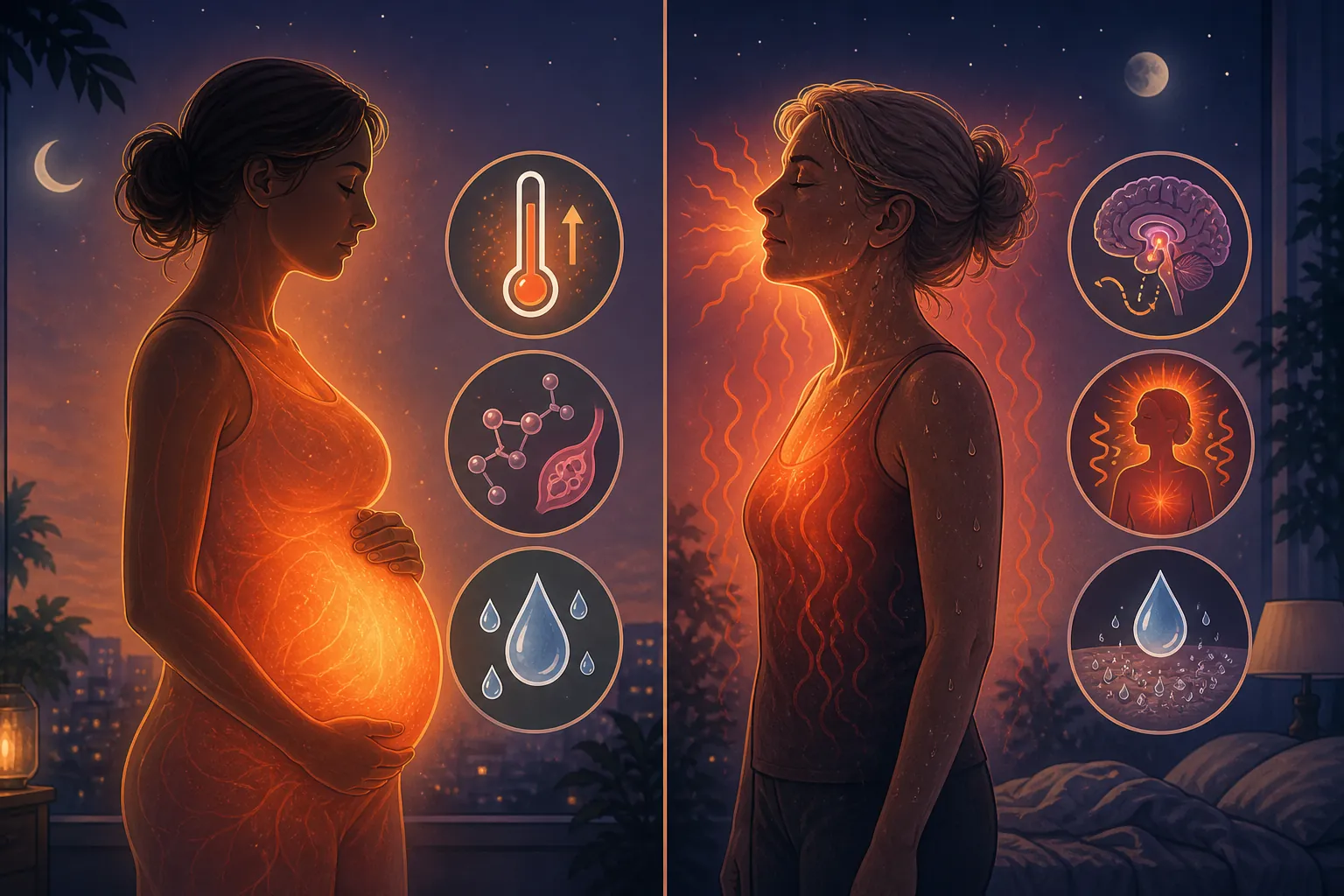
| Heat-wave sleep problem | Pregnancy | Perimenopause |
|---|---|---|
| Main temperature burden | Higher core temperature, increased metabolic heat, higher fluid needs | Fluctuating estrogen, narrowed thermoregulatory comfort zone, hot flashes |
| Common nighttime pattern | Difficulty cooling down enough to fall asleep; waking overheated or thirsty | Repeated awakenings from heat surges, sweating, and damp bedding |
| Safety concern | Heat stress and dehydration deserve a lower threshold for medical caution | Sleep fragmentation, overheating, and symptoms that may overlap with other medical issues |
| Cooling priority | Gentle, steady cooling without cold shock; hydration and safer room temperature | Fast recovery after hot flashes plus reducing heat buildup before sleep |
If You Are Pregnant: Cool Gradually, Hydrate Deliberately, Escalate Early
Pregnancy is the place to be least impressed by toughing it out. Heat exposure during any trimester is associated with adverse pregnancy outcomes, and dehydration can make the body’s cooling job harder.[5] A practical nighttime plan should lower heat load without triggering shivering, dizziness, or a sudden temperature swing.
- Start cooling before the bedroom peaks. If your home traps afternoon heat, close sun-facing coverings earlier, move to the coolest room before bedtime, and do not wait until you feel overheated to change rooms.
- Drink fluids steadily rather than trying to catch up at bedtime. The goal is to support cooling and circulation without forcing repeated bathroom trips all night.
- Use a lukewarm shower 1 to 2 hours before bed, not an icy one. The timing gives the body a chance to release heat before sleep, while avoiding cold shock or shivering.
- Keep bedding minimal and breathable. Pregnancy pillows can trap heat; use only the support you need for comfort and safe positioning.
- Lower the threshold for help. If you feel faint, confused, unable to cool down, have persistent vomiting, contractions, decreased fetal movement, chest pain, or symptoms that feel frightening, seek medical guidance promptly.
Cold-shower advice is especially sloppy here. A very cold shower can make the skin vessels constrict, trigger a stress response, or lead to shivering. Shivering is heat production. That is the opposite of what a pregnant body needs when the goal is a calm drop in core temperature. CNN’s heat-wave sleep guidance points toward a cool or lukewarm shower 1 to 2 hours before bed to support the normal pre-sleep drop in core temperature.[6]
For a shorter pregnancy-specific version, use the extreme-heat FAQ on how to sleep during an extreme heat alert when pregnant. If the heat wave overlaps with an outage or a public safety power shutoff, the bedroom problem changes from comfort management to safety planning; the guide to sleeping safely during a power outage when pregnant is the better route.
If You Are in Perimenopause: Plan for the 3 A.M. Heat Surge
Perimenopause heat-wave sleep advice has to account for both the room and the flash. A cooler bedroom may reduce the background load, but it may not prevent a hot flash from breaking through. The useful question is what lowers the chance of overheating before sleep and what helps you recover quickly when a night sweat wakes you.
- Pre-cool your body, not just the room. A lukewarm shower 1 to 2 hours before bed can help the core temperature drop that sleep onset depends on.
- Make sweat recovery easy. Keep a dry top, towel, or spare pillowcase nearby so one hot flash does not turn into a long, fully awake bedding change.
- Use layers that can be removed without effort. A single heavy comforter is a poor match for repeated temperature swings.
- Point a fan across the body or toward an open path for air movement when outdoor air is safe and cooler. A fan alone may not be enough if the room remains very hot.
- Notice symptom changes. New chest pain, fainting, severe shortness of breath, confusion, or symptoms that do not feel like your usual hot flashes need medical attention rather than more sleep tips.
The lukewarm shower matters here for the same reason it matters in pregnancy, though the safety stakes are different. The shower is not meant to numb the skin. It is meant to encourage heat loss before bed without provoking a rebound response. A cold blast may feel briefly satisfying, but if it leaves you alert, tense, or shivering, it has made sleep less likely.

Shared California Heat-Wave Sleep Moves That Are Worth Keeping
Some strategies do apply to both groups, as long as they are treated as supportive measures rather than magic fixes. The American Heart Association’s 2025 hot-weather sleep guidance emphasizes keeping the sleeping environment cool, staying hydrated, and using lighter bedding and clothing during hot weather.[7] Those are reasonable basics. They just need to sit underneath the population-specific cautions, not replace them.
- Move sleep to the coolest safe place available, even if it is not your usual bedroom.
- Reduce heat trapped against the body: lighter sleepwear, breathable sheets, fewer pillows, and no unnecessary weighted bedding.
- Use fans to increase evaporation when the air is not dangerously hot; do not rely on a fan as the only cooling tool in a room that remains very hot.
- Keep water within reach, but avoid turning bedtime into the first major hydration window of the day.
- Charge devices and check outage alerts earlier in the evening, because a hot room without power is a different risk calculation.
When the power is already out, shift from sleep optimization to heat-safety decisions. The broader guide to sleeping safely without power until restoration is more useful than rearranging bedding in a room that keeps getting hotter.
When Bedroom Management Is No Longer Enough
There is a point where the safest sleep tip is to leave the hot room. California’s emergency guidance directs residents to cooling centers and local resources during dangerous heat, and Cal OES recommends checking on people at higher risk, staying hydrated, limiting strenuous activity, and using cooling centers when needed.[8] Tracking California also points residents toward cooling center information and 211 resources during heat events.[3]
Use that threshold sooner if you are pregnant, alone, caring for children, without air conditioning, in an upper-floor unit, or losing power. Perimenopause does not automatically make heat exposure a medical emergency, but repeated night sweats can still leave you dehydrated, exhausted, and less able to recognize when the room has become unsafe.
Seek urgent help for signs of heat illness: confusion, fainting, inability to cool down, hot dry skin or severe weakness, chest pain, severe shortness of breath, persistent vomiting, or symptoms that feel dangerous. During pregnancy, add obstetric warning signs such as contractions, leaking fluid, vaginal bleeding, severe headache, or decreased fetal movement. A shower, fan, or lighter sheet is not the right tool once those symptoms appear.
For tonight, the practical order is simple: lower the room heat if you can, lower body heat gently with a lukewarm shower 1 to 2 hours before bed, reduce bedding and trapped warmth, keep fluids available, and decide early where you will go if the room stays unsafe. The part that changes is the body you are advising. Pregnancy calls for earlier caution around heat stress and hydration. Perimenopause calls for a plan that expects hot flashes and night sweats rather than treating them as random interruptions.
References
- Climate Change is Costing People Sleep — Climate Central, July 2026
- Study links rising temperatures to reduced sleep in U.S. adults — USC Keck School of Medicine, 2025
- Heat-Related Illness — Tracking California
- Why heatwaves hit women harder — BBC News, July 2026
- Clinical Overview of Heat and Pregnancy — CDC
- How to sleep in a heat wave, according to experts — CNN
- Keep your cool – and stay healthy – with these hot-weather sleep tips — American Heart Association, Aug 2025
- Safety Tips to Prepare for Hot Temps — Cal OES
Explore the mechanism
Next step
Spot an error or have clinical feedback?
Because this article covers clinical, medication, or safety information, we use a moderated correction channel instead of open public comments. Let us know if something about “California Heat Wave Sleep Tips for Pregnancy and Perimenopause” needs a closer look.
Send feedback on this article