
Is It Postpartum Insomnia or Just New Mom Exhaustion?
Many new mothers assume severe sleep problems are just part of parenthood, but there is a clinically meaningful difference between expected newborn-driven sleep fragmentation and treatable postpartum insomnia. This guide provides a framework to distinguish the two and explains why CBT-I is an evidence-based treatment option.
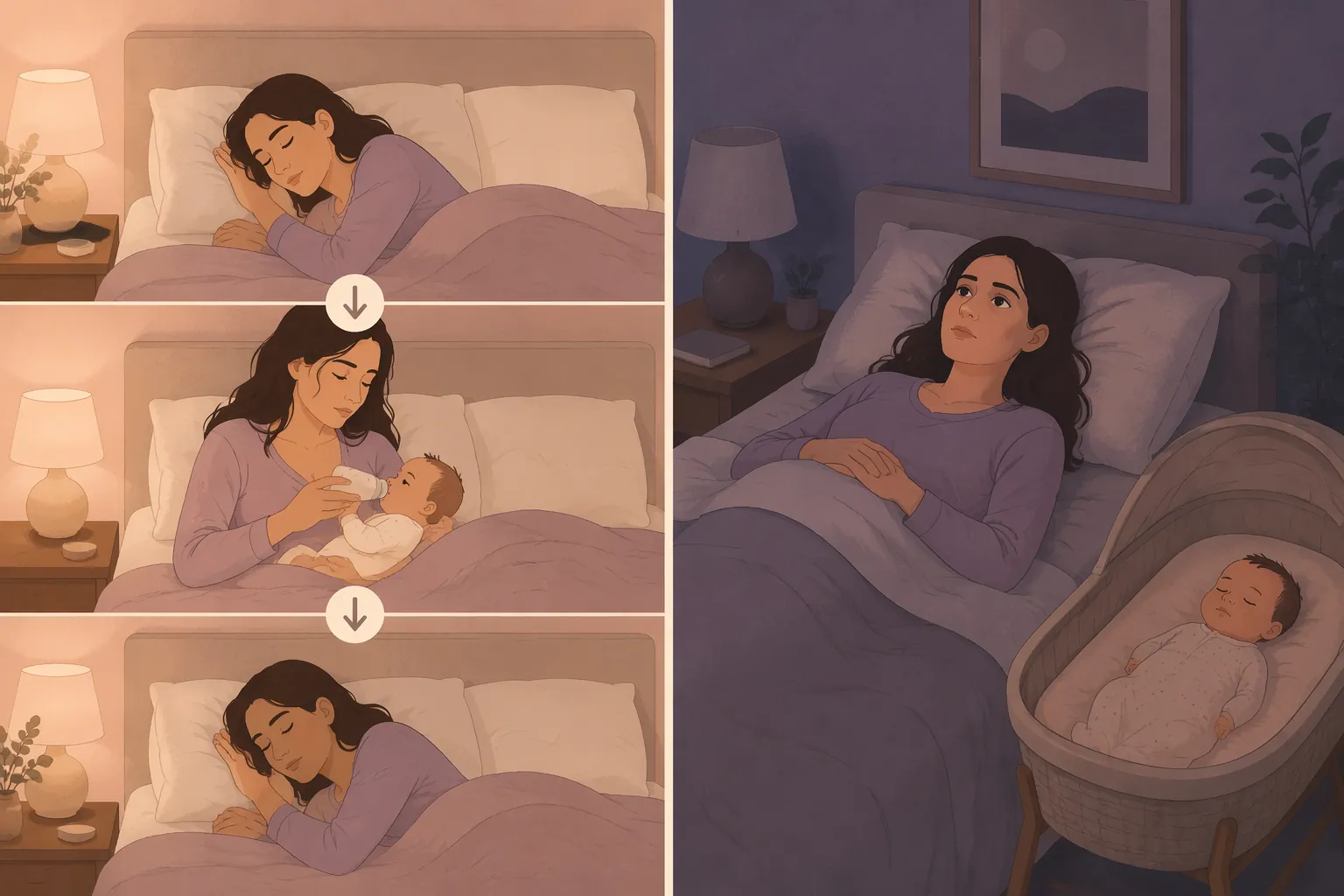
The baby is asleep. The room is dark enough. No one needs you for the next little while. And still, your body will not cross over into sleep.
That moment is where ordinary “motherhood sleep tips for new moms” often fail. They assume the main problem is access: get a longer shift, ask for help, nap when the baby naps, protect a block of sleep. Sometimes that is exactly the problem. Newborn care breaks sleep into pieces, and better support can make a real difference.
But postpartum insomnia is a different problem. It is not only that the baby wakes you. It is that sleep does not come, or does not return, even when the baby is asleep and sleep is available. Postpartum Support International describes several signs that move the concern beyond normal newborn-driven disruption: trouble falling asleep when the baby sleeps, lying awake for 30 minutes or more after nighttime feedings, dreading bedtime, and symptoms that persist beyond four weeks postpartum.[1]

That distinction matters because poor sleep is extremely common after birth. More than two-thirds of new mothers experience poor sleep quality during the first six months postpartum, according to the Sleep Foundation.[2] A number that large should not make every tired mother feel pathologized. It should make the sorting process more careful.
Sleep Opportunity Is Not the Same as Sleep Ability
A mother can be sleep deprived without having insomnia. If the baby wakes every two hours, feeding takes time, pumping adds another task, and a toddler is up early, the body may still know how to sleep. The opportunity is simply too short and too fragmented.
That kind of sleep loss deserves practical help, not dismissal. Partners, relatives, and care teams can protect longer rest windows, move non-feeding tasks away from the recovering parent, and reduce the number of times she has to become fully alert overnight. For that problem, shift planning and protected blocks can help; our guide to protecting uninterrupted sleep blocks after birth goes deeper into that logistics side.
Insomnia asks a different question: when there is a real chance to sleep, can you?
| What is happening | More consistent with newborn-driven fragmentation | More concerning for postpartum insomnia |
|---|---|---|
| The baby wakes overnight | You wake because care is needed, then eventually fall back asleep | You remain awake long after the baby has settled |
| A nap window opens | You sleep if the timing works | You feel exhausted but wired, alert, or unable to drop off |
| After a feeding | You need time to resettle, but sleep returns | You lie awake for 30 minutes or more |
| At bedtime | You feel tired and hope the baby gives you a stretch | You dread the night because you expect to be awake |
| Over time | Sleep changes as feeding patterns and support change | The pattern persists beyond four weeks |
The point is not to diagnose yourself from a table. It is to notice whether the barrier is mostly outside your body or inside the sleep system itself. A partner can take a shift and still not solve insomnia. A perfect nap plan can still leave a mother staring at the ceiling.
The Signs That Deserve More Than Another Sleep Tip
Postpartum insomnia often hides under reasonable explanations. You had a hard delivery. Feeding is unpredictable. Hormones are shifting. Everyone says the first months are brutal. All of that may be true, and none of it proves that lying awake night after night is harmless.
The most useful marker is not how tired you are. Nearly every new mother is tired. The sharper marker is what happens after the baby no longer needs you.
- You cannot fall asleep when the baby is asleep, even though you are exhausted.
- After a nighttime feeding or check-in, you lie awake for 30 minutes or more.
- You begin to dread bedtime because being in bed feels like a fight.
- The pattern continues beyond four weeks instead of easing as the household finds some rhythm.
- The sleep problem travels with mood symptoms: hopelessness, panic, intrusive thoughts, loss of pleasure, or feeling unable to cope.
Those first four markers come directly from the clinical framework Postpartum Support International uses to distinguish perinatal sleep challenges from insomnia patterns that may need more targeted care.[1] The mood piece matters because sleep and postpartum mental health move in both directions. Insomnia can intensify distress, and depression or anxiety can make sleep harder.
There is no virtue in waiting until a sleep problem becomes unbearable. If you are unsure, raising it with an OB-GYN, midwife, primary care clinician, therapist, or PSI-trained support resource is a reasonable early step. You do not need to prove that the problem is “bad enough” before naming it.
Why Persistent Insomnia Changes the Stakes
The concern is not cosmetic sleep optimization. It is the way sustained sleep difficulty can become part of a postpartum mental health loop.
One study cited by the Sleep Foundation found that women who rated their sleep as a “big problem” at six weeks postpartum had eight times higher odds of elevated Edinburgh Postnatal Depression Scale scores above 9 at either six or 12 weeks postpartum.[3] That does not mean poor sleep alone diagnoses postpartum depression. It does mean that a mother saying, “Sleep is a big problem,” deserves attention rather than a reflexive reminder that newborns are hard.
Okun and colleagues also found a temporal pattern: poor sleep at six weeks postpartum predicted depressive symptoms at 12 weeks, with an odds ratio of 3.56.[4] This is still not a promise that treating insomnia prevents every mood disorder. Postpartum depression has many contributors. But it strengthens the case for treating persistent insomnia as a modifiable risk factor instead of background noise.
That distinction can change the kind of help a mother receives. If the care plan only asks, “Can someone else take the baby for three hours?” it may miss the mother who gets those three hours and spends them awake, tense, and ashamed. The better question is, “What happens when sleep is possible?”
Where CBT-I Fits
Cognitive behavioral therapy for insomnia, or CBT-I, is the evidence-based treatment pathway worth discussing when postpartum insomnia signs persist. It is not general sleep hygiene. It is a structured behavioral treatment that works with the learned patterns, anxiety, timing, and conditioned wakefulness that keep insomnia going.
The strongest trial in the research set is important, but it needs to be described carefully. Felder and colleagues studied 208 women in a randomized controlled trial of digital CBT-I delivered during pregnancy, then followed outcomes into the postpartum period. At six months postpartum, insomnia remission was higher in the CBT-I group than in the control group, 53% versus 35%, and depressive symptoms also improved significantly.[5]
That is meaningful evidence for perinatal insomnia treatment. It is not the same as saying every mother who begins CBT-I after delivery will have the same result. The trial began during pregnancy, when the sleep environment and caregiving demands are different from the first months with a newborn. Still, it supports an important practical point: insomnia in the perinatal period is treatable, and behavioral treatment can affect both sleep and mood symptoms.
CBT-I may include work on sleep timing, time spent awake in bed, unhelpful beliefs about sleep, and the body’s association between bed and alertness. In postpartum care, those pieces need adaptation. A mother feeding overnight cannot simply follow a generic adult insomnia protocol as if no baby exists. A good clinician will account for feeding, recovery, safety, partner support, and mental health symptoms.
If you want a fuller explanation of the treatment model, our pregnancy-focused guides on CBT-I as a sleep aid during pregnancy and CBT-I for insomnia during pregnancy explain the approach in more detail. They do not replace postpartum care, but they can help you understand what a provider means when CBT-I comes up.
What Partners and Support People Often Miss
A partner may see the problem as a scheduling failure: if the mother is exhausted, make a better schedule. That instinct is not wrong. It is just incomplete.
Support people can watch for the difference between a mother who is repeatedly woken and a mother who cannot come down after being woken. The second pattern may look quiet from the outside. She may not be crying. She may not ask for help. She may simply get through the feeding, place the baby back down, and spend the next hour in bed with a racing mind while everyone else sleeps.
Useful support sounds less like, “You should nap,” and more like, “When I take the baby, are you actually able to sleep?” If the answer is no, the next move is not another lecture about rest. It is help raising the issue with a clinician, making room for treatment, and reducing the shame that often keeps mothers silent.
This is also where the sleep-mood connection deserves careful attention. Our article on sleep fragmentation and maternal mental health looks more closely at interrupted sleep as its own strain. Insomnia can overlap with fragmentation, but it is not identical to it.
About Sleep Aids While Breastfeeding
Sleep aids are not a shortcut around the insomnia question. They may be appropriate in some postpartum situations, but the decision depends on breastfeeding, infant age and health, other medications, nighttime caregiving responsibilities, and the mother’s mental health picture. Evidence is limited enough that this belongs in shared decision-making with a clinician, not in a generic tips list.
A medication discussion should also include safety after taking anything sedating: who will respond to the baby, whether bed-sharing risks are present, and whether the mother has symptoms of depression, anxiety, panic, or intrusive thoughts that need direct care. Medication may have a role, but it should not be the only plan if insomnia has become persistent.
When to Bring It Up
Bring up postpartum insomnia with a provider if you often cannot sleep when the baby sleeps, regularly lie awake for 30 minutes or more after feedings, dread bedtime, or have had this pattern for more than four weeks. Bring it up sooner if sleep loss is paired with mood symptoms, panic, intrusive thoughts, or feeling unsafe.
You can be simple and specific: “The baby gives me some windows to sleep, but I can’t fall asleep during them,” or “After night feeds I’m awake for an hour or more,” or “I’m starting to dread going to bed.” Those sentences give a clinician more useful information than “I’m tired,” because they separate sleep opportunity from sleep ability.
If sleep is fragmented because the baby wakes, support and protected blocks may help. If sleep is available and your body still cannot take it, especially for weeks or alongside mood symptoms, that is a treatable clinical problem worth raising with a provider.
References
- Addressing Sleep Challenges During the Perinatal Period, Postpartum Support International.
- Postpartum Insomnia: Causes, Symptoms, and Treatment, Sleep Foundation.
- Sleep Deprivation and Postpartum Depression, Sleep Foundation.
- Poor sleep quality increases symptoms of depression and anxiety in postpartum women, 2018.
- Efficacy of digital cognitive behavioral therapy for the treatment of insomnia symptoms among pregnant women: a randomized clinical trial, Sleep, 2022.
Explore the mechanism
Next step
Spot an error or have clinical feedback?
Because this article covers clinical, medication, or safety information, we use a moderated correction channel instead of open public comments. Let us know if something about “Is It Postpartum Insomnia or Just New Mom Exhaustion?” needs a closer look.
Send feedback on this article