
How Postpartum Sleep Deprivation Can Signal Psychosis Risk
Postpartum psychosis is a treatable psychiatric emergency, but its earliest warning sign can be easy to miss. This article explains the difference between ordinary newborn-related sleep loss and pathological insomnia that may signal impending psychosis, and what to do if red-flag symptoms appear.
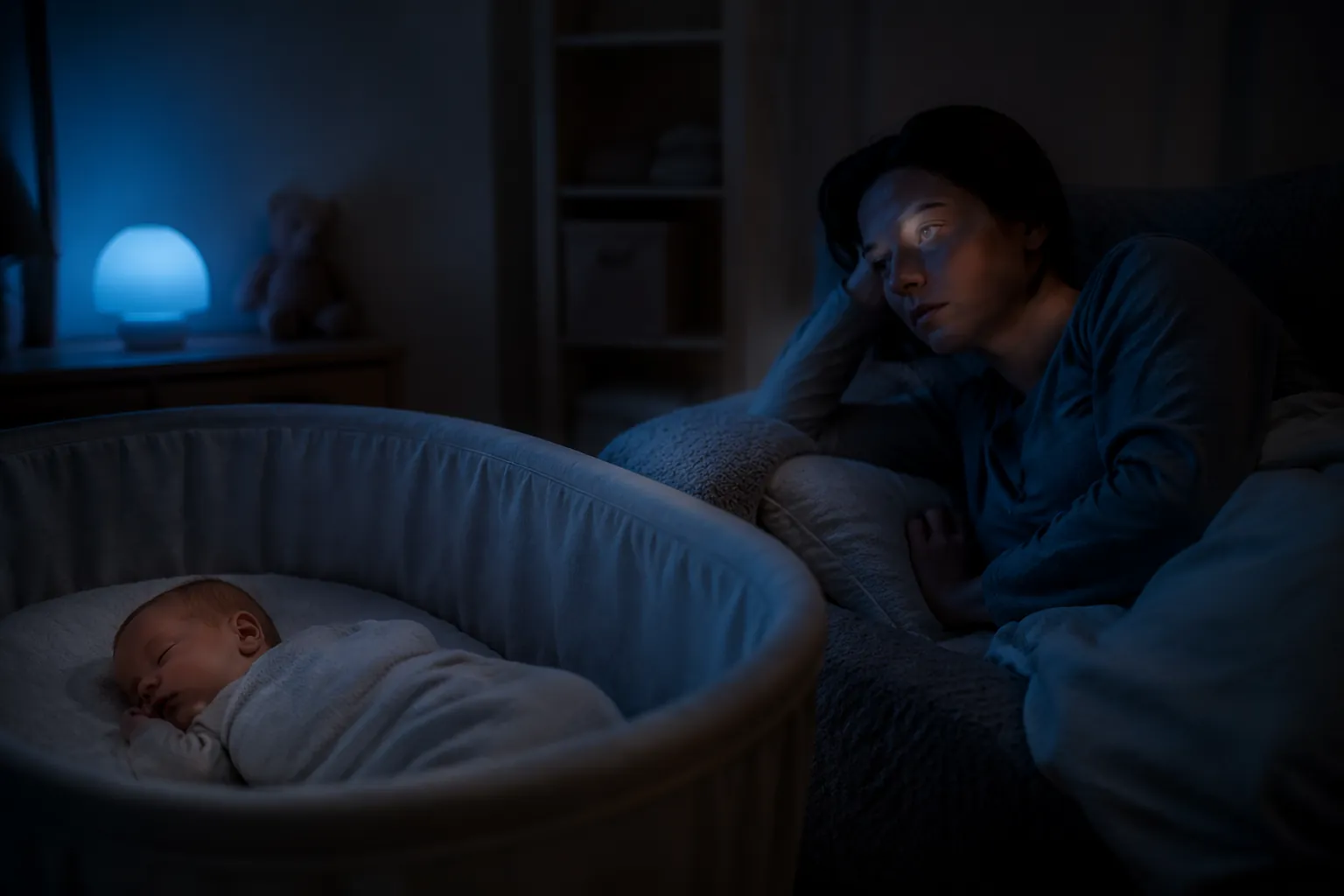
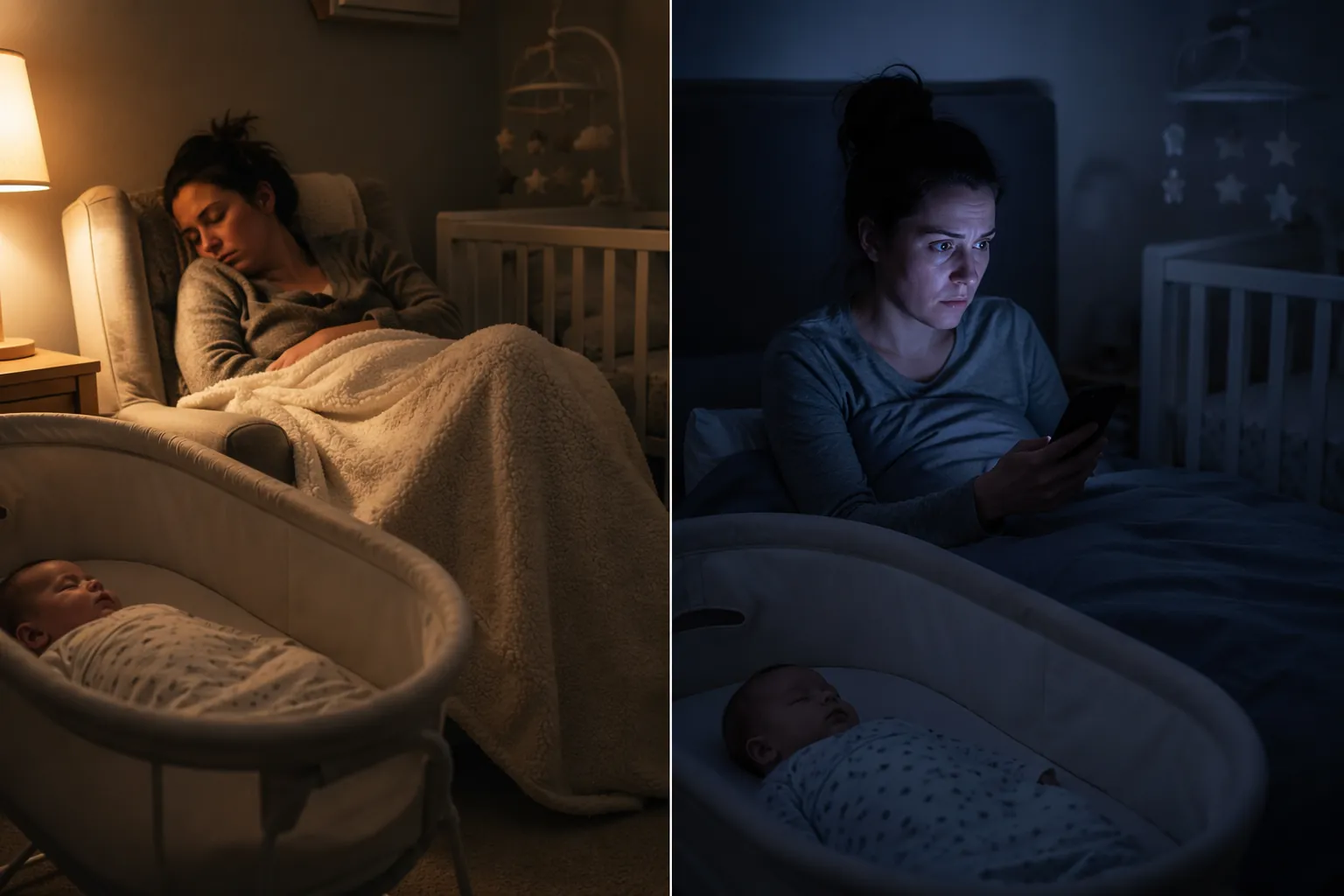
The uneasy postpartum sleep moment is often quiet. The baby is finally down. Another adult has taken over. The room is dark enough, the monitor is close enough, and there is a real chance to sleep. Ordinary exhaustion usually takes that opening, even if only in broken pieces. The more concerning pattern is different: the new parent stays wide awake, feels unusually energized or driven, paces, texts rapidly, reorganizes supplies, talks faster than usual, or insists they do not need sleep.
That distinction matters because postpartum sleep deprivation and psychosis risk are connected in two ways. Sleep loss can act as a trigger for postpartum psychosis in vulnerable people, especially those with bipolar disorder, and insomnia can also be an early warning sign before clearer mood or psychotic symptoms appear. The dangerous sign is not simply being tired after a newborn’s bad night. It is being unable to sleep when sleep is available, especially with wired energy, agitation, racing thoughts, confusion, unusual beliefs, or rapidly shifting mood.
Normal postpartum sleep loss usually follows the baby
Most new parents lose sleep because someone keeps waking them. Feeding, pumping, pain, night sweats, anxiety about the baby’s breathing, visitors, older children, and hospital interruptions can splinter the night into pieces too small to feel restorative. A parent in this state may be tearful, irritable, forgetful, or desperate for a nap. None of that automatically points to psychosis.
The practical test is what happens when the obstacle is removed. If another adult takes the baby for a protected stretch and the parent can sleep, or at least feels heavy with the need for sleep, the pattern looks more like ordinary postpartum exhaustion. The sleep may still be inadequate. It may still deserve real help. But the body recognizes the opportunity.
Red-flag insomnia does not behave that way. A partner, sister, doula, or nurse may create a two-hour window, only to find the parent more activated than before. They may say they are not tired after being awake for a very long stretch. They may seem driven by urgent thoughts, impossible plans, sudden certainty, or fear that does not settle with reassurance. The problem is no longer just that the baby prevents sleep; the parent’s mind and body are not accepting sleep.
| What you observe | More consistent with ordinary newborn-related sleep loss | More concerning for red-flag insomnia |
|---|---|---|
| Sleep opportunity | Sleep is difficult because the baby, pain, feeding, or interruptions keep breaking it up. | Sleep is available, but the parent remains awake, activated, or unable to settle. |
| Need for sleep | The parent feels exhausted and wants sleep, even if they cannot get enough. | The parent says they are not tired, does not seem to feel the need for sleep, or appears unusually energized. |
| Behavior during a protected rest window | They nap, doze, rest quietly, or become calmer with support. | They pace, clean, text rapidly, talk intensely, monitor the baby compulsively, or become more agitated. |
| Thinking and mood | Worry and irritability rise with fatigue but remain understandable and reality-based. | Racing thoughts, confusion, rapidly changing mood, unusual beliefs, paranoia, or disorganized behavior appear. |
| What to do next | Increase practical sleep protection and contact a clinician if insomnia, mood symptoms, or anxiety persist. | Treat it as urgent, especially if confusion, psychotic symptoms, suicidal thoughts, thoughts of harming the baby, or unsafe behavior are present. |
Why the first days after birth deserve extra attention
Postpartum psychosis is rare, but it is treated as a psychiatric emergency because it can involve severe mood disturbance, confusion, delusions, hallucinations, disorganized behavior, suicidal thoughts, or thoughts of harming the baby. It is also treatable, and early recognition changes how quickly care can be arranged. A clinical guide for obstetric providers emphasizes a public-health problem that families often miss: only one-third of women who present with postpartum psychosis have a prior psychiatric history.[1]
That does not mean every sleepless new parent is at high risk. It means prior psychiatric history cannot be the only filter families use. If the first sign is insomnia with wiredness or confusion, waiting for a known diagnosis may waste the window when help is easier to mobilize.
The timing is one reason sleep deserves attention. Heron et al. reported that approximately 65% of postpartum psychosis episodes begin within the first three days after childbirth, a period that often overlaps with labor recovery, hospital disruption, feeding initiation, pain, and the abrupt disappearance of normal night-day structure.[2]
A 2023 narrative review found that sleep disturbance is common among people with postpartum psychosis, with reported prevalence ranging from 42% to 100% across the literature it reviewed. The same review notes that chart-review evidence has found insomnia can precede mood and psychotic symptoms, while also cautioning that the field still cannot always separate sleep disruption as a trigger from sleep disruption as an early symptom.[3]
Bipolar disorder changes the sleep-loss calculation
The clearest evidence that sleep loss can trigger postpartum psychosis comes from research in women with bipolar disorder. In a retrospective study of parous women with bipolar disorder, 25.3% reported sleep loss as a trigger for mania, and those women had approximately double the odds of postpartum psychosis.[4]
A prospective study from the UK BDRN Pregnancy Study gives the sleep signal more clinical weight. Among women with bipolar disorder, losing at least one complete night of sleep during labor and delivery was associated with a fivefold increase in odds of postpartum psychosis, with an odds ratio of 5.19 and a 95% confidence interval of 1.45 to 18.54. In the sleep-loss group, 92% of episodes occurred within two weeks postpartum.[5]
That finding should be taken seriously, not stretched beyond what it can prove. The study sample was modest, with 76 participants, and the confidence interval was wide.[5] Much of the sleep-and-psychosis literature is retrospective, and several studies are concentrated in predominantly white European cohorts, which limits how confidently the evidence can be generalized to all postpartum populations.[3][5]
Still, for someone with bipolar disorder or a strong family history of bipolar disorder, protected sleep after delivery is not a comfort measure only. It is part of risk planning. That may mean arranging overnight support before birth, telling the obstetric and psychiatric teams about prior mania or sleep-loss-triggered mood episodes, and deciding in advance who will call if the person becomes wired, agitated, confused, or unable to sleep.
The call is awkward because the signs can look ordinary at first
Postpartum rooms are full of plausible explanations. A parent may be awake because breastfeeding is painful, because the baby cluster-fed, because the hospital hallway was loud, because discharge instructions were overwhelming, or because anxiety spiked after a difficult birth. Those explanations matter. They should not be dismissed. But they also should not be used to explain away a pattern that is getting stranger.
The person making the call is often not the patient. It may be the partner who notices that the parent has stopped sleeping even when someone else has the baby. It may be a sister who sees dozens of rapid texts overnight. It may be a doula who expected fatigue and instead sees pressured energy. It may be a nurse who hears a new parent describe beliefs that do not fit reality. That person is usually stuck between not wanting to overreact and not wanting to miss a psychiatric emergency.
A useful question is not, “Is this definitely postpartum psychosis?” Families are rarely in a position to answer that. The better question is, “Is this sleep loss behaving like ordinary exhaustion, or is it paired with activation, confusion, or a loss of reality testing?” If it is the second pattern, the threshold for escalation should be low.
What to do when red flags appear
If a new parent cannot sleep despite a real opportunity and also seems wired, agitated, confused, unusually euphoric, paranoid, disorganized, or disconnected from reality, do not wait for the next routine appointment. Contact an obstetric clinician, psychiatric clinician, crisis line, or the on-call service urgently and say plainly that there is concern for postpartum psychosis or mania.
- Use emergency services immediately if there are hallucinations, delusions, severe confusion, suicidal thoughts, thoughts of harming the baby, violent impulses, reckless behavior, or any situation that feels unsafe.
- Do not leave the person alone with the baby during acute concern. This is a safety step, not a punishment.
- Have another adult take over infant care, driving, medications, and communication with clinicians until the situation is assessed.
- Tell clinicians exactly what changed: how long the person has been awake, whether sleep was available, whether they felt tired, and what behaviors or beliefs seemed unusual.
- Mention any personal or family history of bipolar disorder, mania, psychosis, psychiatric hospitalization, or previous episodes triggered by sleep loss.
There is no validated screening tool that specifically rules postpartum psychosis in or out, and common postpartum depression questionnaires cannot reliably distinguish unipolar depression from bipolar depression or detect psychotic symptoms.[1] A low score on a mood questionnaire should not reassure anyone if the real-world behavior looks unsafe, confused, or psychotic.
For parents who are simply exhausted, anxious, and unable to get enough uninterrupted sleep, practical sleep protection and clinical support still matter. Insomnia, anxiety, depression, pain, and feeding difficulties are treatable postpartum problems in their own right. But red-flag insomnia is different because the person may not recognize the danger or may feel too energized to accept help.
Families do not need to decide whether sleep loss caused the psychiatric symptoms or whether insomnia was the first symptom of the illness. The research itself cannot always separate those mechanisms.[3] The actionable point is simpler: if sleep opportunity exists and the new parent remains wired, agitated, confused, or disconnected from reality, treat it as urgent and get psychiatric help now.
References
- Recognizing and Managing Postpartum Psychosis: A Clinical Guide for Obstetric Providers — PMC
- Heron et al. (2008) timing data
- Sleep and Postpartum Psychosis: A Narrative Review of the Existing Literature — PMC
- Mania triggered by sleep loss and risk of postpartum psychosis in women with bipolar disorder — PubMed
- Perinatal sleep disruption and postpartum psychosis in bipolar disorder: Findings from the UK BDRN Pregnancy Study — PubMed
Explore the mechanism
Next step
Spot an error or have clinical feedback?
Because this article covers clinical, medication, or safety information, we use a moderated correction channel instead of open public comments. Let us know if something about “How Postpartum Sleep Deprivation Can Signal Psychosis Risk” needs a closer look.
Send feedback on this article