
How Older Adults Can Sleep Safely During a Storm Power Outage
A pre-dusk guide for older adults and caregivers: how to protect CPAP, insulin, and other medical needs, avoid CO poisoning, prevent falls, and get through the night safely when a storm knocks out power.
If the power is out and dusk is coming, do not start with sleep tricks. Start with the things that can turn an uncomfortable night into an ambulance call: breathing equipment, refrigerated medication, carbon monoxide, and the route from bed to bathroom.
For an older adult, how to sleep during a power outage from a storm is mostly a pre-dusk job. Once the house is dark, tired people make poor decisions. A walker gets parked in the wrong place. A generator gets pulled into a garage because rain is blowing sideways. Someone opens the refrigerator every ten minutes to check insulin. Someone assumes a phone alert will wake Mom, even though many older adults will not hear it.
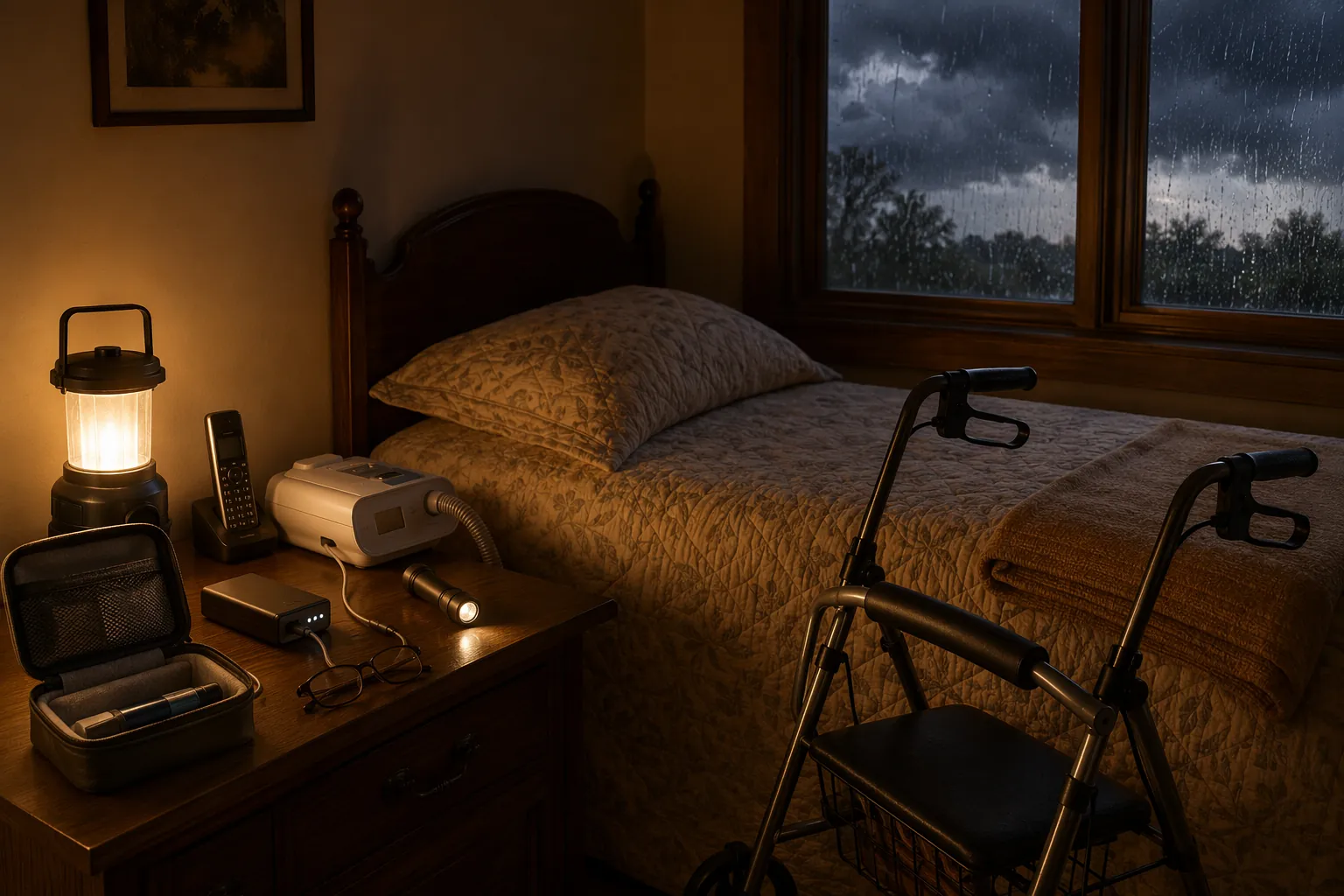
Before Dark: Sort the Night Into Three Decisions
Use the daylight you have left to separate urgent safety from ordinary misery. A bad night of sleep is not the same problem as failed oxygen, spoiled medication, a fall on the way to the toilet, or carbon monoxide exposure.
| Handle before dusk | Can wait until bedtime | Call for help or leave if this applies |
|---|---|---|
| Oxygen, CPAP or BiPAP power plan, insulin or other refrigerated medication, generator placement, bathroom route lighting | Blanket choice, pillow setup, whether to sleep in bed or recliner, noise management, comfort routines | Oxygen concentrator has no backup and the person is oxygen-dependent; indoor CO alarm sounds; generator is indoors or in a garage; confusion, chest pain, severe shortness of breath, or a serious fall occurs |
| Place flashlights where hands already go: bedside, bathroom, medication area, main exit | Decide whether to use a fan, battery lantern, or extra layer | Refrigerated medication has warmed beyond safe limits and a pharmacist or clinician cannot be reached for guidance |
Do this with the person who will actually move through the house tonight. If that person uses a walker, has poor vision, wakes to urinate, or needs medication at night, the plan has to fit those facts. Advice that works for a healthy 35-year-old with a headlamp does not automatically work for an 82-year-old using a rollator.
First, Protect Breathing Equipment and Oxygen
Ask the plain question before anything else: what machine is keeping this person safe tonight, and what happens when it stops?
A CPAP user and an oxygen-dependent person are not in the same category. Many CPAP machines do not have an internal backup battery; ResMed says its AirSense 11 does not contain an internal backup battery and requires an external power source if the wall outlet is down.[1] That is inconvenient and sometimes frightening, but one night without CPAP is not automatically a medical emergency for many users. Oxygen dependence is different. If an oxygen concentrator has no working backup, treat that as a time-sensitive medical problem, not a sleep problem.
Power-outage health data back up that priority. A narrative review of power outages and community health found that emergency department visits among adults 80 and older increased 114% after Hurricane Sandy, and it identified respiratory device failure as a leading problem during the 2003 Northeast Blackout.[2] That is why the breathing plan comes before the blanket plan.
For CPAP or BiPAP
- Check whether the machine has an actual battery, not just a power brick. Many CPAP units need a separate external battery.
- If using a battery, turn off the humidifier and heated hose if the clinician or device instructions allow it. Those features draw more power.
- Put the battery, cord, mask, and machine on the same side of the bed before dark. Do not leave one piece in another room.
- If there is no battery, sleep in the safest position the clinician has already recommended, avoid alcohol or sedating extras, and call for medical advice if the person has severe sleep apnea plus serious heart or lung disease.
- If a full-face mask has an anti-asphyxia valve, understand what it does: it allows passive room-air breathing if the machine stops. It does not turn a powerless CPAP into treatment.
Manufacturer battery numbers are useful only as rough planning figures. ResMed describes external CPAP batteries in the 90Wh to 400Wh range and gives a manufacturer benchmark for possible runtime, but real use depends on pressure settings, leaks, humidification, heated tubing, and battery age.[1] A clinical sleep-medicine source likewise notes that CPAP battery backup is not built into many machines and that insurance coverage varies because some plans treat batteries as convenience items rather than medical necessity.[3] Do not discover that at 11 p.m.
For Oxygen Concentrators
If the person uses prescribed oxygen, find the backup supply while there is still light. Count the portable tanks. Check the regulator. Confirm the flow setting. If there is no backup and the concentrator is dead, call the oxygen supplier, clinician on call, local emergency management line, or 911 depending on symptoms and local instructions. Do not wait to see whether the power returns after bedtime.
Warning signs that should not be managed at home include severe shortness of breath, blue or gray lips, new confusion, chest pain, fainting, or inability to stay awake normally. In an outage, those symptoms are not solved by opening a window or propping up pillows.
Keep Insulin and Refrigerated Medication Cold Without Ruining the Supply
Medication comes next because it is easy to damage while trying to be careful. Insulin begins to degrade above 77°F, and refrigerated medications can degrade faster than food.[4] The CDC says a closed refrigerator can keep food safe for about 4 hours during a power outage, and a full freezer can hold temperature for about 48 hours if the door stays closed.[5] Those food timelines are helpful, but they are not a permission slip to treat every medication as safe.
- Open the refrigerator once, before dark, and remove only the medication that needs a controlled plan.
- Place insulin or other refrigerated medication in an insulated medication pouch or small cooler, separated from direct contact with ice packs unless the product instructions allow it.
- Put a thermometer in the cooler if one is available. Do not guess by touch.
- Write down the time the power failed, the time the medication was moved, and any temperature reading.
- If the medication gets warm, freezes, changes appearance, or you cannot verify safe storage, call a pharmacist or prescriber before using it when possible.
Do not keep reopening the refrigerator to reassure yourself. That is how the cold air is lost. Pick the medication plan once, label it, and leave the food alone unless there is a medical reason to open the door.
Do Not Rely on Alerts an Older Adult May Not Hear
Phone alerts, smoke alarms, and CO alarms matter, but they are not a complete plan for older ears. About 22% of adults ages 65 to 74 and 55% of adults 75 and older have disabling hearing loss.[4] If the plan is “the alarm will wake her,” check whether that has ever been true at night.
Before bedtime, set alerts in more than one form if possible: sound, vibration, flashing light, and a human check-in. Put the phone or weather radio where the person can reach it without standing. If a caregiver is nearby, agree on a check time instead of assuming everyone will wake when conditions change.
This is especially important if the older adult sleeps without hearing aids. Many people remove them at night, exactly when a storm alert or alarm would need to do its work.
Make the Bed-to-Bathroom Route the Main Fall-Prevention Project
The dangerous trip is often not dramatic. It is one ordinary bathroom trip at 2 a.m., in a hallway that looks different because the power is out.
Set up the night as if the person will wake groggy and need the toilet. That is the safer assumption.
- Move throw rugs, baskets, shoes, pet bowls, charging cords, and extra chairs out of the path.
- Park the walker, cane, or rollator on the side of the bed the person actually uses.
- Place a lantern low enough to light the floor but not where it shines into the eyes.
- Put a flashlight on the nightstand and another in the bathroom, both facing the same direction each time.
- If the bathroom is far away, consider a bedside commode only if the person already knows how to transfer safely to it.
- Keep shoes or non-skid slippers at the bedside. Socks on smooth floors are not fall protection.
Do not rearrange the bedroom into a clever new storm layout unless you must. Familiar placement is a safety feature. If a chair has been beside the bed for years, moving it during an outage may create the very hazard you were trying to fix.
Manage Temperature Without Creating Carbon Monoxide Risk
A warm or cold bedroom can wreck sleep. Carbon monoxide can kill. Keep those two facts in the right order.
In the power-outage health literature, carbon monoxide poisoning is the most documented health outcome: Casey and colleagues found it in 23 of 50 reviewed studies, with indoor generator use identified as the primary cause.[2] The CDC warns never to use generators, grills, camp stoves, or similar fuel-burning devices inside the home, basement, garage, or near a window.[5] The Red Cross also instructs households to keep generators outdoors and away from windows, doors, and vents.[6]
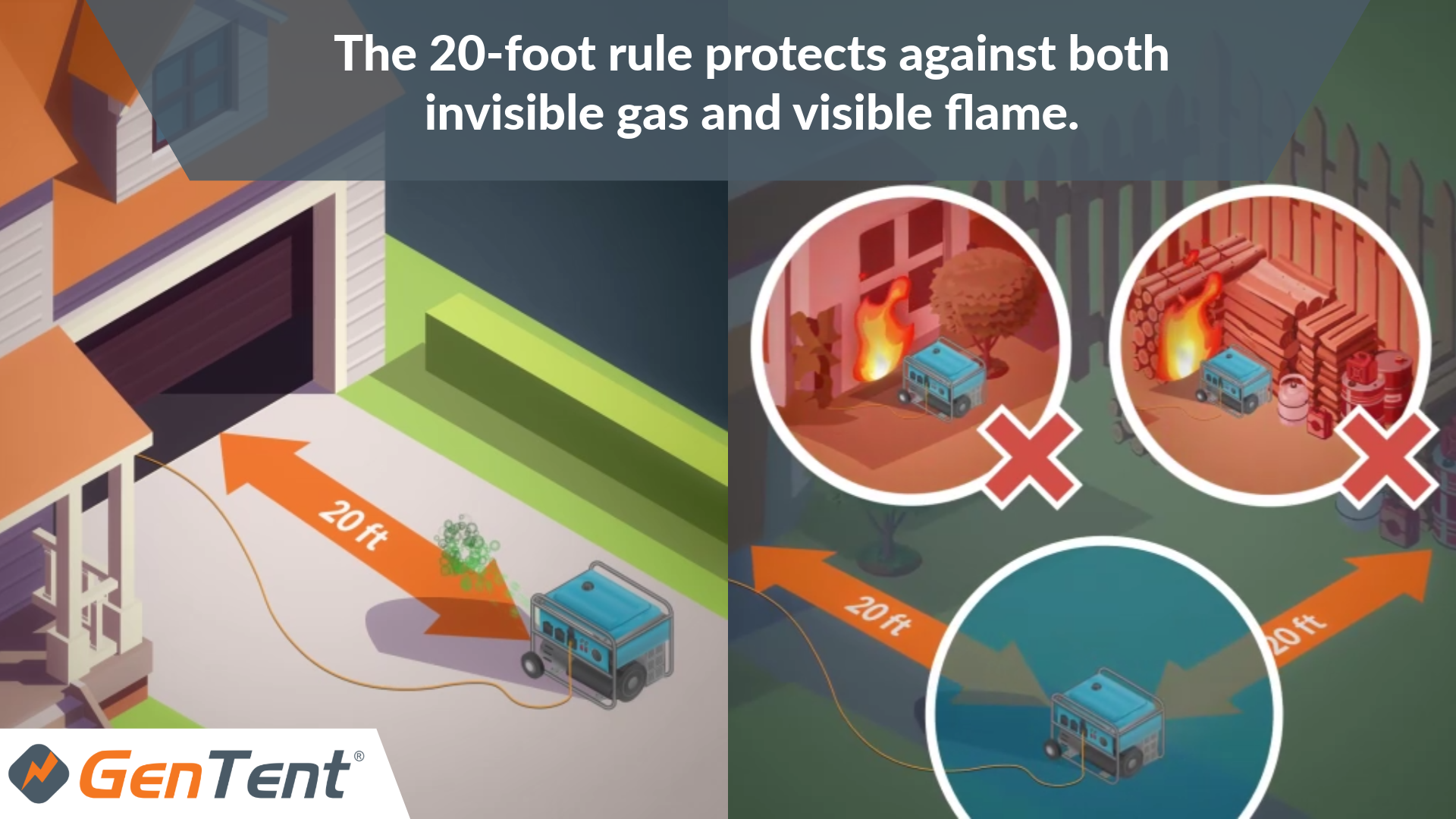
The CDC’s generator rule is specific: keep generators outside and at least 20 feet away from windows, doors, and vents.[5] A garage with the door open is still not outside. A covered porch is not automatically safe. A generator close to a bedroom window is not a sleep aid; it is a poisoning risk.
If the House Is Cold
Use layers, blankets, hats, and one smaller sleeping area before you even think about fuel-burning heat. Older adults can show subtle hypothermia signs: confusion, slurred speech, clumsiness, drowsiness, or shivering that stops. Those signs need action, not another blanket and crossed fingers.
If the House Is Hot
Move to the coolest safe room before bedtime, not after the person is exhausted. Use light bedding, loose clothing, cool cloths, and battery fans if available. Sleep is often disrupted below 65°F and above 75°F, with an ideal sleep range often described around 68°F to 72°F, but comfort numbers are secondary to heat-illness signs.[7] New confusion, faintness, chest pain, severe weakness, or inability to cool down should prompt medical help.
Set the Sleeping Spot for Safety, Not Perfect Sleep
A familiar bed is usually safer than a sofa if the person normally transfers well from that bed. Sofas are low, soft, and awkward to stand from. Recliners can be useful for some people with breathing or reflux issues, but they can also trap a tired person in a poor transfer position. Choose the place where getting up at night will be safest.
- Keep the call bell, phone, or medical alert button on the dominant-hand side.
- Put glasses, dentures, hearing aids, and medications in a shallow tray so they are not swept onto the floor.
- Keep water nearby, but not where it can spill onto cords, batteries, or the walking path.
- Use battery lanterns or flashlights. Avoid candles around oxygen, bedding, pets, and sleepy people.
- If the person is at high fall risk, agree that they will call before getting up, even if they dislike needing help.
If anxiety is keeping everyone awake, it may help to understand why outages feel so unsettling in the body; this power-outage sleep disruption guide covers the general sleep mechanisms. Tonight, though, the practical setup matters more than explaining every sensation.
If Sleep Breaks Apart Overnight
Expect broken sleep. Storm noise, heat, cold, missing CPAP airflow, worry about the refrigerator, and unfamiliar lighting can all wake a person repeatedly. The goal is to avoid adding injury to fatigue.
When the person wakes, keep the response boring and safe: turn on the bedside light, sit at the edge of the bed before standing, use the walker, go to the bathroom by the cleared route, and return the flashlight to the same spot. Do not walk through the house checking windows, breakers, or the refrigerator unless there is a safety reason.
Caregivers should resist the urge to keep troubleshooting all night. If oxygen is handled, medication is protected, the generator is safely outside, and the bathroom route is clear, then a stretch of poor sleep is unpleasant but usually not the emergency. Save your attention for symptoms: breathing trouble, confusion, dizziness, chest pain, a fall, a CO alarm, or a medication problem.
If the Power Comes Back While Everyone Is Asleep
Power returning at 3 a.m. can be its own small hazard. Lights flash on. Machines beep. A CPAP restarts. The refrigerator hums. Someone gets up too fast to “fix everything.”
Unless there is an alarm or medical device issue, sit up first, turn on a light, and move slowly. Check the breathing device connection before putting the mask back on. If a generator is running, turn off and disconnect equipment according to the generator instructions; do not handle wet cords or rush outside in storm conditions just because the lights returned.
For a fuller morning-after sleep reset, use this guide to sleeping after power outage recovery. The overnight priority is still safe movement, safe equipment, and safe medication.
Morning Handoff
In the morning, do not just celebrate the power returning and put everything away. Check what failed while the details are still fresh.
- Confirm whether refrigerated medication stayed within its required storage range, and call a pharmacist if there is any doubt.
- Recharge CPAP batteries, phone banks, lanterns, hearing-assistive devices, and medical alert devices.
- Write down what equipment did not work, which cord was missing, and which route or transfer felt unsafe.
- Replace used batteries, ice packs, oxygen supplies, and medication cooler items.
- Ask the clinician, oxygen supplier, pharmacist, or insurer about a backup plan if this outage exposed a medical dependency that cannot be improvised safely.
Once the urgent recovery is handled, older adults and caregivers can also revisit ordinary sleep routines with better sleep habits for grandparents. But if the night showed that oxygen, CPAP, insulin, lighting, or bathroom access depended on luck, the next storm needs a clinician-approved backup plan, not another improvised night.
References
- Should I get a CPAP battery? — Resmed — https://www.resmed.com/en-us/sleep-health/blog/should-i-get-a-cpap-battery/
- Power Outages and Community Health: A Narrative Review — PMC — 2020 — https://pmc.ncbi.nlm.nih.gov/articles/PMC7749027/
- Does My CPAP Have a Battery Backup? — Enticare — 2024-07-23 — https://enticare.com/2024/07/23/cpap-battery-backup-power-outage/
- Power Outage Preparedness for Seniors & Elderly — PowerOutage.us — https://poweroutage.us/storm-prep/power-outage-preparedness-seniors-elderly
- What to Do to Protect Yourself During a Power Outage — CDC — https://www.cdc.gov/natural-disasters/response/what-to-do-protect-yourself-during-a-power-outage.html
- Power Outage Safety — American Red Cross — https://www.redcross.org/get-help/how-to-prepare-for-emergencies/types-of-emergencies/power-outage.html
- Tips for Sleeping in Hot Weather Without AC — HealthPartners — https://www.healthpartners.com/blog/tips-for-sleeping-without-air-conditioning/
Safety & eligibility read
Cross-check against other interventionsExplore the mechanism
Next step
Spot an error or have clinical feedback?
Because this article covers clinical, medication, or safety information, we use a moderated correction channel instead of open public comments. Let us know if something about “How Older Adults Can Sleep Safely During a Storm Power Outage” needs a closer look.
Send feedback on this article