How to Sleep After Flood Evacuation Stress
Learn how to get usable sleep when displaced by flooding—whether in a shelter, car, or temporary housing. This guide covers practical environmental fixes, nervous system calming techniques, and when to seek professional help for trauma-related insomnia.
If you were evacuated because of flooding and now cannot fall asleep—or you keep jolting awake—your body is not failing a sleep test. Sleep problems are an expected reaction after a terrifying, unexpected event, and acute stress reactions can last from days up to a month; most people recover without treatment.[1] Tonight, the goal is not perfect sleep. It is usable sleep: enough rest to think more clearly tomorrow, whether you are on a shelter cot, reclined in a car seat, or lying awake in temporary housing or someone else’s home.
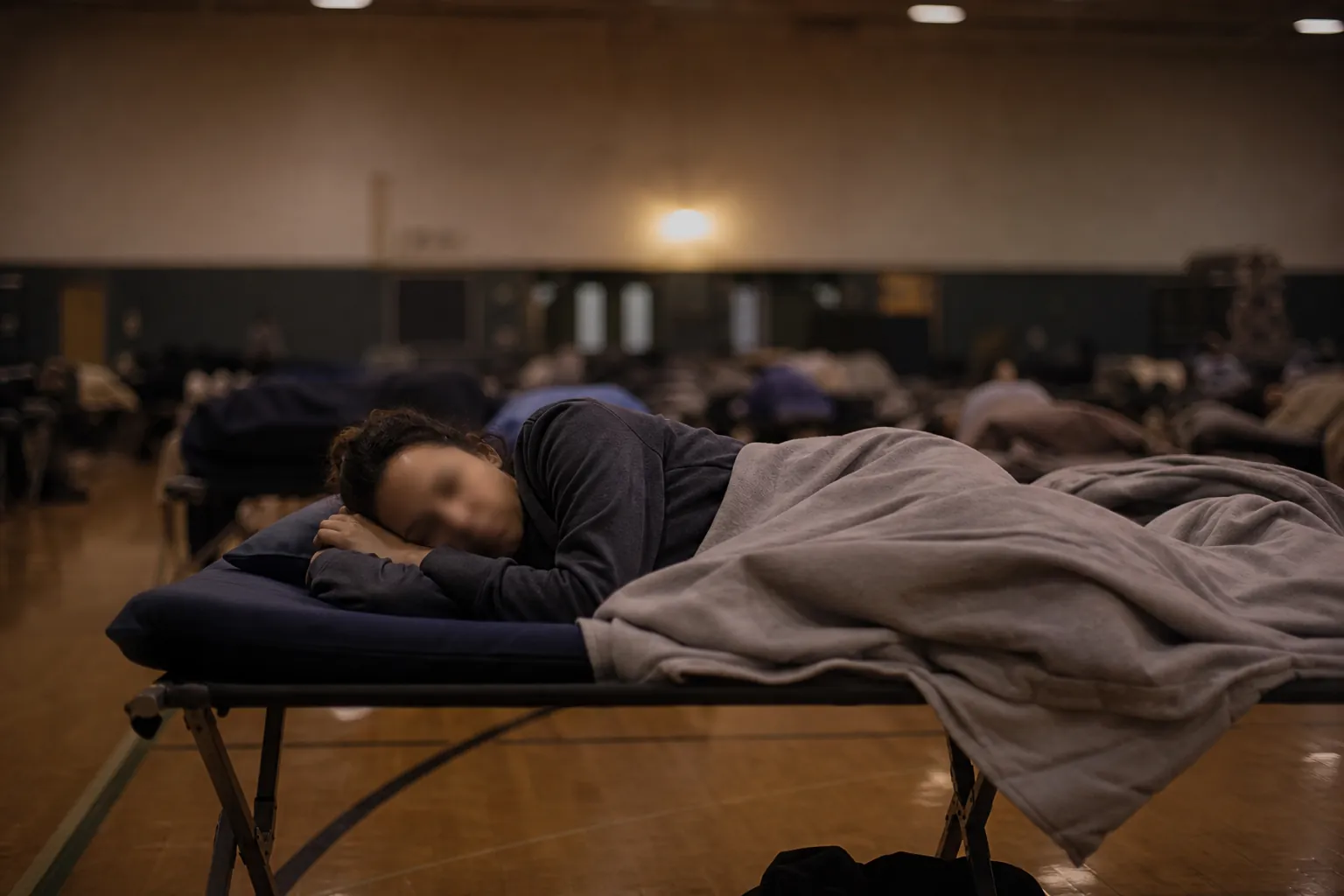
Flood evacuation sleep is hard for two reasons at once: the place is working against sleep, and your nervous system is still checking for danger. Treat both. Do not waste tonight trying to recreate your normal bedroom if you do not have one.
The floor and the car seat are not neutral
A shelter floor, a cot in a gym, or a reclined car seat can look like “a place to lie down” from the outside. Your sleep system does not experience them that way.
In an EEG-monitored study that recreated disaster evacuee sleep environments, sleeping on a shelter floor or in a car significantly increased wake after sleep onset, shortened REM sleep, lengthened the time it took to reach REM, and increased shifts between sleep stages. Sleeping in a car seat also increased sympathetic nervous system activity, a sign that the body stayed more activated during the night.[2]
That study was done in a laboratory with healthy young Japanese men, so it cannot tell us exactly what every flood evacuee, older adult, child, pregnant person, or person with chronic pain will experience. But it does show something important: these sleep locations can measurably fragment sleep even before adding fear, noise, wet clothing, medication schedules, pets, children, damaged homes, insurance calls, and the sound of other people moving around all night.[2]
So if you slept for six hours but feel as if you barely slept, that may be because your sleep was repeatedly interrupted after it began. If you finally fell asleep but woke before feeling restored, your body may have had less consolidated REM and more stage shifting than it would at home. The fix is not to scold yourself into relaxing. The fix is to reduce as many wake-up triggers as the current location allows.
First, make the place less hostile to sleep
Start with the environment before you try to reason your way into sleep. In disaster settings, basic modifications such as earplugs, eye masks, temperature regulation, and white noise are recommended because they reduce the sensory interruptions that keep the body alert.[3] These are not spa accessories. In a shelter or car, they are protective equipment for sleep.
| If you are sleeping... | Try this first | Why it matters tonight |
|---|---|---|
| On a shelter floor or cot | Put any available padding under the hips and shoulders; use a rolled towel or clothing bundle to support the neck; turn your body so foot traffic is not directly in your face. | Pressure points, visible movement, and people stepping near you can keep triggering partial awakenings. |
| In a car | Recline only as far as is safe; avoid sleeping with your chin sharply dropped; support the low back and neck with clothing; keep doors locked; follow local safety guidance about ventilation and location. | The car seat position itself can keep the body more activated, so reducing strain and perceived threat matters.[2] |
| In temporary housing or someone else’s home | Claim one sleep corner, even if it is just a side of a couch; keep essential items in the same reachable place each night; ask for a predictable quiet window if you can. | A small, repeatable setup lowers the amount your brain has to monitor in an unfamiliar place. |
| Near children, older adults, pets, or medical equipment | Decide who is “on watch” for the next block of time if another adult is present; place needed items within reach before lying down. | The brain sleeps more lightly when it believes no one is assigned to respond. |
For noise, use the least complicated barrier you have. Foam earplugs are useful if you can hear alarms and people who depend on you. If earplugs are unsafe or unavailable, steady sound can be better than unpredictable sound: a fan, a white-noise app at low volume, or a phone playing rain-free ambient noise can mask footsteps and conversations. Keep the volume low enough that emergency announcements still cut through.
For light, an eye mask is ideal, but a clean T-shirt folded over the eyes can work if it does not cover the nose or mouth. If you are caring for children, consider dimming rather than blocking light completely so you can orient quickly when they wake.
For temperature, think in removable layers. Shelters and temporary spaces often swing between too cold and too warm. Damp socks, wet cuffs, and clammy base layers can keep the body from settling, so change the layer touching your skin first if you have anything dry. If you only have one blanket, fold part of it under you instead of putting all of it over you; cold from the floor can wake you as reliably as cold air.
For shared-space boundaries, do the smallest thing that changes the sleep signal. Turn your shoes and bag into a visible edge beside your cot. Put your phone, documents, medication, glasses, keys, and water in the same pocket or bag every night. If someone keeps starting conversations after you lie down, a plain sentence is enough: “I’m going to try to sleep now; I can talk in the morning.” You do not need to perform friendliness at the cost of tomorrow’s functioning.
Then lower the alarm in your body
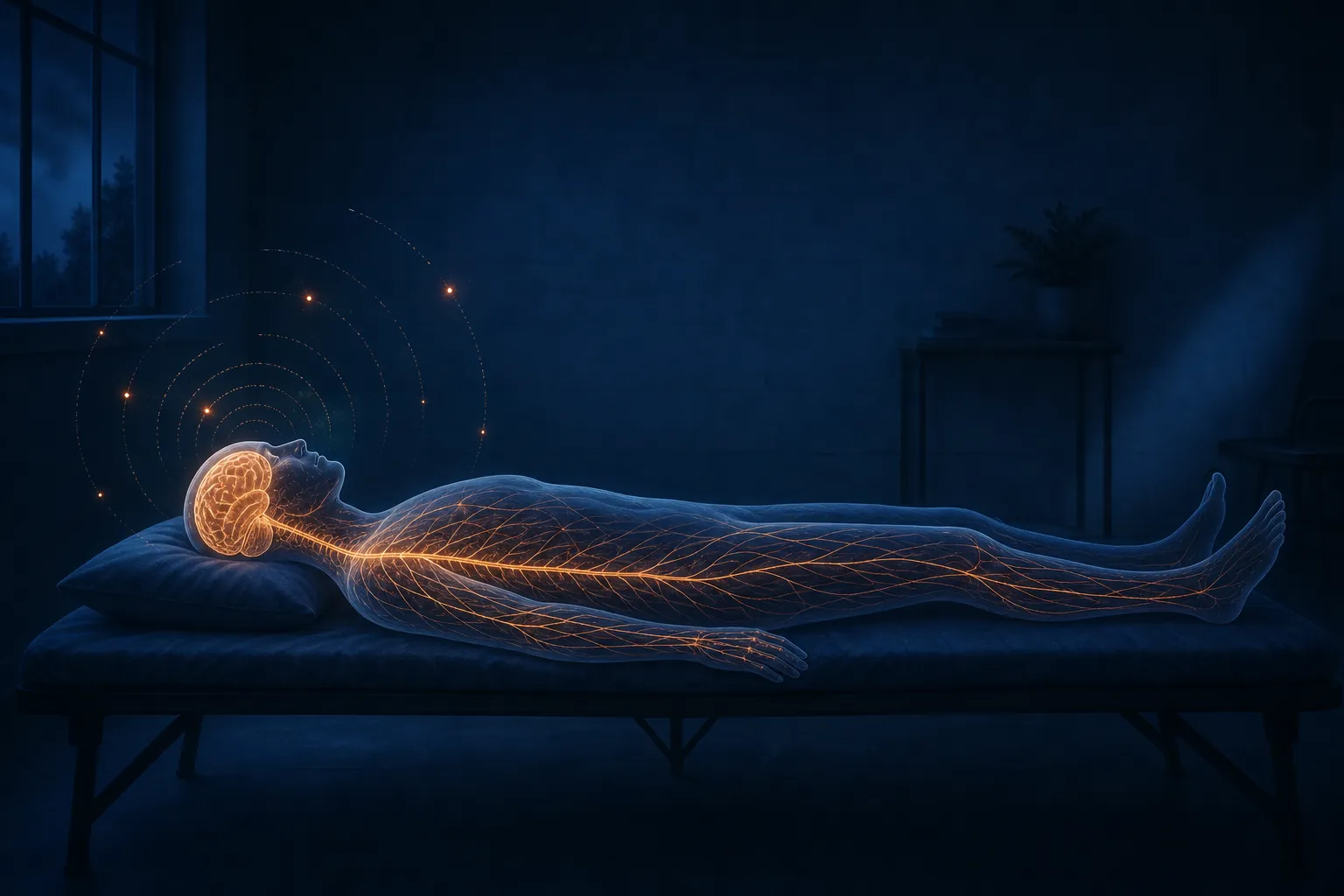
After evacuation, the body may keep acting as if it is still responsible for detecting water, sirens, road closures, missing people, or the next instruction. That scanning can continue even when the immediate danger has passed. The aim is not to convince yourself that everything is fine. The aim is to give the body repeated evidence that, for this short block of time, it can stand down a little.
Choose one quiet technique. Do not cycle through ten of them in frustration.
- Longer exhale breathing: Inhale gently through the nose or mouth, then make the exhale slightly longer than the inhale. Count if counting helps; drop the counting if it turns into another task.
- Body contact check: Notice the places where your body is supported: heel, calf, hip, shoulder, hand. Press each area down lightly for a second, then release. This works even on a cot or car seat.
- Orienting: Name, silently, five stable things around you: wall, bag, blanket, door, light. Then name the current date or location if that feels grounding rather than upsetting.
- One-muscle release: If full progressive muscle relaxation is too much, relax only the jaw, hands, or shoulders. Pick the place you are gripping hardest.
If you are still awake after a while, avoid turning the night into a courtroom where you prosecute yourself for not sleeping. In a normal home, getting out of bed can help break the association between bed and wakefulness. In a shelter or car, that may be unsafe, disruptive, or impossible. Instead, change state in place: sit up for a few minutes, sip water, loosen one layer, stretch your feet, or turn the pillow or clothing bundle over. Then lie back down and repeat the same calming cue.
If the flood came with severe weather and your fear is tied to thunder, wind, or alerts, you may also find the storm-specific steps in Can’t Sleep After a Storm? Here’s What to Do Tonight useful. The overlap is real, but evacuation adds a separate problem: you are trying to sleep in a place your body did not choose.
When worst-case thoughts keep restarting the night
Flood thoughts are often practical at first: Is the water rising? Where are the documents? Is the medication safe? Who has checked on the neighbor? The problem begins when the mind keeps replaying worst-case scenes when there is no action available until morning.
A 2025 study of 1,526 survivors of the 7·20 Henan flood found that disaster exposure was significantly associated with more severe insomnia, and catastrophizing—imagining or magnifying worst-case outcomes—partly explained that association.[4] That does not mean people caused their own insomnia by thinking wrong thoughts. It means that after real danger, the mind may keep using catastrophe rehearsal as a safety behavior, and that rehearsal can keep sleep switched off.
Contain the loop without arguing that the danger was imaginary. Use a small, concrete format:
- Name the fear: “I’m afraid the water will rise again,” or “I’m afraid I missed an important form.”
- Name the next check: “I will check the official alert channel at 6:30,” or “I will call the claims number after breakfast.”
- Name what is already done: “The kids are here,” “The car is parked on higher ground,” “The medication is in the bag,” or “The shelter staff will announce evacuation changes.”
If writing helps, use paper or your phone’s notes app, but keep it short. A flood recovery list can become endless at 2 a.m. The point is not to solve the whole disaster from a cot. The point is to park the next available action where your brain can find it in the morning.
For a deeper explanation of how emotional overload keeps the body awake, see How Emotional Breakdowns Disrupt Your Sleep. If your symptoms feel more like trauma replay, hypervigilance, or a body stuck on high alert, the mechanisms described in How Car Accident Stress Causes Insomnia and What Works may also feel familiar, even though the event was different.
A realistic plan for the next few days
After the first night, build repeatability where you can. Disaster life is full of queues, calls, forms, cleanup, transportation problems, and other people’s schedules. A tiny sleep pattern is still better than a fantasy routine you cannot perform.
- Keep one wake-up anchor. If bedtime is chaotic, choose a roughly consistent wake time or first-light routine: bathroom, medication, water, step outside if safe, check official updates.
- Use daylight as a reset. Morning outdoor light, even briefly, helps the body distinguish day from night when you are sleeping in a windowless shelter or unfamiliar room.
- Nap carefully if you are depleted. A short daytime rest may be necessary after a broken night. If naps make the next night worse, keep them earlier and shorter when you have control.
- Separate alert-checking from sleep as much as possible. Choose one or two reliable alert sources. Rechecking scattered feeds all night can keep the nervous system in emergency mode.
- Protect medication and medical routines. Missed doses, pain flares, asthma symptoms, blood sugar swings, and withdrawal from usual substances can all wreck sleep. If your medication was lost or contaminated, ask shelter staff, a pharmacy, or a clinician how to replace it.
General sleep hygiene can still help, but only after it has been translated into the place you are actually sleeping. If you later regain a stable bedroom and want to rebuild the basics, use Sleep Hygiene Fundamentals and an Evidence-Based Bedtime Routine. For now, “routine” may mean the same hoodie as a pillow, the same earplug routine, the same bag placement, and the same three-line plan before you close your eyes.
When sleep problems are no longer just the first shock
For the first several days, broken sleep can fit the body’s acute stress response. SleepEducation.org describes sleep disruption after trauma as common, with acute stress disorder symptoms lasting from days up to one month, and notes that most people recover without treatment.[1]
Still, do not let “normal after trauma” become a reason to suffer indefinitely. If insomnia is still severe after two weeks—especially if you cannot function, drive safely, care for dependents, manage work, or stop replaying the event—it is reasonable to seek evaluation. You do not have to wait until you are completely falling apart to ask for help.
If sleep difficulties persist beyond one month despite basic supports, SleepEducation.org recommends getting professional help.[1] Flood-related mental health risk is real: reporting on research from the University of York and Centre for Mental Health noted that flood victims were nine times more likely to experience long-term mental health problems, with PTSD prevalence reported across a wide range of 7% to 44%.[5] At the same time, PTSD is not the most common outcome after trauma; Sleep Foundation notes that fewer than 10% of people exposed to trauma develop PTSD.[6]
The practical meaning is simple: take persistent symptoms seriously without assuming your future is decided by this week’s sleep. Professional care may include CBT-I for insomnia, trauma-focused therapy, or both. The U.S. Department of Veterans Affairs describes trauma-focused psychotherapy lasting 8 to 16 sessions as the most effective treatment following disaster, and CBT-I has shown durable sleep improvements in people with PTSD.[7] If insomnia is becoming its own problem, What Actually Cures Insomnia? CBT-I Explained is a useful next read.
Get help sooner if you feel unable to stay safe, are having thoughts of self-harm, are using alcohol or drugs to force sleep, are having panic symptoms that feel unmanageable, or are responsible for driving or caregiving while severely sleep deprived. In the U.S., the SAMHSA Disaster Distress Helpline is available 24/7: call or text 1-800-985-5990.[8]
Sleep after flood evacuation is not about proving you can sleep normally in abnormal conditions. It is about making the current place less punishing, giving the alarm system fewer reasons to fire, containing the thoughts that can wait until morning, and knowing when temporary stress insomnia has stopped being temporary.
References
- Sleeping after a trauma, SleepEducation.org
- Evaluation of Sleep Quality in a Disaster Evacuee Environment, PMC, 2020
- How to Manage Your Sleep During and After a Disaster, SleepHealth.org
- Disaster Exposure and Insomnia Severity During 7·20 Flood in Henan, PMC, 2025
- Flood victims nine times more likely to suffer long-term mental health problems, The Guardian
- Trauma and Sleep, Sleep Foundation
- Disaster Mental Health, PTSD: National Center for PTSD, U.S. Department of Veterans Affairs
- Disaster Distress Helpline, SAMHSA
Explore the mechanism
Next step
Spot an error or have clinical feedback?
Because this article covers clinical, medication, or safety information, we use a moderated correction channel instead of open public comments. Let us know if something about “How to Sleep After Flood Evacuation Stress” needs a closer look.
Send feedback on this article