
Should men get testosterone screening for sleep issues?
A guide for men aged 40–70 with persistent poor sleep who are wondering whether low testosterone could be the cause and whether screening would help. The evidence shows that screening is most useful when sleep problems occur alongside other low-T symptoms and risk factors, but only after ruling out obstructive sleep apnea — because treating apnea may raise testosterone naturally, and starting testosterone therapy before ruling out severe OSA can worsen sleep-disordered breathing.
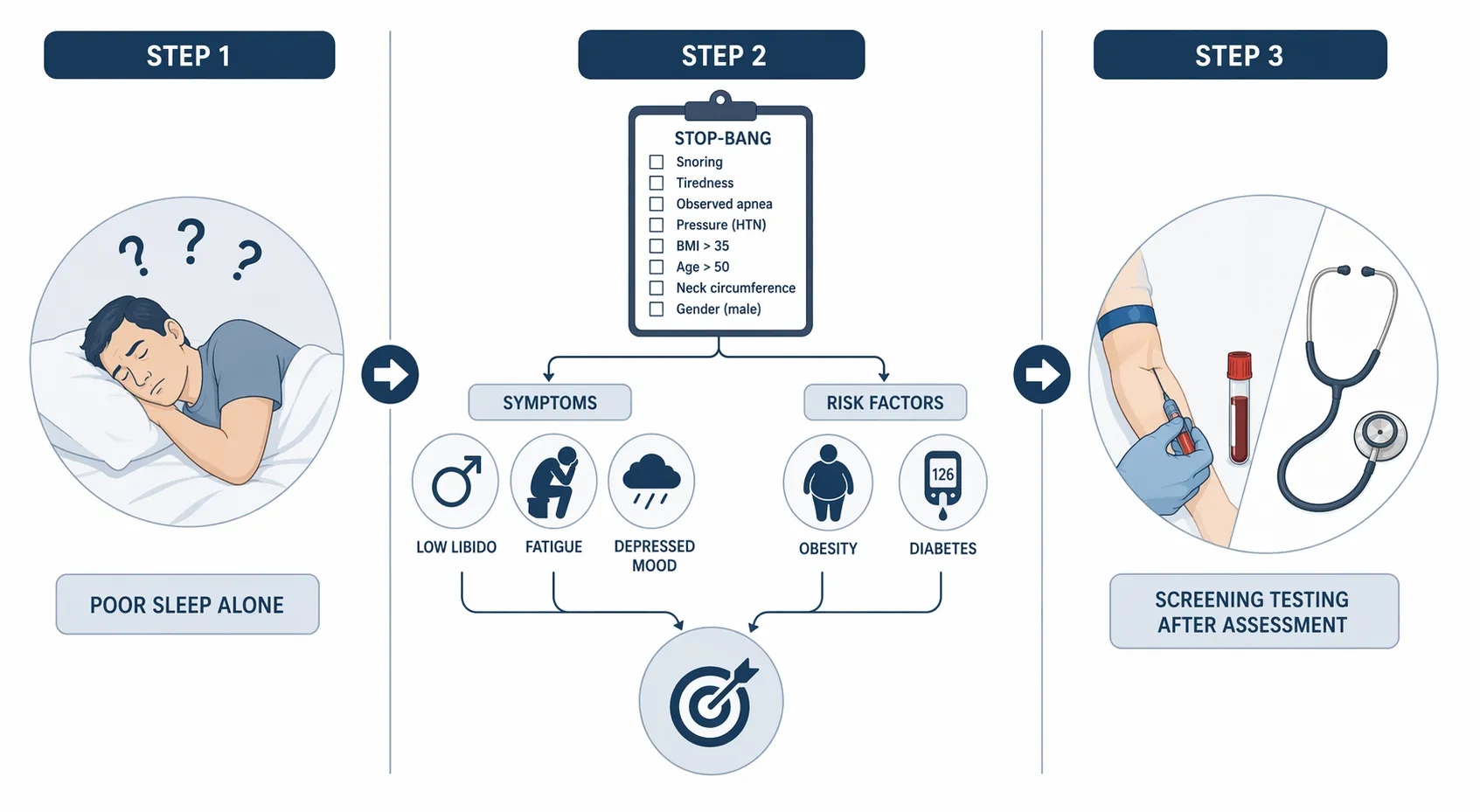
Poor sleep by itself is usually not a strong reason for a man to get testosterone testing in hopes of sleeping better. It becomes a more reasonable conversation when the bad sleep sits in a larger pattern: low libido, fewer or absent morning erections, fatigue that does not match the night before, depressed mood, hot flashes, obesity, type 2 diabetes, metabolic syndrome, opioid use, or a history that points toward pituitary or testicular disease.
That distinction matters because the most common trap is also the most tempting one. A man sleeps poorly for months, sees a testosterone ad, and decides a morning blood draw will finally make the problem concrete. Sometimes that test is useful. But if he snores heavily, wakes choking, has high blood pressure, carries weight around the neck and abdomen, or has a bed partner reporting pauses in breathing, the sleep-apnea question belongs near the front of the visit, not after a testosterone prescription has already been written.
Why the question is legitimate
Sleep and testosterone do talk to each other. In a small controlled study, one week of sleeping fewer than 5 hours per night reduced daytime testosterone levels by 10% to 15% in healthy young men.[1] In older men studied with polysomnography, total sleep time was an independent predictor of morning total and free testosterone.[2] Those findings do not mean that every restless night is an endocrine disorder. They do mean a man is not imagining the connection when months of shortened, fragmented sleep seem to arrive with changes in energy, mood, and sexual function.
There is also evidence in the other direction. Shigehara and colleagues reported that sleep disturbance can be a clinical sign of severe hypogonadism, and that testosterone replacement improved sleep conditions over 1 year in hypogonadal men who did not have obstructive sleep apnea.[3] The qualifying phrase is doing a lot of work: without obstructive sleep apnea. That study supports taking sleep complaints seriously in men with clear hypogonadism features. It does not turn testosterone into a general sleep treatment.
A better way to think about it is as a feedback loop. Sleep restriction can push testosterone down. Severe testosterone deficiency can show up partly as poor sleep. Obesity and metabolic disease can worsen both. Obstructive sleep apnea can fragment the night and distort the morning lab picture. The job in clinic is to separate those strands before deciding what a testosterone number means.
When poor sleep is not enough
If the complaint is only insomnia, light sleep, early waking, or feeling unrefreshed, testosterone testing is usually a low-yield first move. The more basic questions still deserve time: sleep schedule, alcohol, medications, pain, depression, anxiety, restless legs symptoms, nocturia, shift work, caffeine timing, and apnea risk. A testosterone result can distract from those questions because it looks clean and decisive even when it is only one piece of the physiology.
Screening becomes more sensible when poor sleep travels with symptoms that actually fit androgen deficiency. Mayo Clinic’s diagnostic material for male hypogonadism emphasizes that evaluation is based on symptoms plus blood testing, not a lab number in isolation.[4] Guideline reviews also describe testing as most appropriate when symptoms and risk factors point in the same direction.[5]
- Symptoms that strengthen the case: low libido, fewer morning erections, erectile changes, persistent fatigue, depressed mood, and hot flashes.
- Risk factors that strengthen the case: obesity, type 2 diabetes, metabolic syndrome, chronic opioid use, pituitary disorders, testicular injury, and increasing age after midlife.
- Clues that shift attention toward sleep apnea first: loud snoring, witnessed pauses in breathing, waking gasping or choking, resistant or rising blood pressure, large neck circumference, and marked daytime sleepiness.
This is where many men get stuck in the exam room. They do not want to sound as if they are asking for testosterone therapy, but they also know something has changed. A practical way to say it is: “I’m sleeping badly, and I’ve also noticed lower libido, fewer morning erections, and more fatigue. I snore and my partner has noticed breathing pauses. Should we check for sleep apnea and consider morning testosterone testing?” That sentence gives a clinician a much better map than “Can you check my T?”
The order of operations
| What is happening | What should move forward first |
|---|---|
| Poor sleep without low-T symptoms or major risk factors | Evaluate common sleep, mood, medication, and lifestyle causes before testosterone testing |
| Poor sleep plus low libido, fewer morning erections, fatigue, depressed mood, hot flashes, or relevant medical history | Discuss morning testosterone screening with a healthcare professional |
| Poor sleep plus snoring, witnessed apnea, gasping, high blood pressure, obesity, older age, or large neck circumference | Assess obstructive sleep apnea risk before considering testosterone treatment |
| High OSA risk and low-T symptoms together | Evaluate or manage OSA while deciding whether testosterone labs are appropriate |
The table is deliberately simple because the clinical reality is not. A man can have both low testosterone and obstructive sleep apnea. A low morning testosterone result does not prove that testosterone deficiency caused the bad sleep. And treating the number before understanding the breathing problem can make the night worse.
Why sleep apnea comes before testosterone treatment
Obstructive sleep apnea is not just another item on a long checklist. In this age group, it is often the condition that explains the fatigue, the morning fog, the blood pressure drift, and the bed partner’s exasperation. It may also contribute to a lower testosterone reading, especially when it is tangled with obesity and metabolic disease.
The STOP-BANG questionnaire is a common first-pass screen: Snoring, Tiredness, Observed apnea, Pressure or high blood pressure, BMI above 35, Age above 50, Neck circumference above 40 cm, and male sex. A score of 3 or higher is often used as a threshold at which polysomnography should be considered before testosterone workup or treatment decisions move too far ahead.[6]
Some of those items sound almost too ordinary to mention. Men snore. Men get tired. Necks thicken with age. But that is exactly why the screen helps. It turns what a couple may have normalized for years into a pattern a clinician can act on. Snoring plus witnessed pauses is different from insomnia alone. Fatigue plus high blood pressure and a large neck is different from a stressful month at work.
The treatment fork is important. If excess weight is helping drive OSA and low testosterone, weight loss can increase testosterone in a roughly linear relationship, while CPAP alone does not reliably raise testosterone.[7] That does not make CPAP unimportant; it means CPAP’s main job is to treat breathing during sleep, not to serve as a guaranteed hormone intervention.
Starting testosterone therapy in a man with untreated severe OSA changes the risk calculation. The Endocrine Society recommends against starting testosterone replacement therapy in men with untreated severe OSA, and other major sexual-medicine and urology guidelines recommend OSA screening before TRT is initiated.[6] That is not bureaucratic caution. In obese men with severe OSA, testosterone therapy worsened the oxygen desaturation index by 10.3 events per hour at 7 weeks in one randomized trial.[8] In a claims-based study, the 2-year risk of obstructive sleep apnea was 16.5% among testosterone replacement users versus 12.7% among controls.[9] In older men given high-dose testosterone, total sleep time fell by about 1 hour and hypoxemia duration increased by about 5 minutes per night.[10]
Newer trial follow-up keeps the caution alive. In the T4DM postrandomization follow-up, new OSA diagnoses were more frequent in the testosterone group than in the placebo group, 3.0% versus 0.4%, and 25% of participants already had sleep apnea at baseline.[11] Those figures do not prove that every formulation, dose, or patient profile carries the same risk. They do explain why untreated severe OSA should not be waved away as a side issue when testosterone therapy is being discussed.
What testosterone screening actually looks like
If the symptom cluster and risk profile make screening appropriate, the first test is usually a morning total testosterone level, drawn between 8 and 10 AM or at least before 10 AM. Testosterone varies across the day, and a late-afternoon value can mislead. Diagnosis should not be made from one result; standard practice is to confirm with two separate morning measurements on different days.[4][5]
The second draw is not a formality. Illness, poor sleep, alcohol, calorie restriction, medication changes, and lab variation can all affect a single result. A borderline low value after a terrible week should be treated as a clue, not a verdict. Symptoms still matter, and so does the lab’s own reference range.
Follow-up testing depends on the result and the clinical picture. Common additional labs include luteinizing hormone, follicle-stimulating hormone, sex hormone-binding globulin, prolactin, and hematocrit.[5] Those tests help distinguish whether the signal points more toward the testes, the pituitary-hypothalamic axis, altered binding proteins, medication effects, or a safety concern that would matter if treatment were ever considered.
| Test or measure | Why it may be ordered |
|---|---|
| Morning total testosterone | Initial screen when symptoms and risk factors fit |
| Repeat morning total testosterone | Confirms that a low result is persistent rather than a one-off fluctuation |
| LH and FSH | Helps distinguish primary testicular from central pituitary-hypothalamic patterns |
| SHBG | Helps interpret total testosterone when binding protein levels may alter the apparent result |
| Prolactin | May be checked when central causes are suspected |
| Hematocrit | Establishes a safety baseline relevant to testosterone therapy discussions |
How to read a low or borderline result
Thresholds are not as tidy as marketing pages make them look. The American Urological Association uses a total testosterone cutoff below 300 ng/dL. The Endocrine Society uses below 264 ng/dL, while also recognizing a symptomatic mild hypogonadism range from 264 to 400 ng/dL. The International Society for Sexual Medicine and British Society for Sexual Medicine use lower thresholds, including total testosterone below 231 ng/dL or free testosterone below 6.5 ng/dL when SHBG is low.[5]
That variation is not an invitation to shop for the most favorable number. It means diagnosis rests on repeated morning labs, symptoms, risk factors, assay differences, and clinical judgment. A man with classic symptoms and repeatedly low values is in a different category from a man with isolated insomnia and one borderline result. A man with loud snoring and witnessed apneas needs the breathing problem addressed even if the testosterone result is also low.
The causality remains unsettled in places. Obesity can lower testosterone and increase OSA risk, making it difficult to know how much of the hormone change comes from apnea itself rather than shared metabolic drivers. That uncertainty does not erase the practical sequence. It strengthens it: look for OSA risk, document the symptom cluster, confirm testosterone properly, and avoid treating testosterone as a sleep aid before the airway question has been handled.
What to bring to the appointment
A useful visit starts before the blood draw. Bring a short description of the sleep problem: how long it has lasted, whether the issue is falling asleep, staying asleep, waking too early, waking gasping, or feeling unrefreshed despite enough time in bed. If a partner has noticed snoring or pauses in breathing, say so plainly. That information may matter more than another vague complaint of being tired.
- List sexual symptoms directly: libido, morning erections, erectile changes, and any change from your usual pattern.
- List general symptoms without overinterpreting them: fatigue, mood change, hot flashes, reduced exercise tolerance, or loss of motivation.
- Bring risk factors: weight change, diabetes or prediabetes, metabolic syndrome, opioid use, pituitary history, testicular injury, and relevant medications.
- Bring STOP-BANG concerns: snoring, tiredness, observed apnea, high blood pressure, BMI, age, neck circumference, and male sex.
- Ask about sequence: whether sleep apnea evaluation should come before testosterone treatment, and whether morning testosterone testing is appropriate.
There is no need to apologize for asking about testosterone. A man with months of non-restorative sleep, declining libido, and fewer morning erections is asking a legitimate medical question. The safer answer is not “never test.” It is “test for the right reasons, at the right time of day, confirm the result, and do not skip the obstructive sleep apnea assessment when the signs are there.”
So the practical answer is narrow but useful: testosterone testing for sleep problems is most defensible when poor sleep is part of a broader hypogonadism pattern or risk profile. If loud snoring, witnessed apnea, gasping, high blood pressure, obesity, older age, or large neck circumference are also present, obstructive sleep apnea risk should be assessed before testosterone is treated as the solution.
References
- Effect of 1 week of sleep restriction on testosterone levels in young healthy men, JAMA, 2011.
- The association of testosterone levels with overall sleep quality, sleep architecture, and sleep-disordered breathing, SLEEP, 2007.
- Sleep disturbance as a clinical sign for severe hypogonadism: efficacy of testosterone replacement therapy on sleep disturbance among hypogonadal men without obstructive sleep apnea, Aging Male, 2018.
- Male hypogonadism - Diagnosis & treatment, Mayo Clinic.
- Current National and International Guidelines for the Management of Male Hypogonadism.
- The complex relation between obstructive sleep apnoea syndrome, hypogonadism and testosterone replacement therapy, Frontiers in Reproductive Health, 2023.
- The relationship between sleep disorders and testosterone in men, Asian Journal of Andrology, 2014.
- Effects of testosterone therapy on sleep and breathing in obese men with severe obstructive sleep apnoea: a randomized placebo-controlled trial, PubMed, 2012.
- Impact of testosterone replacement therapy on thromboembolism, heart disease and obstructive sleep apnoea in men, PubMed, 2018.
- The short-term effects of high-dose testosterone on sleep, breathing, and function in older men, PubMed, 2003.
- Postrandomization Follow-up of the Testosterone for Diabetes Mellitus Trial, Journal of Clinical Endocrinology & Metabolism, 2024.
Safety & eligibility read
Cross-check against other interventionsExplore the mechanism
Next step
Spot an error or have clinical feedback?
Because this article covers clinical, medication, or safety information, we use a moderated correction channel instead of open public comments. Let us know if something about “Should men get testosterone screening for sleep issues?” needs a closer look.
Send feedback on this article