
How Testosterone Therapy Affects Your Sleep
Testosterone replacement therapy improves deep sleep and REM sleep for most older men with low testosterone, but it also carries a short-term risk of worsening obstructive sleep apnea. This article explains what the clinical evidence shows and who should be monitored.
For men over 50 with confirmed low testosterone, testosterone replacement therapy can improve sleep quality. The more careful answer is that it can improve some parts of sleep while making nighttime breathing worse in some men, especially early after starting treatment or after a dose change. That second half matters most to the person sharing the bed, because louder snoring, breath pauses, morning headaches, and daytime sleepiness are often noticed at home before they show up neatly in a follow-up visit.
The clinical picture is mixed but useful. In hypogonadal men, studies report subjective sleep improvement in roughly two-thirds to just over seven in ten men: 68% in a 2013 meta-analysis by Buvat and colleagues and 71% in a 2019 report by Shore and colleagues.[1][2] The same Shore report has been cited for increases in slow-wave sleep and REM sleep, with mean gains of 18 minutes of N3 sleep and 12 minutes of REM sleep per night, though those figures deserve some caution because the original source appears difficult to verify in standard publication databases and may have come from a poster presentation.[2]
So the practical question is not simply whether testosterone therapy improves sleep. It is whether the man being treated has been screened for obstructive sleep apnea risk, and whether the first weeks of treatment are being watched closely enough to catch a breathing problem while the benefit side is still developing.
What “Better Sleep” Means in the TRT Evidence
Sleep quality is easy to oversell because it sounds like one outcome. In testosterone studies, it can mean several different things: a man says he sleeps better, the sleep recording shows more deep sleep, REM sleep expands, or awakenings become less frequent. Those are related, but they are not interchangeable.
Subjective improvement still matters. If a man with low testosterone wakes less often, feels less dragged through the morning, or no longer needs the same amount of recovery time after a poor night, that is not a trivial endpoint. The useful part is that the subjective reports are broadly consistent with sleep-architecture findings: the same body of evidence points toward more N3 sleep, more REM sleep, and fewer awakenings rather than just a brighter mood about the same fragmented night.[1][2]
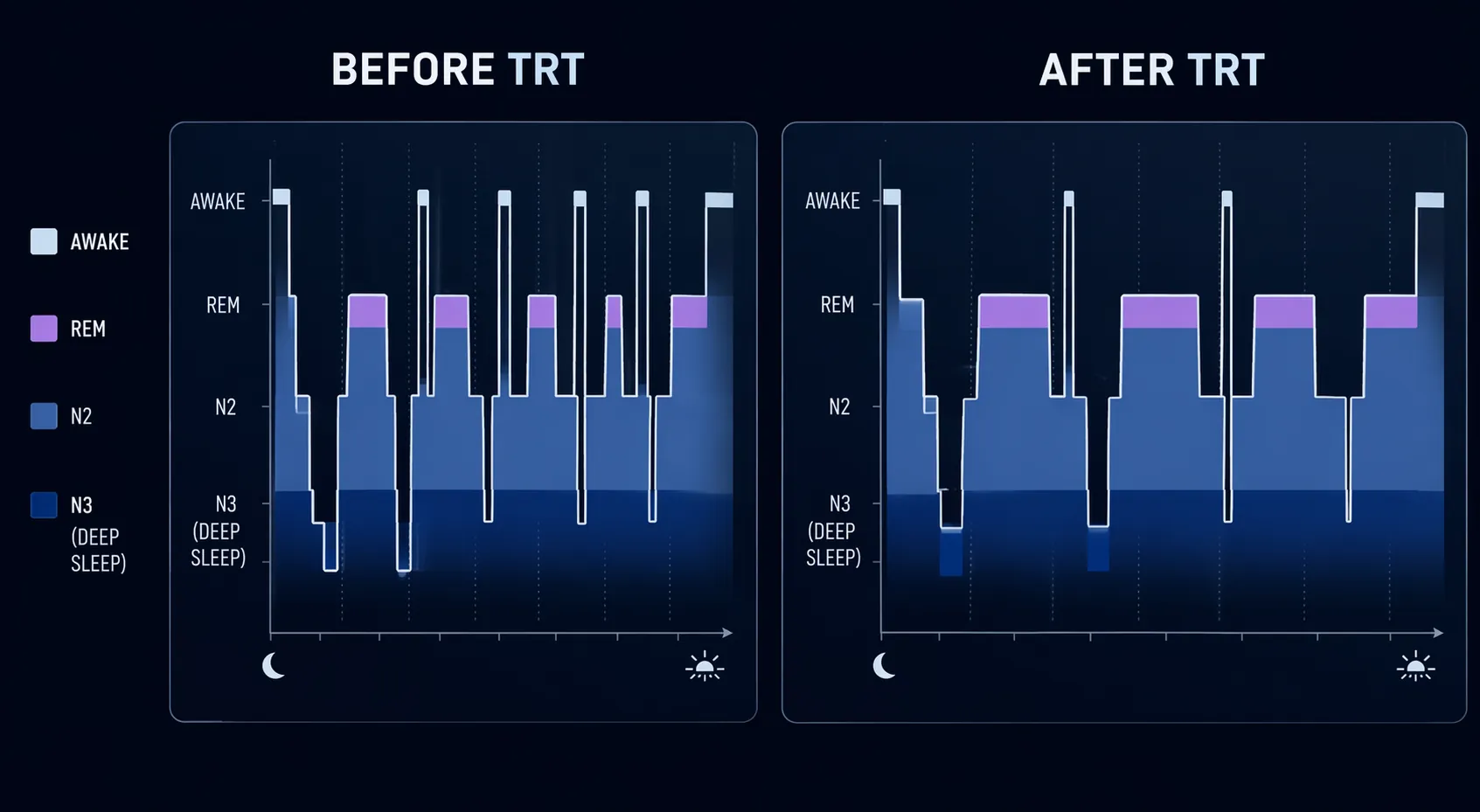
N3, often called slow-wave sleep, is the heavier, harder-to-disrupt sleep that many people think of as genuinely restorative. REM sleep is not “better” than N3, but it is a major part of normal sleep architecture. A treatment that increases both, while reducing awakenings, gives a more credible explanation for why many hypogonadal men report better sleep after TRT.
That does not mean a specific man should expect exactly 18 more minutes of deep sleep or 12 more minutes of REM sleep. Those are group averages from a source with verification concerns, and individual sleep is shaped by age, weight, alcohol, sedatives, nasal obstruction, insomnia, pain, depression, and untreated sleep apnea. The safer reading is narrower: in men with low testosterone, TRT can move sleep architecture in a more restorative direction, but it does not guarantee a predictable nightly sleep-stage gain.
Why Low Testosterone and Poor Sleep Reinforce Each Other
The relationship between testosterone and sleep is not one-way. In the Rancho Bernardo cohort of 2,855 men, lower testosterone was associated with reduced sleep efficiency, more awakenings, and less slow-wave sleep.[3] That kind of finding does not prove that raising testosterone will fix sleep, but it does explain why sleep complaints and low testosterone often travel together.
Testosterone production is also tied to sleep timing and sleep continuity. Reviews of sleep disorders and testosterone in men describe a complicated loop: disrupted sleep can be associated with lower testosterone, while testosterone treatment may change both sleep depth and breathing stability in susceptible men.[7] This is why a clinic visit that treats fatigue, low testosterone, and sleep as separate boxes can miss the part that matters overnight.
For the man with true hypogonadism, TRT may consolidate sleep enough that the household notices fewer restless transitions. For the man with loud snoring, a thick neck, and unrecognized obstructive sleep apnea, the same treatment can make breathing events more visible before it makes sleep feel better.
The Main Complication: Obstructive Sleep Apnea Can Worsen Early
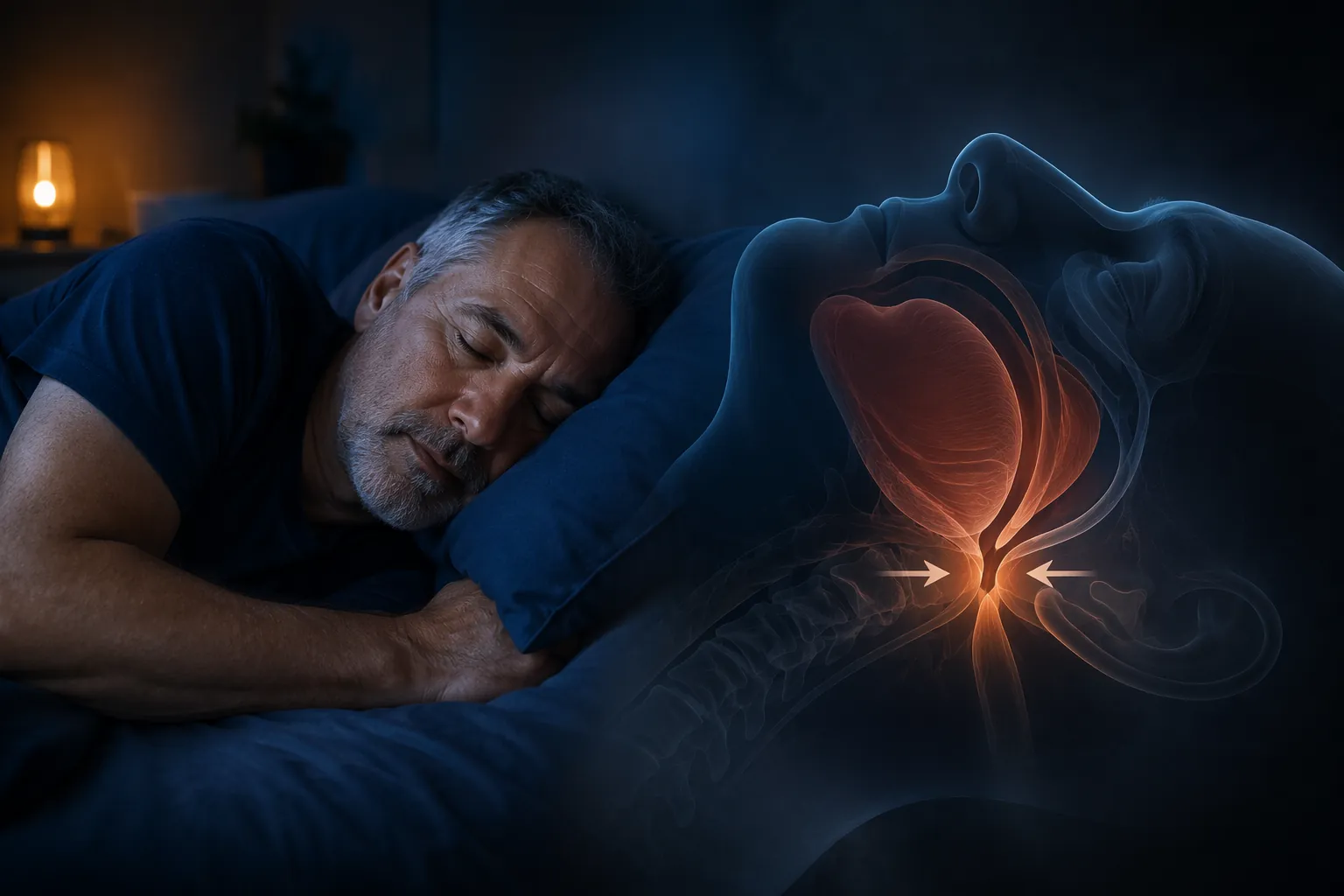
Obstructive sleep apnea is not a side note in this decision. It is the main sleep-related safety issue. In OSA, the upper airway repeatedly narrows or collapses during sleep, causing oxygen drops, arousals, snoring, and pauses in breathing. A person can be asleep for seven or eight hours and still be physiologically interrupted all night.
The large TRAVERSE trial gives one broad signal. Among 5,246 men, sleep apnea was reported in 6.6% of men receiving testosterone therapy compared with 4.5% receiving placebo over 33 months.[4] That trial was designed primarily for cardiovascular safety, not as a sleep-primary study, so the sleep finding should not be stretched into a complete sleep-risk map. Still, it is large enough that the apnea signal should not be buried in small print.
A separate observational cohort by Cole and colleagues found a two-year obstructive sleep apnea risk of 16.5% in testosterone users compared with 12.7% in matched controls.[5] Because this was observational, it cannot prove that testosterone caused every excess case. Men prescribed TRT may differ from controls in ways that affect apnea risk. But it points in the same cautious direction: sleep-disordered breathing deserves active screening, not passive reassurance.
The Timing Matters: Week 7 Is Not Week 18
The most clinically useful nuance comes from a smaller randomized trial by Hoyos and colleagues in 67 obese men with severe obstructive sleep apnea. Testosterone therapy worsened the oxygen desaturation index by 10.3 events per hour at seven weeks, but that worsening returned to baseline by 18 weeks on the same dose.[6]
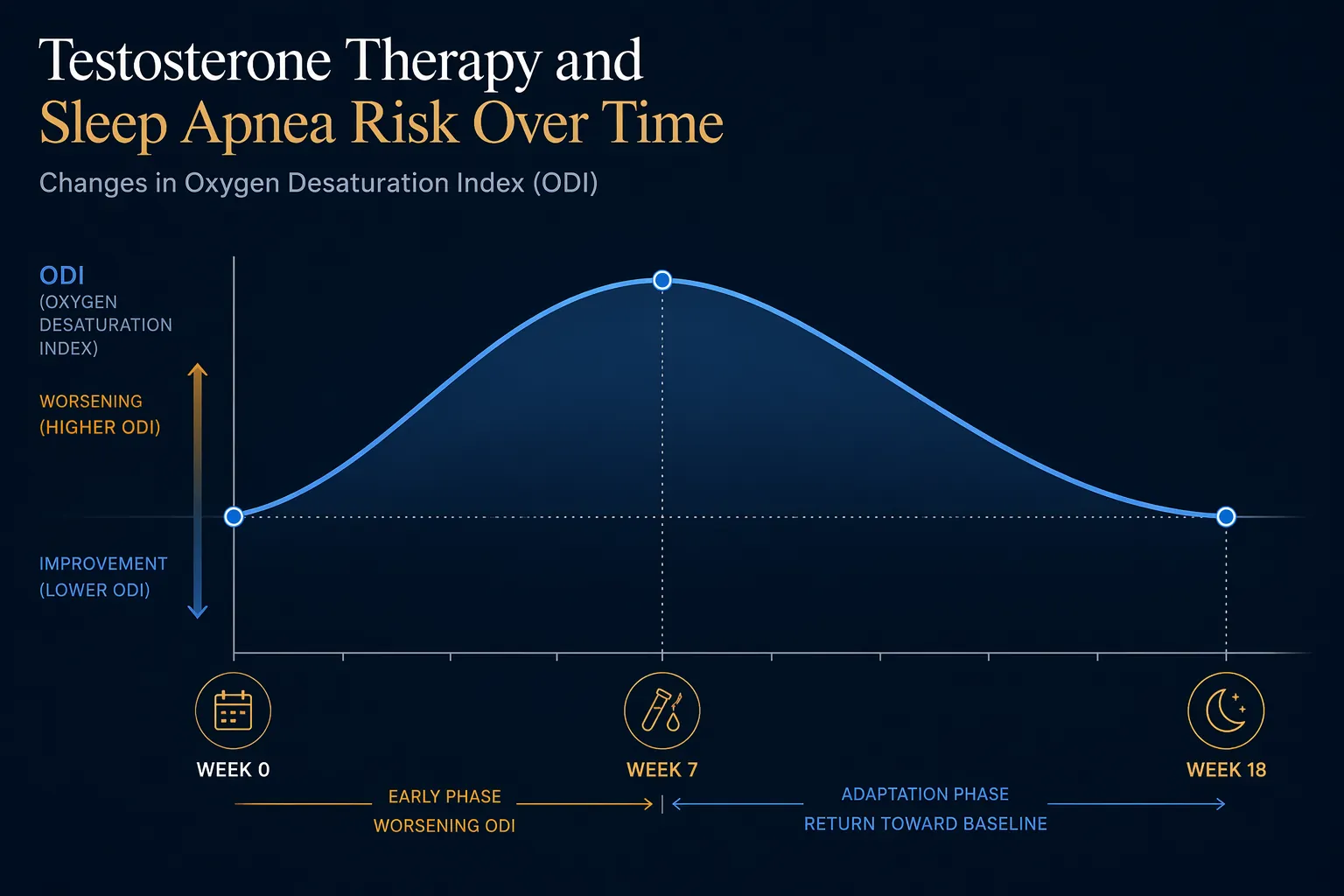
That pattern changes the conversation. A temporary worsening is not the same as a permanent disqualification. It is also not harmless. Seven weeks is long enough for a partner to hear more choking, for a man to become sleepier during the day, or for blood pressure and mood to suffer from more fragmented nights. The fact that the signal resolved by 18 weeks in that study supports monitoring, not ignoring.
This is where the person at home becomes part of the safety system. A bed partner’s report that snoring became louder after TRT started, or after a dose was increased, can be clinically meaningful before a scheduled lab review. It does not diagnose OSA. It does tell the prescriber that the airway side of the treatment needs attention.
| Time point | What to watch | Why it matters |
|---|---|---|
| Before starting TRT | Snoring, witnessed apneas, BMI, neck circumference, daytime sleepiness, morning headaches | Baseline OSA risk changes the balance between sleep benefit and breathing risk |
| First several weeks | New or louder snoring, more restless sleep, gasping, unusual morning fatigue | The Hoyos trial found ODI worsening at seven weeks in obese men with severe OSA |
| Around follow-up | Whether symptoms improved, persisted, or returned toward baseline | In Hoyos, ODI returned to baseline by 18 weeks on the same dose |
| After dose changes | Repeat of early-warning symptoms | A stable dose and a new dose are not always the same sleep-breathing situation |
Who Needs More Caution Before Starting
The men most likely to need a slower, more supervised decision are not hard to recognize. Known obstructive sleep apnea, obesity, a larger neck circumference, loud habitual snoring, witnessed pauses in breathing, morning headaches, and unexplained daytime sleepiness all push the decision toward screening before or very soon after TRT begins.
BMI and neck circumference matter because they are practical markers of upper-airway vulnerability. They do not tell the whole story, and a lean man can still have sleep apnea. But in the TRT decision, they help identify the man whose airway may already be close to the edge before testosterone is added.
Dose also matters. The available evidence does not support treating all testosterone exposure as identical. Starting therapy, increasing a dose, or moving to a regimen that produces higher peaks may create a different early sleep-breathing period than continuing a stable, monitored dose. Dose may modify risk, but the evidence does not provide a precise formula that predicts who will worsen.
- Known OSA should be treated as a prescribing issue, not just a sleep-history footnote.
- Untreated loud snoring plus daytime sleepiness deserves evaluation before TRT is framed as a fatigue solution.
- Obesity and larger neck circumference raise the need for monitoring, especially during the first weeks.
- A bed partner’s observation after initiation or dose change should be documented, not dismissed as anecdotal noise.
How to Read the Evidence Without Overreading It
The benefit side is encouraging, especially because subjective improvement and sleep-stage changes point in the same direction. The risk side is also real, especially because randomized and observational data both show more sleep apnea in testosterone-treated groups, even though they answer different questions and have different limitations.[4][5]
TRAVERSE is valuable because it is large and randomized, but its sleep findings come from a trial built for cardiovascular safety.[4] Cole is useful because it reflects a broader clinical population, but its observational design leaves room for confounding.[5] Hoyos is especially helpful for timing, but it studied obese men with severe OSA, so it should not be generalized to every man starting TRT.[6] Shore’s reported sleep-stage numbers are clinically appealing, but the source-verification concern means they should be presented as suggestive rather than as a guaranteed magnitude of benefit.[2]
That hierarchy is enough to guide safer decisions. It is not enough to promise that TRT will give every hypogonadal older man deeper sleep, nor enough to say that apnea risk should rule TRT out for everyone. The evidence supports a monitored trial in the right patient more than a blanket yes or no.
What Patients and Partners Should Report
A man starting TRT should not be asked only whether he feels more energetic. Someone should ask what happened overnight. Did snoring change? Did the partner notice pauses? Are there new gasps, morning headaches, dry mouth, or a return of daytime sleepiness despite spending enough time in bed?
These reports should not lead to panic or abrupt self-stopping. They should lead to contact with the prescriber. Depending on the situation, the next step may be screening questionnaires, home sleep apnea testing, formal polysomnography, adjustment of TRT dosing, treatment of sleep apnea, or closer follow-up during the early window.
When TRT works well for sleep, the benefit can be meaningful: deeper sleep, more consolidated nights, and fewer awakenings are not cosmetic outcomes. But the safer question is not “Will testosterone therapy help sleep quality?” It is “Have we checked the airway risk before starting, and are we watching the first weeks closely enough to catch the problem that would most predictably harm sleep?”
If sleep becomes deeper and less fragmented, that is a real gain. If snoring, witnessed apneas, morning headaches, or daytime sleepiness worsen after initiation or a dose change, that is a reason to call the prescriber and consider sleep-apnea evaluation.
References
- Buvat et al. 2013 meta-analysis
- Shore et al. 2019 sleep architecture report
- The Association of Testosterone Levels with Overall Sleep Quality, Sleep Architecture, and Sleep-Disordered Breathing, PMC
- Cardiovascular Safety of Testosterone-Replacement Therapy, New England Journal of Medicine, 2023
- Cole et al. 2018 observational cohort on testosterone therapy and obstructive sleep apnea
- Effects of testosterone therapy on sleep and breathing in obese men with severe obstructive sleep apnoea: a randomized placebo-controlled trial, Clinical Endocrinology, 2012
- The relationship between sleep disorders and testosterone in men, PMC, 2014
Safety & eligibility read
Cross-check against other interventionsExplore the mechanism
Next step
Spot an error or have clinical feedback?
Because this article covers clinical, medication, or safety information, we use a moderated correction channel instead of open public comments. Let us know if something about “How Testosterone Therapy Affects Your Sleep” needs a closer look.
Send feedback on this article