
Sleep Apnea or Perimenopause? How to Spot the Difference
Perimenopausal sleep disruption and obstructive sleep apnea affect sleep through distinct biological pathways. This guide maps each condition's mechanism to its symptom signature—timing of night waking, breathing signs, morning symptoms—so you can self-triage before your clinic visit, while clarifying when a sleep study is the only definitive answer.
When sleep falls apart in your 40s or early 50s, “perimenopause” can be both a useful explanation and a too-easy stopping point. Hormonal change really can wake you hot, wired, and unable to return to sleep. But obstructive sleep apnea can also appear for the first time—or become much more obvious—during the menopausal transition, and it can look less like the old stereotype of loud snoring and more like insomnia, night sweats, dry mouth, morning headache, nocturia, and exhaustion after a full night in bed.
The cleanest way to start is not with a symptom checklist, but with the mechanism. Perimenopause disrupts sleep through thermoregulatory and hormonal instability: estrogen and progesterone shifts affect the hypothalamus, hot-flash pathways, sleep depth, and respiratory drive. Sleep apnea disrupts sleep through mechanical airway collapse: breathing partially or fully stops, oxygen falls, the nervous system jolts the body awake enough to reopen the airway, and the cycle repeats. Those pathways can overlap in the same person, but they leave different clues.
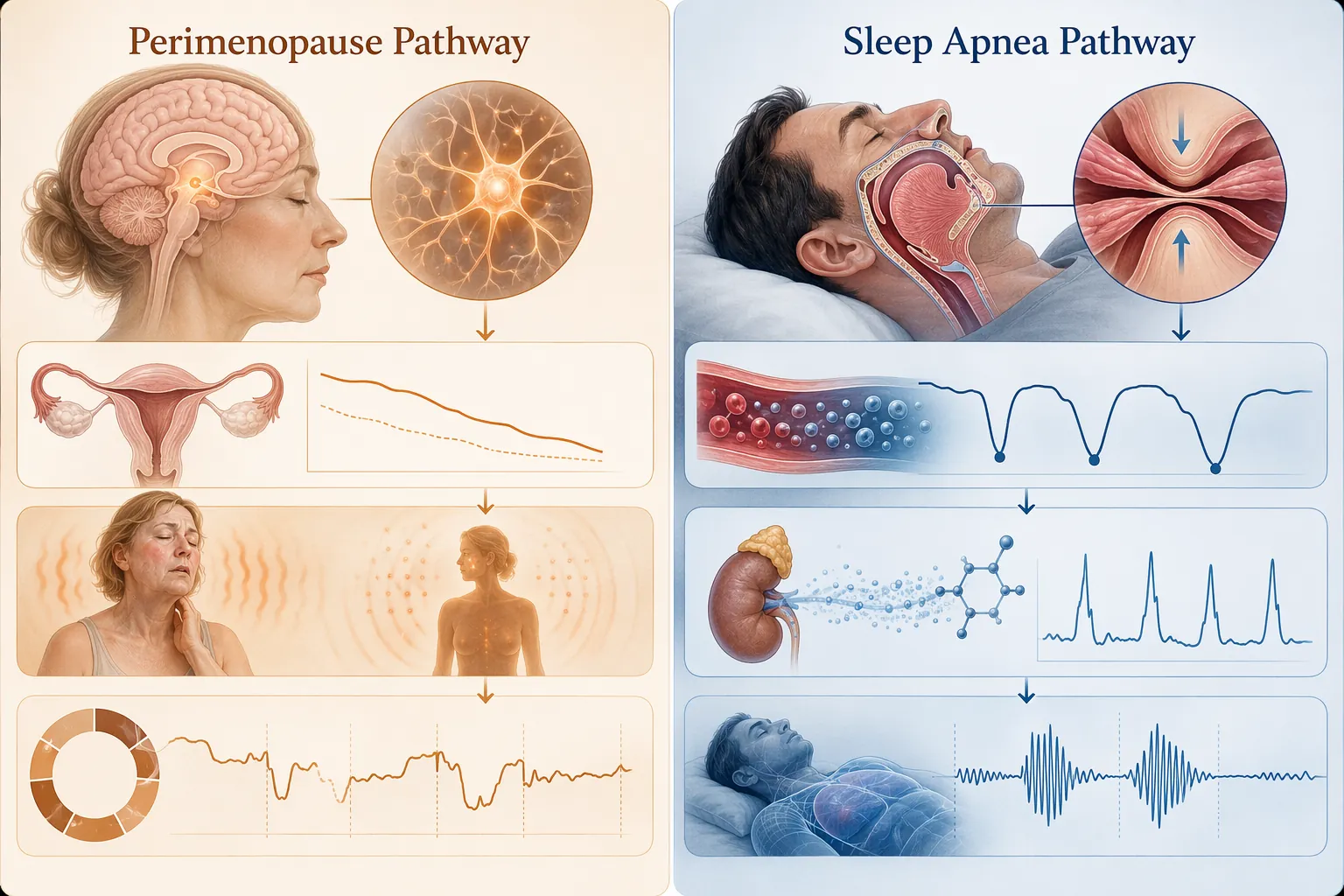
Pattern recognition can make your clinic visit sharper. It cannot diagnose you. A home sleep apnea test or in-lab polysomnography is still the way to rule sleep apnea in or out, especially because perimenopause and sleep apnea are not competing explanations; they commonly travel together.
Two Pathways, Two Different Symptom Signatures
Perimenopause sleep disruption begins with shifting ovarian hormones. Estrogen decline affects the preoptic area of the hypothalamus and thermosensory pathways, narrowing the body’s comfort zone for temperature regulation. A small internal temperature change can trigger a hot flash, sweating, and an awakening that feels abrupt and physical rather than psychological. Progesterone adds another layer: it has sedative effects through GABA-A receptors and also stimulates respiration, so declining progesterone can remove both a calming sleep signal and part of the normal respiratory drive.[1]
That is why a classic perimenopause pattern often sounds like this: you fall asleep, then wake between roughly 2 and 4 a.m. hot, flushed, sweaty, or suddenly alert. You may throw off the covers, wait for your body to cool, then lie awake with a mind that has switched on. The heat is not incidental; it is part of the arousal pathway.
Sleep apnea follows a different chain. The upper airway narrows or collapses during sleep. Airflow drops. Oxyhemoglobin saturation can fall from about 95% to around 80% during apneic events, and the body responds with stress-hormone release, inflammation, and repeated arousals that the sleeper may not fully remember.[2] The result is not only “waking up.” It is sleep that fails at its basic maintenance job even if the clock says you were in bed long enough.
That mechanism explains a different symptom cluster: waking with a dry mouth, waking with a headache, gasping or choking, partner-observed pauses in breathing, fragmented sleep without a clear heat trigger, frequent bathroom trips, and daytime exhaustion that feels disproportionate to the number of hours slept.
The Menopause Link Is Real, But It Does Not Settle the Diagnosis
It is not alarmist to bring sleep apnea into a perimenopause conversation. Johns Hopkins Medicine notes that postmenopausal women are two to three times more likely to have sleep apnea than premenopausal women.[3] A women-focused review also reports that postmenopausal women can have sleep apnea rates comparable to age-matched men, and it cites estimates ranging from 20% developing OSA during menopause to 47%–67% of postmenopausal women found to have OSA, depending on the population and diagnostic threshold.[2]
Those numbers are context, not a personal diagnosis. They matter because they make “you’re perimenopausal” an incomplete answer when the symptom pattern contains breathing clues or morning symptoms. In the SWAN cohort, 37% of women aged 40–55 reported difficulty sleeping, and sleep apnea risk rises during the menopausal transition.[1] A lot of midlife sleep trouble is hormonal. Some of it is airway-related. Some of it is both.
Clues That Point More Toward Perimenopause
Perimenopause becomes the more plausible primary driver when the awakening is organized around heat, flushing, sweating, and early-morning fragmentation. The body event comes first; the insomnia follows. A woman may wake drenched or overheated, then become anxious or frustrated because she is awake again, but the first clue is thermoregulatory.
- Waking hot, flushed, or sweaty, especially in the second half of the night.
- A recognizable hot-flash sequence: heat surge, sweating, cooling, then difficulty returning to sleep.
- More early-morning waking than all-night unrefreshing sleep.
- Sleep worsening alongside cycle irregularity or other menopausal vasomotor symptoms.
- Improvement when hot flashes or vasomotor symptoms are effectively treated.
This pattern still deserves care, not dismissal. Estrogen and progesterone changes can directly alter sleep quality, and lower estradiol has been associated with sleep-disordered breathing and lower sleep efficiency on polysomnography.[1] That last detail is important: hormones do not sit in a separate box from breathing. They can make sleep lighter and also make the airway problem more likely to show up.
Clues That Point More Toward Sleep Apnea
Sleep apnea becomes harder to ignore when the morning tells a different story from the night. If you were technically asleep for seven or eight hours but wake as if the sleep never “took,” that is not the same pattern as one hot flash followed by a long awake stretch. Repeated breathing interruptions can leave the brain and body under-restored even when total time in bed looks adequate.
- Gasping, choking, snorting, or abrupt awakenings with a sense of air hunger.
- Partner-observed pauses in breathing, even if snoring is not loud every night.
- Morning dry mouth, especially when paired with mouth breathing or snoring.
- Morning headache or heavy-headedness.
- Nocturia that is frequent or new, particularly when it improves with sleep-apnea treatment.
- Unrefreshing sleep despite enough hours in bed.
Midlife women may not present with the cartoon version of apnea. Women are more likely to report insomnia-like sleep, fatigue, mood symptoms, or morning symptoms rather than leading with “I snore loudly.” Ubie Health’s clinician-facing discussion of women over 40 emphasizes that sleep apnea symptoms are often missed in this group because the presentation can be atypical.[4]
Blood pressure is another clue, not because it proves apnea, but because it changes the level of concern. Sleep apnea is independently associated with resistant hypertension; perimenopause-related insomnia is not classically linked to sustained resistant blood pressure in the same way. If sleep has deteriorated and blood pressure has become difficult to control, that belongs in the sleep-apnea conversation rather than in a generic “stress and hormones” pile.
The Overlap That Misleads People: Night Sweats
Night sweats feel like the most obvious menopause clue. Sometimes they are. But sweating at night does not rule out sleep apnea. Elektra Health and BlueSleep explain that sleep apnea can cause night sweats through sympathetic nervous system surges and blood pressure spikes during breathing events, not through the same thermoregulatory pathway as a menopausal hot flash.[5]
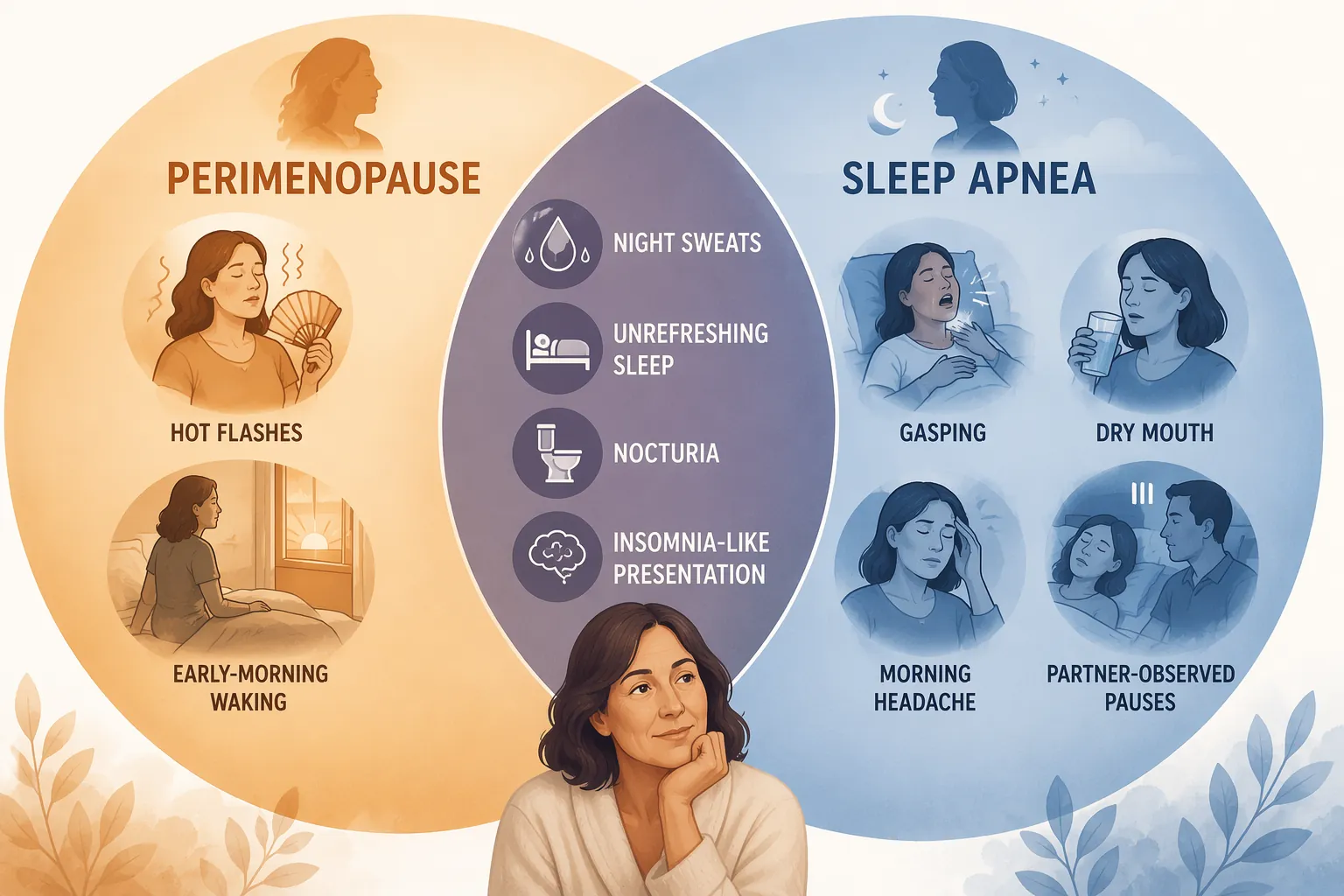
The practical distinction is what surrounds the sweat. A hot flash awakening usually has a heat surge, flushing, sweating, and cooling. An apnea-related sweat may appear with gasping, a racing heart, dry mouth, a headache on waking, or a bed partner saying breathing looked irregular. The sweat is real in both cases. The company it keeps is what changes the interpretation.
| Clue | More suggestive of perimenopause | More suggestive of sleep apnea |
|---|---|---|
| Timing | Early-morning waking, often around the second half of the night, with heat or flushing | Repeated arousals across the night, or waking unrefreshed despite adequate time in bed |
| Body sensation at waking | Hot flash, sweating, cooling phase, then difficulty settling | Gasping, choking, racing heart, dry mouth, headache |
| Breathing signs | No clear breathing pauses or gasping pattern | Interrupted snoring, observed pauses, snorting, gasping, mouth breathing |
| Morning symptoms | Tired after a long awake stretch | Headache, dry mouth, heavy fatigue after what looked like enough sleep |
| Bathroom trips | May occur for many reasons and are not specific | Can be more frequent in sleep apnea and may improve when apnea is treated |
| Treatment response | Improves when vasomotor symptoms or menopause-related insomnia are treated | Persists despite hot-flash control or insomnia therapy; improves with apnea-directed treatment |
Nocturia Is Not Just a Bladder Clue
Getting up to urinate at night is easy to file under aging, pelvic floor changes, fluid timing, or perimenopause. Sometimes those are the right leads. But nocturia is also common in sleep apnea, and DreamSleep Respiratory describes it as one of the features that may distinguish sleep apnea in menopausal women, including improvement when apnea is treated.[6]
The useful question is not “Do I pee at night?” It is more precise: “Am I waking because I need to urinate, or am I waking repeatedly and then deciding to urinate because I am already awake?” If the bathroom trips arrive with dry mouth, headache, gasping, or unrefreshing sleep, they should not be treated as a separate nuisance until breathing has been considered.
Why Snoring Tools Can Miss Midlife Women
Screening questionnaires can be useful, but they are not neutral instruments. Tools that heavily weight loud snoring, male sex, larger neck circumference, or a classic male presentation can under-recognize women whose main complaint is insomnia, fatigue, morning headache, or mood change. That does not make the tools useless; it means a low-risk score should not end the conversation when the symptom pattern is breathing-shaped.
This is where a bed partner’s observation can carry unusual weight. “She snores” is less specific than “she stops breathing, then gasps,” or “the snoring gets quiet, then she jerks or snorts.” If you sleep alone, your clues may be indirect: dry mouth, morning headache, nocturia, unexplained awakenings, or a wearable showing frequent oxygen dips. Wearables are not diagnostic sleep studies, but they can help justify asking for one when symptoms match.
Treatment Response Can Clarify the Next Step
A reasonable sequence is often to treat the most obvious driver and watch what remains. Dr. Kimberly’s discussion of sleep apnea versus menopause emphasizes this kind of sequencing: if hot-flash or perimenopause-targeted treatment improves sleep, that is useful information; if sleep remains unrefreshing or breathing clues persist, sleep apnea testing becomes the next appropriate step.[7]
That sequencing should not turn into months of delay when apnea clues are already present. Partner-observed pauses, gasping, morning headaches, dry mouth, nocturia, resistant blood pressure concerns, or severe daytime sleepiness are not symptoms to “wait out” through another round of sleep hygiene.
CBT-I deserves its place here, but with a hard boundary. In pooled MsFLASH analysis, cognitive behavioral therapy for insomnia was effective for insomnia in women with hot flashes.[8] That supports CBT-I as an insomnia pathway when the problem is conditioned wakefulness, hyperarousal, or menopause-related insomnia. It does not splint an airway open. If the airway is collapsing, CBT-I may help you relate differently to wakefulness, but it will not treat the breathing disorder.
What to Track Before the Visit
A useful sleep log for this question is not a moral inventory of caffeine and willpower. It is a pattern record. Bring the clinician evidence that separates heat, breathing, timing, and morning aftermath.
- Time of awakenings: especially whether they cluster between 2 and 4 a.m. or occur repeatedly across the night.
- Heat pattern: hot flash, flushing, sweating, cooling phase, or sweat without a clear heat surge.
- Breathing signs: gasping, choking, snorting, interrupted snoring, or witnessed pauses.
- Morning symptoms: dry mouth, headache, heavy fatigue, brain fog, or feeling unrefreshed after enough hours.
- Nocturia: number of bathroom trips and whether you woke first or bladder urgency woke you.
- Treatment response: whether hot-flash management, hormone therapy, CBT-I, CPAP, or an oral appliance changed the specific symptoms.
The wording matters. “I have insomnia” is true but broad. “I wake hot at 3 a.m. and then cannot return to sleep” points toward a vasomotor pathway. “I sleep seven hours but wake with dry mouth, morning headache, and exhaustion, and my partner has noticed pauses” points toward a breathing evaluation. “Both are happening” is also a medically useful sentence.
When to Ask Directly for Sleep Apnea Testing
Ask about a sleep-apnea evaluation if any of the following are present: partner-observed pauses, gasping or choking, dry mouth on waking, morning headaches, frequent nocturia, resistant or worsening blood pressure concerns, unrefreshing sleep despite adequate hours, or persistent exhaustion after perimenopause-focused treatment. The same applies if night sweats come with breathing clues rather than a clear hot-flash sequence.
The answer may be a home sleep apnea test or an in-lab sleep study, depending on symptoms, other medical conditions, and clinician judgment. What should not happen is a permanent diagnostic shortcut: “You’re in perimenopause, so of course you sleep badly.” Perimenopause can be the reason. Sleep apnea can be the reason. In midlife, the body is perfectly capable of making both true at once.
References
- Sleep Disturbance and Perimenopause: A Narrative Review — PMC, February 2025. pmc.ncbi.nlm.nih.gov/articles/PMC11901009/
- Obstructive Sleep Apnea: Women's Perspective — PMC, 2016. pmc.ncbi.nlm.nih.gov/articles/PMC5323064/
- How Does Menopause Affect My Sleep? — Johns Hopkins Medicine, 2025. hopkinsmedicine.org/health/wellness-and-prevention/how-does-menopause-affect-my-sleep
- Sleep Apnea in Women 40+ — Ubie Health. ubiehealth.com/doctors-note/sleep-apnea-symptoms-women-40plus-missed-action-4222ex6
- The Connection Between Menopause and Sleep Apnea Symptoms — Elektra Health, 2024. elektrahealth.com/blog/the-connection-between-menopause-and-sleep-apnea-symptoms/
- How Is Sleep Apnea in Menopausal Women Different? — DreamSleep Respiratory. dreamsleep.ca/how-is-sleep-apnea-in-menopausal-women-different-from-sleep-apnea-in-men/
- Is It Sleep Apnea—or Menopause? — Dr. Kimberly MD. kimberlymd.com/blog/is-it-sleep-apnea-or-menopause
- Effects of Interventions on Insomnia in Women with Hot Flashes — PubMed, 2018. pubmed.ncbi.nlm.nih.gov/29165623/
Explore the mechanism
Next step
Spot an error or have clinical feedback?
Because this article covers clinical, medication, or safety information, we use a moderated correction channel instead of open public comments. Let us know if something about “Sleep Apnea or Perimenopause? How to Spot the Difference” needs a closer look.
Send feedback on this article