
Pre-Race Sleep Banking for Ultramarathoners
Most ultra runners start race day already sleep-deprived. This guide explains the evidence-based sleep banking protocol—extending time in bed to ~10 hours per night for 3 to 7 days before the event—that can improve performance, reduce falls, and close the gap between good intentions and actual pre-race sleep.

At the start line of a 100-mile mountain race, most runners look prepared in the ways ultrarunners know how to look prepared: taped feet, sorted drop bags, labeled bottles, practiced calorie plans, headlamp batteries checked twice. Sleep is harder to see. That is the problem.
In a 2024 study of 1,154 mountain ultramarathon finishers, runners started with an average cumulative sleep debt of about -50 minutes before the race, based on self-reported sleep diaries and Athens Insomnia Scale data.[1] That is not a catastrophic number in isolation. It is uncomfortable because it appears before the real sleep stress begins.
The contradiction gets sharper in earlier survey data. In Martin et al.’s study of ultramarathon runners, 74% reported being attentive to their sleep before a race, yet only 55% reported using sleep extension as a strategy.[2] That gap matters more than another lecture about how sleep is important. These are not runners who forgot recovery exists. They know. They just have not turned knowing into a schedule.
For ultramarathon runners, the central question is not whether sleep helps performance. The better question is how to make sleep survive race week: travel, work, packing, nerves, early packet pickup, caffeine drift, hotel noise, and the small pile of last-minute tasks that somehow appears after the drop bags are already closed.
The strongest pre-race strategy is sleep extension, not hope
Sleep banking is the practical name runners use for extending sleep before a known stressor. In this context, it means increasing time in bed to about 10 hours per night for several nights before race day, usually 3 to 7 nights. The goal is not to create a permanent surplus. It is to stop arriving already short, then give the brain and body more margin before a race that may run through one or more nights.
The ultra-specific evidence is not perfect, but it points in a useful direction. In Poussel et al.’s UTMB study, runners who increased sleep time the night before the race completed the event faster than runners who did not.[3] That finding should not be inflated into a promise that one longer night produces a faster finish for every athlete. It is still one of the more directly relevant performance signals available in ultramarathon research.
The safety signal is just as important. In the 2024 mountain ultramarathon study, runners who increased their average daily sleep duration before the race had a lower prevalence of falls attributed to sleep deprivation during the race: 12.3% versus 17.3%.[1] A fall at 3 a.m. on a technical descent is where sleep advice stops being abstract. The consequence lands on the runner, the pacer, the sweep team, and sometimes the medical tent.
This is why the most useful protocol starts before the night before. The final pre-race night is fragile. It is vulnerable to anxiety, unfamiliar beds, early alarms, race shuttles, weather checks, and the very normal realization that the thing you trained for is now unavoidable. A protocol that depends on that one night is not a protocol; it is a wish with a wake-up time.
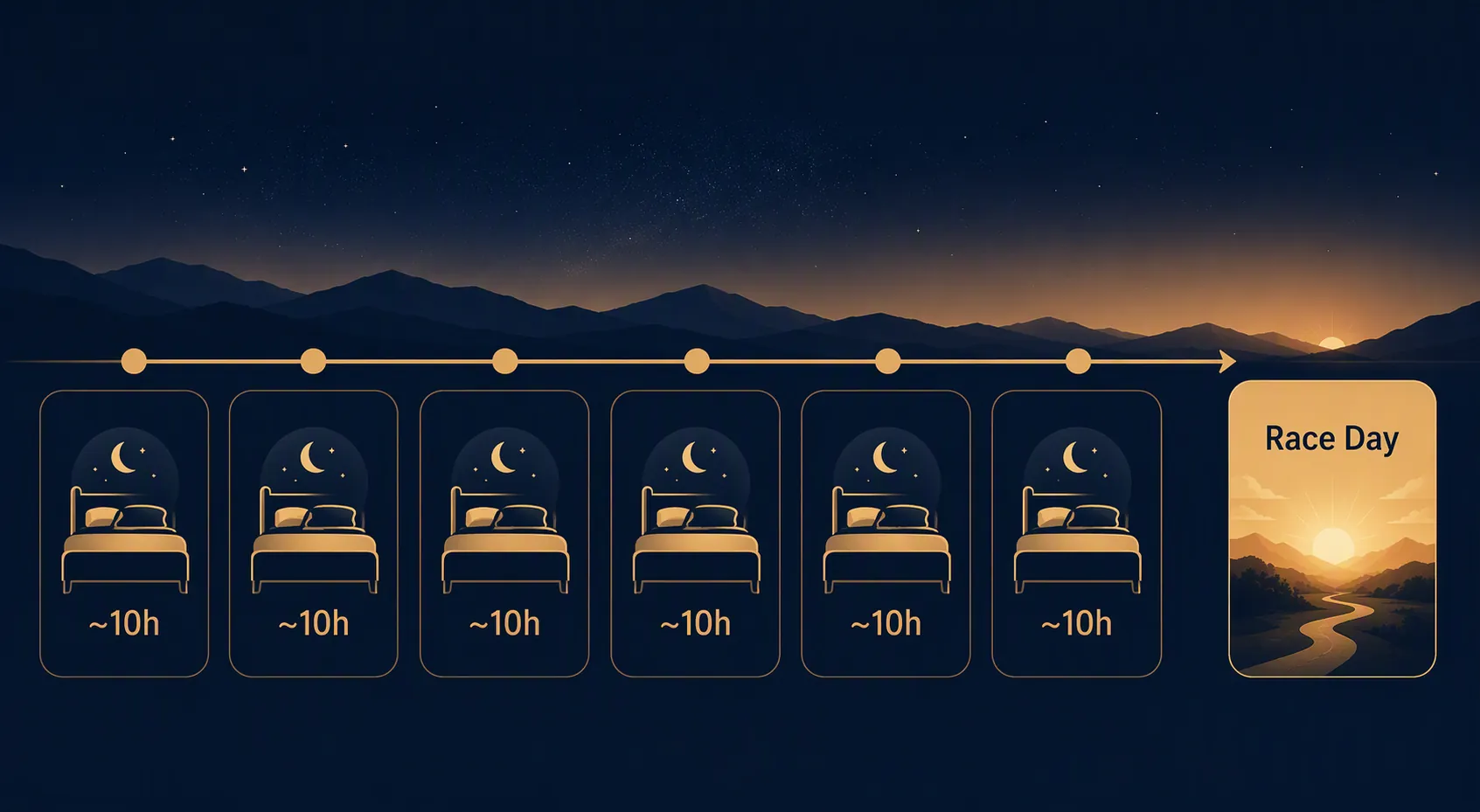
A race-week sleep banking protocol runners can actually use
The working target is simple: plan for about 10 hours in bed per night for 3 to 7 nights before the race. That does not mean every runner will sleep 10 clean hours. It means the calendar protects a larger sleep opportunity, which is the part the athlete can control.
| Race-week window | Main sleep task | What to protect |
|---|---|---|
| 7 to 5 nights out | Start extending time in bed toward about 10 hours | Earlier bedtime, reduced evening tasks, no late caffeine creep |
| 4 to 2 nights out | Keep the extended sleep opportunity consistent | Travel buffers, packing completed earlier, short naps only if needed |
| Night before | Preserve the routine without forcing sleep | Quiet room, realistic alarm plan, acceptance that sleep may be lighter |
| Race morning | Avoid borrowing from sleep with frantic logistics | Pre-packed gear, planned caffeine timing, calm departure |
Start with the calendar, not the pillow. Count backward from the race start. If the race begins Saturday morning, the first meaningful sleep-banking night may be the previous Saturday, Sunday, or Monday. A 7-night version gives more room for imperfect nights. A 3-night version is still more useful than concentrating all effort on Friday.
The first job is to move non-sleep tasks out of the protected window. Gear sorting, shoe decisions, GPX loading, crew notes, and drop-bag labeling should not be scheduled for the hour when the runner claims to be “going to bed early.” That hour is not empty. It is already assigned to sleep opportunity.
For a runner who normally sleeps from 10:30 p.m. to 6:00 a.m., a realistic extension might begin by moving lights-out earlier and wake time later where possible. The exact clock times will depend on work, family, travel, and chronotype. The principle is less flexible: create a longer, repeated sleep window before the race makes sleep optional.
Seven nights is cleaner; three nights is still worth doing
A full week works well because it absorbs chaos. One bad hotel night does not erase the prior six nights. One early work call does not collapse the plan. In crew terms, the week is the redundancy system.
If life only allows 3 nights, use them. Do not discard the strategy because the ideal version is unavailable. The evidence behind pre-race sleep extension supports the direction of the behavior: more sleep opportunity before the event, not perfect sleep performance every night.
Do not measure the protocol by the final night alone
Pre-race insomnia is common enough in endurance sport that it should be expected, not treated as a personal failure. The night before an ultra carries anticipation, logistics, and sometimes altitude or travel disruption. A runner who lies awake before race day may still have executed the sleep strategy well if the preceding nights were protected.
That distinction changes behavior. Instead of trying to force sleep on Friday night, the runner protects Monday through Thursday so Friday has less power. The final night becomes one input, not the whole plan.
Why longer sleep opportunity may help
Ultramarathon research does not yet give a clean laboratory answer for every mechanism. Much of the available ultra-specific evidence relies on questionnaires and self-reported sleep, not polysomnography or continuous objective sleep tracking. The samples are also predominantly male: Martin et al. reported about 15% female participants, and Kishi et al. about 14% female participants.[1][2] That limits sex-specific conclusions, especially for runners whose sleep and recovery may be affected by menstrual cycle phase, perimenopause, pregnancy, or other hormonal factors.
Still, the broader athletic sleep-extension literature gives a plausible bridge. In Mah et al.’s collegiate basketball study, athletes extended sleep by about 111 minutes per night over 5 to 7 weeks and improved sprint times, shooting accuracy, and reaction time.[4] Basketball is not ultrarunning. The value of that study here is not event specificity; it is the demonstration that repeated sleep extension can change performance-relevant capacities rather than merely making athletes feel more rested.
For trail ultras, reaction time and attention matter in a different way. They show up as foot placement, pole timing, navigation decisions, and whether a runner notices the loose rock before the ankle does. That is why the fall data deserve as much attention as finish-time data. Performance and safety are not separate boxes in a long mountain race.
For a deeper explanation of how missed sleep accumulates and why recovery is not always one-for-one, see Restful Ground’s guide to sleep debt and recovery science. The short version for race week is practical: reducing accumulated sleep pressure before a known overnight stressor is more defensible than assuming grit will cover the deficit.
The friction points that usually break the plan
Most runners do not fail at sleep banking because they misunderstand the concept. They fail because race week is built to steal sleep in small, respectable ways.
- Travel compresses the schedule, especially when runners leave after work and arrive late.
- Packing expands into bedtime because gear decisions feel urgent and concrete.
- Caffeine moves later in the day when fatigue rises and taper energy feels strange.
- Anxiety makes the runner monitor sleep too closely, which can make sleep harder.
- Crew and family logistics create late messages, changing plans, and one more thing to confirm.
The fix is not a more elaborate bedtime ritual. It is earlier operational control. Finish drop bags before the sleep-extension block begins. Move crew documents and aid-station notes into a shared file earlier in the week. Set a cutoff after which only safety-critical changes are discussed. If a runner would not test new shoes at 9 p.m. on Thursday, they should not be rebuilding the entire aid-station plan then either.
Naps can help, but they should not replace the main sleep window
Short daytime naps can be useful during race week, especially after travel or an early morning. Keep them brief: about 20 to 30 minutes. A long late-day nap can make the protected nighttime window harder to use, which defeats the point.
The best nap is boring. It does not need a supplement, a gadget, or a heroic “two-hour coma” story. It is a small pressure release that helps the runner stay on schedule for the longer sleep opportunity at night.
Caffeine needs a race-week cutoff, not just a race-day plan
Caffeine is one of the few tools runners reliably respect during the race and casually mishandle before it. If late caffeine is part of the taper week survival plan, it can quietly sabotage the very sleep extension the runner is trying to create.
A practical approach is to set a daily cutoff several days before the race and make it boringly consistent. The exact time depends on the runner’s sensitivity and normal use. The important part is that caffeine timing becomes part of the pre-race protocol rather than a mood-based decision made when packing runs late.
What sleep banking can and cannot promise
The phrase “bank sleep” can be misleading if it suggests sleep works like money in an account. In an interview with Run Ultra, Professor Russell Foster cautioned against the simple idea that people can store sleep indefinitely before deprivation.[5] That caution is useful. Runners should not hear “sleep banking” and assume they can build a permanent surplus that cancels reckless sleep later.
The narrower claim is stronger: before a known, short-term stressor such as an ultramarathon, extending sleep opportunity for several nights is a low-risk, behavior-based intervention with performance and safety signals in the available literature. It may reduce the amount of sleep debt carried to the start line. It may improve the runner’s ability to tolerate the first night of sleep loss. It does not guarantee a finish, a personal best, or clear thinking forever.
That boundary matters because ultrarunning already has enough folklore. A sleep protocol should be treated like a pacing plan: useful, imperfect, and still subject to terrain, weather, gut problems, injury, and decision-making under stress.
A simple protocol for coaches, crew, and runners
A coach or crew chief can help most by making sleep visible in the plan. If the training plan names workouts, the race-week plan should name sleep windows. If the crew spreadsheet lists bottles and gels, it can also list the runner’s planned lights-out time for each pre-race night.
- Choose the sleep-extension window: ideally 7 nights before the race, with 3 nights as a useful minimum when logistics are tight.
- Schedule about 10 hours in bed each night during that window, accepting that actual sleep may be shorter.
- Move packing, travel admin, crew notes, and gear decisions out of the protected sleep period.
- Set a caffeine cutoff that applies throughout race week, not only on the day before the race.
- Use short 20- to 30-minute naps when needed, especially after travel, without letting them push bedtime later.
- Treat the night before as bonus sleep, not the single test of whether the strategy worked.
This is informational, not medical advice. Runners with insomnia, untreated sleep apnea symptoms, restless legs, shift-work sleep disruption, sedative use, or significant daytime sleepiness should not try to solve those problems with race-week planning alone. Those issues deserve clinical attention before they become trail problems.
For ultramarathoners, pre-race sleep banking is not a permanent reserve and not a miracle performance tool. It is the best-supported pre-race sleep intervention because it moves the target from one anxious hotel-room night to a repeatable week-long schedule. That is the kind of preparation runners already understand.
References
- Sleep and Ultramarathon: Exploring Patterns, Strategies, and Repercussions of 1,154 Mountain Ultramarathons Finishers
- Sleep habits and strategies of ultramarathon runners
- Sleep management strategy and performance in an extreme mountain ultra-marathon
- The effects of sleep extension on the athletic performance of collegiate basketball players — SLEEP
- How ultra runners and crew can avoid sleepwalking into disaster — Run Ultra
Safety & eligibility read
Cross-check against other interventionsExplore the mechanism
Next step
Spot an error or have clinical feedback?
Because this article covers clinical, medication, or safety information, we use a moderated correction channel instead of open public comments. Let us know if something about “Pre-Race Sleep Banking for Ultramarathoners” needs a closer look.
Send feedback on this article