
Two Reasons Your Sleep Suffers After an Accident Injury
Learn why accident injuries disrupt sleep through two separate pathways — physical pain and psychological trauma — and how to identify which is affecting you so you can take the right steps to recover your sleep.
The frustrating part is that two very different problems can feel almost identical in the dark. You get into bed, you cannot settle, and after an hour you are no longer sure whether your neck is keeping you awake, your mind is, or both. That distinction matters if you are trying to sleep better after accident injuries, because a sore body and an alarmed nervous system need different first moves.
One pathway starts in tissue: pain signals, inflammation, muscle guarding, restricted movement, and the awkward reality that you may not be able to lie in your usual position. The other starts in threat detection: the body keeps scanning as if the accident is not fully over, so sleep is interrupted by hypervigilance, sudden waking, nightmares, or a feeling that the bed is no longer safe enough to let go.
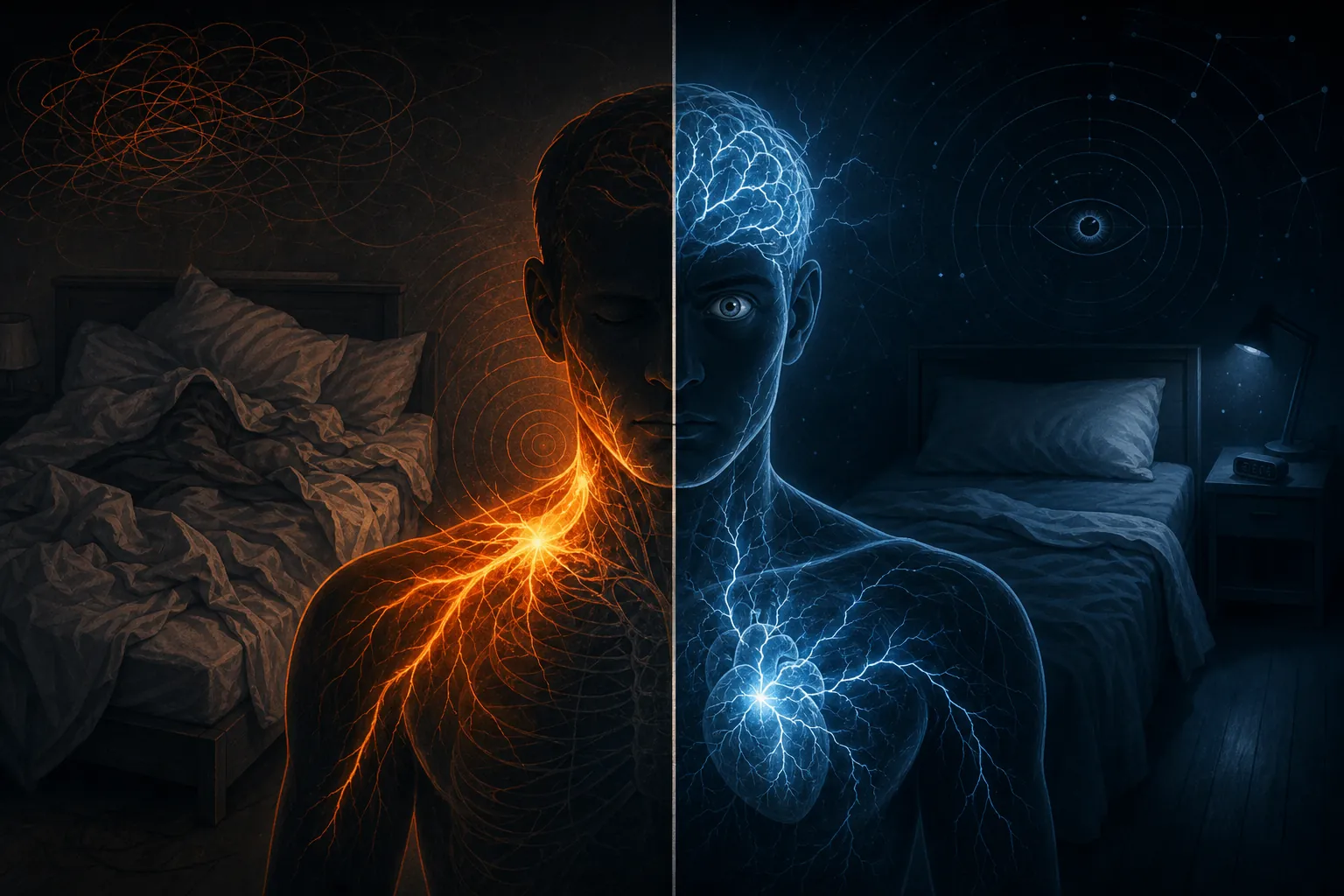
These pathways often overlap. Pain can make the nervous system more reactive. Fear can tighten muscles and make pain feel sharper. Poor sleep then lowers pain tolerance, which can make the next night harder too; the Sleep Foundation describes this pain-sleep feedback loop as one reason trauma and sleep problems can keep reinforcing each other.[1]
First Sort the Night, Not the Whole Injury
A single bad night does not reveal much. Three or four nights in a row can begin to show a pattern. The useful question is not “Am I stressed?” or “Am I injured?” Most people after a crash, fall, or impact are both. The better question is: what is the immediate thing that breaks sleep tonight?
| What wakes you or prevents sleep | Likely dominant pathway | What to examine next |
|---|---|---|
| A sharp increase in pain when rolling, lying flat, turning the neck, or staying in one position | Physical pain and restricted movement | Positioning, inflammation, muscle guarding, medication timing, and whether the injury needs reassessment |
| Jolting awake, scanning sounds, replaying the accident, or feeling unsafe despite being in bed | Psychological hyperarousal | Triggers, nightmares, daytime startle response, avoidance, and whether trauma-focused care is needed |
| Sleeping far more than usual, severe fatigue, headaches, dizziness, confusion, light sensitivity, or major sleep-cycle changes | Possible brain injury branch | Medical evaluation, especially after head impact or whiplash-type acceleration |
| Pain first, then panic about not sleeping; or fear first, then muscle tension and pain | Mixed pathway | Track the sequence rather than trying to name one cause too early |
That sequence is worth writing down. A sleep diary does not have to become a second job. It can be a dated note with bedtime, wake time, pain location, position changes, nightmares, medications or alcohol, and the first thing that seemed to start the bad stretch. It gives a clinician something more useful than “I’m not sleeping,” and it protects you from having a real pattern blurred by exhaustion.
When the Body Is the Main Reason You Cannot Sleep
Pain-driven sleep disruption usually has a mechanical signature. You may feel tired enough to sleep, but a position that used to be ordinary now pulls, burns, throbs, or locks. You may fall asleep briefly, then wake when your body tries to roll. Morning may bring more stiffness than relief because you spent the night bracing instead of cycling through normal movement.
This is where generic “sleep hygiene” advice can become irritating. A dark room does not solve a shoulder that cannot tolerate side-lying. A regular bedtime does not solve a neck that spasms when the pillow is wrong. The mechanism has to be respected before the routine can work.
Sleep also participates in repair. OrthoCarolina describes sleep as a recovery period in which growth hormone and other repair processes support tissue healing; the same source reports that a single night of sleep deprivation can lower testosterone by 24% and slow tissue repair by 18%.[2] Those numbers come from adjacent recovery literature, not a perfect trial of every post-accident injury, so they should not be read as a personal forecast. They do explain why “I’ll catch up later” can backfire when the body is trying to heal.
Inflammation adds another layer. Injured tissue can ache more at night because there are fewer distractions, less movement, and more sustained pressure on one area. If pain keeps fragmenting sleep, the next day’s lower pain tolerance can make the same injury feel louder. That is not weakness. It is a loop.
The Whiplash Example Shows Why Position Advice Has to Be Specific
Whiplash is a useful example because the sleep-position warning is not abstract. Stomach sleeping often forces the neck into about 90 degrees of rotation. For an irritated cervical spine, that can compress facet joints on one side while stretching already stressed ligaments on the other, which is why a familiar instruction — avoid stomach sleeping — has a real mechanical reason behind it.[3]
The practical decision is not to hunt for the “best” sleeping position in general. It is to reduce the specific load your injury cannot tolerate. A neck injury may need a pillow that keeps the head closer to neutral. A rib, shoulder, hip, or knee injury may need support that prevents the body from collapsing into rotation. A low back flare may need a different setup than a cervical strain. The right pillow arrangement is the one that reduces repeated waking and morning aggravation, not the one that looks most orthopedic in a photo.
- If pain spikes when you roll, build the position before you are exhausted: pillow between knees, support behind the back, or arm support for shoulder injuries.
- If neck pain is the limiter, avoid positions that twist the head far from the torso, especially stomach sleeping after whiplash-type injury.
- If pain medication wears off at 2 or 3 a.m., ask a clinician whether timing, dose, or medication type needs adjustment rather than improvising at night.
- If pain is worsening, spreading, or paired with numbness, weakness, fever, bowel or bladder changes, chest symptoms, or severe headache, treat that as a medical issue, not a sleep problem.
The goal is not perfect comfort. After an injury, perfect comfort may not be available yet. The first target is fewer pain-triggered awakenings and less bracing, because that gives the nervous system and the injured tissue a better chance to stop negotiating all night.
When the Alarm System Is the Main Reason You Cannot Sleep
Trauma-driven insomnia can show up even when the physical injury is improving. The body may be less sore, but the nervous system still behaves as if sleep would be poor timing. This can look like lying awake with a racing body, waking at small sounds, avoiding the route where the crash happened, dreading the moment the lights go off, or dreaming in fragments that drag the accident back into the room.
The Baltimore ECA Follow-Up Study gives this pathway some observational weight without turning every shaken sleeper into a diagnosis. In a sample of 1,920 adults, traumatic life event exposure was associated with roughly twice the odds of insomnia symptoms. Among women in the cohort, the odds ratios were 2.26 for remote trauma and 2.43 for recent trauma, while the association was not statistically significant in men.[4]
That finding should be handled carefully. The data were collected in Baltimore from 1993 to 1996, the trauma definitions predated DSM-5, and the sex-specific finding comes from one cohort.[4] It is best read as a directional signal: trauma exposure can be linked with insomnia symptoms, and that link may not affect every group in the same way. It does not mean a person has PTSD because they cannot sleep after an accident.
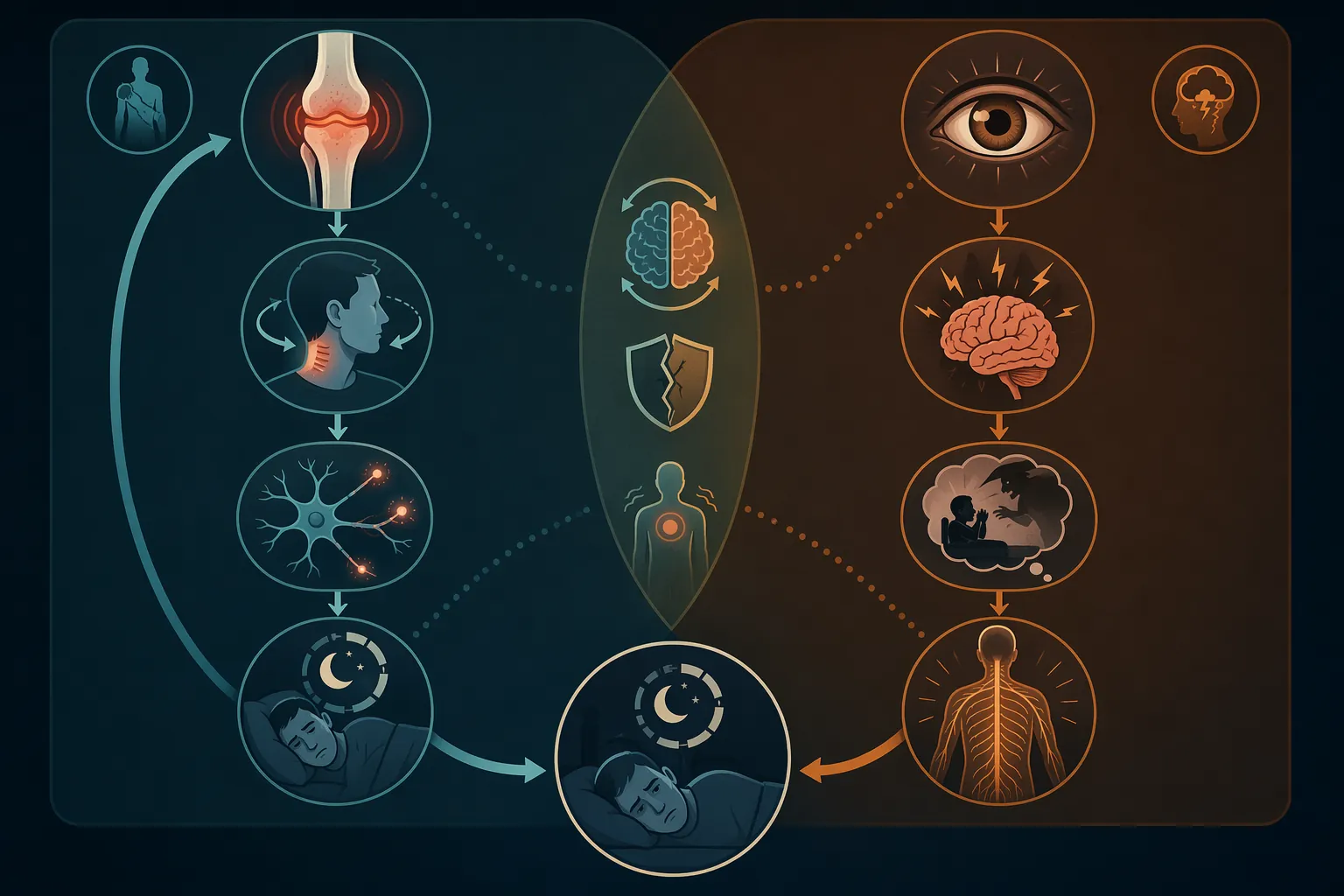
Hyperarousal is the everyday mechanism behind many of these nights. The brain is biased toward detection: What was that noise? Is the pain a sign something is wrong? What if I cannot function tomorrow? After an accident, that vigilance can feel rational because something did happen. The problem is that sleep requires a temporary surrender of monitoring, and the nervous system may not be ready to grant it.
Nightmares add another route. REM sleep is involved in emotional memory processing, and after trauma, dreams can become less like ordinary dreams and more like threat rehearsals. The VA notes that sleep problems are common in PTSD, including trouble falling or staying asleep and nightmares, though PTSD-specific sources should not be applied too broadly to everyone who has had a frightening accident.[5]
This is where the remedy changes. If the main driver is hyperarousal, a better pillow may help only at the edges. The work is more likely to involve reducing conditioned fear around bedtime, treating insomnia directly, and evaluating trauma symptoms if they persist or intensify. Cognitive behavioral therapy for insomnia, or CBT-I, is considered a first-line insomnia treatment in major clinical guidance, and the VA describes it as effective for many people with PTSD-related sleep problems; AASM’s public sleep education materials also point people toward professional help when trauma-related sleep symptoms continue.[5][6]
- If you wake in panic, note what came first: pain, a dream, a sound, a memory, or no obvious trigger.
- If bedtime itself has become threatening, treat that as a conditioned arousal pattern rather than a character flaw.
- If nightmares repeat the accident or make you avoid sleep, bring that detail to a clinician instead of only reporting “insomnia.”
- If alcohol or sedatives are becoming the main way to force sleep, ask for medical guidance; sedation and restorative sleep are not the same thing.
The Brain Injury Branch Deserves Attention Without Taking Over Every Case
Some post-accident sleep problems are neither simple pain nor ordinary stress. A head impact, blast exposure, violent jolt, or whiplash-type acceleration can raise the possibility of concussion or mild traumatic brain injury. Sleep may become unusually long, unusually short, fragmented, delayed, or unpredictable.
The range is wide. CT Physical Therapy Care summarizes brain-injury sleep literature by noting that 30% to 70% of mild TBI survivors report poor or excessive sleep, and sleep-cycle disturbances have been reported in up to 47% of brain injury survivors.[3] Those figures do not mean most tired people after a crash have a brain injury. They mean sleep changes after head or acceleration injury deserve to be asked about directly, especially when they come with neurological symptoms.
The clues that should move this out of self-management are familiar but important: worsening headache, repeated vomiting, confusion, fainting, seizure, weakness, unequal pupils, slurred speech, new balance problems, major behavior change, or symptoms that worsen rather than settle. For a person already diagnosed with concussion, sleep planning should follow the clinician’s recovery guidance rather than a generic insomnia routine.
Where the Two Pathways Tangle
The cleanest examples are rare. More often, pain and hyperarousal trade places during the night. A person wakes because the shoulder hurts, then spends 40 minutes replaying the accident. Another person wakes from a crash dream, then notices the neck is tight and cannot get comfortable. By morning, both report “I didn’t sleep,” but the treatment target depends on the first domino.
Tracking sequence prevents a common mistake: escalating the wrong solution. If pain is the first domino, the plan may need better injury evaluation, physical therapy guidance, nighttime positioning, or clinician-directed pain control. If hyperarousal is the first domino, the plan may need CBT-I, trauma-informed therapy, nightmare-focused treatment, or a medical review for anxiety, depression, PTSD, or other post-trauma conditions. If both are active, it is reasonable for care to address both rather than waiting for one to politely disappear.
| Pattern over several nights | More useful next step than generic sleep advice |
|---|---|
| Pain rises predictably in one position | Change the mechanical load and ask whether the injury plan is controlling night pain |
| Sleep worsens after reminders of the accident | Track triggers and consider trauma-focused evaluation if symptoms persist |
| Nightmares or startled awakenings dominate | Ask about CBT-I, nightmare treatment, and PTSD screening without self-diagnosing |
| Sleep need is dramatically higher or sleep timing becomes erratic after head/neck impact | Discuss concussion or brain injury symptoms with a clinician |
| No pattern is obvious because every night feels different | Use a brief sleep diary for one to two weeks to reveal sequence and frequency |
When “Normal After an Accident” Has Gone On Too Long
Some sleep disruption in the first days after an accident is expected. The body hurts, schedules are disrupted, paperwork and appointments pile up, and the mind keeps returning to what happened. Expected does not mean irrelevant. It means the first response can be calm sorting rather than panic.
A useful threshold is about a month. Sleep Education from the American Academy of Sleep Medicine advises seeking help when sleep problems after trauma continue for more than one month, or sooner if symptoms are severe.[6] Passing 30 days is not proof of PTSD, brain injury, or permanent insomnia. It is a sign that the problem deserves more than another round of “try relaxing before bed.”
Bring specifics: what wakes you, what position worsens pain, whether nightmares are present, whether you are avoiding reminders, whether headaches or dizziness are part of the picture, what medicines or substances you use at night, and whether sleep is too little, too much, or simply non-restorative. Those details help separate undertreated pain from trauma-related insomnia, concussion recovery, medication effects, mood symptoms, or a mixed pattern.
What Actually Helps Depends on the Driver
If the physical pathway is dominant, the first useful changes are usually concrete: reduce painful loading, support the injured area, time treatment so pain is not peaking in the middle of the night, and ask for reassessment if symptoms are worsening or not following the expected course. Sleep routine still matters, but it cannot carry the whole plan when the body is being asked to tolerate the wrong position for seven hours.
If the psychological pathway is dominant, the work is different. A regular schedule can help stabilize sleep pressure, but it will not by itself convince a threat system to stand down. CBT-I treats the insomnia pattern directly. Trauma-focused evaluation can identify whether symptoms are an expected stress response, acute stress symptoms, PTSD, depression, anxiety, or something else that needs care. The distinction matters because the goal is not to label distress; it is to stop using the wrong tool for the wrong mechanism.
If the brain injury branch is plausible, do not force the problem into either pain or stress. Sleep changes after concussion can be part of the injury picture, and recovery advice may involve activity pacing, light exposure, symptom monitoring, and medical follow-up. That is a different conversation from “you are anxious” or “you just need a better pillow.”
Better sleep after accident injuries begins with the dominant pathway: tissue pain and inflammation, threat-system arousal, possible brain injury, or a combination. Once that is clearer, the next step becomes less generic. Support the injury if the body is waking you. Treat insomnia and trauma symptoms if the alarm system is waking you. Get medical guidance when neurological signs, worsening pain, severe distress, or sleep disruption beyond a month suggest the problem needs a closer look.
References
- The Role of Trauma in Sleep Problems — Sleep Foundation.
- Sleep: The Secret Ingredient of Injury Recovery — OrthoCarolina.
- How to Sleep With Whiplash: Best Positions & the 'Towel Trick' — CT Physical Therapy Care.
- The Association between Traumatic Life Events and Insomnia Symptoms among Men and Women: Baltimore ECA Follow-Up Study — 2022.
- Sleep Problems and PTSD — VA National Center for PTSD.
- Sleeping After a Trauma — Sleep Education / American Academy of Sleep Medicine.
Explore the mechanism
Next step
Spot an error or have clinical feedback?
Because this article covers clinical, medication, or safety information, we use a moderated correction channel instead of open public comments. Let us know if something about “Two Reasons Your Sleep Suffers After an Accident Injury” needs a closer look.
Send feedback on this article