Why sleep problems last after cancer treatment ends
Persistent insomnia after cancer treatment is driven by four distinct mechanisms — inflammation, hormonal disruption, conditioned hyperarousal, and behavioral habits — each of which requires a targeted approach rather than generic sleep hygiene. This article explains why sleep problems persist and how to address them with evidence-based interventions.
This article is about sleep problems after cancer treatment has ended: the survivorship phase, when surgery, chemotherapy, radiation, or other active treatment may be behind you, but your nights have not returned to anything that feels like baseline. If you are still in active treatment, the causes can overlap, but the decisions are different; start with why cancer treatment disrupts your sleep and your oncology team.
The contradiction is familiar and maddening: the calendar says treatment is over, the appointment schedule has thinned out, and people around you may be relieved on your behalf. Yet at night your body may still behave as if the alarm system never powered down.
That mismatch is common enough to be recognized in cancer survivorship research. A meta-analysis of 160 studies including 46,279 patients found a pooled sleep disturbance prevalence of 60.7% among people with cancer, though that figure mixes active-treatment and post-treatment phases rather than isolating survivorship alone.[1] The persistence data are harder to dismiss: an American Cancer Society cohort reported that 51% of 9-year cancer survivors still had high sleep disturbance, and the Sister Study found that survivors more than 2 years from diagnosis were more likely to report at least one sleep disturbance than more recent survivors.[2][3]
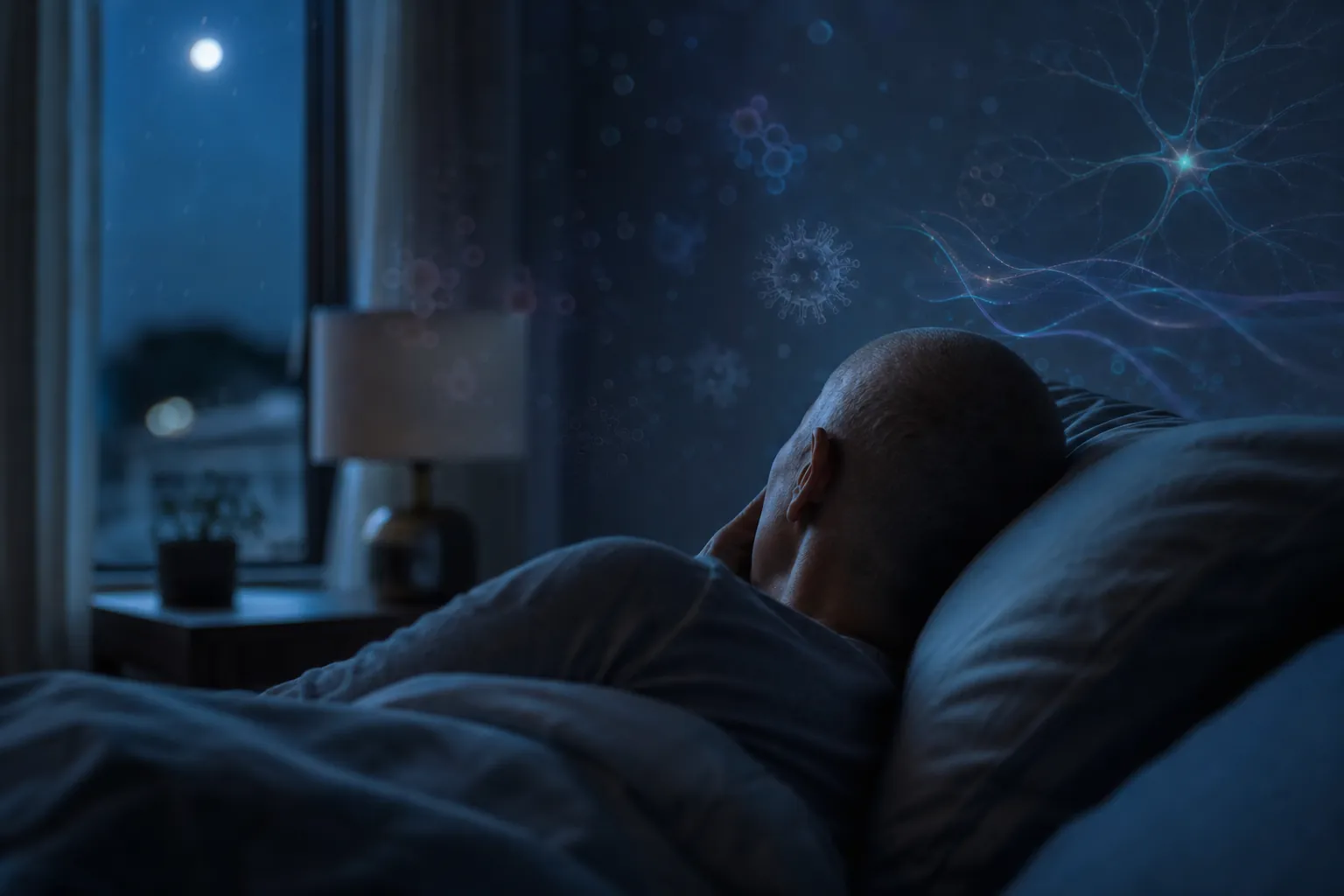
Those numbers do not mean every bad night is caused by cancer treatment, and they do not mean insomnia is harmless. They mean the question should shift from “Why can’t I relax?” to “Which driver is keeping sleep unstable, and what kind of intervention matches it?”
Four mechanisms can keep sleep broken after treatment
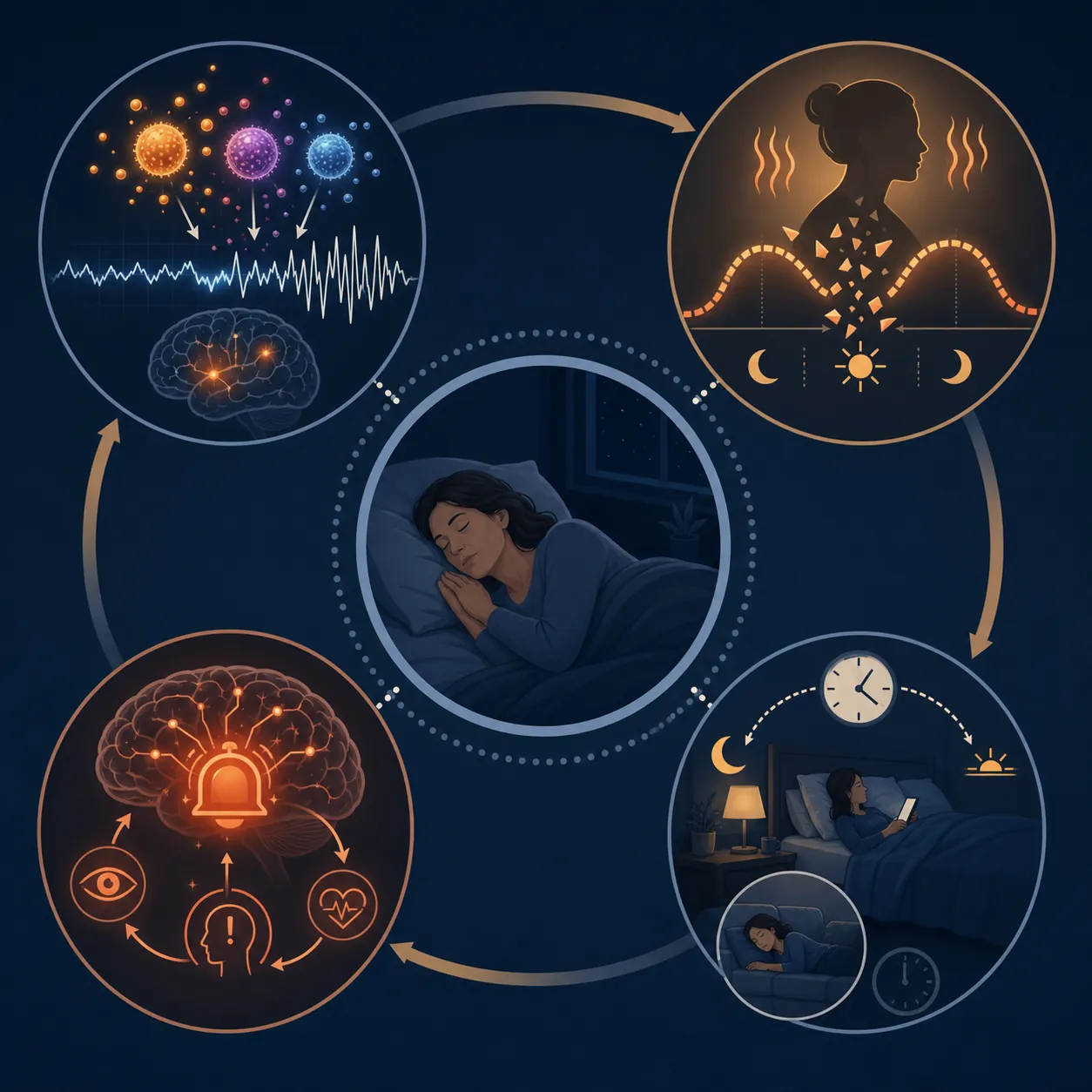
Post-treatment insomnia is often described as if it were one thing. It usually is not. One survivor may be waking from hot flashes after endocrine therapy. Another may fall asleep quickly but wake at 3 a.m. in a fear-of-recurrence scan of the body. Someone else may have spent months napping through fatigue and pain, then find that the bed has become a place for light sleep, waiting, and clock-checking.
The mechanisms can overlap, but separating them matters because the next step changes.
| Dominant driver | What it can feel like | Intervention logic |
|---|---|---|
| Inflammation or pain-related disruption | Unrefreshing sleep, frequent awakenings, sleep that worsens with pain or lingering treatment effects | Bring the oncology or survivorship team into the assessment; do not treat it as a discipline problem |
| Hormonal disruption | Hot flashes, night sweats, sudden awakenings, sleep fragmentation | Manage the endocrine or vasomotor symptoms with clinician guidance |
| Conditioned hyperarousal and fear of recurrence | Feeling sleepy until bed, then alert; scanning the body; dread of night waking | Use insomnia-specific treatment such as CBT-I, often with support for cancer-related fear |
| Behavioral legacy from treatment | Long time in bed, irregular naps, resting in bed while awake, light fragmented sleep | Rebuild the sleep-wake pattern, usually through CBT-I rather than generic sleep hygiene |
Inflammation can disturb sleep architecture
Cancer treatment can leave inflammatory signals elevated, including cytokines such as IL-6, IL-1β, and TNF-α. These molecules are part of immune signaling, not “stress” in the everyday sense, and they can influence the regulation of sleep and wakefulness. ESMO’s clinical practice guideline on insomnia in adult patients with cancer discusses inflammation, cancer treatment, and sleep disruption as part of the clinical picture rather than treating insomnia as a purely behavioral complaint.[4]
This mechanism should be handled carefully. It does not prove that every survivor with insomnia has cytokine-driven sleep disturbance. It does explain why some people can do the usual sleep hygiene routine perfectly and still wake repeatedly or feel unrefreshed. If pain, neuropathy, endocrine symptoms, medication effects, or ongoing inflammatory problems are part of the picture, the sleep plan belongs inside survivorship care, not in a self-improvement corner.
Hormonal disruption fragments sleep before habits get a vote
Aromatase inhibitors, androgen deprivation therapy, and treatment-induced menopause can produce hot flashes and night sweats that break sleep into pieces. NCI’s patient guidance on sleep problems in people with cancer lists treatment side effects, pain, emotional distress, and other cancer-related factors as contributors to insomnia and disrupted sleep.[5]
This is where generic advice becomes especially thin. A survivor waking drenched at 2 a.m. does not mainly need to be told to keep the room dark. The room may already be dark. The problem is that the body’s temperature and hormonal signaling are interrupting sleep from the inside.
For some people, this overlaps with the same sleep biology seen in perimenopause and menopause: vasomotor symptoms, temperature instability, and repeated awakenings. The details are not identical for everyone, especially when hormone-sensitive cancers are involved, so the next step is not do-it-yourself hormone treatment or supplement escalation. It is a clinician-guided conversation about symptom management, cancer history, medication options, and safety. For a broader look at the menopause side of this mechanism, see how perimenopause sleep loss accelerates your biological age.
Conditioned hyperarousal is not ordinary overthinking
After cancer, the bed can become a place where vigilance turns on. A minor ache, a skipped breath, a hot flash, or a normal nighttime awakening can start a loop: check the body, estimate risk, remember the next scan, calculate how much sleep is left, try harder to sleep, become more awake.
That loop is not the same as being a generally anxious person. Cancer-related dysfunctional beliefs about sleep and fear of cancer recurrence can perpetuate insomnia; ESMO identifies cancer-related factors and psychological processes as relevant to insomnia assessment and management in adult patients with cancer.[4] Harvard Health has also highlighted that cancer survivors’ sleep may remain affected long after treatment, including through persistent worry and survivorship-related distress.[6]
The distinction matters because reassurance alone often fails. If someone wakes at 3 a.m. and their nervous system has learned that nighttime is when danger gets reviewed, “try to relax” may become another task to fail. The treatment target is the learned alarm pattern: the association between bed, wakefulness, monitoring, and threat. That is why insomnia-specific therapy is more useful than another lecture about screens.
The fear loop is also why every sleepless night should not be treated as a hidden sign of recurrence. New, severe, or medically concerning symptoms deserve medical attention. But the fact that fear arrives at night does not make the fear medically accurate. For a related explanation of how threat conditioning keeps the body awake, see how to sleep when earthquake anxiety keeps you awake.
Treatment teaches habits that once made sense
During treatment, napping may be survival. Staying in bed longer may be the only way to tolerate fatigue. Resting in bed during the day may be reasonable when pain, nausea, immune risk, or exhaustion make ordinary routines impossible. None of that is laziness.
The problem is that the nervous system learns from repetition. If bed becomes the place for pain, waiting, scrolling, worrying, daytime recovery, and shallow sleep, it may stop functioning as a strong cue for consolidated nighttime sleep. NCI notes that people with cancer may have sleep problems related to pain, medicines, emotional distress, and changes in sleep habits, among other factors.[5]
This is the behavioral legacy of treatment. It is not a character flaw; it is an adaptation that outlived the conditions that made it useful.
Why sleep hygiene often disappoints survivors
Sleep hygiene advice can still be sensible. A cooler room may help hot flashes. Morning light can support circadian timing. Alcohol can worsen sleep fragmentation, and late caffeine can make insomnia easier to trigger. But sleep hygiene is usually too blunt for persistent sleep problems after cancer treatment.
It does not directly unlearn the association between bed and threat. It does not treat night sweats caused by endocrine therapy. It does not assess neuropathy, pain, sleep apnea, medication effects, depression, or inflammatory contributors. It can also land badly: as if a survivor who has already endured treatment is now being told they are failing because the bedroom is not optimized enough.
A better question is not “Have you tried sleep hygiene?” It is “What is the dominant mechanism, and what intervention actually reaches it?”
CBT-I is the anchor treatment when the bed has become a wake-up cue
Cognitive behavioral therapy for insomnia, or CBT-I, is not general counseling and not a nicer name for sleep tips. It is a structured insomnia treatment that works on the behaviors and conditioned arousal that keep insomnia going: time in bed, wake time, sleep effort, clock monitoring, unhelpful sleep beliefs, and the association between the bed and being awake.
ESMO identifies CBT-I as a recommended approach for insomnia in adult patients with cancer, and a systematic review of insomnia interventions in cancer patients and survivors reported a 10.9-point drop in Insomnia Severity Index scores in CBT-I intervention evidence.[4][7] The exact fit still depends on the person, but the direction is important: persistent post-treatment insomnia usually deserves insomnia-specific care, not another round of generic advice.
CBT-I is especially relevant when the pattern looks like this: you feel exhausted in the evening, become alert when you get into bed, spend long stretches awake, nap to compensate, then enter the next night with more pressure to sleep. A CBT-I clinician may use tools such as sleep scheduling, stimulus control, cognitive work around sleep threat, and careful sleep restriction. The word “restriction” can sound harsh in survivorship, so it should be individualized and medically appropriate, especially when fatigue, pain, or other conditions are active.
If cancer-related fear is the main accelerator, CBT-I may still be useful, but it may need to sit alongside support for fear of recurrence, trauma symptoms, or health anxiety. The point is not to talk yourself out of legitimate medical follow-up. It is to stop nighttime from becoming the place where every body signal is prosecuted.
When the driver is hormonal, pain-related, or medical, route it back into care
CBT-I can be the anchor for chronic insomnia, but it is not a substitute for evaluating treatable medical contributors. If night sweats, hot flashes, pain, neuropathy, restless legs symptoms, breathing pauses, medication timing, depression, or new symptoms are shaping the night, the survivorship or oncology team needs to know.
For hormone-related sleep disruption, the question is not simply “What can I take to sleep?” It is whether vasomotor symptoms, endocrine therapy, treatment-induced menopause, or androgen deprivation therapy are fragmenting sleep. That conversation may include nonhormonal symptom options, medication adjustments, cooling strategies, or specialty referral, depending on cancer type and risk profile.
For inflammatory, pain-related, or treatment-late-effect contributors, the goal is not to promise that one anti-inflammatory habit will solve insomnia. Movement, nutrition, light exposure, and stress reduction may support recovery for some people, but persistent awakenings tied to pain or treatment effects deserve assessment. Sleep apnea should also stay on the differential when symptoms fit, and it can be confused with menopause-related night waking; sleep apnea or perimenopause explains that distinction more directly.
Use medications and supplements cautiously, especially long term
There is a reason survivors reach for sleep medication, melatonin, cannabis, alcohol, or over-the-counter aids: being awake night after night is not a small inconvenience. In the American Cancer Society survivorship report, 28% of 9-year survivors used sleep medication.[2]
The caution is not moral; it is clinical. In a study of breast cancer survivors, sleep medication use was associated with a 33% increased fracture risk.[8] That does not mean every medication is inappropriate or that the study proves the same risk for every survivor, every drug, or every cancer type. It does mean casual long-term reliance deserves a better review than “it helps me get through the night.”
Melatonin and other products also need context: cancer history, current medications, endocrine therapy, liver metabolism, fall risk, next-day sedation, and whether the product is being used instead of treating the actual driver. If alcohol has become the nightly sedative, the sleep architecture cost is especially relevant; how alcohol disrupts sleep in perimenopause covers that pattern in more detail.
A practical decision frame for the next appointment
Before the next survivorship, oncology, primary care, or sleep medicine visit, it helps to describe the pattern rather than only saying “I can’t sleep.” The pattern points toward the mechanism.
- If you wake hot, sweaty, or flushed, ask whether endocrine therapy, androgen deprivation therapy, or treatment-induced menopause could be fragmenting sleep.
- If you get sleepy outside the bedroom but alert in bed, ask for CBT-I or a referral to a clinician trained in insomnia treatment.
- If pain, neuropathy, breathing symptoms, restless legs, medication timing, or new symptoms are involved, ask for medical assessment before treating it as simple insomnia.
- If fear of recurrence takes over at night, say that directly; it is a survivorship issue, not a private weakness.
- If you are using sleep medication, cannabis, alcohol, or OTC aids regularly, ask for a safety review and a longer-term plan.
For targeted help, look for CBT-I through a behavioral sleep medicine provider directory, an accredited sleep center, or a survivorship clinic that treats insomnia as part of cancer recovery. NCCN survivorship resources can also help frame what belongs in follow-up care, while your oncology team remains the right place for individualized decisions about symptoms, medications, hormone-related options, and recurrence concerns.
Lasting insomnia after cancer treatment is real, explainable, and treatable. The useful next step is not another generic sleep tip. It is identifying the dominant mechanism and matching the care to that mechanism.
References
- Prevalence of Sleep Disturbance in Patients With Cancer: A Systematic Review and Meta-Analysis
- Study Finds Sleep Problems Persist in Cancer Survivors, American Cancer Society
- Sleep Disturbances among Cancer Survivors — Sister Study
- Insomnia in adult patients with cancer: ESMO Clinical Practice Guideline
- Sleep Problems in People with Cancer, National Cancer Institute
- Cancer survivors' sleep is affected long after treatment, Harvard Health
- Interventions for insomnia in cancer patients and survivors — systematic review, JNCI Cancer Spectrum
- Sleep medication use and risk of fractures in breast cancer survivors
Safety & eligibility read
Cross-check against other interventionsExplore the mechanism
Next step
Spot an error or have clinical feedback?
Because this article covers clinical, medication, or safety information, we use a moderated correction channel instead of open public comments. Let us know if something about “Why sleep problems last after cancer treatment ends” needs a closer look.
Send feedback on this article