
Why Your Doctor Asks About Snoring Before Testosterone Replacement
Your doctor's question about snoring before prescribing testosterone isn't a formality — it's a safety screen backed by physiology and clinical guidelines. This article explains why testosterone can worsen sleep apnea, what doctors are looking for, and what the screening results mean for your treatment plan.
You came in ready to talk about testosterone: fatigue, libido, mood, muscle loss, maybe the slow feeling that your body has stopped responding the way it used to. Then your doctor asks, “Do you snore?” Or worse, “Has anyone ever seen you stop breathing in your sleep?”
That question is not a detour. It is one of the practical places where a doctor’s concerns about testosterone replacement and sleep impact become immediate. Your doctor is looking for signs of obstructive sleep apnea, because testosterone replacement therapy can worsen breathing instability and oxygen drops in some men, especially when severe sleep apnea is present and untreated. The concern is not that every man who snores is unsafe for TRT. The concern is that untreated severe OSA changes the risk calculation before the first prescription is written.

Ordinary snoring by itself is not the diagnosis. The red-flag cluster is different: loud habitual snoring, gasping or choking at night, witnessed pauses in breathing, morning headaches, daytime sleepiness, high blood pressure, a larger neck circumference, higher BMI, and age over 50. If you are trying to sort out whether your snoring sounds routine or suspicious, Restful Ground’s guide to the difference between snoring and sleep apnea is a useful first pass. For the broader clinical picture, the reference on obstructive sleep apnea symptoms, diagnosis, and treatment explains what happens after a screen turns positive.
Why Testosterone Can Matter at Night
Sleep apnea is not just snoring with a medical label attached. In obstructive sleep apnea, the upper airway repeatedly narrows or collapses during sleep. Oxygen can fall, carbon dioxide can rise, and the brain has to interrupt sleep enough to reopen the airway. A man may not remember waking up, but his cardiovascular system still absorbs the nightly stress.
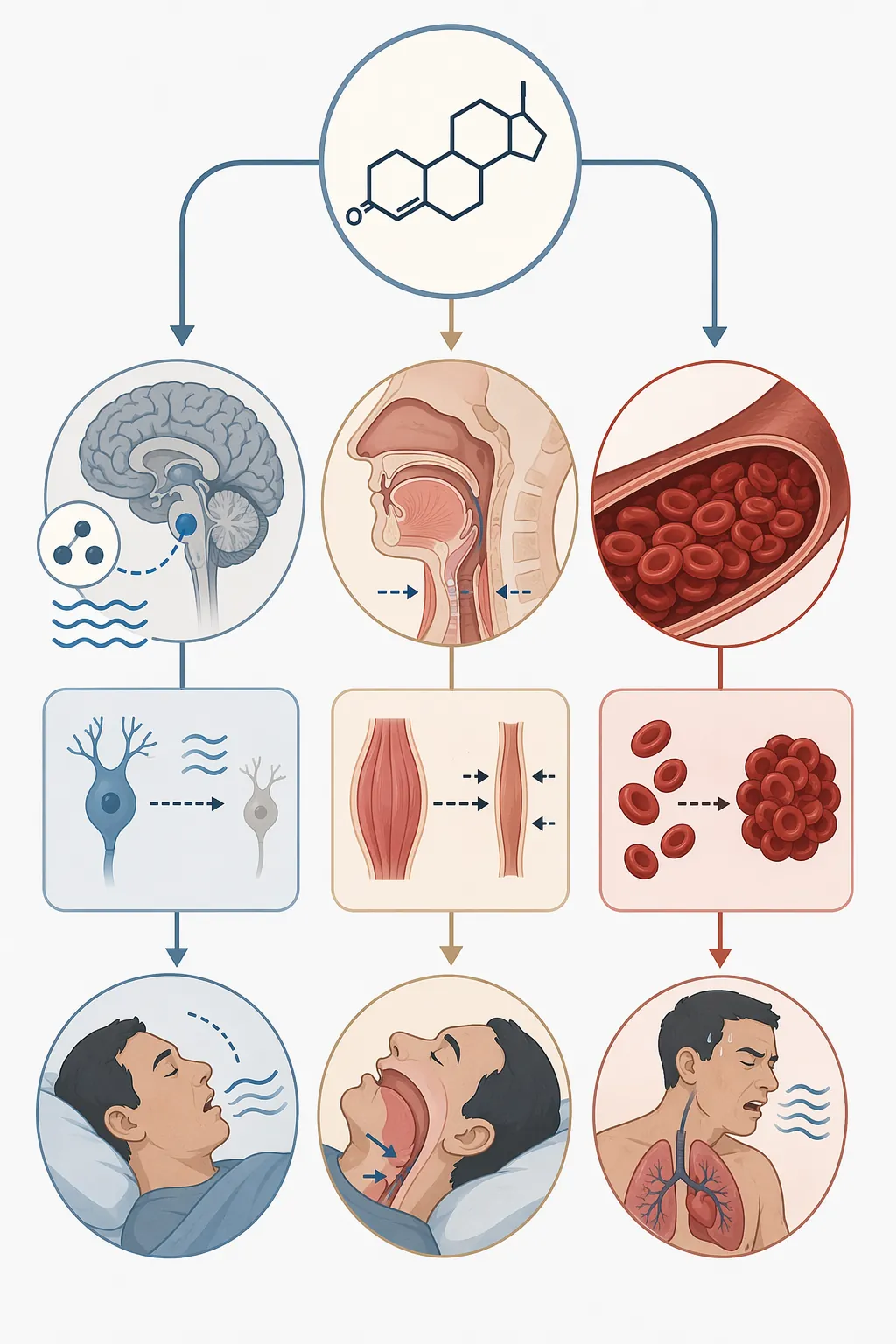
Testosterone enters this picture through several plausible pathways. The literature does not support the lazy version of the claim — that TRT always causes or worsens sleep apnea in every man. It does support enough concern that severe untreated OSA should be found before treatment begins.
Ventilatory control can become less stable
During sleep, breathing is partly regulated by chemoreceptors that respond to carbon dioxide and oxygen. Testosterone appears to influence ventilatory control, including chemosensitivity to carbon dioxide, which may make breathing less stable in susceptible men during sleep.[1][2]
That matters because sleep is already a vulnerable state for breathing control. The body is not using the same conscious breathing drive it uses while awake. If the control system becomes more unstable, breathing can overshoot, undershoot, and trigger more frequent arousals or oxygen dips. The patient feels tired; the bed partner hears the gasping; the doctor sees a risk that may be magnified by TRT.
The upper airway may be easier to collapse
The airway is not a rigid pipe. It depends on surrounding muscles to stay open, especially during sleep. Reviews of the testosterone-and-OSA literature describe possible hormonal effects on upper-airway dilator muscle activity and airway stability.[1][2]
This is why a doctor pays attention to neck circumference and body habitus rather than asking only whether you make noise at night. A narrowable airway plus reduced muscle support plus deeper sleep-related relaxation is a different clinical problem from occasional snoring after alcohol or congestion. It is also why a man with borderline symptoms may be handled differently from a man whose partner reports repeated breathing pauses.
More red blood cells can add another strain
TRT can increase red blood cell mass. When that increase becomes excessive, it is called polycythemia or erythrocytosis. Thicker blood is harder to move, and that matters more in a person whose oxygen levels are already dipping during sleep. Reviews discussing TRT and OSA identify polycythemia-related hyperviscosity as one of the mechanisms by which treatment can add cardiovascular strain in vulnerable patients.[2]
This is the part many patients never hear clearly. The sleep question is not only about whether TRT will make snoring louder. It is also about whether untreated nighttime oxygen stress, rising hematocrit, and cardiovascular workload are about to be stacked on top of one another. A primary-care doctor or endocrinologist who ignores that combination owns the consequences later.
What Your Doctor Is Screening For
Most offices do not start with a sleep lab referral for every man asking about testosterone. They start with a screen. One common tool is STOP-Bang, a short questionnaire that asks about Snoring, Tiredness, Observed apnea, high blood Pressure, BMI over 35, Age over 50, Neck circumference over 16 inches in men, and male Gender.[3]

| STOP-Bang area | What the doctor is trying to learn |
|---|---|
| Snoring | Whether nighttime airway vibration is frequent or loud enough to raise suspicion |
| Tiredness | Whether sleep is failing to restore daytime function |
| Observed apnea | Whether someone has seen breathing pauses, gasping, or choking |
| Pressure | Whether high blood pressure is already present |
| BMI | Whether body size increases airway-collapse risk |
| Age | Whether age over 50 adds risk |
| Neck circumference | Whether airway anatomy may be less forgiving during sleep |
| Gender | Whether male sex adds baseline risk in the score |
A low STOP-Bang score of 0 to 2 generally points toward lower OSA risk. A score of 3 to 4 is usually treated as intermediate risk, where a sleep study may be considered depending on symptoms and medical history. A score of 5 to 8 is high risk and commonly supports referral for sleep testing before TRT is started.[4]
The point of that score is sequencing, not punishment. A high-risk screen does not automatically mean “no testosterone.” It usually means the doctor should clarify whether OSA is present, how severe it is, and whether it is treated before adding a medication that can complicate breathing and hematocrit management.
What a Positive Screen Can Change
If your answers suggest possible sleep apnea, the next step may be a home sleep apnea test or an in-lab polysomnogram. Which one is appropriate depends on your symptoms, other medical conditions, and the level of suspicion. The sleep study is not there to delay care for its own sake. It sorts a noisy but lower-risk history from clinically significant OSA that should be treated before or alongside TRT.
- Low-risk screen: the doctor may continue the TRT evaluation while documenting sleep symptoms and baseline labs.
- Intermediate-risk screen: the doctor may consider sleep testing, especially if there are witnessed apneas, daytime sleepiness, hypertension, or elevated hematocrit.
- High-risk screen: the doctor is more likely to order a sleep study before prescribing, because severe untreated OSA would change treatment safety.
- Confirmed severe OSA: treatment usually comes first, or at least becomes part of the same plan before TRT is started or escalated.
The Endocrine Society’s 2018 clinical practice guideline recommends against starting testosterone therapy in men with untreated severe obstructive sleep apnea.[5] That is the line many prescribers are thinking about when they ask the snoring question. It does not say that every man with mild symptoms is barred from treatment. It says untreated severe OSA is important enough to change the prescribing threshold.
If OSA is found, the treatment plan may still include testosterone later. The safer version is more deliberate: treat the sleep apnea when indicated, avoid overaggressive dosing, choose a formulation thoughtfully, monitor hematocrit, and reassess snoring, gasping, daytime sleepiness, and blood pressure after TRT begins. Men with mild OSA may have options beyond CPAP in some situations; Restful Ground’s guide to mild sleep apnea alternatives covers that narrower group. Men with suspected moderate or severe disease should not try to solve the problem with quick fixes such as mouth taping; the safety concerns are different when airway obstruction is already possible.
The follow-up matters because some TRT-related breathing effects may appear early. In a randomized placebo-controlled trial of 67 obese men with severe OSA, testosterone therapy worsened the oxygen desaturation index by 10.3 events per hour at 7 weeks, but the difference was no longer significant at 18 weeks.[6] That time course is exactly why reassurance based on “transient” effects can be both partly true and clinically insufficient. A transient oxygen problem is still a problem if it occurs in the wrong patient.
The Evidence Is Cautious, Not Hysterical
The best reading of the evidence is not that TRT universally causes sleep apnea. It is that the risk signal is real enough to screen for, strongest in men who already have OSA or high OSA risk, and important enough that severe untreated disease should be handled before treatment.
Guidelines and reviews do not phrase the concern identically. The Endocrine Society takes the stronger practical stance by recommending against TRT in untreated severe OSA.[5] European Academy of Andrology guidance, as summarized in the TRT-and-OSA review literature, does not treat OSA as an absolute contraindication but advises monitoring for hypoxia and sleep apnea development during testosterone therapy.[2] Wittert’s review is more reassuring, concluding that “apart from a very transient deleterious effect, testosterone treatment does not adversely affect OSA.”[1]
That disagreement is not a reason to shrug off the screen. It is a reason to calibrate it. Randomized trials help show timing and biological plausibility, but many are small or time-limited. Guidelines have to decide what to do with a patient sitting in the exam room today, especially when the bad outcome is preventable.
The trial data are mixed in the way clinical data often are. The Hoyos trial found a worsening in oxygen desaturation at 7 weeks that was not sustained at 18 weeks.[6] In an earlier study of 17 older men given short-term high-dose testosterone, treatment reduced total sleep time by about 1 hour and increased hypoxemia duration by about 5 minutes per night.[7] Those findings do not prove that standard TRT will harm every patient. They do explain why a doctor does not want to discover severe OSA after treatment has already begun.
Retrospective data add a different kind of signal. In a single-provider retrospective chart review of 474 hypogonadal men on TRT, up to 13% developed polycythemia, and 52% of those men also had OSA.[8] The design limits what can be concluded; it can show association, not prove that OSA caused the polycythemia or that TRT caused OSA. Still, the overlap is exactly the kind of pattern a cautious prescriber has to respect.
A larger retrospective cohort study of 3,422 men found that the 2-year risk of an OSA diagnosis was 16.5% in men receiving TRT compared with 12.7% in controls.[9] Again, this is not the same as proving direct causation. Men selected for TRT may differ from controls in ways that affect sleep apnea risk. But the difference supports the idea that OSA should be on the checklist before and after treatment.
Why Low Testosterone Symptoms and Sleep Apnea Often Travel Together
There is another source of confusion: fatigue, low mood, low libido, weight gain, and poor concentration can sit in both conversations. A man may interpret the whole problem as low testosterone. A doctor may hear the same story and wonder whether fragmented sleep is doing part of the damage.
Obesity is a major reason the two problems overlap. It increases OSA risk and is also associated with lower testosterone. That does not mean every man with low testosterone has sleep apnea, and it does not mean treating sleep apnea will reliably normalize testosterone. It means the symptoms are not specific enough to skip the sleep questions.
This distinction protects patients from two bad shortcuts. One shortcut is to blame every tired older man on sleep apnea and dismiss hypogonadism. The other is to prescribe testosterone while ignoring witnessed apneas, uncontrolled blood pressure, or a rising hematocrit. Neither is careful medicine.
For men whose OSA is closely tied to obesity, weight-focused treatment may become part of the larger plan. Restful Ground’s discussion of which sleep apnea patients benefit most from Zepbound is relevant for that specific subgroup, not as a substitute for diagnosis but as part of the treatment-sequencing conversation.
What to Tell Your Doctor Before TRT
If your doctor asks about snoring, answer as concretely as you can. “Sometimes” is less useful than what actually happens: your partner leaves the room, you wake choking, you fall asleep in a chair after lunch, your blood pressure has crept up, or someone has noticed long pauses in your breathing.
- Bring partner observations if you have them; witnessed apneas carry more weight than embarrassment about snoring.
- Mention morning headaches, dry mouth, nighttime choking, daytime sleepiness, and drowsy driving.
- Ask whether your STOP-Bang score is low, intermediate, or high, and what that means for sleep testing.
- Ask how hematocrit will be monitored after TRT starts, especially if you already have OSA risk.
- Report any worsening snoring, gasping, or sleepiness after starting treatment rather than waiting for the next annual visit.
If you are unsure whether your symptoms need prompt evaluation, Restful Ground’s sleep apnea FAQ can help frame the next questions. If the main problem is broader sleep disruption rather than classic apnea symptoms, the adult self-triage guide for insomnia and sleep problems may help separate adjustment insomnia from a breathing-related sleep disorder.
The snoring question is not a verdict against testosterone replacement. It is the step that helps make TRT safer, more targeted, and less likely to fail for reasons that were detectable before the first prescription.
References
- The relationship between sleep disorders and testosterone in men, Asian Journal of Andrology, 2014
- The complex relation between obstructive sleep apnoea syndrome, hypogonadism and testosterone replacement therapy, Frontiers, 2023
- STOP-Bang Score for Obstructive Sleep Apnea, SleepApnea.org
- Why does my doctor ask about snoring before prescribing testosterone?, Ubie
- Testosterone Therapy in Men With Hypogonadism: An Endocrine Society Clinical Practice Guideline, Endocrine Society, 2018
- Effects of testosterone therapy on sleep and breathing in obese men with severe obstructive sleep apnoea: a randomized placebo-controlled trial, Clinical Endocrinology, 2012
- The short-term effects of high-dose testosterone on sleep, breathing, and function in older men, Journal of Clinical Endocrinology & Metabolism, 2003
- Obstructive Sleep Apnea Is Associated With Polycythemia in Hypogonadal Men on Testosterone Replacement Therapy, Journal of Sexual Medicine, 2020
- The incidence of obstructive sleep apnea in men receiving testosterone replacement therapy, BJU International, 2018
Safety & eligibility read
Cross-check against other interventionsExplore the mechanism
Next step
Spot an error or have clinical feedback?
Because this article covers clinical, medication, or safety information, we use a moderated correction channel instead of open public comments. Let us know if something about “Why Your Doctor Asks About Snoring Before Testosterone Replacement” needs a closer look.
Send feedback on this article