
Sleep Tips Without AC During a Power Outage Heat Wave
Generic heat-sleep advice can be unsafe for older adults, pregnant people, and perimenopausal women during a power outage. This guide identifies each group's distinct thermoregulation risks, ranks cooling methods by safety, and provides concrete temperature thresholds and backup plans.
During a power outage heat wave, the useful sleep question is: is this bedroom still safe for this body tonight? If the indoor temperature is staying above 88°F / 31°C, the safer decision for older adults, pregnant people, and anyone who cannot cool down reliably is to relocate to a cooler place rather than keep improvising in bed.[1] If the room is around 90°F or hotter, a fan is no longer a dependable cooling plan; it can move hot air across the body without lowering core heat, especially when sweating is impaired or dehydration is setting in.[2]
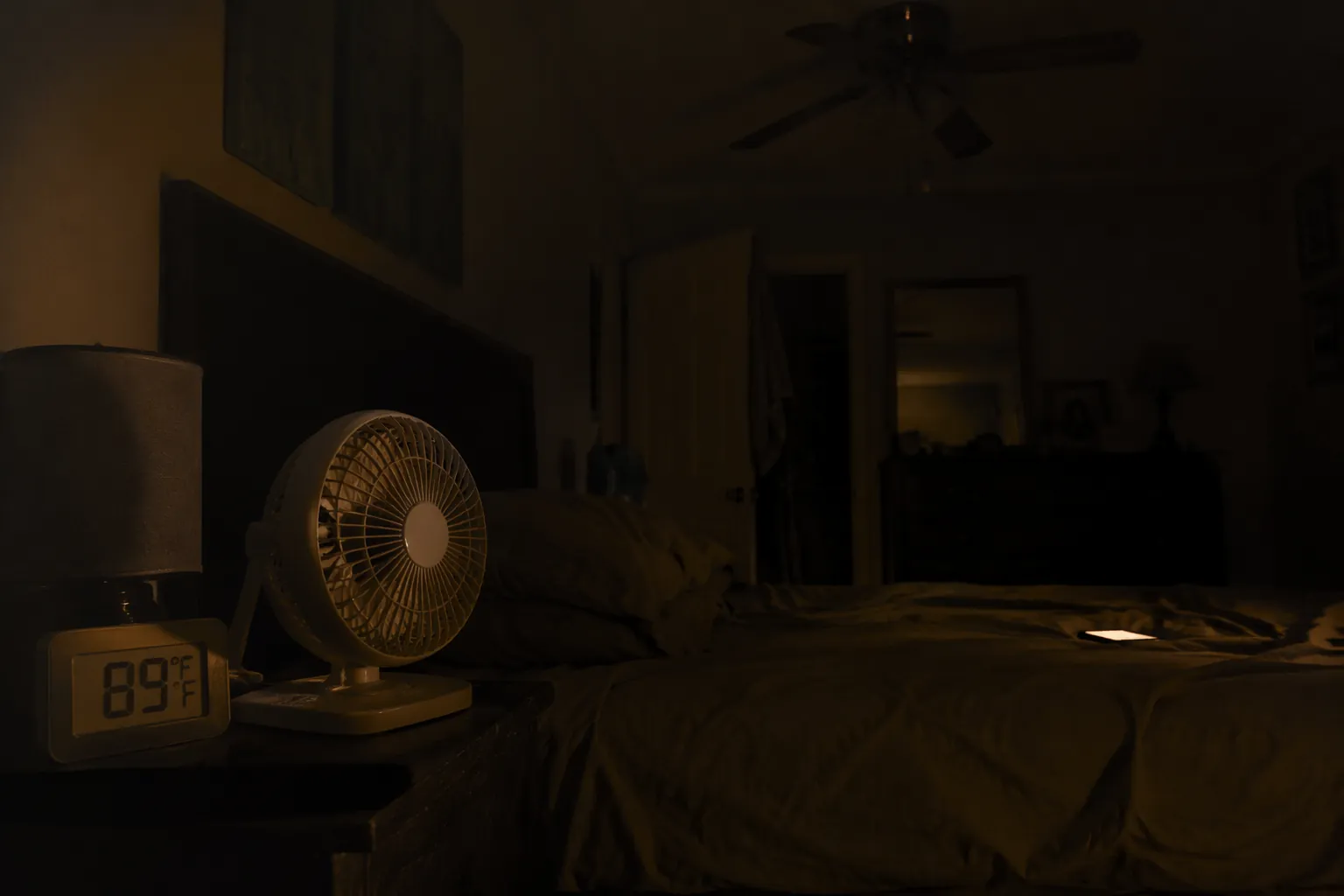
That is the point where the usual advice about breathable sheets and chilled pillowcases becomes too small for the problem. Comfort still matters, because no one makes good decisions after hours of sweating and broken sleep. But for older adults, pregnant people, and perimenopausal women, the first job is not to make a hot room feel nicer. It is to prevent heat illness, dehydration, medication complications, and a night that becomes harder to leave at 2 a.m.
Start with a calm overnight safety check
Do this before debating whether to sleep downstairs, take a cool shower, or point a battery fan at the bed.
| Check | What changes the decision | Safer next move |
|---|---|---|
| Who is in the home | Adult over 65, pregnant person, perimenopausal woman with severe hot flashes, anyone with limited mobility, heart disease, kidney disease, or medication that affects heat response | Use a lower threshold for leaving. Do not wait for symptoms to prove the room is unsafe. |
| Indoor temperature | Stays above 88°F / 31°C | Plan to relocate to a cooling center, cooled relative’s home, hotel, library, community space, or other local cooled site.[1] |
| Fan use | Room is about 90°F or hotter, or the person is not sweating well, feels faint, or cannot drink enough | Do not rely on the fan as primary cooling. Use water-on-skin cooling if safe, or leave for a cooled location.[2] |
| Symptoms | Confusion, fainting, vomiting, worsening weakness, hot/red skin, very heavy sweating followed by worsening illness, or inability to cool down | Treat as urgent. Call emergency services or seek medical help promptly.[3] |
| Power outage hazards | Generator, grill, or camp stove being used near the home, garage, windows, or doors | Move it outside and away from openings. Never run a generator indoors, in a garage, or near windows because of carbon monoxide risk.[2] |
A cheap indoor thermometer is more useful here than a dozen clever hacks. People misjudge heat at night, and older adults in particular may not feel heat stress early enough to act on it. If the number is already near the relocation threshold before bedtime, assume the room may get worse before it gets better.
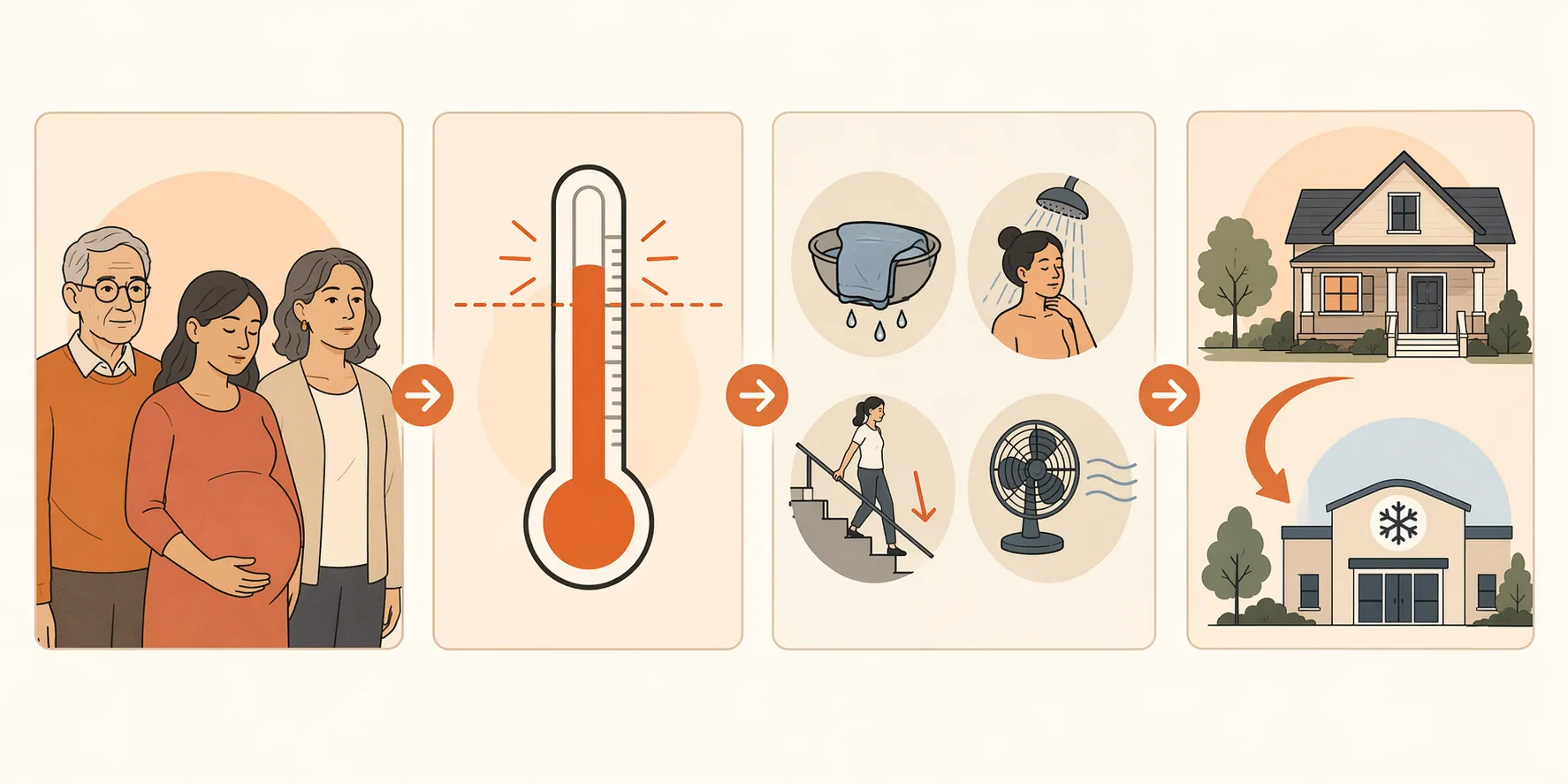
Why the same hot room is not the same risk
Heat advice often treats the body as if it were a healthy adult with normal sweating, normal blood vessel response, no pregnancy, and no medications. That is not the room many families are standing in during an outage.
Older adults: the problem is not just age, but heat dissipation
Older adults can have a reduced ability to lose heat through normal thermoregulation, including changes in skin blood flow and the body’s ability to recognize and respond to the temperature that supports sleep. Raymann and Van Someren’s work on older adults and sleep temperature describes diminished ability to identify the optimal temperature for sleep initiation, a problem that matters when the bedroom is not merely uncomfortable but hot for hours.[4]
Medication makes this more serious. The American Geriatrics Society Beers Criteria is not a heat-wave checklist, but it is useful because it flags medication classes that can be risky in older adults. In hot conditions, special caution is reasonable with diuretics, beta-blockers, anticholinergic drugs, some antidepressants, and combinations of several medications, because they may affect hydration, sweating, blood pressure, alertness, or the body’s ability to shed heat.[5]
That does not mean stopping medicine during a power outage. A daughter checking on a parent should not pull a blood pressure pill or diuretic because the bedroom is hot. It means the plan should be more conservative: check the room temperature, watch for dizziness or confusion, keep a medication list ready, call the prescriber or pharmacist if there is time, and leave for a cooler location sooner rather than trying one more hour of fan air.
- Higher caution signs for an older adult include new confusion, unusual sleepiness, dizziness when standing, weakness, stopped sweating despite heat, rapid worsening of symptoms, or being unable to drink safely.
- Higher caution situations include living alone, limited mobility, no working phone, no indoor thermometer, recent medication changes, heart or kidney disease, and a bedroom that remains above the danger threshold.
- The safer assumption is that the body may be under stress before the person reports feeling “too hot.”
Pregnancy: hydration helps, but it is not the whole answer
Pregnancy already increases cardiovascular demand. During extreme heat, the body has to support pregnancy and cool itself at the same time. CDC clinical guidance states that heat exposure during pregnancy is associated with adverse outcomes including preterm birth and low birthweight, and that even short-term high-heat exposure can matter.[6]
So “just hydrate” is incomplete advice. HealthLink BC advises pregnant people to drink about 3 to 4 liters of water per day during extreme heat unless a clinician has given different instructions.[1] That is a useful target for many people, but it does not make a persistently hot room safe, and it does not apply cleanly to everyone with fluid restrictions, severe nausea, kidney disease, heart disease, preeclampsia concerns, or a clinician-directed limit.
Medication questions also deserve a real answer. CDC guidance for pregnancy and heat notes that clinicians should consider medications that can affect heat response, including antihistamines and antihypertensives.[6] A pregnant reader should not stop a prescribed medication because the power went out. But if the forecast is dangerous, the indoor temperature is climbing, or symptoms appear, that is a reason to call the obstetric clinician, pharmacist, nurse line, or local health service for specific advice and to arrange a cooler place to stay.
- Do not wait out a very hot night if there are contractions, decreased fetal movement, fainting, persistent vomiting, confusion, severe headache, chest pain, or an inability to keep fluids down.
- If the home is above 88°F / 31°C and not cooling, relocation is a practical pregnancy safety measure, not an overreaction.[1]
- If transportation is the obstacle, call 211, a local health department, emergency management office, clinic line, neighbor, relative, or community group before the hottest part of the night.
Perimenopause: hot flashes are a thermoregulation problem, not a character flaw
A perimenopausal woman may start the night already primed for sudden heat surges. A hot flash is not just “feeling warm.” It is a thermoregulatory event that can bring flushing, sweating, a racing feeling, and abrupt waking. Sleep science has long tied sleep timing and continuity to core body temperature and heat loss through the skin; when the room is too hot, the body has fewer ways to make the normal temperature drop that supports sleep.[7]
Ambient heat can amplify the misery and the risk. The person may sweat through clothing, wake repeatedly, drink less because the bathroom is dark or stairs are unsafe, then become more dehydrated as the night goes on. There are not power-outage-specific trials proving which cooling routine prevents hot-flash-related heat illness. The sensible plan is extrapolated from known thermoregulation and symptom patterns: cool the skin, lower the room heat if possible, reduce exertion, replace fluids, and do not stay in a dangerously hot indoor environment just because the symptom has been dismissed before.
This is especially important when hot flashes coexist with other risks: high blood pressure treatment, antidepressants, sedating medications, migraine, heavy bleeding, poor sleep for several nights, or caring for someone else through the outage. A night of repeated heat surges in an 89°F bedroom is not the same as a bothersome warm night with working AC in the next room.
Cooling methods, ranked by safety during an outage
The safest methods during a power outage are the ones that remove heat from the body or get the person to a cooler environment without adding a new hazard. The weakest methods are the ones that only make the room feel more bearable for a few minutes while core heat continues to rise.
| Cooling choice | Safety ranking | Best use |
|---|---|---|
| Relocating to a cooled place | Safest when indoor heat stays high | Use when the home remains above 88°F / 31°C, symptoms appear, pregnancy or older-adult medication risk is present, or the person cannot cool reliably.[1] |
| Cool shower, sponge bath, or damp cloths | High value | Use cool—not icy—water on skin, especially neck, wrists, chest, groin, and back of knees. Repeat as needed. |
| Moving to the lowest/coolest part of the home | High value if the space is safe | Use a basement, shaded lower floor, or interior room if it is cooler, accessible, and not isolated from help. |
| Hydration with electrolytes as appropriate | Important but not sufficient | Drink steadily; pregnant people may be advised to drink 3 to 4 liters per day during extreme heat unless told otherwise by a clinician.[1] |
| Battery fan | Conditional | Use only if it helps evaporate moisture from skin and the room is not dangerously hot. Do not rely on it around 90°F or hotter.[2] |
| Frozen bedding, chilled socks, cold pillowcases | Comfort-only | Fine if already available and safe, but not a plan for a high-risk person in a room above the danger threshold. |
| Generator-powered AC | Only if generator safety is strict | Never run a generator indoors, in a garage, on a porch near openings, or near windows because of carbon monoxide risk.[2] |
Best first: water on skin and a cooler location
A cool shower before lying down can buy time, but it should not become a reason to stay in an unsafe room. If showering is risky because of dizziness, pregnancy balance changes, frailty, darkness, or slippery floors, use a seated sponge bath or damp cloths instead. Keep the water cool rather than painfully cold. The goal is steady heat loss, not a shock that leaves someone shivering, faint, or unwilling to repeat the method.
Damp cloths can be more practical than a shower at night. Put them on the neck, upper chest, wrists, inner elbows, groin, and behind the knees. Re-wet them when they warm up. If a fan is being used safely, moving air over damp skin can help evaporation. If the air is very hot, the person is not sweating, or the fan is only blowing hot air into the face, stop treating the fan as the main cooling tool.
Move down, not just across
Heat rises, and bedrooms can be among the worst rooms in a house during a power outage. Sleeping on a lower floor, in a shaded room, or in a basement can help if the space is safe, dry, ventilated, and reachable without a fall risk. For an older adult, the coolest room is not automatically the best room if it is down steep stairs, far from a bathroom, or away from a working phone.
Set up the sleep spot before the person is exhausted: water within reach, phone charged from a power bank if available, flashlight, medication list, glasses, mobility aid, and a clear path to the bathroom or exit. The 2 a.m. version of the plan should not depend on someone finding keys in the dark while nauseated.
Hydration is a support measure, not permission to stay
Drink before thirst becomes intense. Use water, oral rehydration solution, or familiar electrolyte drinks if they are tolerated. Avoid treating alcohol as a sleep aid in heat; it can worsen dehydration and judgment. Heavy meals, unnecessary exertion, and repeated trips up and down stairs also add heat load when the body is already working hard.
Pregnant people should follow clinician guidance if they have been told to limit fluids or monitor blood pressure. Older adults on diuretics, people with heart failure or kidney disease, and anyone with vomiting or diarrhea need individualized advice sooner. The practical point is simple: if the person cannot drink enough, cannot keep fluids down, or becomes more confused or weak, the home plan is failing.
Fans need rules
A fan can help when it increases evaporation from damp skin in a room that is warm but not dangerously hot. It becomes questionable when the indoor air is around 90°F or hotter, when humidity is high, when the person is dehydrated, or when sweating is impaired.[2] For an older adult on medications that affect heat response, the fan may create a false sense of safety because the moving air feels like action while core heat continues to build.
If using a fan, pair it with wet skin or damp cloths, keep checking the indoor temperature, and reassess symptoms. Do not aim strong air at someone who is shivering after a cold shower. Do not use a fan to delay relocation once the room is above the danger threshold.
Generators are not bedroom equipment
Generator safety deserves a hard line. A generator can keep medical devices, fans, or limited cooling equipment running only if it is operated correctly. It must never be used inside a home, basement, garage, or near windows, doors, or vents because carbon monoxide can kill without warning signs people recognize in time.[2]
If generator placement is uncertain, do not use it as the overnight sleep solution. Leave for a cooled site instead. Carbon monoxide risk is not a tradeoff for a slightly cooler room.
A workable plan for tonight
If the indoor temperature is below the relocation threshold, no red-flag symptoms are present, and the person can cool down and drink safely, a stay-home plan can be reasonable for the next stretch of the night. Keep it boring and checkable.
- Check the indoor temperature in the room where the person will actually sleep.
- Move to the coolest safe part of the home before exhaustion sets in.
- Use cool water on skin: shower, sponge bath, or damp cloths.
- Drink steadily, following pregnancy, kidney, heart, or medication-related fluid instructions.
- Use a fan only if the room is not dangerously hot and it is helping evaporation from damp skin.
- Set a reassessment time rather than hoping to sleep through the problem.
- Decide in advance where to go if the room crosses 88°F / 31°C, symptoms appear, or the person cannot cool down.[1]
For a caregiver, the reassessment matters. Call or check in at a specific time. Ask for concrete observations: room temperature, whether they urinated recently, whether they feel dizzy standing up, whether they are sweating, whether they know the day and where they are, whether they can get to the door if someone comes to pick them up. “I’m fine” is not enough information during a hot outage.
When staying home is no longer reasonable
Leave earlier than pride wants you to. The safest sleep location may be a cooling center, a relative’s living room, a friend’s apartment, an air-conditioned public building during open hours, or a locally arranged emergency shelter. Availability varies by municipality, so use 211, local health department alerts, city emergency management pages, utility outage updates, community centers, clinics, faith organizations, and neighbors to find the nearest cooled option.
Relocation is the right call if the indoor temperature remains above 88°F / 31°C, if the only cooling method is a fan in very hot air, if an older adult has medication or mobility risks, if a pregnant person has symptoms or cannot keep fluids down, if perimenopausal heat surges are becoming relentless in a hot room, or if anyone is becoming confused, faint, weak, or unable to cool.[1][2][3]
Pack the medication list, medications, water, phone charger or power bank, ID, prenatal records if easily available, glasses, mobility aids, and anything needed for safe toileting or blood sugar monitoring. If the person uses medical equipment that needs electricity, do not wait until the battery is nearly gone to ask for help.
If the room is still too hot, the body is not cooling, or the person in the bed is in one of these higher-risk groups, the safest sleep tip is not another trick for the pillow. It is to get to a cooled place while leaving is still simple.
References
- Extreme Heat and Pregnancy, HealthLink BC, June 2026.
- Power Outages, Centers for Disease Control and Prevention.
- Heat Wave Safety, American Red Cross.
- Diminished capability to recognize the optimal temperature for sleep initiation may contribute to poor sleep in elderly people, Sleep, 2008.
- American Geriatrics Society 2023 updated AGS Beers Criteria® for potentially inappropriate medication use in older adults, American Geriatrics Society, 2023.
- Clinical Overview of Heat and Pregnancy, Centers for Disease Control and Prevention, September 2025.
- The Temperature Dependence of Sleep, Frontiers in Neuroscience, 2019.
Safety & eligibility read
Cross-check against other interventionsExplore the mechanism
Next step
Spot an error or have clinical feedback?
Because this article covers clinical, medication, or safety information, we use a moderated correction channel instead of open public comments. Let us know if something about “Sleep Tips Without AC During a Power Outage Heat Wave” needs a closer look.
Send feedback on this article