
How to Sleep Safely During a Power Outage When Pregnant
A power outage during pregnancy raises unique heat and dehydration risks that don't affect others the same way. This guide covers cooling strategies, a hydration protocol, and the symptom thresholds that tell you when to call your OB-GYN or head to the ER.
When the AC stops during a hot-weather outage, the question is not just how to sleep during a power outage. During pregnancy, especially later pregnancy, the safer question is whether sleeping at home tonight is still reasonable.
The CDC is blunt about why pregnancy changes the calculation: pregnant people can develop heat exhaustion or dehydration sooner because the body is working to cool both the pregnant person and the developing baby. The CDC also places pregnant people in a higher-risk group for heat-related illness and recommends making a heat action plan with a doctor before dangerous heat hits. Extreme heat in pregnancy is also treated in federal heat-health guidance as a serious fetal-health concern, including associations with preterm birth, low birth weight, and fetal death. [1]
That does not mean every power outage is an emergency. It does mean the decision point comes before the night gets worse, not after hours of sweating, dizziness, contractions, or reduced fetal movement.
First decide: stay home, call your OB-GYN, or go in now
Before setting up a sleeping spot, check symptoms. A partner or caregiver can do this out loud: fetal movement, contractions, headache, vision, swelling, bleeding, fainting, and whether there are signs of labor. This is not overreacting. It is triage.
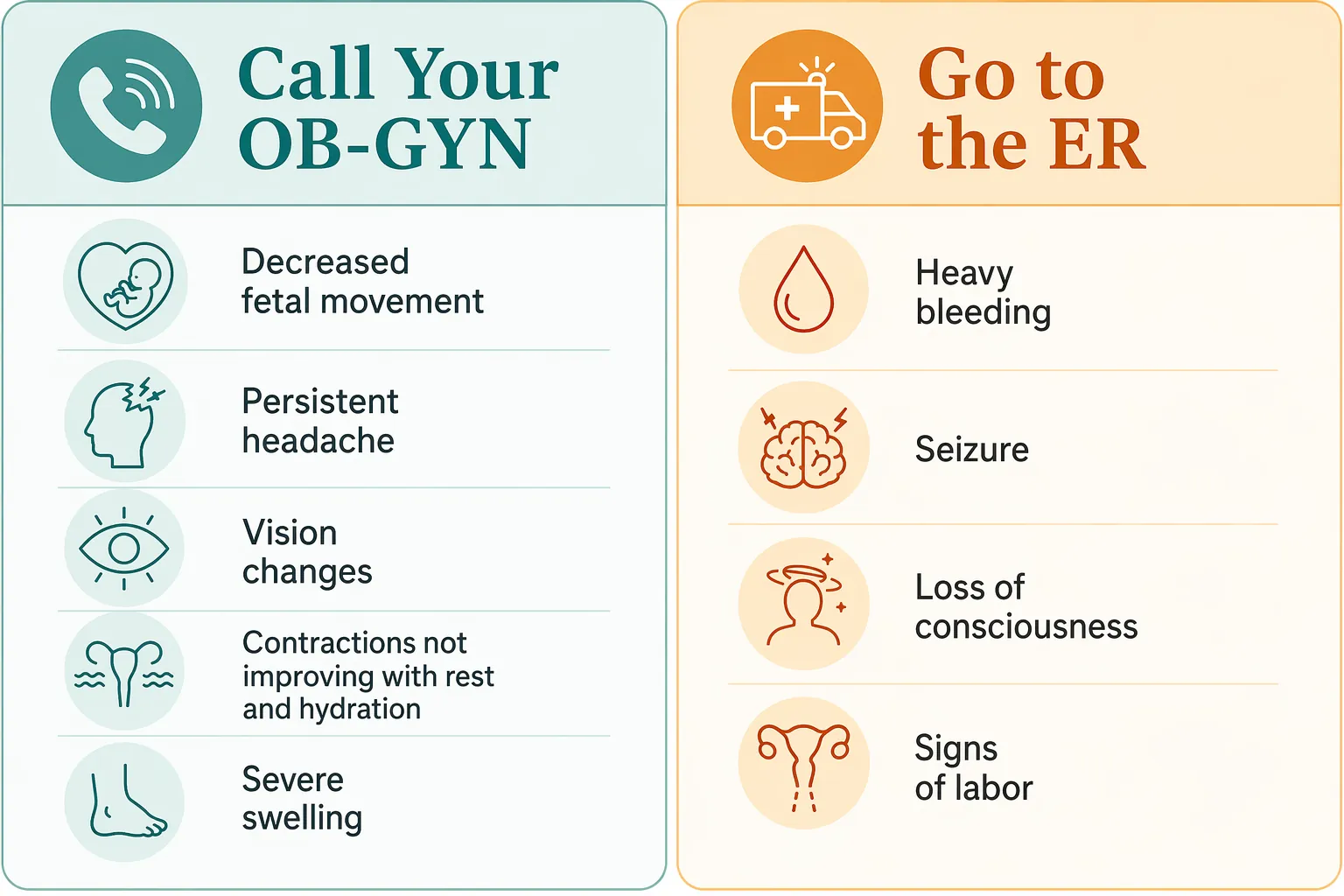
Use the following split as the practical boundary. The outage-specific contraction guidance comes from one OB-GYN practice’s hurricane-season advice, so it is useful for this exact scenario but should not replace your own clinician’s instructions. [2]
| Call your OB-GYN, midwife, or labor-and-delivery triage now | Go to the ER or call emergency services now |
|---|---|
| Decreased fetal movement, especially if it is a change from your baby’s usual pattern | Heavy bleeding |
| Contractions or abdominal tightening that do not improve after rest, hydration, and cooling | Seizure |
| Persistent headache | Loss of consciousness or fainting |
| Vision changes | Signs of labor, especially if you have been told you are preterm or high risk |
| Severe swelling, especially if sudden or paired with headache or vision symptoms | Any symptom your clinician has specifically told you to treat as an emergency |
Contractions are the place where people talk themselves into waiting too long. Dehydration can cause tightening that feels like early labor; if rest, fluids, and cooling do not settle it, call. [2] If you cannot reach your OB-GYN or triage line and symptoms are worsening, do not keep troubleshooting the bedroom.
If none of those warning signs are present, the next question is whether you can make the home meaningfully cooler. If the answer is no, look for an air-conditioned alternative before you are exhausted: a relative’s home, a cooling center, a hotel, or another safe indoor place. For a broader non-pregnancy-specific setup, use the general guide to sleeping during a power outage. Here, the priority is narrower: lower heat strain on a pregnant body tonight.
If you are staying home, cool the environment before the bed
Start with the room, because a damp cloth cannot compensate for a room that keeps getting hotter. Move to the lowest safe level of the home. Heat rises, and lower floors are often less punishing after sunset. Choose a room with the best cross-breeze if windows can be opened safely. If the outdoor air is hotter, smoky, unsafe, or more humid than indoors, do not open windows just to feel like you are doing something.
Keep flashlights or battery lanterns within reach so nobody is walking half-asleep through a dark house to the bathroom. The American Red Cross and CDC both emphasize basic outage safety: use flashlights instead of candles when possible, avoid running generators indoors, and protect yourself from carbon monoxide hazards. [3][4]
- Move the sleep setup downstairs or to the coolest interior room that is safe and accessible.
- Use light bedding only. A sheet is enough if you are hot.
- Keep a clear path to the bathroom with a flashlight at both the bed and the bathroom door.
- If you have a battery fan, point it across the body rather than directly at the face all night.
- If the house is not cooling and you feel worse, stop trying to make the setup work and seek a cooler place or medical guidance.
Then cool the body, gently and repeatedly
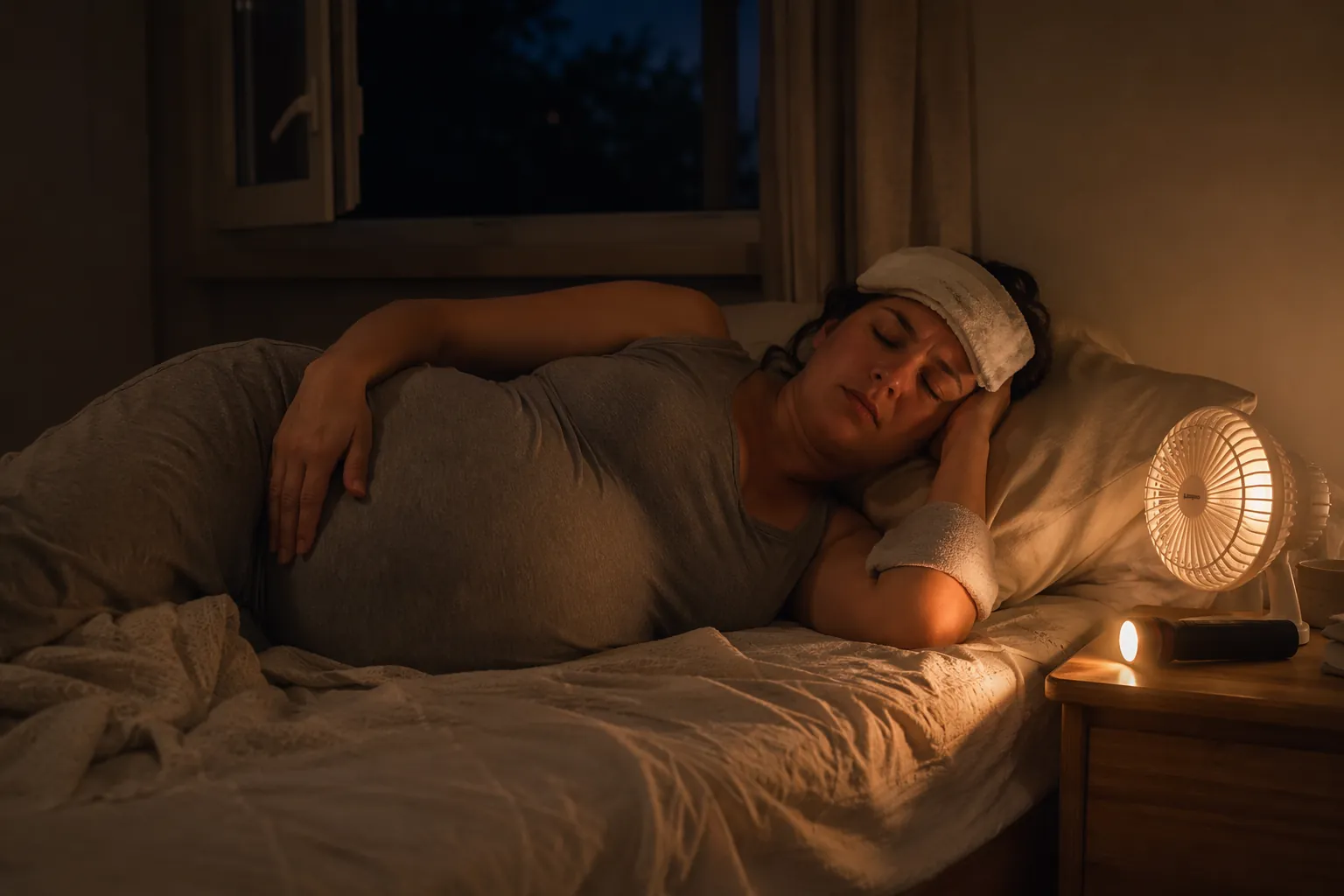
Once the room is as safe as you can make it, shift to body cooling. The goal is steady heat relief, not a dramatic cold shock right before sleep.
A lukewarm shower is a better first move than a cold shower. Cold water can feel good for a minute, but it can also be stimulating and uncomfortable before bed. Lukewarm water brings skin temperature down without turning the whole bedtime routine into another jolt. [2]
- Use a lukewarm shower or sponge bath before lying down.
- Place damp cloths on pulse points: wrists, neck, inner elbows, behind the knees, or ankles.
- Refresh cloths when they become warm. A partner can rotate them without turning on bright lights.
- Sleep on the left side if that is comfortable, with pillows arranged for support rather than heat trapping.
- Avoid heavy compression, weighted blankets, or layers that make it harder to shed heat.
Left-side sleeping is commonly recommended during pregnancy because it supports blood flow; in an outage, it also keeps the plan simple. If left-side positioning hurts, adjust with pillows rather than forcing a rigid pose all night. [5]
This is where ordinary pregnancy insomnia advice has limits. A pregnancy pillow, a bedtime routine, or a relaxation track may help under normal conditions, but they do not solve heat strain when the room is hot and the fan has stopped. Save the normal sleep troubleshooting for a stable environment; if you want that later, use the guide to pregnancy insomnia remedies by trimester. Tonight, cooling comes first.
Hydrate earlier, then taper only if you already drank enough
The annoying part of pregnancy hydration is real: drinking more can mean more bathroom trips in a dark, hot house. But withholding fluids to sleep longer is the wrong trade when heat is the problem.
Tommy’s, a UK pregnancy charity with NHS-aligned guidance, gives a baseline of about 1.6 liters of fluid per day in pregnancy and advises drinking more in hot weather or when sweating. It also lists observable dehydration signs: dark urine, dizziness, dry mouth, and urinating fewer than four times a day. [6]
For an outage night, that becomes a daytime-forward plan:
- Drink steadily during the afternoon and early evening instead of trying to catch up at bedtime.
- Increase fluids if you are sweating, the house is still hot, or your urine is darker than usual.
- Use an electrolyte drink if you have been sweating heavily or have had poor intake, unless your clinician has told you to restrict sodium or fluids.
- Only taper fluids in the last two hours before bed if you have already hydrated well.
- Keep water at the bedside anyway. If you wake up hot, thirsty, dizzy, or contracting, drink.
A partner can help by watching the simple signs, not by policing ounces. Is urine getting darker? Are they dizzy when standing? Have they barely peed? Is their mouth dry? Those are more useful at 2 a.m. than a perfect hydration target.
Make the bathroom trip safer, not rarer at any cost
Trying to avoid every nighttime bathroom trip can backfire. The safer compromise is to make bathroom trips boring and low-risk: clear the floor, put a flashlight where a hand naturally lands, wear nonslip footwear if floors are damp, and sit up slowly before standing. Heat, dehydration, and late pregnancy balance changes are a bad combination in the dark.
If dizziness appears when standing, pause and cool down. If there is loss of consciousness, seizure, heavy bleeding, or signs of labor, that has moved out of sleep-management territory.
What to set beside the bed tonight
Do not build a full disaster kit at midnight if the pregnant person is already overheated. Put the essentials within reach first, then improve the setup tomorrow if the outage continues.
| Bedside item | Why it matters tonight |
|---|---|
| Water bottle | Prevents choosing between thirst and walking through the dark |
| Electrolyte drink or packets | Useful after heavy sweating or poor intake |
| Two or more damp cloths | Lets one cool while another is in use |
| Battery fan, if available | Adds air movement without relying on the grid |
| Flashlight or battery lantern | Reduces fall risk during bathroom trips |
| Phone with OB-GYN, triage, and hospital numbers saved | Makes escalation faster if symptoms change |
| Medication list and prenatal records if easy to grab | Helps if you need to leave quickly |
If you use insulin for gestational diabetes or another condition, do not guess about heat exposure. Ask your pharmacist or diabetes care team how long your specific insulin can be kept at room temperature and what to do if the house stays hot. For device and medication backup planning beyond pregnancy, see the medical device and medication power-outage guide.
If the outage may last another night
Tomorrow’s useful work is not a generic hurricane checklist. It is a pregnancy heat plan: where you will go if the house does not cool, who can drive, which hospital or labor-and-delivery unit you would use, what your OB-GYN wants you to do for contractions or reduced fetal movement, and how you will keep medications safe.
The CDC’s general outage guidance also matters if the power is still out: keep generators outside and away from windows, avoid unsafe heating or cooking devices indoors, and follow local instructions for food, water, and shelter. [4] If you are managing pregnancy along with an older adult, a child, or someone using CPAP, the companion guide on sleeping in a power outage when you’re pregnant, older, or use CPAP may be more useful than a pregnancy-only plan.
For tonight, the boundary is simple enough to remember in the dark: cool the room, cool the body, hydrate earlier rather than withholding fluids, and treat decreased fetal movement, persistent contractions, headache, vision changes, or severe swelling as a reason to call. Heavy bleeding, seizure, loss of consciousness, or signs of labor are reasons to go in now.
References
- Heat and Pregnancy — CDC
- Pregnant During Houston Hurricane Season: Heat, Power Outages, and When to Call Your OB-GYN — Pristine Healthcare
- Power Outage Safety — American Red Cross
- What to Do to Protect Yourself During a Power Outage — CDC
- Pregnancy & Sleep: Common Issues & Tips — Sleep Foundation
- Coping with hot weather in pregnancy — Tommy’s
Explore the mechanism
Next step
Spot an error or have clinical feedback?
Because this article covers clinical, medication, or safety information, we use a moderated correction channel instead of open public comments. Let us know if something about “How to Sleep Safely During a Power Outage When Pregnant” needs a closer look.
Send feedback on this article