
Can Time-Restricted Eating Help Older Adults Sleep Better?
Many older adults wake up before dawn due to a natural circadian shift — not a sleep problem. This article explains how early time-restricted eating (finishing meals 3+ hours before bed within a 10-hour window) may help realign the body’s clock, and what current evidence says about safety and effectiveness for adults over 65.
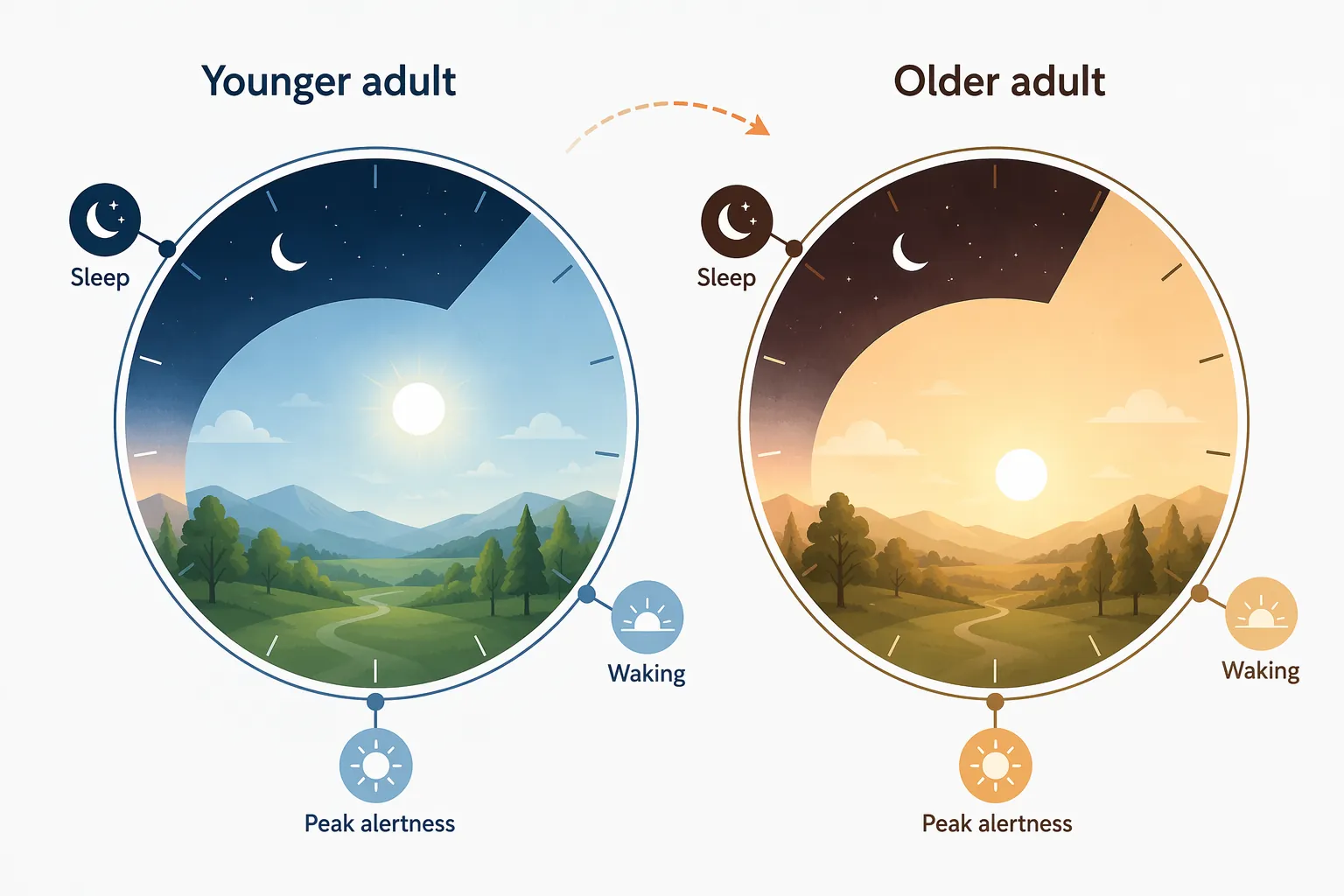
Waking at 3 a.m. in later life is often treated as if someone has failed at sleep: the room was not dark enough, the bedtime was wrong, the routine was not soothing enough. Sometimes those things matter. But for many older adults, the first fact to sit with is kinder and more useful: the body clock itself tends to move earlier with age. Around age 60 to 65, the sleep-wake rhythm may shift roughly 1 to 2 hours earlier, and melatonin timing often moves earlier too.
That does not make early waking pleasant. It also does not automatically make it a disorder. A person who used to sleep from 11 p.m. to 7 a.m. may now feel sleepy at 9:30 p.m., wake at 4:30 or 5 a.m., and then be told to “just stay in bed” as though the older nervous system were simply being stubborn. It is not.

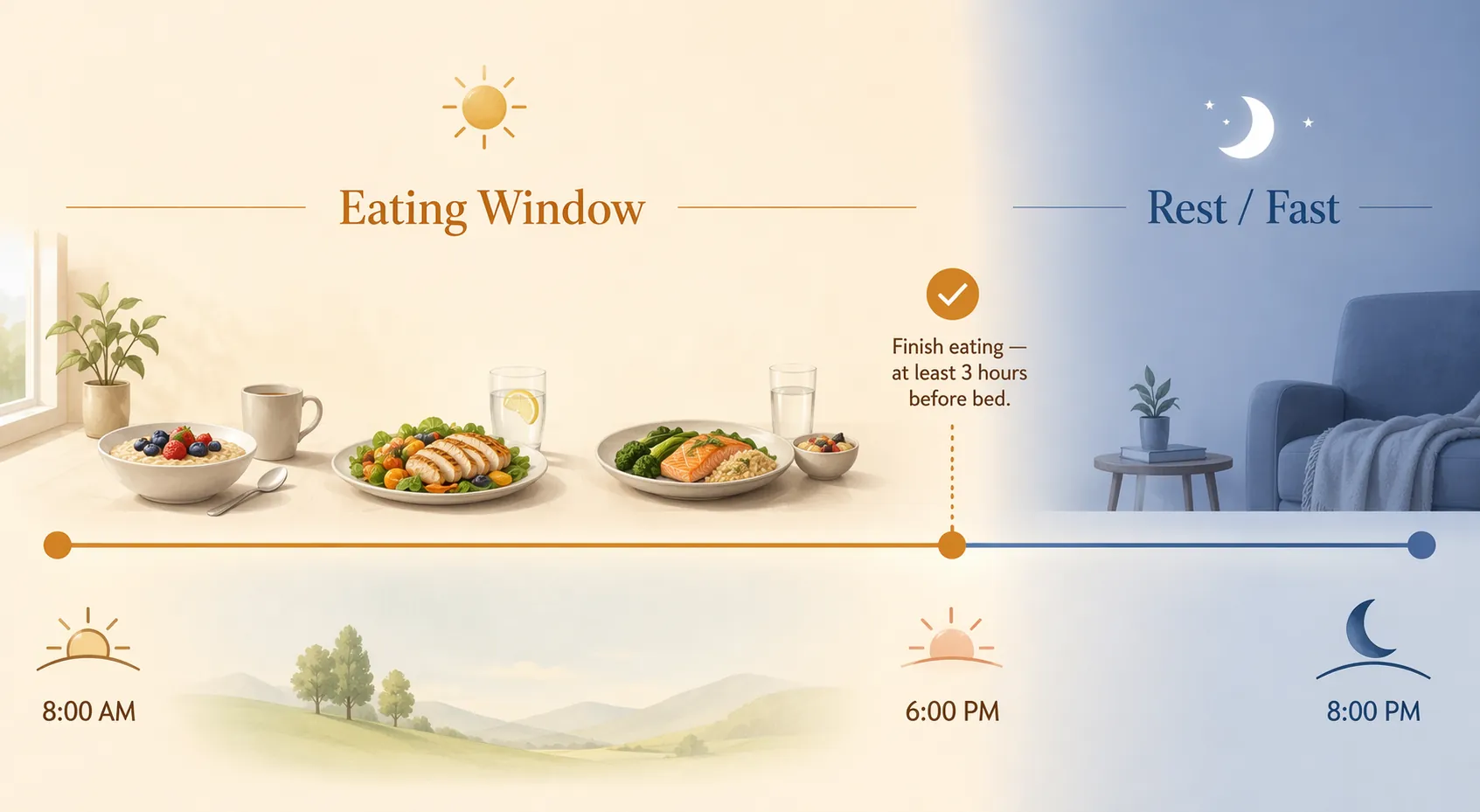
This is where time-restricted eating for better sleep in older adults becomes interesting—not as a weight-loss project dressed up as sleep advice, and not as a fasting challenge. The more sensible version is an early, gentle timing strategy: eat within a roughly 10-hour daytime window, finish the last meal at least 3 hours before bed, and avoid making late evening food the strongest “daytime” signal your body receives.
For an older adult, that might look like breakfast around 8 a.m. and dinner finished by 6 p.m. if bedtime is near 9:30 or 10 p.m. The point is not to prove toughness by fasting longer. The point is to ask whether meal timing can stop arguing with an already-earlier circadian system.
Why meal timing may matter more after 65
Sleep timing is not run by one clock alone. The central clock in the brain responds strongly to light and darkness. Other clocks—in the liver, gut, pancreas, muscle, and fat tissue—respond to repeated daily cues, including when food arrives. In younger adults with a later sleep phase, a late dinner may be merely unhelpful. In an older adult whose internal night is already arriving earlier, late eating can become a mixed signal.
That distinction matters. Early time-restricted eating is not the same thing as generic intermittent fasting. A strict 16:8 or 18:6 fasting plan may be sold as metabolic discipline. A 10-hour daytime eating window for an older adult is a different clinical idea: keep nourishment adequate, keep medication timing safe, and make food timing agree with the body’s earlier day.
An earlier dinner does several practical things at once. It reduces the chance that digestion, reflux, bathroom trips, or post-meal glucose swings are still active at bedtime. It gives the gut and metabolic tissues a clearer overnight rest period. And it may help reinforce the same “day is over” message that dim evening light and a regular bedtime are trying to send.
None of that proves that meal timing will fix insomnia. It explains why the idea is biologically plausible in older adulthood. The question is not whether fasting is virtuous. It is whether moving food earlier can help an aging circadian system stay better aligned without creating new problems.
What the older-adult sleep evidence actually shows
The best older-adult sleep signal comes from the 2024 Think FAST pilot study by James and colleagues. Participants were adults 65 and older with memory decline. They followed a time-restricted eating approach that used a 14-hour nightly fast starting by 8 p.m., which left a 10-hour eating window during the day. Over 8 weeks, their Insomnia Severity Index score dropped from 6.72 to 5.00, with a reported p value of 0.04 and a medium effect size.[1]
That is worth noticing because the study actually included older adults and measured insomnia severity. Too much sleep advice for people in their 70s is built from studies of people young enough to have a very different circadian system.
It is also worth keeping in proportion. The Think FAST pilot included 18 participants. The sample was 95% women and 89% non-Hispanic white, and all participants had memory decline.[1] That does not make the result meaningless. It does mean it should not be presented as proof that time-restricted eating improves sleep for all older adults.
Another older-adult pilot, published by Anton and colleagues in 2019, tested a 16:8 time-restricted feeding pattern in overweight adults 65 and older. The mean age was 77, and adherence was 84%, which is useful feasibility information. But sleep was not measured, so this study cannot be used as evidence that the approach improves sleep.[2]
A 2024 systematic review by Bohlman and colleagues found that time-restricted eating does not typically worsen sleep parameters in adult studies, but those studies involved adults ages 22 to 49. The authors specifically called for studies in older adults because aging itself involves circadian disruption.[3] That is the correct caution. Younger-adult sleep data should not be casually imported into late life.
There is also an inconvenient counterpoint. A 2023 cross-sectional study by Li and colleagues found that a 10-hour time-restricted eating pattern was associated with worse cognitive performance in some domains among older Chinese adults.[4] Cross-sectional findings do not prove that the eating window caused the cognitive differences. They do, however, make it harder to market time-restricted eating to older adults as harmless by default.
| Evidence layer | What it can reasonably tell us | What it cannot tell us |
|---|---|---|
| Circadian aging mechanism | Older adults often have an earlier sleep-wake rhythm, so earlier food timing is biologically plausible. | It does not prove that meal timing treats insomnia. |
| Think FAST pilot | A gentle 10-hour eating window was linked with lower insomnia severity over 8 weeks in a small older-adult sample.[1] | It cannot establish broad effectiveness for all adults over 65. |
| Anton 2019 pilot | Some overweight older adults could follow a time-restricted eating schedule with high adherence.[2] | It did not measure sleep. |
| Younger-adult systematic review | Adult studies generally do not suggest sleep worsening.[3] | The participants were not older adults. |
| Li 2023 cross-sectional study | It raises a caution about cognitive outcomes in older adults.[4] | It does not prove that time-restricted eating causes cognitive harm. |
The version that makes sense is early and gentle
If this strategy is considered at all, the older-adult version should usually start with preservation, not restriction: preserve breakfast if morning medications or appetite require it; preserve enough protein; preserve hydration; preserve social meals when possible; and preserve the ability to stop if dizziness, weight loss, weakness, or medication problems appear.
A practical trial might simply move dinner earlier and stop evening snacking, rather than compressing the day into a narrow feeding window. For example, someone who currently eats from 8 a.m. to 9 p.m. might first aim for 8 a.m. to 6 p.m. That is still a 10-hour eating window. It is not an extreme fast.
The last meal should end at least 3 hours before bedtime when feasible. For a person who naturally gets sleepy at 9:30 p.m., finishing dinner around 6 p.m. is more coherent than finishing at 8:30 p.m. and then wondering why the body feels half-awake in bed.
This is also why late-night “healthy snacks” deserve scrutiny. A snack may be nutritionally reasonable and still be poorly timed for a person whose internal night has already begun. On the other hand, a needed snack for blood sugar safety is not optional. Timing advice has to yield to medical reality.
Medication and nutrition decide whether this is appropriate
For adults over 65, the safety filter is not a footnote. A time-restricted eating plan can collide with the ordinary machinery of later-life care: pills that must be taken with food, pills that must be taken away from food, glucose-lowering medications, blood pressure medications, diuretics, thyroid medication, supplements, and the simple problem of getting enough calories and protein into the day.
AARP and Harvard Health both flag concerns about intermittent fasting in older adults, including medication timing conflicts, dehydration, dizziness or orthostatic hypotension, and the risk that eating less often may worsen inadequate intake or muscle loss concerns.[5][6]
| Issue to review | Why it matters before trying a 10-hour eating window |
|---|---|
| Diabetes medications or insulin | Long fasting periods can create blood sugar risk if medication timing is not adjusted by a clinician. |
| Blood pressure medications and diuretics | Less food or fluid during the evening may worsen dizziness, dehydration, or orthostatic hypotension in susceptible adults. |
| Thyroid medication | Many thyroid medicines have specific timing rules around food, calcium, iron, and other supplements. |
| Pills that require food | Some medications are better tolerated or safer when taken with meals; removing an evening meal may remove the usual dosing anchor. |
| Low body weight or recent weight loss | A shorter eating window can unintentionally reduce calories. |
| Low protein intake or frailty | Older adults need to protect muscle; a fasting plan that crowds out protein can work against that. |
| Fall risk | Dizziness, low blood pressure, dehydration, or nighttime weakness can turn a sleep experiment into a safety problem. |
| Cognitive impairment | Meal timing changes may require caregiver support, and missed meals or missed medications are not small side effects. |
This is the point where many wellness articles become too breezy. An older adult taking morning thyroid medication, a midday blood pressure pill, evening metformin, and a bedtime medication does not need a fasting slogan. They need a medication map. The same caution applies to drugs that appear on geriatric medication-review lists or that increase fall, confusion, sedation, or blood pressure risk. Meal timing can change how a day functions.
Nutrition needs the same seriousness. If a 10-hour eating window leads to a normal breakfast, lunch, dinner, fluids, and enough protein, it may be quite manageable. If it turns into skipped breakfast, a light lunch, early soup for dinner, and no evening nourishment in someone already losing weight, it is the wrong experiment.
How to discuss a cautious trial with a clinician
The most reasonable trial is not “start intermittent fasting Monday.” It is a short clinical conversation about whether a daytime eating window fits the person in front of you.
- Describe the sleep pattern plainly: early waking, trouble returning to sleep, fragmented sleep, bedtime sleepiness, naps, and any nighttime bathroom trips.
- Bring the full medication and supplement schedule, including which pills require food and which must be separated from meals.
- Ask whether a roughly 10-hour daytime eating window is safe with current diabetes, blood pressure, thyroid, heart, kidney, or cognitive concerns.
- Choose the gentlest useful change first, such as finishing dinner earlier or ending evening snacking, rather than adopting a stricter fasting protocol.
- Track sleep and safety together: wake time, time awake at night, daytime sleepiness, dizziness, falls, weight change, appetite, hydration, and missed medications.
A useful trial should have an exit ramp. Stop and seek medical advice if there is dizziness, faintness on standing, low blood sugar symptoms, confusion, unintended weight loss, worsening weakness, worsening sleep, or difficulty taking medications correctly.
The sleep goal also needs to be realistic. If the body clock has shifted earlier, a perfect return to a younger schedule may not be the right target. Better targets may be fewer long awakenings, less distress at 3 or 4 a.m., steadier daytime energy, and a schedule that matches the body more closely.
Where this leaves time-restricted eating for older sleepers
Early time-restricted eating is promising because it fits a real feature of aging sleep: the circadian system often moves earlier. It asks a practical question—can food timing be moved earlier too?—instead of blaming the person who wakes before dawn.
The evidence is still thin. One small older-adult pilot found a reduction in insomnia severity over 8 weeks. Another pilot suggests some older adults can follow a restricted schedule, but it did not measure sleep. Younger-adult reviews do not show obvious sleep worsening, yet they do not answer the older-adult question. A cross-sectional cognitive study adds a reason for restraint.
So the narrow answer is the honest one: early time-restricted eating may be worth discussing with a clinician for an older adult whose main pattern is early waking or fragmented sleep, especially if the plan is gentle, daytime-based, and nutrition-preserving. It is not a stand-alone insomnia cure, and it should not be started around medications without review.
The better question for the appointment is simple: would a 10-hour daytime eating window fit this person’s medications, nutrition needs, weight status, fall risk, hydration, and sleep goals? If the answer is yes, the experiment can be modest. If the answer is no, waking early still deserves attention—but not another reason for blame.
References
- Think FAST pilot study — PMC. 2024.
- The Effects of Time Restricted Feeding on Overweight, Older Adults: A Pilot Study — PMC. 2019.
- Time-restricted eating and sleep: a systematic review — PMC. 2024.
- Association of time-restricted eating with cognitive function in older adults — Scientific Reports. 2023.
- Is Intermittent Fasting Safe for Older Adults? — AARP.
- Is intermittent fasting safe for older adults? — Harvard Health.
Safety & eligibility read
Cross-check against other interventionsExplore the mechanism
Next step
Spot an error or have clinical feedback?
Because this article covers clinical, medication, or safety information, we use a moderated correction channel instead of open public comments. Let us know if something about “Can Time-Restricted Eating Help Older Adults Sleep Better?” needs a closer look.
Send feedback on this article