
A walking routine for perimenopause sleep and heart health
For perimenopausal women with fragmented sleep and rising heart-disease risk, walking is the best-evidenced non-drug intervention that addresses both — but the sleep benefit is strongest when sleep is already disturbed. Here's what the research supports and how to build a walking routine around perimenopause physiology.
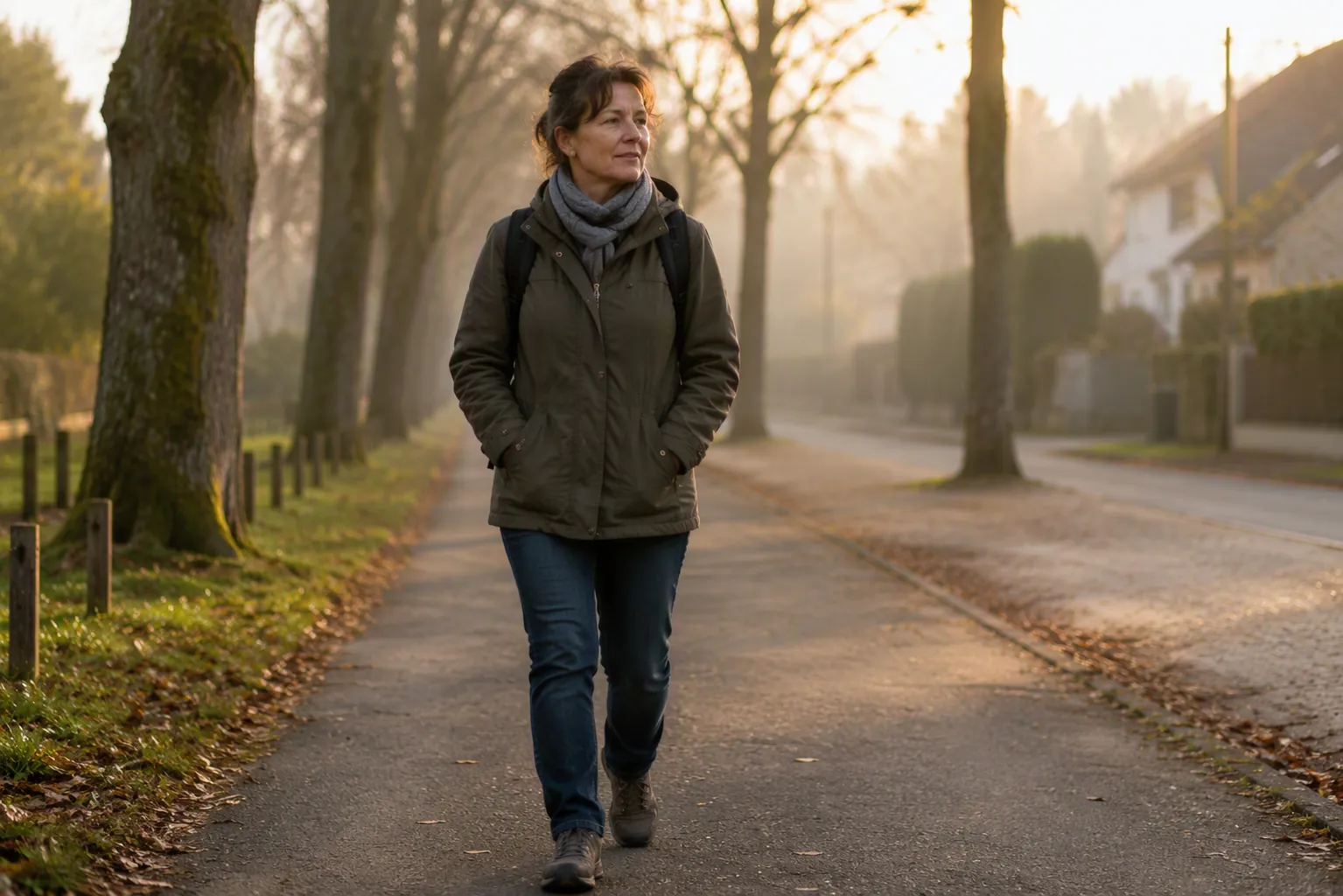
A walking routine for better sleep and heart health sounds almost too neat for perimenopause, which is rarely neat. One night you fall asleep easily and wake at 3 a.m. hot, alert, and annoyed. Another night you sleep but feel unrefreshed. Meanwhile, every health article seems to add a new warning about cholesterol, blood pressure, belly fat, and heart disease after menopause.
Walking deserves attention here, but not because it is magic or because a woman in midlife needs one more wholesome assignment. It deserves attention because the menopause-specific sleep evidence points toward exercise as useful, especially when sleep is already a problem, and the cardiovascular evidence points toward walking as one of the most realistic ways to lower risk without turning daily life into a training program.
The sleep evidence is encouraging, with one important catch
For sleep, the most relevant evidence is not a generic claim that exercise improves sleep. It is a 2023 systematic review and meta-analysis of 17 randomized controlled trials in menopausal women. In that analysis, exercise interventions reduced insomnia severity overall, with a standardized mean difference of −0.91, a 95% confidence interval from −1.45 to −0.36, and p=0.001.[1]
That is a meaningful signal, but the fair interpretation depends on the subgroup result. Women who already had sleep disorders showed a much larger improvement, with an SMD of −2.47. Women without pre-existing sleep disorders showed a smaller effect, with an SMD of −0.38.[1] In plain terms: if your sleep is already fragmented, walking and other exercise are more likely to be worth the effort. If your sleep is mostly intact, adding walking may still help your health, but it should not be sold as a dramatic sleep intervention.
That distinction matters because sleep disruption is common enough in this life stage to be validating, not exotic. The same review cites SWAN data showing that 46% to 48% of menopausal women meet insomnia criteria, compared with 38% of premenopausal women.[1] Those numbers do not mean every midlife woman is doomed to poor sleep. They do mean that waking more often, struggling to return to sleep, or feeling less restored is not a personal failure dressed up as a bedtime problem.
The sleep research also has limits. Much of it relies on subjective sleep measures, which are valuable when the problem is lived sleep quality, but they are not the same thing as detailed objective sleep architecture. And walking may not stop vasomotor awakenings. If hot flashes or night sweats are repeatedly dragging you awake, a walk at lunch cannot be expected to do the job of temperature management, medication discussion, or clinical care when symptoms are severe.
Why walking fits the heart-risk side of the problem
The heart-health case for walking comes from a different kind of evidence. It is not the same as a menopause sleep RCT, and it should not be treated as a guarantee for an individual person. But it is still useful because it answers a practical question: if a woman is going to choose one ordinary movement habit to keep repeating, is walking a reasonable one?
A 2025 European Society of Cardiology report on Cheng et al. analyzed UK Biobank accelerometer data from 32,192 people with high blood pressure, with a mean age of 64 and about 8 years of follow-up. In that hypertensive population, each additional 1,000 steps per day up to 10,000 was linked with lower risk: 17% lower major adverse cardiovascular event risk, 22% lower heart-failure risk, and 24% lower stroke risk.[2]
That study does not prove that every extra 1,000 steps will cause that exact reduction for a perimenopausal woman in her 40s or early 50s. It was observational, older on average, and focused on people with hypertension. Still, it gives a useful dose-response frame: more walking was associated with lower cardiovascular risk, and the meaningful unit was not a heroic leap. It was another 1,000 steps.
A second heart-health finding is closer to the target population. In Women’s Health Initiative data presented by the American College of Cardiology, post-menopausal women who walked at least 40 minutes several times per week at an average-to-fast pace had about a 25% lower risk of heart failure.[3] Again, this is not a prescription with a guarantee attached. It is a pattern: regular, purposeful walking showed up as protective in post-menopausal women, without requiring running, boutique classes, or an athletic identity.
The 10,000-step target is less useful than your own starting point
The 10,000-step number has become a cultural ruler, and it is a lousy way to begin if your sleep is broken and your day is already crowded. The cardiovascular data above used “up to 10,000” as an upper dose-response range, not as a verdict on anyone who lands below it.[2] If you currently walk very little, the more relevant question is not whether you can become a 10,000-step person by next Tuesday. It is whether you can add enough walking to your actual baseline that your body notices and your life can absorb it.
A small 2019 trial helps bridge the gap between population-level cardiovascular findings and daily experience. In a 4-week Fitbit trial of 59 middle-aged adults with a mean age of 49, within-person analyses found that on days participants took more steps than usual, they reported better sleep quality and longer sleep duration. The walking-sleep relationship appeared stronger for women than men, though the sample was 72% female, so that sex comparison should be handled cautiously.[4]
That kind of finding is modest, but it is practical. It suggests that the useful comparison may be you versus your usual day, not you versus a step target built for someone else’s schedule, joints, neighborhood, commute, and caregiving load.
Build the routine around baseline, consistency, timing, and symptoms
A perimenopause walking routine should be boring in the best way: repeatable, adjustable, and hard to turn into another self-improvement project. You do not need a wearable to start, although step counts can be useful if you already use them. Time, route, and perceived effort are enough.
| Routine decision | What to do | Why it fits the evidence |
|---|---|---|
| Baseline | Notice your usual walking for several ordinary days. If you track steps, use that number. If not, use your usual routes and walking minutes. | The most useful first increase is from your own current level, not from a fixed 10,000-step rule. |
| Increase | Add a small repeatable amount: one extra loop, one errand on foot, or roughly another 1,000 steps if you track. | Cardiovascular risk in the hypertensive UK Biobank analysis decreased with each additional 1,000 steps per day up to 10,000.[2] |
| Consistency | Aim for purposeful walks several times per week, with some walks long enough to feel like a real bout rather than only scattered movement. | Post-menopausal women walking at least 40 minutes several times per week at an average-to-fast pace had lower heart-failure risk in WHI data.[3] |
| Timing | Put most brisk walking earlier in the day when possible. Keep evening walking gentle to moderate and finish it well before bed. | Timing research distinguishes higher-strain exercise from lighter walking; strain and timing matter for sleep disruption.[5][6] |
| Symptom fit | If hot flashes, night sweats, pain, anxiety, or blood-pressure concerns dominate your nights, keep walking but do not make it your only intervention. | Exercise can reduce insomnia severity, especially when sleep is already disturbed, but walking alone may not resolve vasomotor awakenings.[1] |
Start below the point where the routine becomes dramatic
The first version should feel almost underwhelming. If a 40-minute walk is realistic, fine; it resembles the walking pattern linked with lower heart-failure risk in post-menopausal women.[3] If it is not realistic, begin with a shorter regular walk and build toward longer bouts. The point is to remove the negotiation. A walk that happens four times a week beats a perfect plan that requires the weather, your workload, your pelvis, your knees, and your mood to cooperate.
Pace should be honest rather than performative. For heart health, the WHI walking pattern involved average-to-fast walking, not a slow browse.[3] For sleep, especially late in the day, the goal is not to prove toughness. A light-to-moderate walk that lets your nervous system settle is a different intervention from a high-strain workout that leaves you wired.
Use timing, but do not become afraid of evening walks
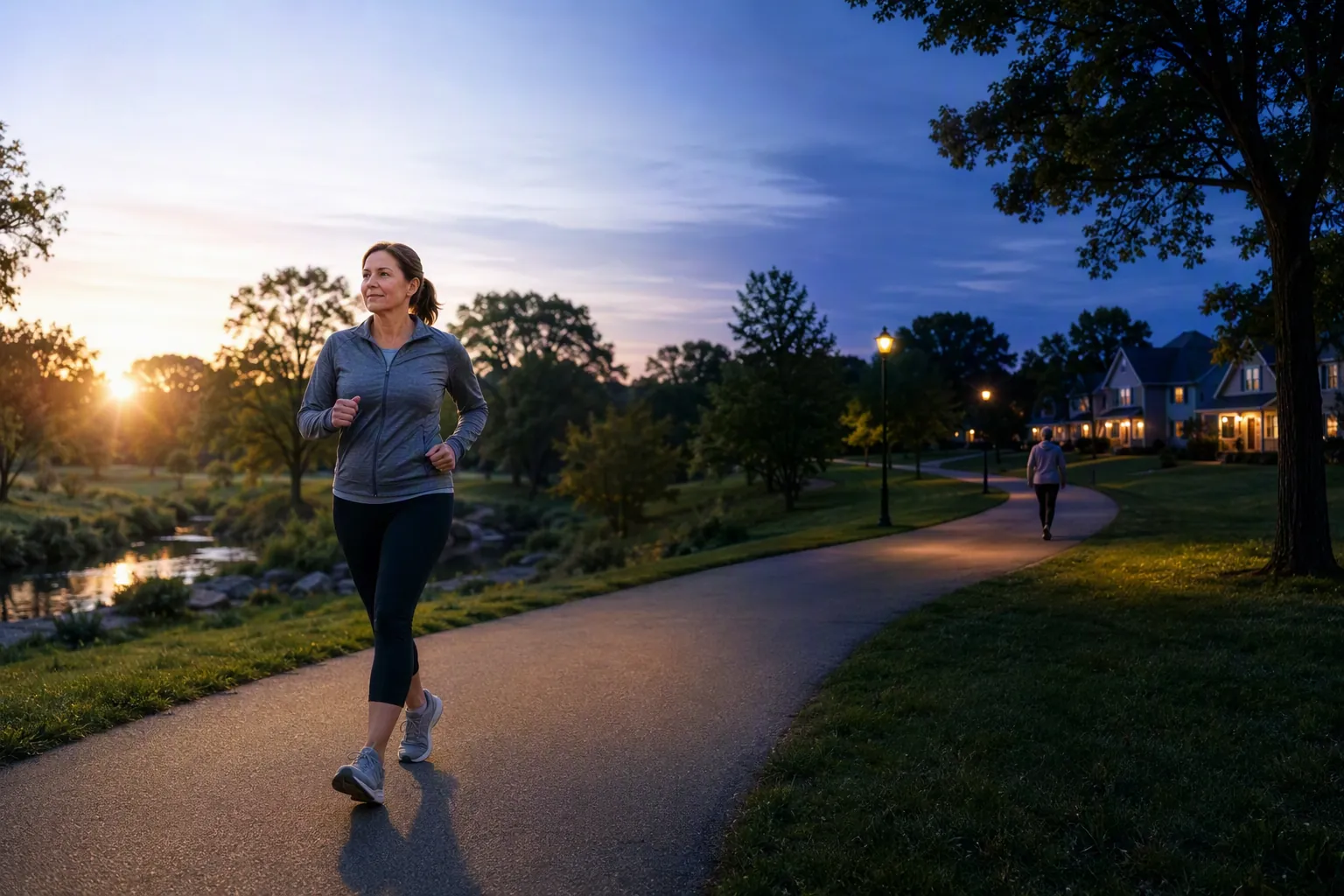
Exercise timing advice often gets flattened into “never exercise at night,” which is not what the evidence supports. In a 2025 Nature Communications study of 14,689 people and 4 million person-nights, exercise ending at least 4 hours before habitual sleep onset was not associated with sleep disruption, regardless of strain level.[5] That is most relevant for higher-strain exercise: intervals, hard classes, heavy resistance sessions, or anything that leaves your body revved.
Walking is usually lower strain. Harvard Health’s 2024 review notes that light-to-moderate walking ending at least 2 hours before bed does not disrupt sleep.[6] For many women, a gentle early-evening walk may be reasonable, especially if it replaces scrolling, late caffeine, or another hour of sitting under bright indoor light. The line to respect is intensity. If a late walk turns into a breathless hill session and you lie awake afterward, your body has already given you the useful data.
What walking can realistically change
Walking can give your sleep system several helpful cues at once: daylight exposure if you walk outside, a clearer activity-rest rhythm, mild-to-moderate physical fatigue, and a stress outlet that does not require buying anything. Those mechanisms are physiologically plausible, but they should not be inflated into a promise that walking will correct every menopausal sleep disturbance.
This is where the subgroup result matters in practice. The woman most likely to notice a sleep difference is the one whose sleep is already disturbed, because the exercise effect was much larger in women with pre-existing sleep disorders than in those without.[1] So if you are waking often, lying awake, or feeling that your sleep quality has dropped sharply, a walking routine is not a silly suggestion. It is a reasonable non-drug foundation.
But if the main event is heat—waking drenched, throwing off covers, then chilling, then repeating the cycle—walking may help your overall regulation without stopping the trigger. That is where temperature management, bedroom cooling, layered bedding, caffeine timing, alcohol awareness, and a clinician conversation can matter more than another lap around the block. The same is true if insomnia is severe, blood pressure is high, chest symptoms appear, or fatigue becomes disabling.
A workable week, without turning it into a project
A good starting week might look like this: three or four purposeful walks, mostly earlier in the day, with one or two longer walks if your schedule and body allow. On other days, add ordinary walking where it is least irritating: park farther away, take one phone call outside, walk a short errand, or do a quiet loop after dinner as long as it stays light and ends well before bedtime.
If you use step counts, increase from your baseline rather than chasing a fixed number. If you do not use step counts, use time: add a few minutes to a route you already tolerate, or repeat the same manageable loop until it becomes automatic. The cardiovascular studies make regularity and dose look worthwhile; they do not require you to make walking the center of your personality.
After 2 to 4 weeks, judge the routine by the right outcomes. Are you falling asleep a little more easily? Waking less often? Returning to sleep faster? Feeling less restless in the evening? Is your blood pressure being monitored if it was already a concern? Are the walks sustainable enough that you can imagine still doing them when work gets messy or the weather is poor?
If the answer is yes, build gradually. If the answer is no, do not conclude that you failed at walking. It may mean the walking dose is too low, the timing is wrong, vasomotor symptoms are overpowering the benefit, or sleep needs a broader plan. Walking is a strong foundation for the overlap between perimenopause sleep and heart health. It is not a substitute for care when your body is clearly asking for more.
References
- Effects of exercise on sleep disorders in menopausal women: a systematic review and meta-analysis, PMC, 2023.
- Walking further and faster is linked to a reduced risk of heart attacks, heart failure and stroke in people with high blood pressure, European Society of Cardiology, 2025.
- Regular Walking May Protect Against Heart Failure Post-Menopause, American College of Cardiology, 2018.
- Walk to a better night of sleep: testing the relationship between physical activity and sleep, PMC, 2019.
- Exercise timing and intensity affect sleep architecture and quality, Nature Communications, 2025.
- Does exercising at night affect sleep?, Harvard Health Publishing, 2024.
Safety & eligibility read
Cross-check against other interventionsExplore the mechanism
Next step
Spot an error or have clinical feedback?
Because this article covers clinical, medication, or safety information, we use a moderated correction channel instead of open public comments. Let us know if something about “A walking routine for perimenopause sleep and heart health” needs a closer look.
Send feedback on this article