
How to sleep during a heat wave in perimenopause
Perimenopause makes heat-wave nights hit harder, and the right order matters more than the length of the tips list. The practical route is a three-tier triage: cool the bedroom and body first, cut evidence-backed triggers second, and know when hot-flash insomnia warrants CBT-I or a clinician conversation.
If you are searching for how to sleep during a heat wave in perimenopause, you probably do not need to be told that fans exist. You may already have opened the window, closed it again when the air outside felt worse, swapped bedding, drunk cold water, aimed the fan at your feet, then woken up wet at 3 a.m. anyway. The useful question is order: what deserves attention tonight, what is worth changing for the rest of the week, and when the problem is no longer solved by rearranging a bedroom.

The practical sequence is simple enough to remember when you are already tired: cool the room and your skin first, cut the triggers with the best evidence second, and escalate if repeated nocturnal hot flashes are turning into persistent insomnia. The separate question of why late-summer heat can hit perimenopause sleep so hard is covered in Is August really the worst month for perimenopause sleep?; this guide starts with what to do now.
| Tier | What to do | Why it comes here |
|---|---|---|
| Tonight | Move sleep to the coolest available room, block daytime heat, ventilate only when outdoor air is cooler, manage humidity, cool skin gently, and use fans cautiously. | If the room is storing heat or sweat cannot evaporate, smaller tricks have less room to work. |
| This week | Cut alcohol and caffeine first; treat spicy food, hot drinks, and hot baths as secondary trigger tests. | These are behavior changes with plausible payoff and low downside, but they should not be used to blame you for every hot flash. |
| If it persists | Treat repeated hot-flash awakenings and conditioned insomnia as a reason for CBT-I or a clinician conversation. | Perimenopausal night waking can be physiologic, not just poor sleep hygiene. |
Tonight: cool the room before you negotiate with your symptoms
Start with location, not bedding. If one room in the home is consistently cooler, sleep there during the heat wave, even if it is not your bedroom. A lower floor, shaded room, or room away from afternoon sun often beats a prettified sleep setup that has been baking all day. During daylight, keep sun-facing curtains, blinds, or shades closed. At night or early morning, ventilate only when the outdoor air is actually cooler than the indoor air; opening windows because it is “bedtime” can backfire when the heat wave has left the outside air warmer than the house. Heat-wave sleep guidance from the European Insomnia Network also emphasizes ventilating at the coolest time of day and aiming for a cooler bedroom environment, with about 19°C used as a practical target where feasible.[1]
That target is not a moral obligation, and for many homes without air conditioning it is not realistic. The point is direction. In one laboratory study of postmenopausal women, cooling the bedroom to 18°C significantly reduced objectively recorded hot flashes compared with 23°C and 30°C.[2] Another study in older adults found the best sleep range clustered around roughly 20–25°C, with sleep quality and quantity worsening as temperatures rose beyond that range.[3] These are not direct perimenopause heat-wave trials; one sample was postmenopausal, and the other involved older adults. Still, they are useful adjacent evidence for a practical judgment: if you can move the sleeping environment even modestly toward cooler, it is worth doing before adding more elaborate tricks.
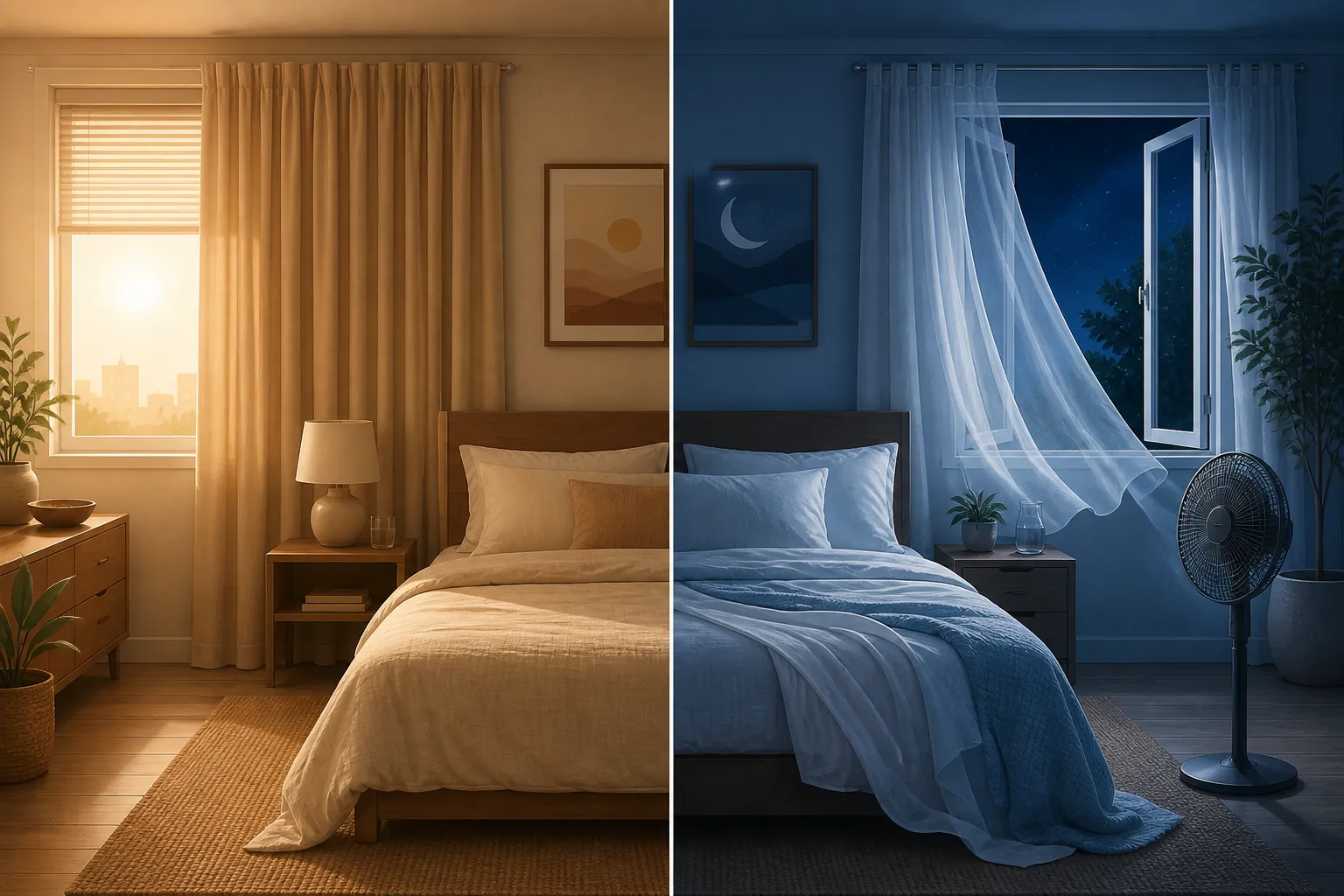
Humidity deserves more respect than it usually gets in sleep advice. In humid heat, sweat sits on the skin instead of evaporating efficiently, so you can feel soaked without feeling cooled. If you have a dehumidifier, use it in the sleeping area or in the room that feeds air into it. If you do not, avoid adding moisture to the room late in the evening: long steamy showers, drying laundry indoors, or cooking that fills the home with humid air can make the bedroom feel heavier just when your body is trying to shed heat.
Then cool the body gently. A lukewarm shower or footbath before bed is more useful than an aggressively cold shower for many people, because the goal is to help the body release heat without triggering a jolt of alertness or rebound discomfort. The European heat-wave sleep guidance also favors lukewarm pre-bed cooling over very cold showering.[1] If you wake hot, wetting exposed skin with a damp cloth can make moving air more effective. Keep the cloth by the bed so this does not become a full middle-of-the-night project.
Bedding should be boringly adjustable. Use breathable layers that can be removed without fully waking yourself: a light sheet, a thin blanket nearby if you chill after a sweat, and sleepwear that does not cling when damp. Cotton, linen, bamboo-derived fabrics, and technical cooling fabrics can all work for different bodies; the larger point is not the label but whether the layer traps heat and moisture against your skin. If you are waking drenched, a towel or spare top within reach is sometimes more sleep-preserving than getting up, turning on lights, and changing the bed.
Use the fan, but do not ask it to do impossible work
A fan can help when it moves cooler air across damp skin. It is much less impressive when it is simply pushing very hot air around a closed room. A 2024 critical review in The Lancet Planetary Health concluded that electric fans do not meaningfully reduce core temperature above about 35°C air temperature and are, at most, about 36% as effective as air conditioning; fan plus skin-wetting was the more promising low-cost combination.[4] That is the safety message to keep: use air movement with evaporation, not as a substitute for cooling the room when the air itself is dangerously hot.
If you do not have AC, the fan setup should serve the room strategy. In the evening, place it to pull in cooler outdoor air only when outdoor air is cooler. If the room is closed because outside air is hotter, aim the fan across a dampened sheet, damp skin, or a bowl of cool water nearby rather than directly blasting your face all night. Keep cords safe, keep water away from plugs, and stop treating fan discomfort as a personal failure. Sometimes the air is simply too hot for a fan-alone answer.
Do not sleep through heat-exhaustion warning signs in the name of toughness. Heavy sweating with dizziness, weakness, nausea, cool clammy skin, or confusion warrants medical attention, especially if symptoms do not improve with cooling and fluids.[5] Perimenopause can make nights miserable; heat illness is a different problem.
Why this can feel worse than ordinary summer insomnia
The room may be hot, but the wake-up loop may also be hormonal. In a laboratory study of perimenopausal women, participants averaged 3.5 objective hot flashes per night; 69.4% of those hot flashes were associated with an awakening, and hot-flash-associated wake time accounted for roughly 27% of total nocturnal wakefulness.[6] That number matters because it describes the thing many women are told is just restlessness: a body heat event followed by a real awakening.
Hot flashes are also common enough that they should not be treated as a niche complaint. Cleveland Clinic notes that about three in four women experience hot flashes, and Yale Medicine describes hot flashes as a common menopause-transition symptom that can continue for years for some women.[7][8] None of that means every bad night is a medical event. It does mean that if you are doing the room work and still waking repeatedly in a sweat, the next step is not another cheerful reminder to drink water.
This week: cut the triggers with the best evidence first
Trigger advice gets vague quickly, so keep the hierarchy tight. Caffeine is the first serious test. In a Mayo Clinic survey study of 1,806 postmenopausal women, caffeine intake was associated with more bothersome hot flashes and night sweats.[9] That does not prove caffeine causes every night sweat, and the sample was postmenopausal rather than perimenopausal. It is still enough to justify a one-week experiment: move caffeine earlier, reduce the dose, or cut it temporarily during the heat wave and see whether the nights change.
Alcohol belongs beside caffeine, not in the footnotes. It can fragment sleep and is commonly listed by menopause clinicians as a hot-flash or night-sweat trigger.[7][8] During a heat wave, the cleanest test is not moderation mathematics at midnight; it is skipping alcohol for several nights and watching whether the 2–4 a.m. sweat-wake cycle eases. If it does, you have useful information. If it does not, you have at least removed one sleep disruptor while you work through the rest of the sequence.
Spicy food, hot beverages, and hot baths close to bed are lower-weight but reasonable to adjust. They are not equal pillars with caffeine and alcohol, and they are not proof that you caused your symptoms. During the worst heat-wave nights, shift spicy meals earlier, choose cooler evening drinks, and avoid turning a bath into a body-heating event right before sleep. If you nap because the previous night was awful, keep it short; the European heat-wave sleep guidance suggests naps of 20 minutes or less.[1]
This is also the week to stop overcorrecting with ice-cold water all night if it is making you pee, wake, and restart the whole cycle. Hydration matters in heat, but repeated bathroom trips can become their own sleep disruption. Front-load fluids earlier in the day, keep water by the bed, and drink enough to respond to thirst rather than turning the nightstand glass into another rule you have to obey.
When heat-wave tactics are no longer enough

Escalation is not panic. It is the moment you stop treating repeated physiologic awakenings as if they are a bedding-management flaw. The line is crossed when nocturnal heat episodes are repeatedly waking you, you start anticipating the wake-up before it happens, or the bed begins to feel like the place where you wait for the next surge. That conditioned arousal is how a heat-wave problem can become insomnia even after the weather changes.
CBT-I is the first clinician-level conversation to put on the table for persistent insomnia. A 2023 systematic review describes cognitive behavioral therapy for insomnia as a first-line treatment for menopause-related insomnia, with strong evidence compared with many other behavioral options.[10] CBT-I is not another sleep-hygiene handout. It usually works with sleep timing, stimulus control, the fear and monitoring that build around wakefulness, and the pattern of compensating after bad nights.
Medication conversations are also legitimate when vasomotor symptoms are the repeated trigger. Options to discuss with a clinician may include menopausal hormone therapy for eligible women, fezolinetant sold as Veozah, or low-dose paroxetine sold as Brisdelle. Yale Medicine describes hormone therapy as the most effective treatment for hot flashes for appropriate candidates, and notes fezolinetant as an FDA-approved nonhormonal option for moderate-to-severe vasomotor symptoms; Cleveland Clinic also discusses nonhormonal prescription options for hot flashes.[7][8] Fezolinetant also carries a December 2024 FDA boxed warning about rare serious liver injury, so it is especially not a DIY decision.[8]
A practical way to prepare for that appointment is to track only what the clinician can use: bedtime, wake time, number of sweat-related awakenings, alcohol and caffeine exposure, room conditions if you know them, and whether you are avoiding bed because you expect another bad night. You do not need a perfect spreadsheet. A few nights of honest notes can separate “the room was brutally hot” from “I am having repeated vasomotor awakenings and now insomnia is learning the pattern.” Persistent midlife insomnia also deserves to be taken seriously beyond comfort; the broader health context is discussed in Does poor midlife sleep raise women’s heart disease risk?.
For tonight, the order is enough: move to the coolest room you can, block heat before it enters, ventilate only when the air helps, reduce humidity where possible, cool skin gently, and use the fan with evaporation rather than faith. For this week, cut caffeine and alcohol first and treat the smaller triggers as experiments. If the nights still revolve around repeated hot-flash awakenings and dread of sleep, the next step is not a longer list of tricks. It is CBT-I or a clinician conversation about vasomotor-symptom treatment.
References
- How to sleep during a heatwave: do’s and don’ts, European Sleep Research Society, 2022.
- Effects of REM sleep and ambient temperature on hot flash-induced sleep disturbance, Menopause, 2006.
- Nighttime ambient temperature and sleep in community-dwelling older adults, Science of the Total Environment, 2023.
- Electric fans for reducing adverse health impacts in heatwaves: a critical review, The Lancet Planetary Health, 2024.
- Tips for sleeping without air conditioning, HealthPartners.
- Nocturnal hot flashes are associated with nocturnal awakenings in perimenopausal women, Fertility and Sterility, 2014.
- How To Find Relief for Hot Flashes at Night, Cleveland Clinic, April 2024.
- Hot Flashes: How to Get Relief Before, During, and After Menopause, Yale Medicine, updated December 2024.
- Mayo Clinic Study Suggests Caffeine Intake May Worsen Menopausal Hot Flashes, Night Sweats, Mayo Clinic News Network, 2014.
- Treatments for menopausal sleep disturbances: a systematic review, medRxiv, 2023.
Safety & eligibility read
Cross-check against other interventionsExplore the mechanism
Next step
Spot an error or have clinical feedback?
Because this article covers clinical, medication, or safety information, we use a moderated correction channel instead of open public comments. Let us know if something about “How to sleep during a heat wave in perimenopause” needs a closer look.
Send feedback on this article