
A 12-Week Weight Training Routine for Perimenopause Sleep
A research-backed 12-week progressive weight training protocol designed for perimenopausal women with disrupted sleep, specifying compound lifts, sets, reps, and morning or early-afternoon timing to maximize clinically meaningful sleep improvements within 10–12 weeks.
A useful weight training routine for better sleep in perimenopause should look less like a motivational poster and more like a prescription you can actually follow: three sessions a week, 30 to 60 minutes each, compound lifts, steady progression, and a fair expectation that sleep quality may start to shift around weeks 10 to 12.
The best head-to-head evidence is encouraging, though not definitive. In a randomized trial of 60 postmenopausal women with insomnia, resistance training improved Pittsburgh Sleep Quality Index scores by a mean of 4.0 points, compared with 2.63 points for aerobic exercise; both helped, but resistance training improved sleep more in that trial, with a reported p value under 0.001. The catch matters: this was a small study, and the participants were postmenopausal, not strictly perimenopausal, so the superiority finding needs replication before anyone treats it as settled law. [1]
Still, the dose used in the plan below is not invented from gym folklore. A 2023 meta-analysis of 12 randomized trials involving 1,493 participants found the largest sleep effects with resistance training programs lasting 10 to 12 weeks, performed at least 3 times per week, for 30 to 60 minutes per session. [2]

The 12-week plan at a glance
Train on three nonconsecutive days, ideally in the morning or early afternoon. Monday, Wednesday, and Friday works. So does Tuesday, Thursday, and Saturday. The point is not the calendar; it is giving your nervous system, joints, and sleep-wake rhythm a repeatable signal without cramming hard lifting against bedtime.
| Phase | Weeks | Session length | Training target | Main work |
|---|---|---|---|---|
| Familiarization | 1–3 | About 30 minutes | 15–20 controlled reps; bodyweight and light bands | Squat, bridge, row, wall push-up, bird-dog, plank |
| Loading | 4–8 | 40–50 minutes | 2–3 sets of 8–12 reps with a weight that feels challenging by the last 2 reps | Goblet squat, dumbbell Romanian deadlift, dumbbell bench press, dumbbell row, overhead press, farmer’s carry |
| Progressive overload | 9–12 | 50–60 minutes | 3–5 sets of 6–8 reps for main lifts, near failure but not sloppy | Heavier squat, deadlift or hinge, press, row, overhead press, suitcase or loaded carry |
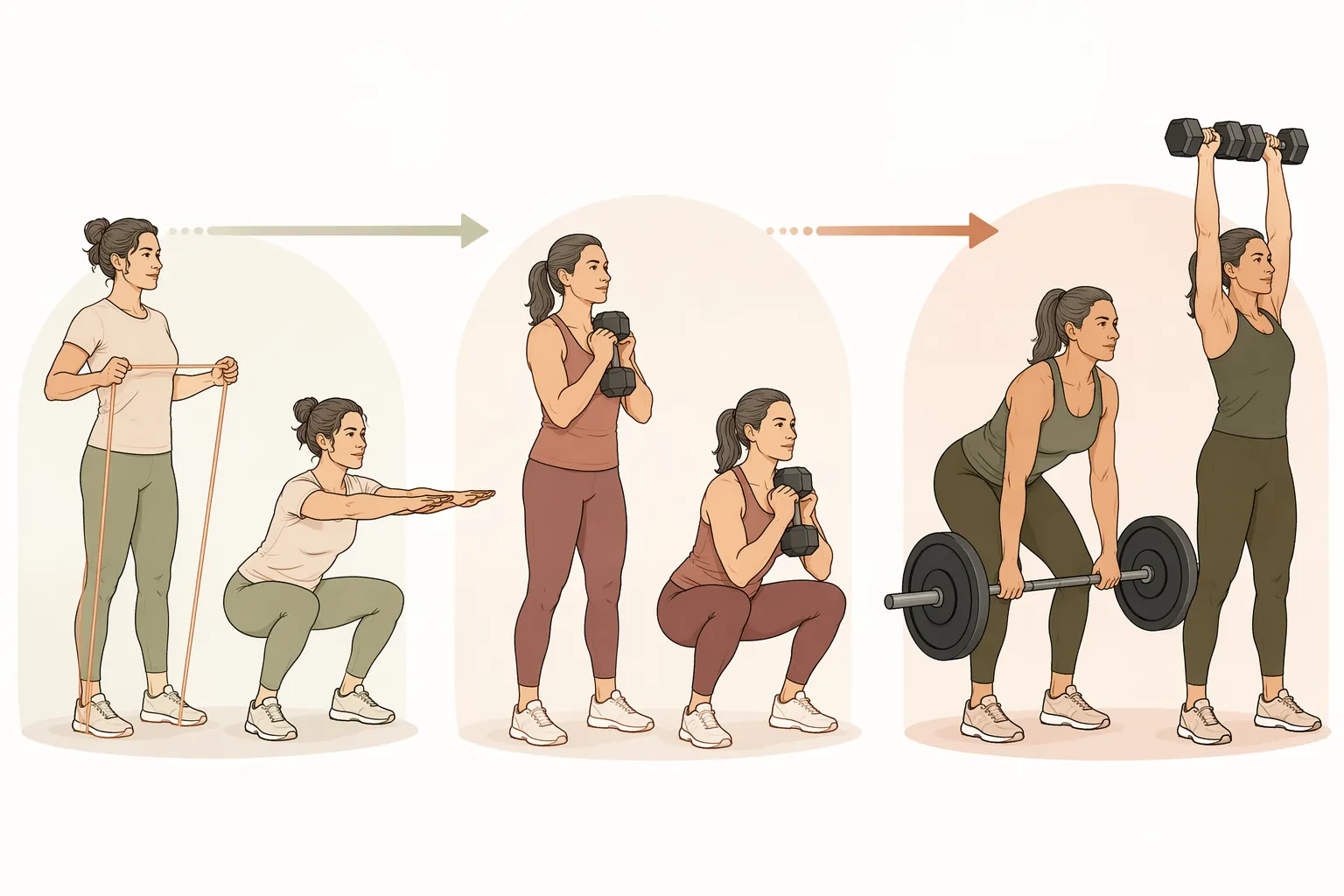
You are not chasing soreness. You are building a repeatable training stress strong enough to change fitness, temperature regulation, mood, confidence, and possibly the number of nighttime awakenings. If a session leaves you wired at 10 p.m. or dragging for two days, it was too much for this purpose.
What sleep improvement is realistic?
For women who wake at 3 or 4 a.m. often enough that it has become part of the household weather, “exercise more” is too vague to be useful. The goal here is not perfect sleep after the first week. The realistic target is a measurable improvement in sleep quality across 10 to 12 weeks: fewer rough nights, fewer or shorter awakenings, less time lying awake, or better daytime functioning even before every night looks tidy.
Perimenopause is a reasonable stage to take this seriously. Sleep disturbance becomes common across the menopausal transition, with large studies and reviews describing difficulty sleeping in a substantial share of women in midlife. The physiology is not imaginary: estrogen fluctuation can affect thermoregulation, progesterone decline may reduce GABA-ergic sleep pressure, and circadian disruption can make sleep feel less stable even when bedtime habits are decent. [3]
Exercise more broadly also has support. A 2023 systematic review of 17 randomized trials including 2,463 menopausal women found that exercise reduced insomnia severity, with the strongest benefit in women who already had sleep disorders. That does not mean every form of exercise performs the same job, but it does mean established insomnia is not a reason to assume movement is pointless. [4]
Before you lift: the working rules
- Train three times per week on nonconsecutive days.
- Schedule sessions in the morning or early afternoon when possible.
- Start every session with 5 minutes of easy movement: brisk walking, marching in place, step-ups, or light cycling.
- Use a load that lets you finish the assigned reps with good form and 1 to 3 reps “in reserve” most of the time.
- Progress only when the final reps are challenging but controlled.
- Track sleep quality weekly, not night by night. One bad night after training is data; it is not a verdict.
If you are new to dumbbells, or returning after years away, the first three weeks are not wasted time. They are where you learn how a squat feels before it is loaded, how to hinge without rounding your back, and how to finish a set without holding your breath. Readers who want a gentler on-ramp can pair this plan with entry-level dumbbell work, but the full protocol below is the sleep-focused progression.
Weeks 1–3: familiarization, not punishment
Do this full-body session three times weekly for three weeks. Rest 45 to 75 seconds between sets. The pace should feel deliberate: lower slowly, pause briefly when needed, and avoid rushing just to get it over with.
| Exercise | Sets | Reps or time | Load | What to watch |
|---|---|---|---|---|
| Bodyweight squat to a chair or box | 2 | 15–20 | Bodyweight | Feet stable, knees tracking over toes, stand tall at the top |
| Glute bridge | 2 | 15–20 | Bodyweight | Push through heels, pause at the top, avoid arching the low back |
| Banded row | 2 | 15–20 | Light band | Shoulders down, elbows pull back, no shrugging |
| Wall push-up or elevated counter push-up | 2 | 10–15 | Bodyweight | Body moves as one line; stop before shoulders roll forward |
| Bird-dog | 2 | 8–10 per side | Bodyweight | Slow reach, steady hips, no twisting |
| Plank from knees or toes | 2 | 15–30 seconds | Bodyweight | Breathe normally; stop before form collapses |
Progress during these weeks by improving control, not by adding exhaustion. When you can squat to the chair without dropping into it, row the band without your neck joining the effort, and breathe through a plank, you are ready for the loading phase.
A simple week looks like this: Session 1 on Monday morning, Session 2 on Wednesday morning or early afternoon, Session 3 on Friday morning or early afternoon. If work or caregiving makes that impossible, keep the nonconsecutive pattern and protect the finish time. A 7 p.m. session that becomes intense at 8 p.m. is less sleep-sensitive than a shorter lunchtime session you can actually repeat.
Weeks 4–8: load the compound lifts
Now the program becomes strength training in the practical sense: squat, hinge, push, pull, press, and carry. Use dumbbells if you train at home. Use machines only when they help you perform the pattern safely, not because they let you avoid learning the movement.
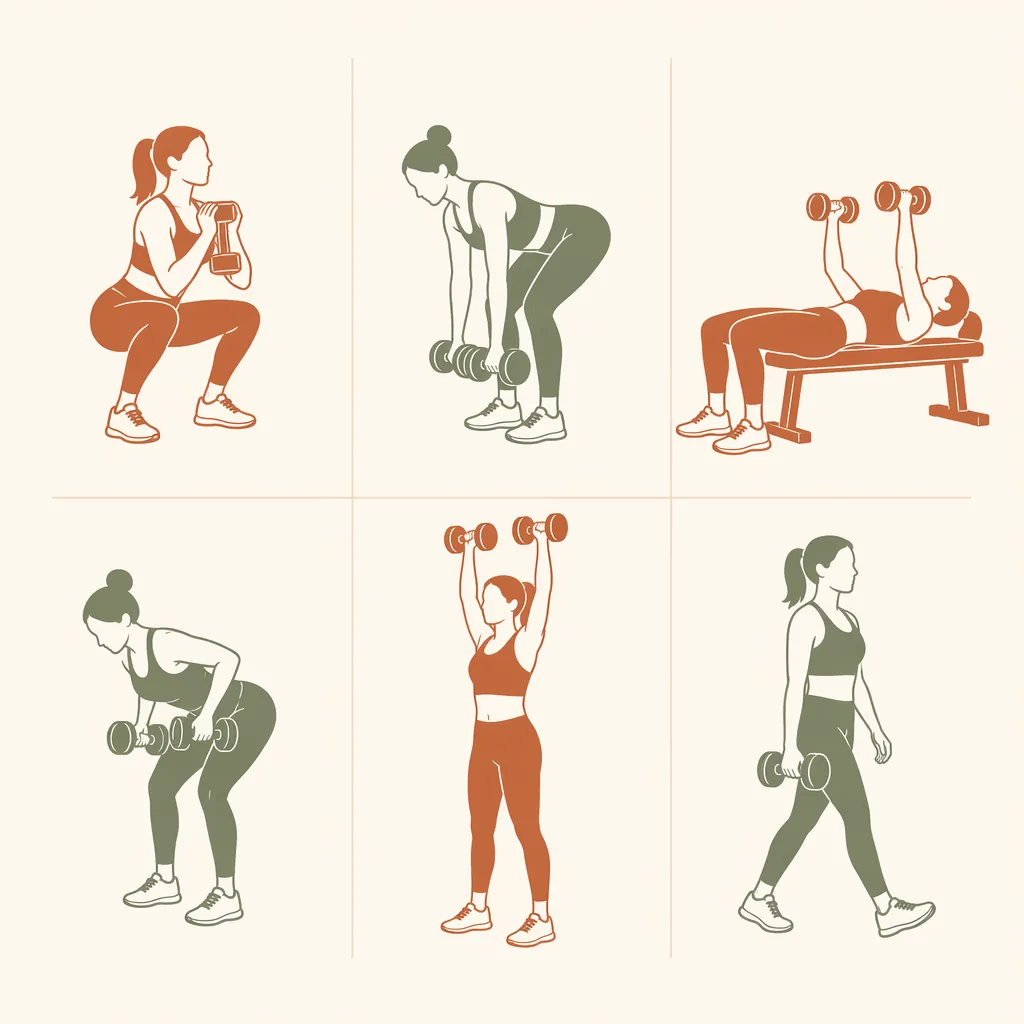
For each lift, choose a weight you could lift about 8 to 12 times with good form. The final two reps should require attention. They should not require bargaining with your spine, bouncing the weight, or holding your breath until your face changes color.
Session A
| Exercise | Sets | Reps | Load target | Rest |
|---|---|---|---|---|
| Goblet squat | 3 | 8–12 | A dumbbell or kettlebell held at chest height; last 2 reps challenging | 75–90 seconds |
| Dumbbell bench press or floor press | 3 | 8–12 | Controlled press; no shoulder pain | 75–90 seconds |
| Bent-over dumbbell row | 3 | 8–12 per side | Torso steady; pull elbow toward hip | 60–90 seconds |
| Farmer’s carry | 3 | 30–45 seconds | Two dumbbells heavy enough that posture takes effort | 60 seconds |
Session B
| Exercise | Sets | Reps | Load target | Rest |
|---|---|---|---|---|
| Dumbbell Romanian deadlift | 3 | 8–12 | Hinge at hips; weights close to legs; hamstrings working | 75–90 seconds |
| Standing dumbbell overhead press | 2–3 | 8–12 | Ribs down; press without leaning back | 75–90 seconds |
| Supported one-arm dumbbell row | 3 | 8–12 per side | Use a bench, chair, or sturdy surface for support | 60–90 seconds |
| Glute bridge or hip thrust | 2–3 | 10–12 | Add a dumbbell across hips if bodyweight is easy | 60–75 seconds |
Session C
| Exercise | Sets | Reps | Load target | Rest |
|---|---|---|---|---|
| Goblet squat or split squat | 3 | 8–12 | Choose split squat only if knees and balance tolerate it | 75–90 seconds |
| Dumbbell Romanian deadlift | 2–3 | 8–12 | Slightly lighter than Session B if needed | 75–90 seconds |
| Dumbbell chest press or elevated push-up | 3 | 8–12 | Stop before shoulder discomfort | 75–90 seconds |
| Bent-over row | 3 | 8–12 | Same weight both sides if possible | 60–90 seconds |
| Farmer’s carry | 2–3 | 30–45 seconds | Walk slowly; tall posture | 60 seconds |
Progress in weeks 4 to 8 by the double-progression rule: first add reps, then add weight. If the plan says 3 sets of 8 to 12 and you complete 12, 12, and 12 with clean form, increase the load at the next session by the smallest available amount. If the new weight drops you back to 8 or 9 reps, that is normal.
If one lift stalls while the rest improve, leave it alone for a week. Perimenopause already brings enough false accusations of inconsistency. A poor night of sleep, heavier bleeding, a hot-flash cluster, or a stressful workday can all show up under the dumbbells. The answer is usually not to quit the program; it is to avoid turning every session into a test.
Weeks 9–12: progressive overload without late-night adrenaline
The final phase is heavier and a little longer. Keep the same three-day rhythm. Main lifts move toward 6 to 8 reps for 3 to 5 sets. You should finish most working sets with 1 or 2 reps left in reserve. This is not the time to chase one-rep maxes, especially if sleep is the outcome you care about.
Session A: squat and press emphasis
| Exercise | Sets | Reps | Options |
|---|---|---|---|
| Squat | 4 | 6–8 | Heavier goblet squat, double-dumbbell front squat, or barbell back squat |
| Bench press | 3–4 | 6–8 | Dumbbell, barbell, or floor press |
| Bent-over row | 3–4 | 6–8 | Dumbbell or barbell |
| Farmer’s carry | 3 | 30–45 seconds | Two heavy dumbbells or kettlebells |
Session B: hinge and overhead emphasis
| Exercise | Sets | Reps | Options |
|---|---|---|---|
| Deadlift or Romanian deadlift | 4 | 6–8 | Dumbbells, kettlebell, trap bar, conventional deadlift, or sumo deadlift |
| Standing overhead press | 3–4 | 6–8 | Dumbbells or barbell |
| Supported row | 3 | 8–10 | Use slightly higher reps if heavier rows irritate the low back |
| Suitcase carry | 3 | 30–40 seconds per side | One heavy dumbbell; do not lean |
Session C: full-body consolidation
| Exercise | Sets | Reps | Options |
|---|---|---|---|
| Squat variation | 3 | 6–8 | Use a slightly lighter load than Session A |
| Deadlift or hinge variation | 3 | 6–8 | Use a slightly lighter load than Session B |
| Chest press | 3 | 6–8 | Dumbbell, barbell, or machine if needed |
| Row | 3 | 6–8 | Dumbbell, cable, or barbell |
| Loaded carry | 3 | 30–45 seconds | Farmer’s carry, suitcase carry, or front-rack carry |
A good progression in this phase is modest. Add weight when all working sets reach the top of the rep range with good form and no unusual joint pain. If you are using adjustable dumbbells, the next jump may be bigger than your body is ready for; in that case, add a set before you add load, or slow the lowering phase rather than forcing the heavier pair.
If sleep worsens after the first heavier week, reduce the final set on each main lift for one week and keep the earlier training time. The program should challenge you, but it should not leave you overheated, hungry, and mentally revved near bedtime.
Why morning or early-afternoon training fits perimenopause sleep
Exercise timing is not a moral issue. Some people can lift after dinner and sleep beautifully. But for perimenopause sleep, morning or early-afternoon sessions have a practical advantage: they give body temperature, heart rate, appetite, and alertness time to settle before bed. General sleep guidance also cautions that vigorous exercise close to bedtime can interfere with sleep for some people, especially when it raises core temperature or leaves the body activated. [6]
That matters more when night sweats and temperature instability are already part of the problem. If you are waking soaked, throwing off covers, then getting chilled, the training plan should not add another late-evening heat load. Pairing earlier lifting with practical cooling steps, including breathable bedding and sleepwear that works with menopause night sweats, is more sensible than pretending one habit solves the whole thermoregulation problem.
If the only time you can train is late afternoon, do it. If the only time is evening, make it lighter: fewer sets, longer cooldown, no personal records, and a clear stop at least a few hours before bed when possible. The sleep outcome matters more than proving toughness at 8:30 p.m.
How lifting may help sleep during the transition
The mechanism is probably not one clean switch. Perimenopause sleep disruption sits at the intersection of hormone fluctuation, temperature control, mood, stress physiology, and circadian timing. Resistance training may help by improving physical fatigue in the useful sense, increasing confidence in the body, supporting metabolic health, and reducing some symptoms that cause awakenings.
Hot flashes are the clearest sleep-adjacent pathway. In a 15-week trial of postmenopausal women with moderate-to-severe hot flashes, resistance training three times weekly significantly improved both the Women’s Health Questionnaire sleep domain and vasomotor symptom domain. The reported p values were 0.003 for sleep and 0.002 for vasomotor symptoms. [5]
That does not prove the dumbbells directly “fix” sleep architecture. A more cautious reading is better: if resistance training reduces nighttime hot flashes for some women, it may reduce awakenings, which then improves perceived sleep quality. That is still a result worth having. A woman who wakes twice instead of five times does not need the mechanism to be glamorous.
There is also an emerging idea that skeletal muscle activity may help reinforce peripheral circadian clocks. It is plausible, and it appears in discussions of resistance training and sleep, but it has not been proven as the reason this kind of protocol works in perimenopausal women. Treat it as a possible supporting mechanism, not the foundation of the plan.
How to track progress without letting one bad night run the program
Track weekly patterns. A simple 1-to-5 sleep-quality score is enough for most people: 1 means terrible, 3 means workable, 5 means restorative. Add two notes: number of awakenings and whether hot flashes or night sweats were involved. If you menstruate irregularly, note cycle bleeding or symptoms too, because a difficult hormone week can blur the training signal.
| What to track | How often | Why it matters |
|---|---|---|
| Sleep quality score | Each morning, then average weekly | Shows trend without overreacting to one night |
| Number of awakenings | Each morning | Helps distinguish sleep fragmentation from trouble falling asleep |
| Night sweats or hot flashes | Each morning | Connects thermoregulation symptoms to awakenings |
| Training completion | After each session | Confirms whether the dose was actually delivered |
| Load and reps | After each lift | Shows progressive overload without guessing |
| Alcohol close to bedtime | When relevant | Helps identify a separate sleep disruptor |
The alcohol line is not there to scold. It is there because a reader can lift perfectly and still sabotage sleep continuity with evening wine. If that is part of the picture, review how alcohol before bed affects perimenopause sleep quality rather than assuming the training failed.
Adjustments for common barriers
If you are sore
Mild soreness is common when you start or increase load. Sharp pain, joint pain, or soreness that changes how you walk is a sign to reduce weight, cut a set, or choose the easier variation. For sleep purposes, barely being able to sit down the next day is not a badge of honor; it is a dosing error.
If you miss a session
Do the missed session the next day if it still leaves a recovery day before the following lift. If not, skip it and continue. Do not stack two full sessions back to back to make the spreadsheet look clean.
If hot flashes dominate the night
Keep training earlier in the day and lower the last set of the session for one week if you feel overheated after lifting. Also treat night-sweat management as its own intervention: room temperature, bedding, sleepwear, and medical options all matter. Resistance training may help some women with vasomotor symptoms, but it should not be your only tool if the awakenings are severe.
If grief, anxiety, or stress is the main driver
Keep the routine gentle enough to support sleep rather than becoming another demand. Strength training can help mood and agency, but it is not a substitute for care when insomnia is tied to loss, trauma, or sustained anxiety. If grief is part of the pattern, use a more specific guide to coping with grief and insomnia during perimenopause alongside the training plan.
When the plan is not enough
A fair trial is 8 to 12 weeks of consistent training, not three heroic sessions and then silence. If you complete most sessions, train at an appropriate load, avoid late hard workouts, and still have persistent insomnia, frequent awakenings, loud snoring, gasping, morning headaches, or heavy daytime sleepiness, ask for medical evaluation.
This is especially important because sleep apnea risk rises after menopause, with research reviews describing a 2- to 3-fold increase. Residual sleep disruption should not automatically be blamed on hormones, stress, or insufficient discipline. [3]
If the main problem is conditioned insomnia—the bed has become the place where your brain rehearses every unresolved thing—strength training may be helpful but incomplete. Evidence-based insomnia care such as CBT-I or a sleep specialist evaluation belongs on the table, particularly if sleep has not improved after a consistent 8- to 12-week trial. A practical next step is guidance on CBT-I for perimenopause sleep, especially when night sweats and insomnia have started feeding each other.
The cleanest decision is this: if you can safely train, use the 12-week protocol as a structured non-drug option, not a cure-all. Lift three times a week, progress gradually, keep sessions away from bedtime when possible, and judge the plan by weekly sleep quality rather than one restless night. If sleep does not move after a consistent trial, the next step is evaluation, not self-blame.
References
- Effect of Aerobic Exercise Versus Resistance Exercise on Insomnia and Quality of Life in Postmenopausal Women: A Randomized Controlled Trial, PubMed Central, 2020.
- Effects of Resistance Training on Sleep Quality: A Systematic Review and Meta-Analysis of Randomized Controlled Trials, PubMed, 2023.
- Sleep Disturbance and Perimenopause: A Narrative Review, PubMed Central.
- Effects of Exercise on Insomnia in Menopausal Women: A Systematic Review and Meta-Analysis of Randomized Controlled Trials, PubMed, 2023.
- Resistance Training for Hot Flushes in Postmenopausal Women: A Randomized Controlled Trial, Taylor & Francis Online, 2021.
- The Best Time of Day to Exercise for Sleep, Sleep Foundation.
Safety & eligibility read
Cross-check against other interventionsExplore the mechanism
Next step
Spot an error or have clinical feedback?
Because this article covers clinical, medication, or safety information, we use a moderated correction channel instead of open public comments. Let us know if something about “A 12-Week Weight Training Routine for Perimenopause Sleep” needs a closer look.
Send feedback on this article