
Your Bedtime Movie's Color Palette Affects Your Sleep
If a movie is part of your bedtime routine, the useful question is not whether you can be shamed into becoming a person who meditates in a perfectly dark room. It is: which movies are less likely to keep your brain on duty?
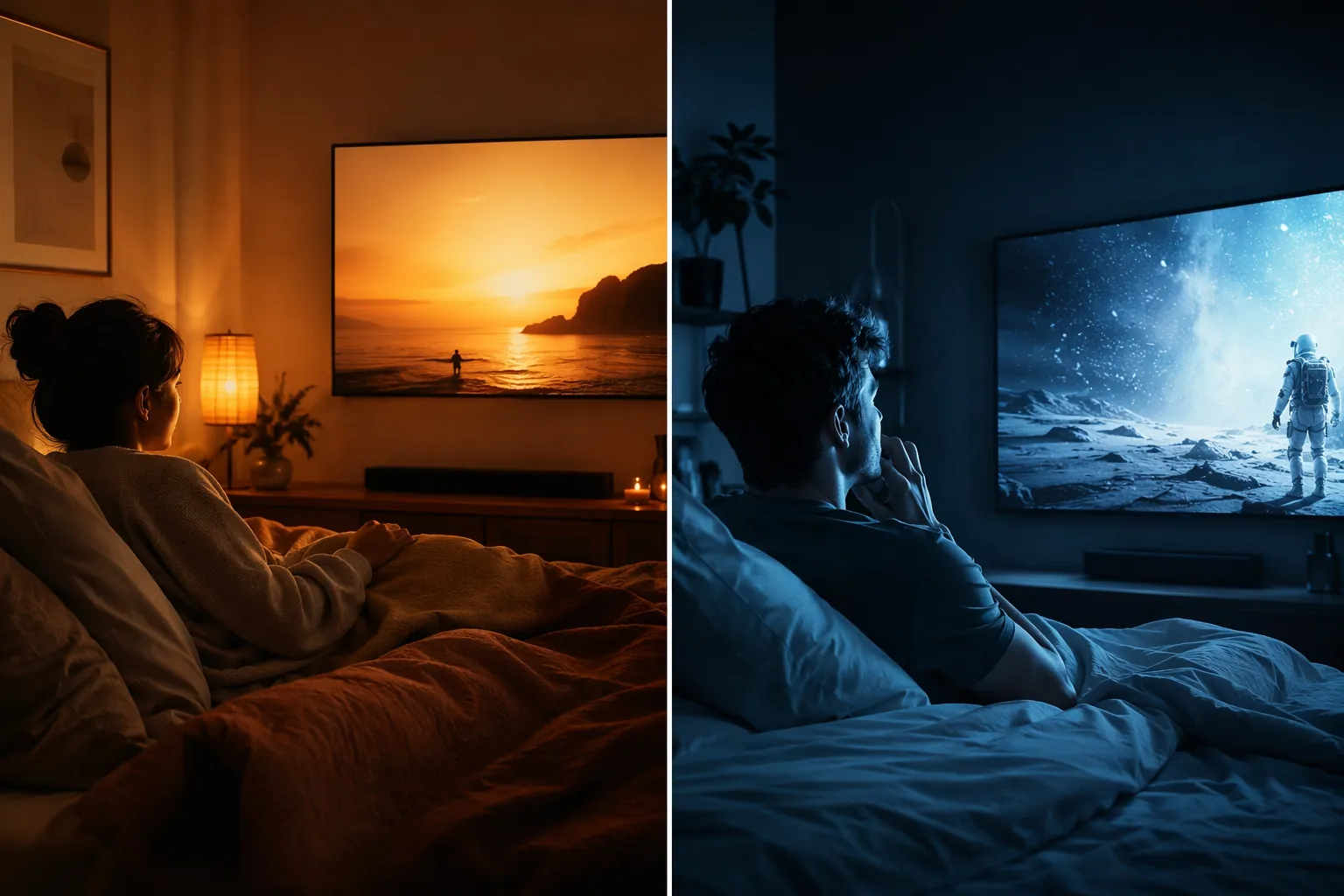
For the best movies to watch before bed for relaxation, start with this rule: choose something warm-toned, familiar, slow-to-moderate in pace, and emotionally low-stakes. Muted golds, terracottas, amber interiors, soft pastels, and storybook compositions are better bedtime bets than icy blues, neon cityscapes, harsh sci-fi lighting, or high-brightness action. That does not make any film sleep medicine. It only makes some choices less hostile to sleep than others.
This is harm reduction, not absolution. A Sleep Foundation survey published in June 2022 found that 52.7% of U.S. adults named TV watching as their primary bedtime ritual, so pretending the screen is not there is not especially helpful advice for many households.[1] The screen is there. The question is whether it is glowing like a glacier, screaming at you, and ending on a cliffhanger.
Why a Movie’s Color Palette Can Matter at Bedtime
Your eyes do not treat all light as the same kind of evening information. Harvard Health describes blue light as especially efficient at suppressing melatonin, estimating that blue wavelengths suppress melatonin about 2 to 3 times more efficiently than other wavelengths.[2] Melatonin is not a knockout drug; it is more like a timing signal. When bright, blue-heavy light arrives late, the body can read it as a reason to delay the night shift.
A small 2025 LED study makes that difference feel less abstract. In a sample of 12 participants, blue light exposure kept melatonin at 7.5 pg/mL after 2 hours, while red light allowed recovery to 26.0 pg/mL over the same period.[3] That study was small and short, so it should not be inflated into a universal bedtime law. But it fits the broader mechanism: wavelength matters, and blue-heavy light is a poor lullaby.
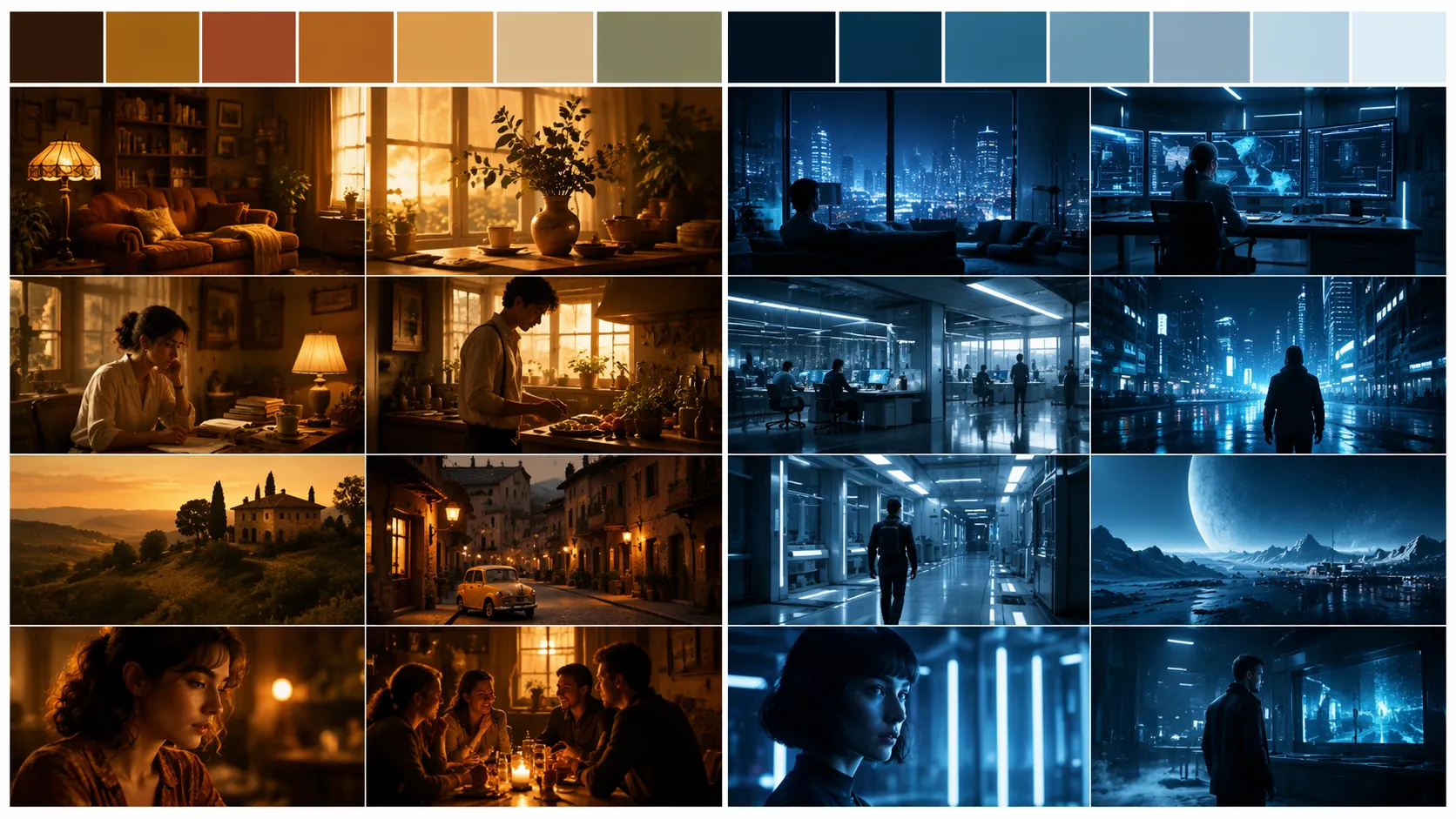
A movie is not just a lightbulb, of course. It is a moving package of brightness, color, contrast, motion, sound, suspense, faces, and unfinished business. Still, color palette is one of the few movie traits you can judge quickly before pressing play. If the trailer looks like candlelight, wallpaper, wood, late-afternoon sun, and slightly dusty pinks, it is probably a gentler visual choice than one built from police lights, fluorescent labs, cold rain, and electric-blue control panels.
What the Film Color Analysis Suggests
The most film-specific clue here comes from OddMattress, which analyzed 100 films for a “Snooze Score” based on color temperature and published the results in April 2026. The Royal Tenenbaums and Moonrise Kingdom topped its list of the best films to fall asleep to, while fantasy had the highest genre score at 75 and 1960s films had the most sleep-friendly decade average at 79.[4]
This is useful, with a very visible fence around it. OddMattress is a mattress brand, not a sleep lab, and its film ranking is content marketing rather than peer-reviewed film science. The analysis did consult GP and sleep specialist Dr. Deborah Lee, and it is grounded in a real blue-light mechanism, but a Snooze Score should be treated as an indicator, not a clinical seal of approval.[4]
Still, the top two choices pass the eye test. The Royal Tenenbaums is full of controlled interiors, vintage reds, browns, yellows, and symmetrical rooms that rarely feel visually chaotic. Moonrise Kingdom leans into storybook yellows, khakis, soft greens, and a sun-faded island palette. Neither film asks your visual system to spend the last hour before bed bathing in sterile blue light.
That does not mean every viewer will find them equally soothing. Wes Anderson’s precision can be calming if it feels contained and familiar; it can be faintly irritating if you are already overstimulated and allergic to twee little suitcases. The point is not that these are universally perfect bedtime movies. The point is that their color design gives you a repeatable template.
A Practical Bedtime Movie Shortlist
A principled list is better than a list of everyone’s favorite “cozy” films, because cozy is not a measurement. For bedtime, a film earns its place by being visually warm, emotionally non-punishing, and easy to leave unfinished if sleep arrives before the credits.
| Movie | Why it fits bedtime better than most | One caution |
|---|---|---|
| The Royal Tenenbaums | Warm interiors, controlled compositions, vintage reds and browns; ranked at the top of the OddMattress Snooze Score list. | Family melancholy may not be relaxing for everyone. |
| Moonrise Kingdom | Soft yellows, khaki greens, storybook framing; also ranked at the top of the OddMattress list. | Best if you already know the plot and will not stay up tracking every detail. |
| A gentle fantasy you already know | OddMattress found fantasy had the highest genre Snooze Score, which makes visual sense when the palette leans candlelit, pastoral, or storybook rather than icy and battle-heavy. | Fantasy can also mean peril, monsters, and big climactic noise; choose the quiet kind. |
| An older warm-toned classic | OddMattress found 1960s films had the highest average decade score, suggesting older color palettes may sometimes be gentler late at night. | Decade is only a clue; a tense plot is still a tense plot. |
| A familiar low-stakes comfort rewatch | Familiarity reduces the need to monitor every scene and makes it easier to drift without fear of missing the point. | If you love it so much that you quote along until midnight, it has failed the assignment. |
The Royal Tenenbaums and Moonrise Kingdom are the cleanest anchor examples because the film-level analysis actually names them.[4] The broader categories are not prescriptions. They are screening filters. If a fantasy film is mostly torchlight, moss, wool cloaks, and gentle wandering, it may behave differently at bedtime than one built from blue lightning, battles, and frantic editing.
How to Judge a Movie Before You Press Play
Look at the stills, trailer thumbnails, or opening minutes. You are not trying to become a cinematographer; you are trying to avoid inviting a tiny Times Square into bed.
- Better signs: muted golds, amber lamps, terracotta walls, wood, candlelight, dusk, natural interiors, soft pastels, low-contrast warmth.
- Riskier signs: icy blues, neon signs, cold rain, fluorescent offices, harsh white labs, blue-gray crime scenes, high-brightness sci-fi rooms.
- Better motion: lingering shots, gentle camera movement, domestic routines, landscapes, conversations that do not feel like interrogations.
- Riskier motion: chase scenes, jump cuts, combat, disaster sequences, loud visual contrast, anything that makes you brace for impact.
- Better story shape: familiar, low-stakes, episodic, emotionally resolved enough that you can stop midway without feeling abandoned.
Color should get the first glance, not the final vote. A warm-toned thriller can still keep you awake. A beautifully amber film about dread, grief, betrayal, or a child in danger is still asking your nervous system to keep watch. The body is annoyingly literal about that.
Pace, Stakes, and Familiarity Can Overrule the Palette
The color-temperature evidence explains one route by which a movie can interfere with sleep. It does not measure suspense, volume, plot hooks, emotional threat, or whether you are the sort of person who simply must know who inherited the haunted estate. Those traits matter because relaxation is not just dimmer light; it is reduced vigilance.
For bedtime, familiarity is underrated. A rewatch gives the brain permission to loosen its grip. You already know where the story goes. You know whether anyone dies, whether the dog is fine, whether the couple reconciles, whether the final act detonates into noise. A new movie, even a warm and gentle one, may keep pulling you forward.
This is where many “cozy movie” lists become less useful than they look. A film can be aesthetically soft and narratively sharp. Another can be visually plain but emotionally easy because you have seen it ten times and your body treats it like a bedtime story. When choosing between the two, the familiar low-stakes rewatch often wins.
If Your Sleep Is Already Fragile, Be More Conservative
Some readers do not arrive at bedtime with much margin. The National Institute on Aging advises people dealing with sleep problems during the menopause transition to avoid screens before bed.[5] Pregnancy can also complicate sleep, and a 2025 review on balancing screen time during pregnancy treats screen exposure as a behavior worth managing rather than ignoring.[6]
That does not mean a pregnant reader or a perimenopausal reader has committed a moral failure by watching a movie in bed. It means the trade-off is less forgiving. If hot flashes, reflux, anxiety, fetal movement, pain, or early waking are already in the room, a blue-heavy, suspenseful film is a very silly additional roommate.
For fragile sleepers, make the bedtime movie boring on purpose. Choose a known story. Lower the brightness before you start, not after your eyes have adjusted to the glow. Skip anything with jump scares, courtroom reveals, medical emergencies, apocalyptic stakes, or a plot that will make you say “just one more scene” at 11:48 p.m.
Make the Screen Gentler
The cleanest sleep advice is still to stop using screens before bed. You know this. I know this. The remote control knows this and is hiding under a blanket. If the movie is staying, reduce the damage.
- Dim the screen as low as remains comfortable; brightness and color both matter.
- Use night mode or a warmer display setting, while remembering that it reduces exposure rather than making the screen sleep-neutral.
- Set a sleep timer before the movie starts so the room does not keep glowing after you drift.
- Keep the volume modest and avoid headphones if they make the movie feel more immersive than relaxing.
- Start earlier than you think; a “short” movie that begins too late is still a sleep delay with nice production design.
- Pair the movie with a non-screen wind-down cue, such as a warm bath earlier in the evening, if your routine needs more help transitioning.
If you want the same harm-reduction logic applied to a more obviously stimulating bedtime screen habit, the guide to watching late-night baseball without ruining your sleep is a useful sibling problem. For a deeper look at the blue-light mechanism in a more vulnerable group, see why screens before bed disrupt kids’ sleep more than adults’.
The Bounded Answer
Warm-toned movies are a smarter relaxation choice than blue-heavy ones under the same viewing conditions. The mechanism is plausible, the melatonin evidence supports caution around blue wavelengths, and the film-level analysis gives a practical way to sort choices without pretending taste is data.
The best bedtime movie is visually warm, emotionally undemanding, familiar enough not to hook you, and watched with the screen made as gentle as possible. If it lets you stop bracing, it has done its job. If it makes you negotiate with the next scene, it is not relaxing; it is just beautifully lit trouble.
References
- Why Do We All Still Watch TV Before Bed?, Sleep Foundation, June 2022
- Blue light has a dark side, Harvard Health
- Comparative Effects of Red and Blue LED Light on Melatonin, PMC, 2025
- The best and worst films to fall asleep to, according to blue light, OddMattress, April 2026
- Sleep Problems and Menopause: What Can I Do?, National Institute on Aging
- Balancing screen time during pregnancy, PMC, 2025
Read the full guide: Free Movies to Stream Before Sleep, Chosen by Your Life Stage