Do celebrity ayahuasca experiences improve trauma sleep?
Short answer
Celebrity ayahuasca stories may describe real trauma-related change. They do not prove that ayahuasca directly improves sleep.
That distinction matters if you arrived here through celebrity ayahuasca stories about trauma and sleep improvement, because most public accounts talk about grief, fear, rebirth, self-love, mortality, identity, or spiritual confrontation. Sleep is usually implied, not measured. If someone says a ceremony helped them feel less haunted, it is plausible that sleep could improve later. But that is a different claim from saying ayahuasca works like a sleep medicine.
- Best-supported sleep claim: possible indirect, delayed sleep improvement when trauma symptoms and hyperarousal decrease.
- Weakly supported claim: ayahuasca directly improves insomnia or nightmares.
- Complicating finding: the only polysomnography study available found same-day REM suppression and increased REM latency after ayahuasca in healthy male volunteers.
- Evidence tier: observational studies, surveys, open-label case series, and expert interpretation; no placebo-controlled PTSD sleep trial.
What celebrities have actually claimed
The celebrity thread is not imaginary. Will Smith has described taking part in 14 ayahuasca ceremonies and said the experience cleared away mental "cobwebs." Miley Cyrus has called it life-changing and said it unlocked something. Aaron Rodgers has described self-love and a connection with ancestors. Sting has spoken of confronting mortality. Lindsay Lohan called an ayahuasca experience "a rebirth." Mike Tyson has said it "cured me." Public coverage has also included harder accounts, including Megan Fox saying she "went to hell for eternity" and the negative account associated with Stephen "tWitch" Boss that his widow later discussed publicly.[1]
Those stories belong in the conversation because trauma recovery is not always neat. People do sometimes describe a single experience as a psychological hinge: before it, they were stuck; after it, some inner posture changed. It would be too easy, and not very humane, to mock that just because the speaker is famous.
The problem starts when a vivid recovery story quietly becomes a sleep claim. In the public accounts above, sleep is not the primary outcome. There is no baseline insomnia score, nightmare count, actigraphy, sleep diary, PTSD sleep item tracked over time, or clinician-rated sleep measure. The person may have changed. The sleep claim remains mostly inferred.
The negative stories matter for the same reason. They interrupt the edited arc in which a ceremony is frightening, then cleansing, then permanently transformative. A frightening altered state may still be followed by growth for some people, but it may also destabilize others. Public celebrity coverage is not a denominator. We see the stories that become tellable.
Was sleep measured?
In the celebrity accounts, no. In the clinical literature, partly, but not in the way a person with trauma insomnia would most want.
| Question | What the evidence can say | What it cannot say |
|---|---|---|
| Do celebrity accounts prove better sleep? | They show that some public figures report major psychological or spiritual change. | They do not isolate sleep as an outcome. |
| Does ayahuasca change sleep the same day? | One polysomnography study found REM suppression and increased REM latency after daytime dosing in healthy male volunteers. | It does not show therapeutic sleep improvement in people with PTSD. |
| Could trauma-related sleep improve later? | Observational veteran and retreat data report PTSD, mood, and self-reported sleep improvements after ayahuasca-assisted programs. | They cannot separate ayahuasca from therapy, community, expectation, retreat setting, lifestyle change, or time. |
| Has ayahuasca been compared with established trauma-sleep treatments? | Not in direct comparison trials identified in the provided evidence. | There is no head-to-head evidence against CBT-I, EMDR, or prazosin for nightmares. |
For trauma-related insomnia, that missing middle is not a small technicality. The sleeper is not just trying to feel inspired. They are trying to stop jolting awake, scanning the room, dreaming in threat loops, or lying still while the body behaves as if danger is still present. That trauma-to-hyperarousal pathway is why sleep can stay disrupted long after the original event is over, a pattern also discussed in Restful Ground's piece on Prince Harry's trauma and sleep struggles.
The same-day sleep finding is REM suppression, not sedation
The most sleep-specific ayahuasca study is Barbanoj and colleagues' 2007 polysomnography study in Psychopharmacology. It involved 22 healthy males who received ayahuasca during the daytime. The researchers found that ayahuasca suppressed REM sleep and increased REM latency, while increasing slow-wave sleep. Unlike d-amphetamine, which degraded both objective and subjective sleep quality, ayahuasca did not reduce subjective sleep quality despite the REM changes.[2]
That is a narrow study, and it should be read narrowly. It was small. It included healthy men, not women, not people with PTSD, and not people seeking treatment for insomnia or trauma nightmares. The dosing was daytime dosing, and the study looked at acute sleep architecture rather than weeks of recovery.
Still, it is important because it is the clearest direct sleep measurement we have. And it does not support the casual idea that ayahuasca simply "improves sleep" in the way a hypnotic drug might. If anything, the immediate objective signal is more complicated: REM is pushed back and reduced, while slow-wave sleep rises.
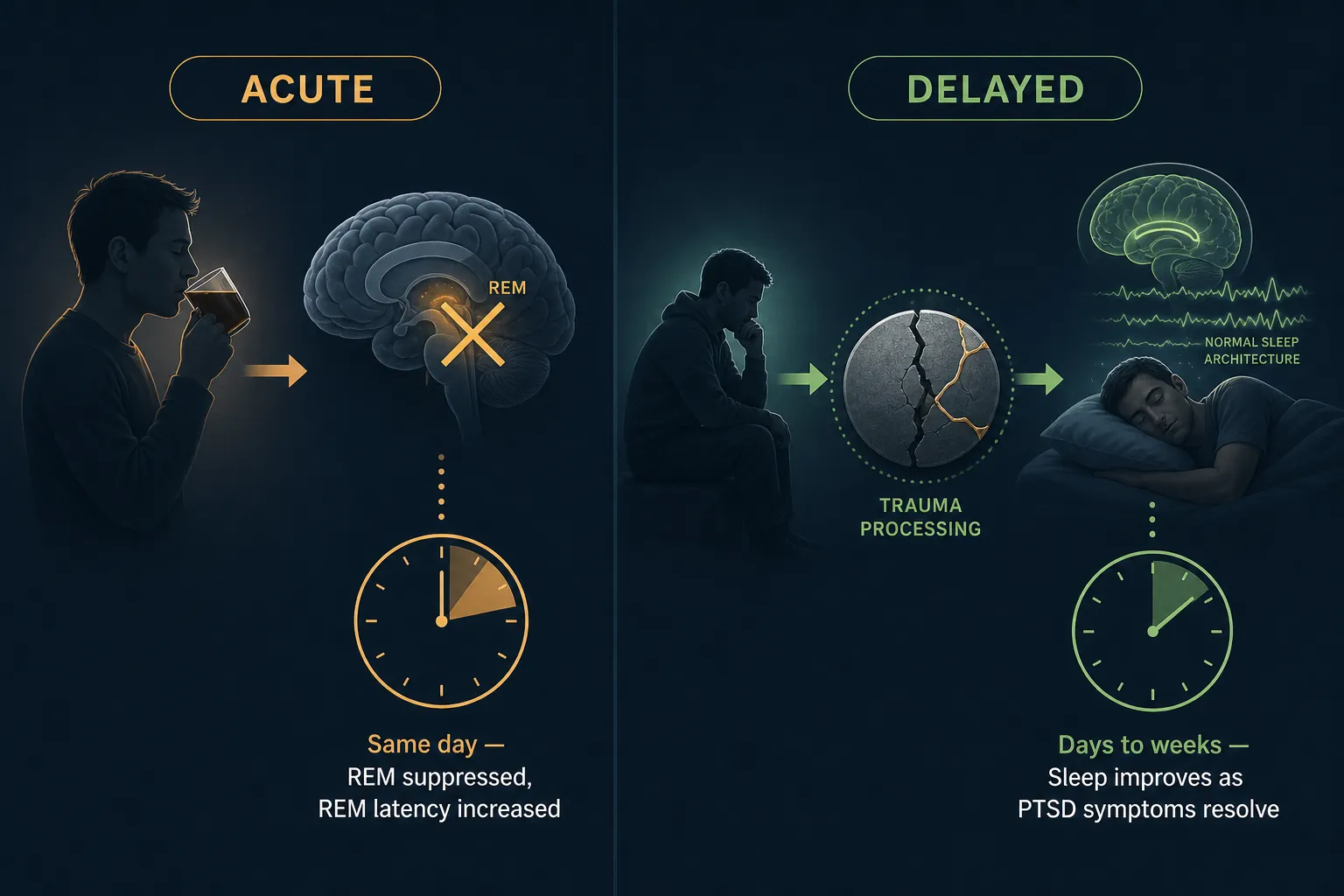
For a trauma sleeper, REM is not an abstract lab variable. Nightmares, fear memory, awakenings, and emotional processing often cluster around the parts of sleep that make REM especially relevant. A same-day REM-suppression finding does not automatically mean harm, and it does not rule out later improvement. But it does mean that the most precise sleep evidence does not match the simplest wellness claim.
How sleep might improve later
The stronger argument for ayahuasca and sleep is indirect: if PTSD symptoms decrease, the nervous system may spend less of the night in threat mode. Fewer intrusive memories, less avoidance, less shame, less depression, and less physiological alarm could make sleep easier. In that model, ayahuasca is not acting like a sleeping pill. Sleep improves downstream because the person is less activated.
That is where the veteran and retreat data become relevant. A 2024 Heroic Hearts Project observational study of 58 veterans reported a 26% average PTSD symptom reduction, a 29% depression reduction, and that 80% no longer met PTSD criteria post-treatment, along with self-reported sleep quality improvements. But the program combined ayahuasca with therapy, community support, and lifestyle changes, and it did not include a placebo control.[3]
A 2024 mixed-methods case series by Weiss and colleagues followed 8 military veterans after a 3-day ayahuasca intervention. Seven of the 8 veterans, or 87.5%, showed reliable or clinically significant reductions on the PCL-5, and 70% maintained improvements at 3-month follow-up. A 2024 erratum corrected the baseline severity characterization from severe to moderate, but the reported improvement trajectory remained sustained.[4]
That evidence deserves attention, especially because veterans' sleep problems often sit inside a larger trauma and injury picture rather than a simple habits problem. Restful Ground's article on sleep problems among veterans with head trauma is useful context for why sleep outcomes in this population cannot be reduced to bedtime discipline.
The caution is equally important. In the Heroic Hearts and Weiss materials, sleep improvement is not cleanly isolated from PTSD improvement, therapy, group support, expectancy, setting, or post-retreat changes in behavior. A person may sleep better after a retreat because they are less depressed, less ashamed, more connected, more hopeful, more supported, or no longer drinking in the same way. Those are clinically meaningful possibilities. They are not proof of a direct sleep mechanism.
Mood and anxiety findings widen the picture, but they still do not settle sleep
The broader ayahuasca mental health literature is larger than the sleep literature. Sarris and colleagues published a cross-sectional study of 11,912 ayahuasca consumers in Scientific Reports; among respondents with depression, 94% reported improvement, and among those with anxiety, 90% reported improvement. Reported "complete resolution" was 32% for depression and 16% for anxiety. Sleep was not a primary endpoint.[5]
Ruffell and colleagues followed 63 retreat participants and reported statistically significant improvements in depression, anxiety, and self-compassion sustained at 6 months, along with a modest correlation between childhood trauma history and SIGMAR1 epigenetic methylation changes.[6]
A 2024 systematic review analyzing 43 studies found ayahuasca associated with antidepressant, anti-anxiety, and anti-addictive effects.[7] That is relevant because depression, anxiety, addiction, and trauma can all disturb sleep. But association across mental health outcomes is not the same thing as demonstrating that ayahuasca treats insomnia, nightmares, sleep fragmentation, or REM-related trauma symptoms.
The evidence gap a sleep clinician would notice
To turn the celebrity claim into a clinical sleep claim, several missing pieces would need to appear. The field would need controlled studies in people with PTSD-related insomnia or nightmares. It would need pre- and post-treatment sleep measures, not just general transformation language. It would need to separate ayahuasca from psychotherapy, retreat setting, social support, expectancy, abstinence from substances, and post-retreat lifestyle changes.
- Measured sleep outcomes: insomnia severity, nightmare frequency, awakenings, total sleep time, sleep efficiency, and daytime impairment.
- Objective measures where feasible: polysomnography, actigraphy, or validated sleep diaries over time.
- Timing: acute same-night effects separated from days-to-weeks trauma recovery effects.
- Comparison groups: placebo or active control conditions, plus established options such as CBT-I, EMDR, and prazosin for nightmares.
- Safety tracking: panic, dissociation, destabilization, medication interactions, and delayed psychological effects.
The absence of those studies does not mean every positive account is false. It means the sleep conclusion has to stay smaller than the story. A person can have a meaningful psychological experience without that experience becoming evidence for a specific treatment effect on sleep architecture or PTSD insomnia.
If trauma is the reason you are awake
If you are asking about ayahuasca because ordinary sleep advice has failed you, that is understandable. Trauma sleep is often not fixed by dimming the room, buying a new pillow, or trying harder to relax. Hypervigilance, nightmares, conditioned fear, and body-level alarm can keep sleep fragmented even when the bedtime routine is reasonable.
That is also why this question belongs with a clinician, not a celebrity profile. Ayahuasca is a Schedule I substance in the United States. The evidence does not include placebo-controlled PTSD sleep trials, and there are no direct comparison studies showing that ayahuasca outperforms CBT-I, EMDR, or prazosin for nightmares. The psychological risks are also easier to understate in public transformation stories than in clinical reality.
For people unsure whether post-trauma sleep symptoms have crossed into clinical territory, Restful Ground's guide to earthquake anxiety, sleep, and PTSD thresholds may help frame when professional evaluation is warranted.
So the careful answer is this: celebrity ayahuasca trauma stories are not meaningless, and some people may sleep better after major trauma symptoms loosen. But the strongest sleep-specific evidence shows acute REM suppression, not direct sleep enhancement. Any sleep improvement is best understood as indirect, delayed, and still supported mainly by observational evidence.
References
- Celebrity ayahuasca accounts, Hollywood Reporter, SheKnows, and Lucid News sources
- Daytime ayahuasca administration modulates REM and slow-wave sleep in healthy volunteers, PubMed, PMID 18030450
- Heroic Hearts Project observational study, HHP 2024 report
- A mixed-methods case series of a 3-day ayahuasca intervention in military veterans, PubMed, PMID 38059941
- Ayahuasca use and reported effects on depression and anxiety symptoms: an international cross-sectional study of 11,912 consumers, Nature Scientific Reports
- Ceremonial Ayahuasca in Amazonian Retreats-Mental Health and Epigenetic Outcomes From a Six-Month Naturalistic Study, Frontiers in Psychiatry
- Systematic review of ayahuasca studies, PMC, PMID 10994171
Read the full guide: What ayahuasca depression therapy does to your sleep