
Garmin Cirqa vs Whoop sleep tracking for life stages
For a life-stage sleep tracking choice, the short version is this: Garmin Cirqa is the better fit when your main problem is fluctuating daily energy, perimenopausal sleep disruption, or aging sleep architecture; Whoop 5.0 is the better fit when you want pregnancy/women’s health structure or a lower-friction recovery verdict. That is not the same as saying either device has proven clinical accuracy for those groups. As of July 25, 2026, Cirqa is only days old, and neither Garmin nor Whoop has published sleep-stage validation specifically in perimenopausal, pregnant, older adult, or ADHD/neurodivergent populations.
That caveat matters because this is not a generic Garmin Cirqa vs Whoop sleep tracking review built around one healthy test sleeper. Both devices sit on a similar sensor foundation: optical heart-rate sensing, motion sensing, HRV, blood oxygen, skin temperature, and respiration-rate estimates. The more useful question is what each company does with those signals once the night is over, and whether that packaging matches the body wearing the band.
If you want the stricter accuracy argument, read the separate Garmin Cirqa vs Whoop sleep tracking accuracy comparison. This article is a decision-routing guide: which sleep-related features are most likely to be useful for the physiological situation you are actually in.
The Life-Stage Verdict
| If this is your main sleep context | Stronger fit | Why |
|---|---|---|
| Perimenopause | Garmin Cirqa | Body Battery updates throughout the day, which better matches energy swings after fragmented sleep; skin temperature and Natural Cycles support add cycle-aware context. |
| Pregnancy | Whoop 5.0 | Whoop has more structured women’s health features, including pregnancy, nursing, and cycle-related logging; Garmin’s SpO2 and respiration data still matter if sleep-disordered breathing is a concern. |
| Adults 50+ | Garmin Cirqa | Garmin has age-stratified sleep-stage context from its sleep research, and Pulse Ox/respiration data may be more directly relevant to aging sleep concerns than biological-age dashboards. |
| ADHD or neurodivergent sleep tracking | Whoop 5.0 for most users | Both are screenless, but Whoop’s green/yellow/red Recovery framing creates less dashboard management than Garmin’s multi-metric ecosystem. |
The table is intentionally not an accuracy ranking. Cirqa was announced on July 21, 2026 and became available on July 24, 2026, so there has not been time for independent Cirqa-specific sleep accuracy testing as of this article’s date.[1] Whoop has a stronger public validation history, but its published PSG sleep validation work has involved earlier Whoop hardware rather than Whoop 5.0, and that still does not answer how well it performs in pregnancy, perimenopause, aging, or ADHD.[2]
What Both Bands Can See, And What They Still Guess
Garmin Cirqa and Whoop 5.0 are both screenless bands, which is already a meaningful sleep design choice. There is no bright watch face inviting one more tap at bedtime, and neither device is trying to be a tiny phone on your wrist. For people with insomnia, pregnancy discomfort, hot flashes, sensory sensitivity, or late-night executive-function drift, that restraint is not cosmetic.
Under the surface, both rely on indirect signals. Heart-rate patterns, HRV, movement, blood oxygen, temperature change, and breathing estimates can describe trends around sleep; they do not read brain waves the way laboratory polysomnography does. That is why deep sleep and REM numbers from any wrist tracker should be treated as directional information, not a nightly verdict on whether your brain “did sleep correctly.” If sleep stages are the part that makes you anxious, the guide to deep sleep vs. REM tracker numbers is the better starting point.
The real split is feature architecture. Garmin gives you a sleep score, Body Battery, HRV Status, respiration, Pulse Ox, temperature-linked features, and broader readiness-style context. Whoop compresses more of the daily decision into Recovery, Strain, Sleep Performance, and coaching prompts. One approach gives you more handles. The other gives you fewer decisions.
Perimenopause: Garmin’s Daytime Energy Curve Matters More Than A Morning Score
Perimenopausal sleep is often not just “bad sleep.” It can be fragmented sleep, early waking, temperature disruption, alcohol sensitivity, a night that looks acceptable on paper but leaves the next day unstable, or a morning that starts fine and collapses by midafternoon. A tracker that only answers “How recovered were you when you woke up?” misses part of that lived pattern.
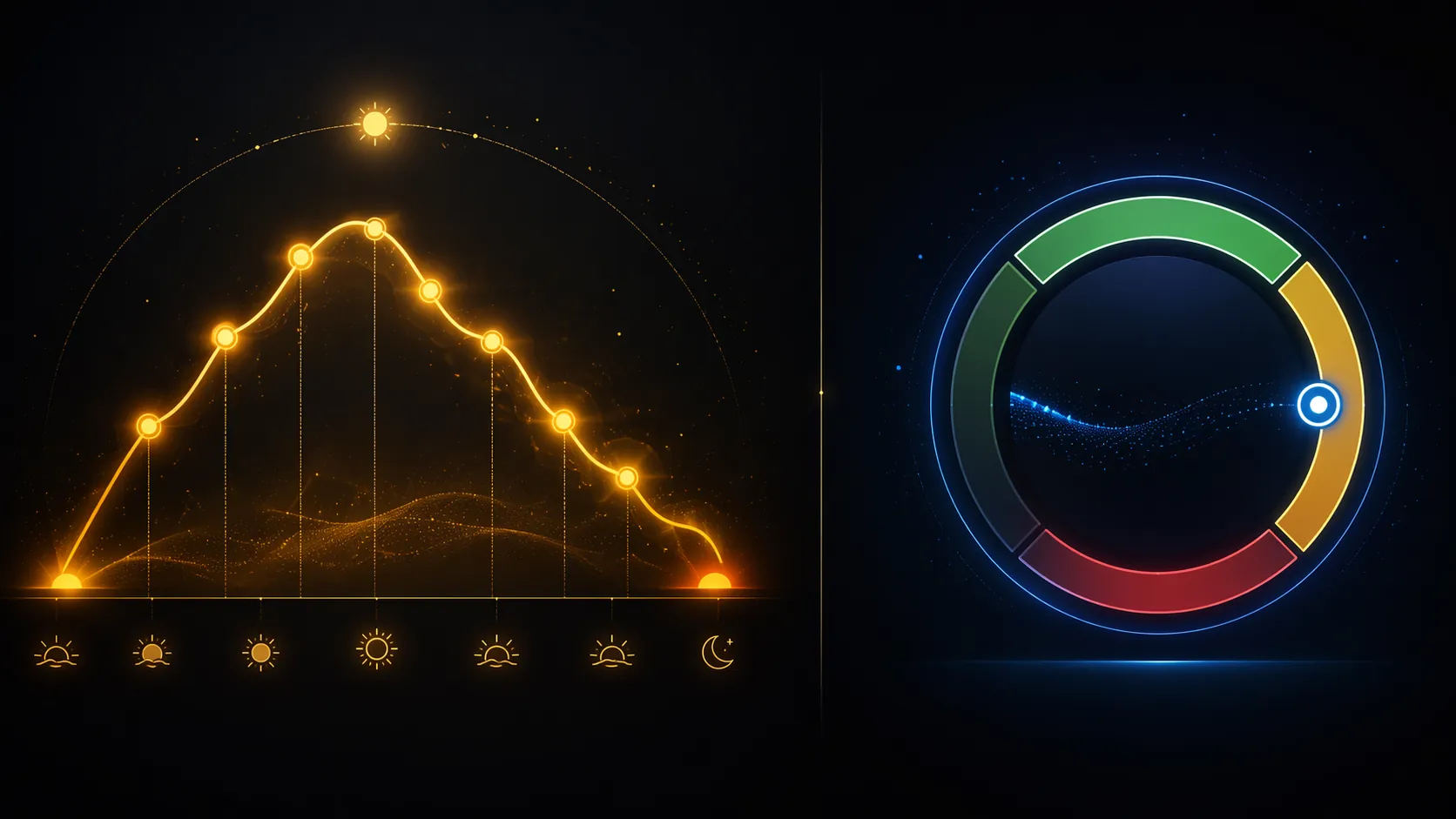
This is where Garmin Cirqa has the clearest life-stage advantage. Garmin’s Body Battery is designed to change through the day rather than remain a single morning readout, and DC Rainmaker’s Cirqa hands-on confirms that the band carries Garmin’s continuously updating Body Battery behavior.[1] For a perimenopausal user, that can be more useful than a pristine sleep score. The practical question is not only whether last night was “good,” but whether a poor night is still draining you at noon, whether a quiet morning rebuilt capacity, or whether a normal-looking night failed to restore much at all.
Whoop’s Recovery score is more elegant, but it is less temporally sensitive for this particular problem. Recovery is a morning status signal, not a live map of recovery changing across the day. For many athletes, that is fine: decide whether to push or pull back, then train. For a person navigating hot flashes, disrupted cycles, caregiving wakeups, or medication timing, the body may not move through the day in one clean overnight-to-morning arc.
Garmin also has a skin-temperature pathway that connects to Natural Cycles, a point Forbes highlighted in its Cirqa launch coverage.[3] That does not make Cirqa a menopause diagnostic device, and it does not mean temperature alone explains sleep disruption. It does mean Garmin’s system has a clearer route for cycle-aware context than a plain sleep score would.
Whoop is not weak here; it is just strong in a different way. Whoop has invested visibly in women’s health features, including cycle coaching, menopause symptom logging, and broader women’s health integrations described in wearable comparisons and Whoop’s own materials.[4][5] If your main need is symptom logging inside a structured women’s health ecosystem, Whoop deserves attention. If your main frustration is “my energy changes all day and my tracker only judges the night,” Garmin is the more useful shape.
For deeper context on why perimenopausal sleep disruption can feel disproportionate to a simple sleep score, see how perimenopause sleep loss accelerates biological age and the related guide to alcohol and perimenopause sleep.
Pregnancy: Whoop Has The Better Structure, Garmin Has Useful Breathing Context
Pregnancy changes the tracker question. The most useful device is not necessarily the one with the most sleep-stage detail. It is the one that lets the user place sleep next to pregnancy status, nursing, cycle history, and symptoms without turning every rough night into a mystery to solve from scratch.
On that front, Whoop 5.0 is the stronger fit. Whoop’s ecosystem includes pregnancy and nursing-related logging, cycle coaching, and women’s health integrations that Garmin Cirqa does not match as directly.[4][5] That structure matters because pregnancy sleep problems rarely arrive as isolated sleep-stage complaints. Night waking, discomfort, bathroom trips, reflux, changing temperature, anxiety, and postpartum feeding schedules all need context.
Garmin Cirqa still has one pregnancy-relevant strength that should not be dismissed: SpO2 and respiration tracking. Pregnancy-related sleep-disordered breathing is a known clinical concern, especially later in pregnancy, and wrist SpO2 trends may give someone a reason to seek proper evaluation sooner. That is not the same as diagnosis. A consumer band cannot rule sleep apnea in or out, and a reassuring oxygen graph should not override symptoms such as loud snoring, witnessed pauses, gasping, severe daytime sleepiness, or high-risk pregnancy concerns.
Both devices being screenless is also unusually helpful in pregnancy. When sleep is already being interrupted by the body, the device should not add notification light, app grazing, or one more surface for worry. The difference is what happens in the app the next morning: Whoop gives a more guided framework; Garmin gives more separate signals to interpret.
Aging 50+: Garmin’s Age-Aware Sleep Context Is More Directly Relevant
For adults over 50, the issue is not that sleep suddenly becomes less important. It is that sleep architecture changes, and a tracker built around younger norms can quietly make normal aging look like nightly failure. Deep sleep tends to decrease with age, and Garmin’s 2019 sleep study results, based on more than 3,200 nights of production data in collaboration with KUMC, explicitly reported age-related sleep-stage patterns.[6]
That makes Garmin Cirqa more interesting for older adults than a simple spec sheet would suggest. The Cirqa itself is new, and the older Garmin study used vivosmart 3 hardware rather than Cirqa’s newer sensor platform, so this is not Cirqa-specific validation.[6] Still, Garmin has at least built sleep scoring around age-stratified context in a way that is directly tied to the sleep question. If you are 62, a device that recognizes age-related sleep-stage shifts is more useful than one that implicitly treats the ideal sleeper as a younger athlete.
Pulse Ox and respiration data also become more relevant with age. Older adults are more likely to be dealing with snoring, medication effects, cardiometabolic risk, overnight oxygen concerns, or symptoms that deserve a clinician’s attention. Garmin’s Pulse Ox data is not a diagnostic sleep study, but it can add context to a pattern: waking with headaches, daytime sleepiness, unexplained fatigue, or a partner reporting breathing pauses.
Whoop’s counterargument is Healthspan and Pace of Aging. Those features may appeal to older adults who want a broader longevity dashboard, and Whoop’s subscription model allows the company to keep adding software layers.[4] But for sleep specifically, Garmin’s age-stratified sleep context is the cleaner match. Biological-age framing can be motivating for some people; for others, it becomes another score to defend against.
If you want the mechanics of Garmin’s sleep score before choosing a device, the Garmin Sleep Score guide explains the scoring components in more detail.
ADHD And Neurodivergent Sleep: The Cleaner Interface May Win
For ADHD and many neurodivergent users, the best sleep tracker is often the one that creates the fewest new tasks. A dashboard that asks for daily interpretation, cross-checking, and restraint can become its own bedtime problem. The person who already struggles with initiation, switching, sensory load, or data anxiety may not benefit from five extra metrics simply because they are available.
Both Garmin Cirqa and Whoop 5.0 get one thing right: no watch screen. That lowers the risk of late-night checking and makes either device more sleep-friendly than a smartwatch for people who are easily pulled into notifications. If you are still comparing screenless bands with watches, the broader guide to the best smartwatch for sleep tracking can help separate those categories.
Between these two, Whoop’s single Recovery verdict is usually the better fit for cognitive load. Green, yellow, and red may sound simplistic in a spec comparison, but simplicity can be a real accessibility feature. A person can decide whether to push, maintain, or take it easier without opening a small committee meeting between Sleep Score, Body Battery, HRV Status, Training Readiness, respiration, and stress.
Garmin can still be the better choice for an ADHD user who likes data and uses it gently. Body Battery may help someone notice the cost of late caffeine, skipped meals, overstimulation, or a fragmented night without waiting for the next morning’s recovery label. But if you know that numbers become loops, reassurance rituals, or self-blame, Whoop’s narrower interface is safer. The guide to sleep trackers for people who actually can’t sleep goes deeper on orthosomnia risk and data anxiety.
Where The Accuracy Claims Stop
Whoop has the stronger validation story overall, but that sentence needs limits. Whoop has published sleep validation material and explanations of how it measures and scores sleep, and a 2025 algorithm update was reported as improving sleep-stage classification by 7%.[2][7][8] The unresolved issue is population fit: those materials do not prove that Whoop 5.0 stages sleep accurately in pregnant users, perimenopausal users, older adults, or ADHD/neurodivergent users.
Garmin has useful sleep research behind its scoring approach, including the age-stratified 3,200-night dataset, but Cirqa-specific sleep validation does not exist yet in the public record. WeGuide’s Cirqa clinical research overview likewise treats Cirqa as a newly launched device without device-specific sleep validation available at launch.[9] Carrying over confidence from Garmin’s broader platform is reasonable as a hypothesis; it is not proof.
That distinction should change how you use either band. Use sleep stages as trends. Use HRV, resting heart rate, respiration, temperature, SpO2, and recovery-style metrics as context. Do not use either device to dismiss symptoms that deserve medical evaluation, especially loud snoring, gasping, witnessed pauses, severe daytime sleepiness, pregnancy breathing concerns, new insomnia, or sudden changes in sleep quality.
Which One Should You Choose?
Choose Garmin Cirqa if your main sleep problem is not just the night but the way the night echoes through the day. It is the stronger pick for perimenopause, many adults over 50, people who want Body Battery’s continuously updating energy curve, and users who care about SpO2, respiration, skin temperature, and age-aware sleep-stage context. It is also the more appealing option if you want to avoid a subscription and are comfortable interpreting several related metrics.
Choose Whoop 5.0 if your main need is structure. It is the stronger pick for pregnancy-related tracking, women’s health logging, nursing and cycle context, and ADHD/neurodivergent users who benefit from a single recovery verdict instead of a dashboard full of competing signals. It is also the safer choice if you want the brand with the stronger public validation history, while accepting that the validation does not specifically answer your life-stage question.
Choose neither as a substitute for a sleep-disorder evaluation. A better-matched wearable can reduce uncertainty, spot patterns, and help you describe what is happening. It cannot diagnose sleep apnea, explain every wakeup, or decide whether fragmented sleep is clinically normal for your body.
References
- Garmin Cirqa: Everything You Need To Know, DC Rainmaker, 2026.
- Podcast No. 62: WHOOP Sleep Validation Study, WHOOP.
- Garmin Cirqa Is Here: 10 Top Facts, Forbes.
- Whoop vs Garmin, Wareable.
- Garmin Cirqa vs Whoop 5 vs Fitbit Air Compared, Garmin Rumors.
- Garmin Health Announces Sleep Study Results, Garmin Health, 2019.
- How WHOOP Measures and Scores Sleep, WHOOP.
- WHOOP sleep tracking accuracy gets a serious boost, Gadgets & Wearables, 2025.
- Garmin Cirqa Clinical Research, WeGuide.
Read the full guide: How to Use an Old Phone as a Bedside Sleep Tracker