Better Sleep Through Every Phase of a Hurricane
Match the Sleep Plan to the Storm Phase
Useful hurricane preparation tips for better sleep start with timing. The sleep problem is not the same 48 hours before landfall as it is when the wind is up, the hallway is crowded, or the house is hot after the power drops.
| Storm phase | Main sleep disruptor | What to do first |
|---|---|---|
| About 48 hours before landfall | Anticipatory anxiety, constant checking, unfinished decisions | Set the backup sleep zone, assign roles, and move storm updates away from bedtime |
| Night before landfall or while sheltering | Arousal from news, noise, and uncertainty | Use low-stimulation updates, finish charging, and sleep where you can move quickly if conditions change |
| Active storm | Noise, safety positioning, adult alertness | Sleep in the safest interior space and rotate adult rest if someone must stay aware |
| Power outage | Heat, humidity, poor airflow, medical-device planning | Move low, create airflow if safe, cool the body directly, and ration battery power |
| Evacuation or shared shelter | Light, noise, crowding, loss of routine | Protect the smallest possible sleep boundary with earplugs, eye mask, and a predictable wind-down |
| After the storm | Stress rebound, cleanup decisions, disrupted schedule | Keep nights boring, take daytime decisions out of bed, and watch the duration of insomnia |
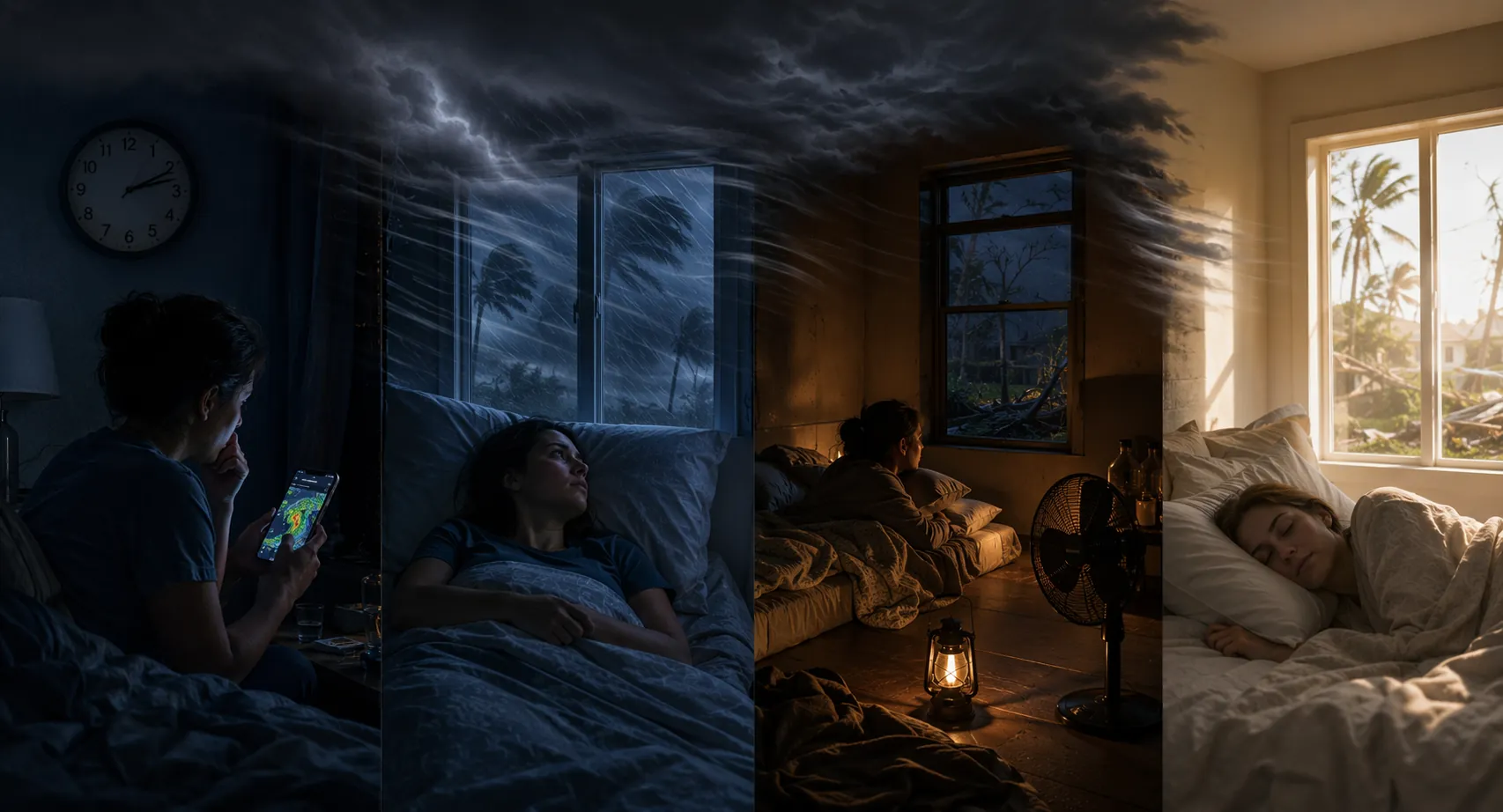
Nobody needs a lecture about perfect sleep during a hurricane. The better target is usable rest: enough sleep, even broken sleep, to make safer decisions, drive only when necessary, handle children or pets, check on older relatives, manage medical devices, and avoid making the next morning harder than it already will be.
Forty-Eight Hours Out: Make the Sleep Decision Before the Anxiety Peaks
Two days out is when the house still has light, outlets, air conditioning, and enough patience to make decisions. Use that window. Do not wait until the rain bands arrive to decide where the mattress goes, who sleeps near the toddler, where the dog crate fits, or whether the CPAP battery is actually charged.
The backup sleep zone should be an interior room or the lowest practical floor, away from windows, with enough floor space for the people who may need to use it. Nest Bedding’s hurricane sleep guidance emphasizes staging that zone before the storm arrives, not after the house is already noisy or the power is unstable.[1]
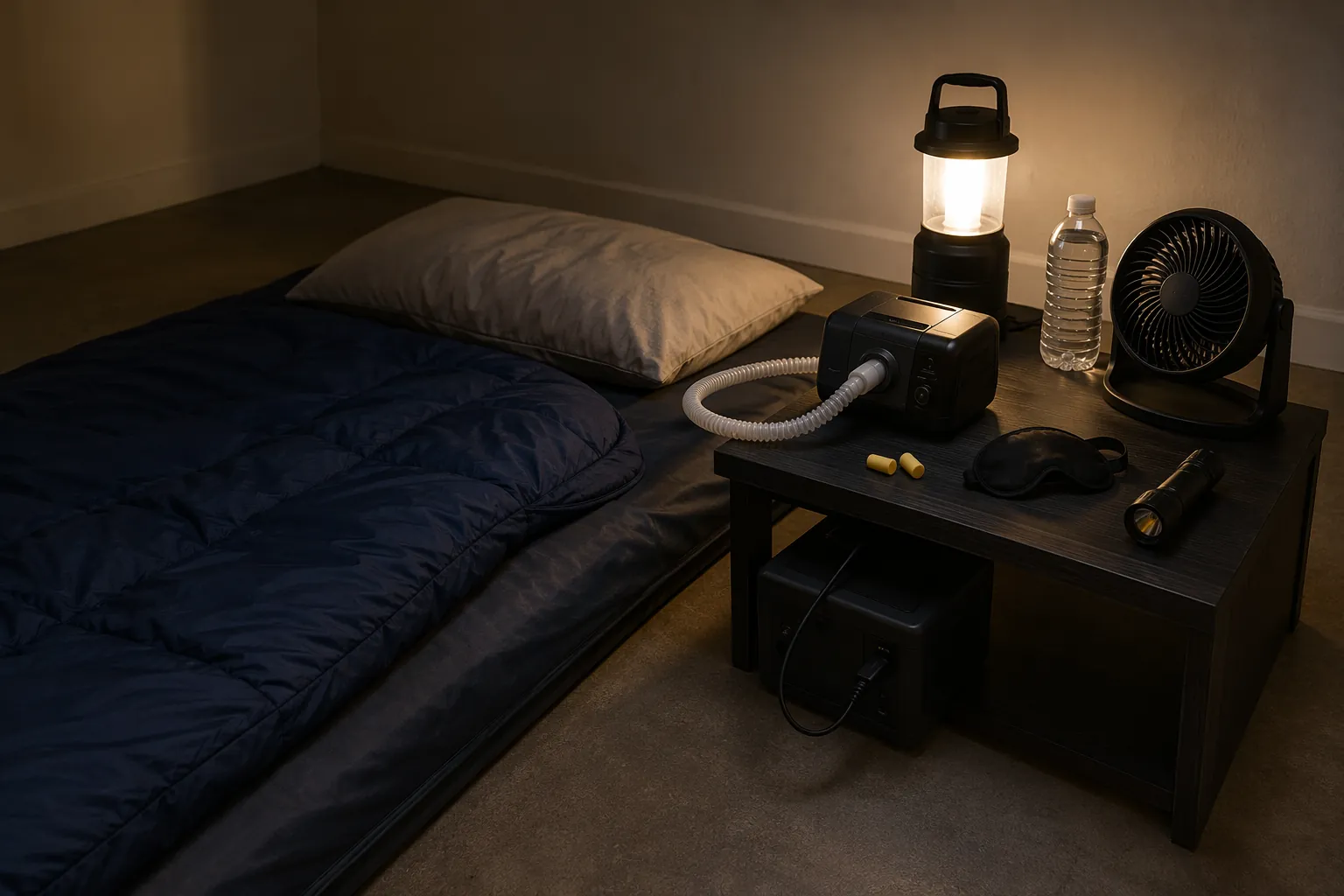
- Put the mattress, air mattress, or bedding where people will actually sleep if windows become unsafe.
- Place shoes, glasses, medications, flashlight, water, and phone chargers within reach, not across the house.
- Set out earplugs and eye masks before hands are wet, rooms are dark, or children are already upset.
- Charge battery packs, rechargeable fans, radios, medical-device batteries, and any backup lighting.
- Decide who is responsible for weather alerts, pets, older relatives, and children if everyone is woken up suddenly.
That last item matters because anxiety feeds on unfinished loops. “Where will we sleep if the hallway is safest?” is not a question you want to answer at 11:40 p.m. while somebody is still watching radar with the volume up.
Put Storm Updates on a Bedtime Diet
Before landfall, the main sleep problem is often not noise. It is arousal: checking the cone, refreshing radar, watching live shots from beaches, reading comment threads, and trying to sleep with the nervous system still acting as if it is on watch.
Baylor College of Medicine advises limiting news exposure at least 30 minutes before bed and notes that reading updates can be less activating than watching video coverage when anxiety is high.[2] That is not the same as ignoring the storm. It means choosing a lower-arousal way to stay informed.
- Set one final pre-bed check time, then switch from live video to text alerts or official written updates.
- Keep emergency alerts on, but stop watching repeated footage that adds alarm without adding decisions.
- Write the next action on paper: “If warning changes, move to hallway,” or “If power fails, use charged fan first.”
- Put one adult in charge of the final check so the whole house is not independently refreshing the same map.
If storm anxiety is the part that keeps catching you, the same monitor-without-escalating idea shows up in other disaster contexts too. The site’s wildfire anxiety sleep guide is useful for the mechanism: the body may be responding to uncertainty, not only to the hazard itself.
The Night Before Landfall: Lower the Load, Not the Standards
The night before landfall is when “just keep your normal bedtime” starts to sound ridiculous. A normal bedtime may not be available. What is available is a lower-load bedtime: fewer open decisions, less bright media, less wandering around the house, and fewer reasons to get back up.
This is the time to move from preparation mode to sheltering mode. Put phones on chargers. Confirm that alerts can wake the responsible adult. Move children’s comfort items into the safe sleep area. If someone uses medication at night, put it in the room where that person will sleep. If the safest room is not comfortable, safety wins.
People with more specific sleep vulnerabilities may need a modified version of the same plan. The site has separate tropical-storm sleep guidance for perimenopause and for pregnancy, perimenopause, and ADHD. The basic hurricane plan still applies, but temperature sensitivity, sensory overload, medication timing, bathroom access, and alert fatigue may need more attention.
CPAP and Medical Devices Need Conservative Math
If you use CPAP, oxygen equipment, refrigerated medication, or another sleep-related medical device, do not treat battery planning as a bedtime detail. It belongs in the 48-hour window, while stores may still be open and the device can still be tested.
CPAP.com, an e-commerce source rather than an independent clinical authority, states that a 100 Wh battery may provide about 8 to 10 hours of CPAP use with the humidifier off, while 160+ Wh batteries may provide roughly 14 to 40 hours depending on pressure and setup.[3] Treat those numbers as planning estimates, not guarantees. Actual runtime depends on machine model, pressure, humidification, heated tubing, battery age, and whether other devices are drawing power.
- Turn off heated humidification if your clinician or device instructions allow it and battery life matters more than comfort.
- Test the battery with your actual machine before the storm, not just with the manufacturer’s estimate.
- Keep distilled water, mask parts, extension cords, and backup power in the same staged area.
- If power loss would create a medical emergency, plan evacuation or generator support before landfall.
During the Active Storm: Sleep Where Safety Already Is
Once conditions deteriorate, the sleep goal changes again. The question is no longer “How do I relax enough for bed?” It is “Where can I rest without creating a new safety problem?” That usually means an interior room, hallway, closet, or lowest-floor space away from windows, depending on the home and the local threat.
This is where some sleep advice gets too polished. Wind, rain, pressure changes, alerts, pets, and children may break the night into pieces. Amerisleep’s hurricane sleep guidance suggests treating 3 to 5 hours of broken sleep as a realistic expectation and rotating sleep between adults so one person remains alert during the active storm.[4] That should be read as expert consensus guidance, not as a published hurricane sleep trial.
A rotation does not have to be elaborate. One adult sleeps from the first safe window until a set time, then takes over while the other rests. If there is only one adult, the equivalent is not staying awake all night on principle; it is setting alerts, keeping shoes and a flashlight reachable, and resting whenever conditions allow.
- Use earplugs only if they do not prevent you from hearing emergency alerts, a child, a medical-device alarm, or a person who needs help.
- Keep one phone charged and audible for official alerts; silence nonessential notifications.
- Sleep with shoes nearby in case broken glass, water intrusion, or debris becomes an issue.
- Do not move back to a more comfortable room near windows just because the first lull feels quiet.
Noise reduction has limits. Some commercial sleep guidance gives estimated decibel reductions for earplugs, but precise protection depends on product rating, fit, and whether they are inserted correctly.[4] For hurricane sleep, the practical point is simpler: reduce noise enough to stop startling awake every few minutes, but not so much that the person responsible for safety becomes unreachable.
When the Power Is Out: Heat Becomes the Sleep Problem
After the worst weather passes, many houses get harder to sleep in, not easier. The air goes still. Humidity sits in the rooms. Refrigerators are closed, fans are rationed, and everyone is tired enough to argue over nothing.
HealthPartners recommends several power-outage cooling tactics that matter directly for sleep: create cross-ventilation when it is safe to open windows, sleep on the lowest floor, and use damp cloths on pulse points to cool the body.[5] The lowest-floor advice is especially practical in hot homes because upper rooms often hold more heat.
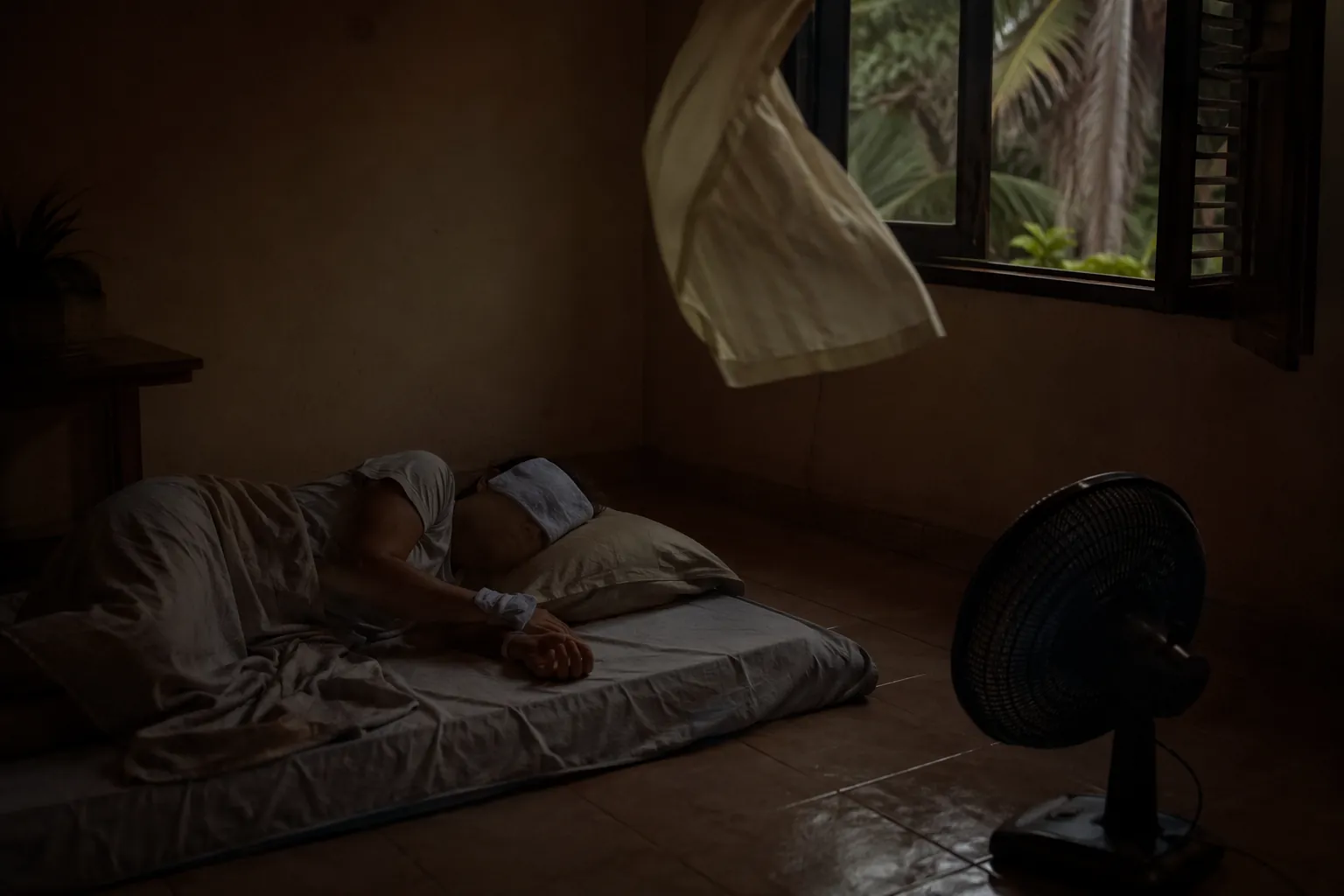
- Move sleep to the lowest safe level of the home, especially if bedrooms upstairs are holding heat.
- Open windows only if outdoor conditions, security, debris, rain, and local safety guidance make that reasonable.
- Place a battery fan to move air across the body rather than trying to cool the whole room.
- Use a damp cloth on the neck, wrists, or forehead, and re-wet it as it warms.
- Sleep in lightweight, breathable clothing and use the least bedding needed for comfort.
Do not spend all the battery power on the first uncomfortable night if the outage may last. A small fan aimed well can be more useful than a large fan placed across the room. If someone is elderly, pregnant, medically fragile, heat-sensitive, or using a device that depends on power, comfort has already become a safety issue.
For a deeper heat-specific plan, use the site’s guides to sleeping during a power outage and power-outage sleep disruption. Hurricane outages add storm damage and access problems, but the heat-management mechanics are similar.
Evacuation and Shelter Sleep: Protect a Small Boundary
Evacuation sleep is rarely good sleep. A hotel room may be crowded. A relative’s house may have different noise, pets, light, or bedding. A public shelter may have all of that plus announcements and people moving through the night.
Sleep Health Foundation and American Sleep Apnea Association guidance for shared or disrupted sleep environments supports the basics that are actually worth packing: earplugs, eye masks, and consistent bedtime boundaries where possible.[6] The point is not to recreate home. It is to give the brain a few repeated cues that the next stretch is for rest.
- Pack earplugs, eye mask, medications, chargers, and any sleep-device supplies in the go bag, not deep in the car.
- Choose a sleep spot away from doors, bright lights, bathrooms, or high-traffic paths when there is any choice.
- Keep a short bedtime sequence for children: bathroom, water, one comfort item, one quiet activity, lights down.
- Use headphones or white noise only if they do not block shelter instructions or emergency communication.
In a shared shelter, bedtime boundaries may be social as much as physical. A calm “we’re trying to sleep now” matters. So does not becoming the person playing storm coverage out loud beside a row of cots.
After the Storm: Watch the Calendar, Not Just the Clock
The first nights after a hurricane can be strange. The danger may be lower, but the body has not received the memo. There may be chainsaws, insurance calls, boil-water notices, school closures, roof damage, missing routines, and the steady mental math of what has to be handled next.
ADAA notes that post-storm insomnia often resolves within 3 to 7 days, though recovery can take 2 to 4 weeks; insomnia that persists beyond a month can warrant professional evaluation for PTSD or another stress-related condition.[7] That timeline is useful because it keeps two mistakes in check: panicking over a few bad nights, and ignoring a sleep problem that is no longer settling.
- Keep cleanup planning out of bed; write tomorrow’s first tasks before trying to sleep.
- Return to ordinary wake time as soon as conditions allow, even if bedtime is still imperfect.
- Use daylight, meals, and brief movement to help reset the day-night signal.
- Avoid turning the bed into the command center for insurance calls, outage maps, and damage photos.
- Seek professional help if insomnia, nightmares, panic, or hypervigilance keeps going past about a month or interferes with basic functioning.
Better sleep through a hurricane does not mean normal sleep through a hurricane. It means changing the strategy as the threat changes: reduce arousal before landfall, prioritize safe positioning during the storm, manage heat during the outage, and take persistent post-storm insomnia seriously when the calendar says it is no longer just the first bad week.
References
- Hurricane Sleep Guidance, Nest Bedding.
- Sleep and News Exposure Guidance, Baylor College of Medicine.
- CPAP Battery Runtime Guidance, CPAP.com.
- Hurricane Sleep Guidance, Amerisleep.
- Power Outage Cooling Guidance, HealthPartners.
- Shelter and Sleep Hygiene Guidance, Sleep Health Foundation / American Sleep Apnea Association.
- Coping After Natural Disasters, Anxiety and Depression Association of America.
Read the full guide: How to Sleep Through Fireworks Noise for Every Life Stage