
Which meteor showers are worth wrecking your sleep for?
Last reviewed: July 31, 2026. If you are looking tonight, the practical answer is already clear: the Southern Delta Aquariids and alpha Capricornids are peaking under a 98% illuminated moon, and the American Meteor Society’s own rule is that showers peaking with the moon more than half illuminated are affected by moonlight and difficult to observe.[1] For most people with a fixed morning alarm, this is the cleanest skip of the 2026–27 run.
That is the whole point of sleep-aware meteor planning. The best meteor shower viewing tips that won’t wreck your sleep schedule do not start with the biggest advertised ZHR. They start with the moon, then with the hour the shower actually becomes useful. EarthSky’s 2026 guide is especially helpful on this second point because it separates ordinary late-night showers from timing exceptions: the Geminids can produce good activity before midnight, while the Draconids are unusual because their radiant is highest at nightfall and evening can be better than after midnight.[2]
Use ZHR as a calibration number, not a promise. It is an idealized rate under favorable conditions, and public guides do not always quote the same figure. The table keeps rates source-attributed for that reason instead of smoothing them into one supposedly exact answer.
| Shower | Peak night | Moon illumination | Source-attributed rate | Best sleep-aware viewing window | Timing note | Sleep-cost judgment |
|---|---|---|---|---|---|---|
| Southern Delta Aquariids + alpha Capricornids | Jul. 30–31, 2026[1] | 98%[1] | Not worth using as the deciding number here; the moon is the controlling fact. | Skip. If you are already awake and the sky is clear, try only a brief dark pre-dawn look away from the moon. | AMS flags showers above roughly half moon illumination as moon-affected and difficult to observe.[1] | Clearest skip |
| Perseids | Aug. 12–13, 2026[1] | 0%[1] | AMS ZHR 100[1]. Other viewer-facing expectations can be lower, so treat 100 as a calendar ZHR, not a guaranteed backyard count. | A deliberately planned late-night session, preferably with recovery time the next day. | Like many showers, the after-midnight geometry helps because your location rotates onto Earth’s forward-facing side.[3] | Worth planning for |
| Draconids | Oct. 8–9, 2026[2] | Confirm close to the date; the useful planning fact here is the evening timing. | Not a rate-driven pick in this ranking. | Evening, as soon as skies are dark enough. | The Draconids are the rare major shower where more meteors may fly in the evening hours than after midnight because the radiant is highest at nightfall.[2] | Best zero-sleep-cost chance |
| Geminids | Dec. 13–14, 2026[1][2] | 21%[1] | AMS ZHR 150[1]; EarthSky gives about 120[2]. | Start in the mid-to-late evening and continue only as late as your next morning can tolerate. | EarthSky notes the radiant rises in mid-evening, the waxing crescent will not interfere, and the Geminids are the one major shower with good activity before midnight.[2] | Worth planning for, with softer sleep cost than most high-rate showers |
| Quadrantids | Jan. 3–4, 2027[1] | 13%[1] | AMS ZHR 120[1]. | Only if the predicted maximum lines up with a viewing window you can actually hit. | AMS describes a sharp maximum of about 6 hours.[1] | High-rate gamble; unforgiving if you miss the window |
The two-step filter: moon first, then your alarm
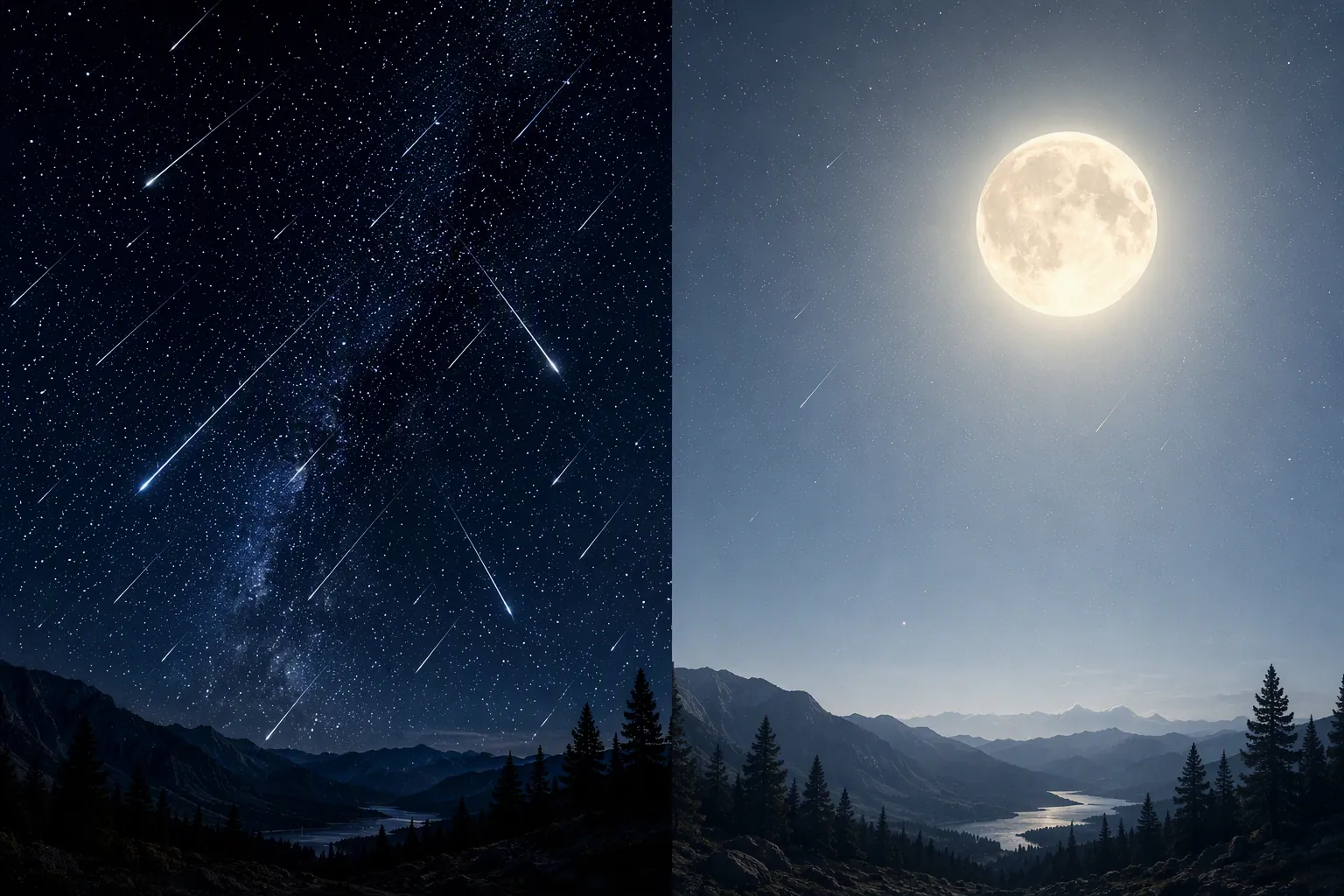
The first cut is blunt on purpose: if the moon is more than roughly half illuminated at the peak, downgrade the shower before you think about rates. A bright moon does not make meteors impossible, but it erases the faint ones first, and faint meteors are what fill out an hour. Spending sleep on a moon-washed peak is how a person ends up cold, tired, and underwhelmed at the same time.
That is why July 31 is such a useful worked example. The sky calendar says “peak.” The sleep calendar says “98% moon.” If you have work, caregiving, school drop-off, medication timing, or a body that does not bounce back from a broken night, the better plan is to keep the night intact. If you still want to make a token attempt, make it short, dark, and pre-dawn rather than turning the whole night into a vigil.
The second cut is the hour the shower becomes useful. NRAO’s explanation is the simple physics behind many late meteor nights: between midnight and dawn, your observing site is on the forward-facing side of Earth as the planet moves through space, so it runs into more meteoroids.[3] That is excellent for meteor counts and inconvenient for people whose alarm is not negotiable.
So the planning question is not “Can I stay up?” It is “What does this cost tomorrow, and how many recovery nights can I afford?” For a hypothetical person with an early fixed alarm, a shower that only becomes good after midnight may cost part of the night before, the morning after, and sometimes the following evening’s bedtime. A shower that starts producing before midnight costs less because it lets the person choose a real end time instead of drifting into accidental sleep debt.
Perseids and Geminids are the planned late-night choices
The Perseids earn their place in 2026 because the peak falls under a 0% moon.[1] That is the kind of condition worth building a real plan around: nap if that works for you, set a hard viewing window, decide in advance who is driving, and protect the following night. Space.com’s 2026 Perseid guide says rates begin increasing from about 11 p.m. local time, which is late enough to matter but not so late that the only reasonable strategy is an all-night watch.[4]
For a deeper Perseid-specific plan, use the site’s Perseid sleep guide rather than trying to solve the whole night from this table. If your best window depends on whether you are a morning type or an evening type, the chronotype-based Perseid timing guide and the minute-by-minute Perseid schedule are better tools.
The Geminids may be the kinder high-value shower for many sleepers. The moon is only 21% illuminated, and EarthSky notes that the radiant rises in mid-evening and that the shower can be watched all night on Dec. 13–14 under a waxing crescent that will not interfere.[2] AMS gives the Geminids a ZHR of 150, while EarthSky gives about 120, which is exactly the sort of difference that should keep expectations humble.[1][2] The practical point is that both sources still make the Geminids a strong target, and the timing lets you see something before the most sleep-hostile part of the night.
The Draconids are the evening exception
The Draconids are the shower to keep on the calendar even if you are unwilling to pay for a late night. Their advantage is not a giant rate number in this comparison. Their advantage is timing. Because the radiant is highest at nightfall, the evening hours can be better than the post-midnight hours.[2]
That changes the household logistics. You can step outside after dinner, give your eyes time to settle, watch for a defined stretch, and still keep a normal bedtime if clouds or light pollution make the effort unrewarding. It is the rare meteor-shower plan where a strict sleep schedule is not an obstacle.
The Quadrantids are high-rate, but not forgiving
The Quadrantids look tempting on paper: Jan. 3–4, 2027, a 13% moon, and an AMS ZHR of 120.[1] The catch is the maximum. AMS describes it as sharp, lasting about 6 hours.[1] If that window lines up with your dark sky, clear weather, and a tolerable wake-up time, the shower can be worth a targeted alarm. If it misses your window, staying half-awake for hours is a poor trade.
This is the one to treat like an appointment, not a mood. Check the updated maximum close to the date, decide whether you can hit it, and either go outside for that window or let it pass. The mistake is trying to compensate for uncertainty by sacrificing the whole night.
Make the chosen session count
Once you have chosen a night, the small viewing habits matter more because you are spending a limited sleep budget. Get away from direct lights, give yourself a real dark-adaptation runway, and stop checking a bright phone every few minutes. The National Park Service explains that rhodopsin-based dark adaptation takes roughly 20–40 minutes and that red light helps preserve night vision.[5]
- Choose the darkest practical location you can reach without making the next morning unsafe or chaotic.
- Arrive before the useful window, not at the end of it, so your eyes are ready when rates improve.
- Use a red light or dimmed red setting for necessities, and avoid scrolling.
- Set an end time before you go outside. A planned late night is very different from accidentally losing half a night.
If your sleep is fragile, spend fewer nights
This ranking is a planning tool built from public astronomy data. It is not a medical claim about pregnancy, perimenopause, ADHD, older adulthood, medications, caregiving, or any other reason a broken night may hit harder. If you already know that one late night turns into several rough days, the sleep-aware answer is to be more selective, not more heroic.
For the nights you do choose, plan the recovery instead of improvising it. The site’s guides to sleep-debt recovery nights, next-day recovery after sky events, chronotype self-assessment, and sleep regularity are better places to work through that part.
For the 2026–27 season, the practical judgment is simple: skip the moon-washed July peaks without guilt, plan deliberately for the Perseids and Geminids if you can recover, take the Draconids from the evening if skies cooperate, and treat the Quadrantids as optional unless you can hit the narrow maximum.
References
- Meteor Shower Calendar — American Meteor Society
- EarthSky’s meteor shower guide — EarthSky
- Why are the best times to observe meteors between midnight and dawn? — National Radio Astronomy Observatory
- Perseid meteor shower 2026 guide — Space.com
- Dark Adaptation of the Human Eye and the Value of Red Flashlights — National Park Service
Read the full guide: Which Meteor Shower Won't Ruin Your Sleep?