Which Meteor Shower Won't Ruin Your Sleep?
It is July 31, 2026, which means the Perseids are close enough to feel tempting and close enough for the usual advice to start appearing: go out after midnight, stay under dark skies, wait patiently. That can be wonderful advice for a stable sleeper. It is less wonderful if pregnancy, perimenopause, ADHD, older age, insomnia, untreated sleep apnea, or medication changes have already made sleep expensive.
The fastest answer to how to watch a meteor shower without ruining your sleep is to choose the shower whose timing does the least damage. In 2026, that points first to the Draconids, then to the Geminids if you can tolerate a later evening, and only then to the Perseids if you are stable enough to treat the night as a planned sleep disruption.
| 2026 shower | Best sleep-compatible viewing window | What the sky offers | Sleep cost | Best fit for fragile sleepers |
|---|---|---|---|---|
| Draconids, Oct. 8–9 | Dusk and early evening; the radiant is highest around nightfall [1] | Usually a quieter shower, but unusually friendly to bedtime because it does not require waiting for the early morning hours | Lowest | Pregnancy, perimenopause, ADHD, older adults, and anyone currently guarding a fragile sleep schedule |
| Geminids, Dec. 13–14 | Late evening into before midnight; AMS calls the Geminids “the one major shower that provides good activity prior to midnight” [1] | One of the strongest annual showers, with meaningful activity before the worst circadian timing | Moderate | People who can handle a planned late evening but should not be outside at 2 or 3 a.m. |
| Perseids, Aug. 12–13 peak | Best after midnight; 2026 has a new moon on Aug. 12 and expected ZHR above 100 under ideal dark skies [1][2][3] | Beautiful, famous, and unusually well-timed for moonlight this year | Highest | Only for sleepers stable enough to absorb a late night and recover deliberately |
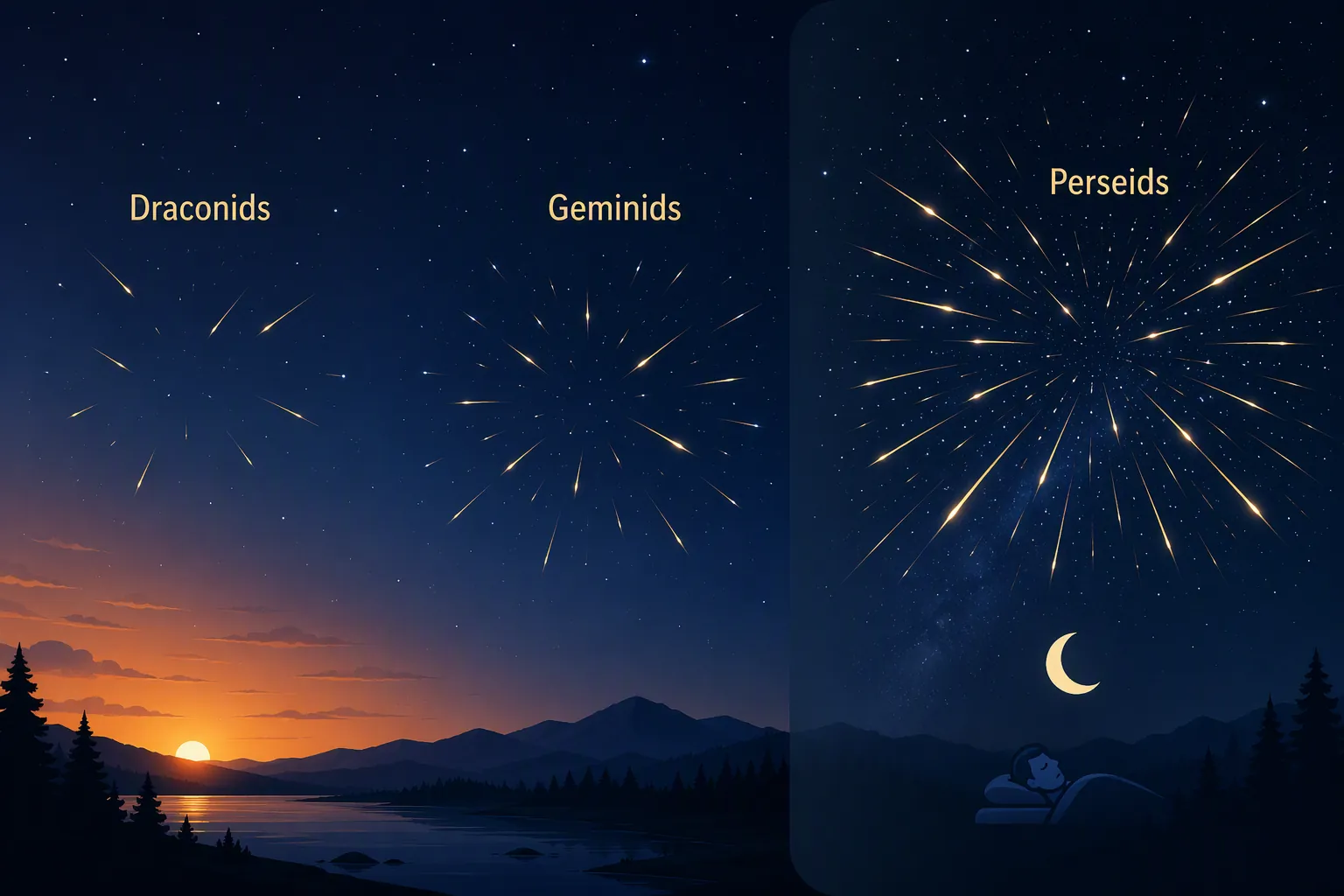
The Perseids win on drama this year. A new moon is exactly what meteor watchers want, and a ZHR above 100 is not a number to shrug off. But ZHR is a sky metric, not a nervous-system metric. It describes an idealized meteor rate under excellent conditions, not what happens to a pregnant person who finally fell asleep at 11 p.m. and then wakes every hour after a 2 a.m. viewing trip.
Why “best viewing” so often lands at the worst sleep hour
Meteor-shower advice is not randomly obsessed with the hours after midnight. As Earth rotates, your location turns onto the forward-facing side of Earth’s motion through space. After local midnight, you are more like the windshield than the rear window, meeting more incoming meteoroids head-on. That is why major showers often improve in the second half of the night [1][2][3].
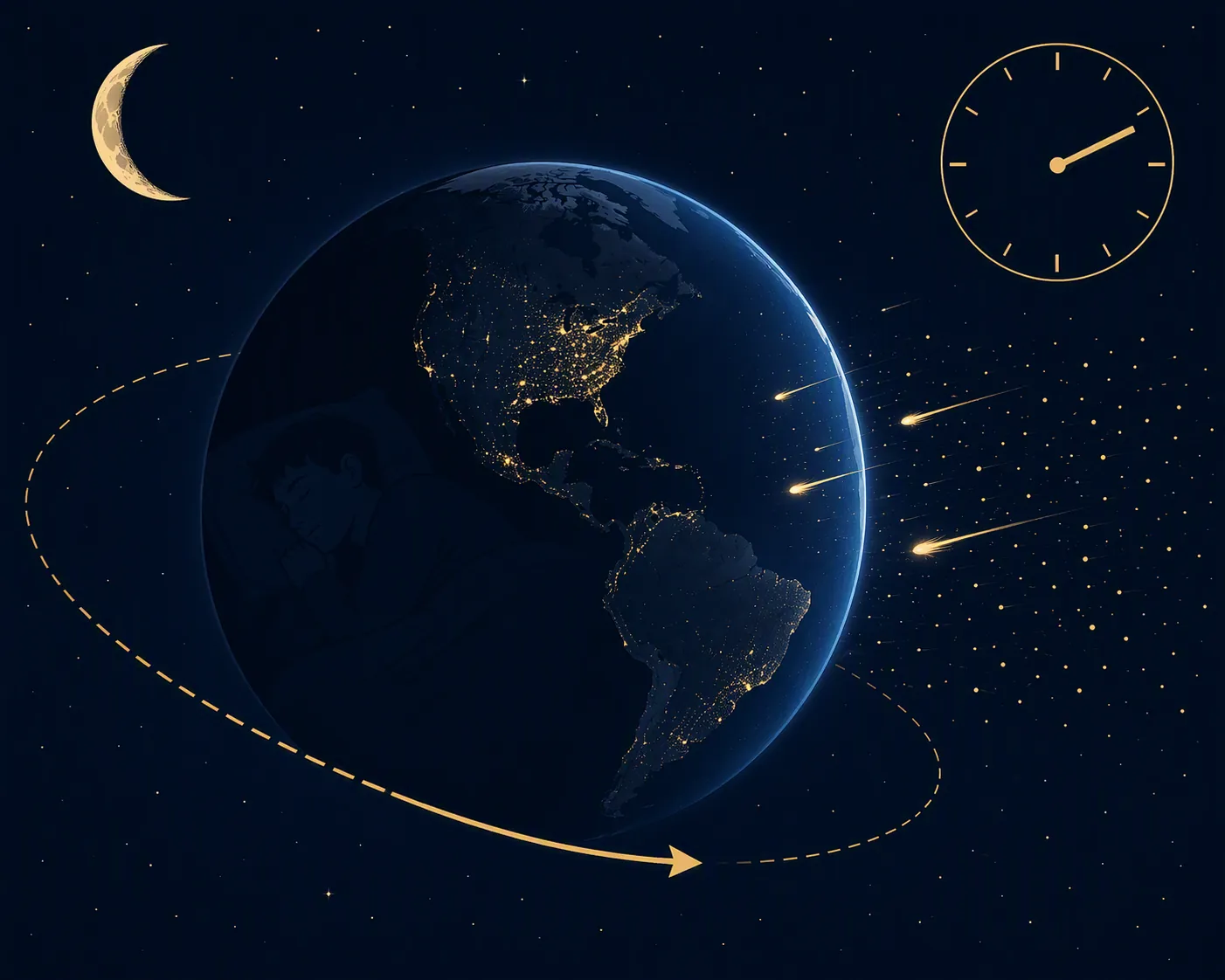
The problem is that the same window overlaps the part of the night many fragile sleepers can least afford to disturb. The 1–5 a.m. stretch is not merely “late.” It is when body temperature, alerting signals, sleep pressure, medication timing, bathroom trips, hot flashes, pain, and fall risk can collide. For a healthy sleeper, a 2 a.m. meteor watch may be a novelty. For someone already fighting fragmented sleep, it can become the event that turns one bad night into several.
This is why the Draconids matter more than their usual meteor count suggests. They are not the grandest shower on the calendar. They are the rare shower whose best timing does not ask you to borrow from the biological middle of the night.
Match the shower to the sleep system you actually have
The sources cited here do not study pregnant viewers, perimenopausal viewers, ADHD adults, or older adults as meteor-watching groups. The population guidance below is a sleep-medicine synthesis: take the known timing of the showers, then overlay the sleep vulnerabilities Restful Ground already tracks across life stage and neurotype. That makes the conclusion narrower, but more useful.
Pregnancy: do not casually add a late-night stressor
Pregnancy sleep can already be chopped up by bathroom trips, reflux, hip pain, leg discomfort, fetal movement, anxiety, and the simple problem of finding a position that works. In the third trimester especially, a late-night excursion is rarely just “one hour outside.” It can mean getting dressed, driving, walking on uneven ground, cooling down, warming back up, re-settling, and then discovering that the sleep window has closed.
For pregnancy, the Draconids are the cleanest choice because the outing can happen before the body has committed to the main sleep episode. Step outside after dinner, keep it close to home, and leave while the evening still feels like evening. The Geminids can be reasonable if symptoms are mild and the plan ends before midnight. The Perseids are the costly option: their best sky window arrives exactly when many pregnant sleepers are trying to protect the few deeper stretches they still get.
If pregnancy sleep is already strained, it is better to use a dusk-friendly shower than to rely on recovery heroics afterward. For deeper pregnancy-specific help, Restful Ground’s guides to safe pregnancy insomnia remedies and pregnancy sleep problems are the better place for symptom-level planning.
Perimenopause: the early morning is already crowded
Perimenopause is where the cheerful “just stay up late and nap tomorrow” advice starts to sound especially thin. Many readers are not protecting a perfect night; they are protecting the part of the night not already taken by hot flashes, temperature swings, early waking, anxiety spikes, or a 4 a.m. mind that begins working before anyone asked it to.
The Perseids’ after-midnight strength collides with that pattern. A 1–3 a.m. viewing window may mean entering the exact zone where a hot flash or early waking would have fractured sleep anyway, then adding cold air, movement, anticipation, and the pressure to “make it worth it.” The sky may be generous; the nervous system may not be.
Choose the Draconids first. If you want a brighter major shower and your symptoms are currently manageable, choose the Geminids with a hard stop before midnight. If you choose the Perseids, do it on purpose: no pretending it is a normal night, no scheduling a demanding morning, and no using the event as proof that your sleep should be more flexible than it is.
For heat, night sweats, and moonlit-weather overlap, the related perimenopause guides on Buck Moon night sweats and sleeping through heat without air conditioning are more useful than generic meteor tips.
ADHD: plan for timing drift and hyperfocus, not “discipline”
For ADHD adults, the risk is not a character flaw. It is timing. ADHD often travels with delayed sleep timing, inconsistent bedtime cues, reward-seeking attention, and the kind of hyperfocus that can turn “I’ll look for one hour” into checking radiant maps, camera settings, meteor counts, cloud cover, and forums until 3 a.m.
The Draconids work because they start before the night has a chance to slide. Go out early, keep the viewing site simple, and decide the endpoint before you see your first meteor. The Geminids are the tempting middle ground: strong enough to feel worthwhile before midnight, but late enough that you need an external stop. Use another person, a ride home, a calendar alarm with a named consequence, or a pre-packed “leave now” routine. Do not make the exit depend on willpower in a dark field under an interesting sky.
The Perseids are the highest-risk choice for ADHD sleep because their best timing rewards the exact extension loop that many ADHD adults are trying to avoid. If you go, the plan needs to be boringly specific: arrive, watch, leave. No camera experimentation unless that was the whole plan. No “one more peak minute” after the agreed stop. For more on ADHD sleep cueing and sensory loops, see Restful Ground’s ADHD sleep coverage beginning with ADHD sleep routines and nighttime hyperfocus.
Older adults: an early waking can help, but darkness changes the equation
Older adults deserve a more careful answer than “never go out late.” Some older sleepers naturally wake earlier, and for them a pre-dawn Perseid look may line up better than it would for a younger night owl who has to tear themselves out of deep sleep. If someone already wakes at 4:30 a.m., a short, safe, nearby viewing session may be less disruptive than staying up until 1 a.m.
The limiting factor is not only sleep timing. It is footing, visibility, temperature, medication effects, balance, bathroom urgency, and the drive home. Dark-sky viewing often means uneven ground, low light, and fewer visual anchors. A meteor is not worth a fall.
For older adults, the safest hierarchy is Draconids at dusk, Geminids from a familiar location before midnight, then Perseids only if the viewing spot is close, flat, well known, and does not require a sleepy drive. A porch, driveway, accessible park path, or window with a limited view may be the better version of the event than a perfect dark-sky site.
If you still choose the Perseids, make it a planned disruption
The 2026 Perseids are not a bad choice because they are late. They are a bad default for fragile sleep because they are late and unusually attractive this year. The new moon makes the invitation stronger. That is exactly why the sleep plan has to be stricter.
- Decide before sunset whether this is a viewing night. Do not make the decision at 11:45 p.m. when novelty is doing the thinking.
- If naps are safe and useful for you, keep the nap early and intentional. Mayo Clinic’s general adult napping guidance favors short naps and avoiding naps after 3 p.m.; for a late-night event, some sleepers may instead use a full-cycle nap earlier in the day, but not so late that it steals bedtime pressure [4].
- Protect the morning after. Get outdoor light soon after waking, keep meals and movement on a normal rhythm, and avoid turning the recovery day into a second schedule experiment. Natural light-dark exposure is one of the strongest time cues for the circadian system [5].
- Return to your usual bedtime the next night. A single late night can leave REM pressure and sleepiness feeling uneven afterward; REM rebound is a recognized response after REM loss or sleep deprivation [6].
- Expect one night, possibly two, to feel imperfect. That is not a reason to panic. It is a reason not to stack the meteor shower on top of travel, alcohol, heavy work deadlines, or another late night.
Dark-sky viewing is also not the same biological problem as sitting under bright indoor light for hours. A quiet field under a dark sky is generally dim, and that is better than scrolling under bright light while waiting to leave. Still, the sleep cost of the Perseids is mainly timing, arousal, travel, cold or heat, and the broken middle of the night. Darkness does not make a 2 a.m. outing sleep-neutral.
Keep the meteor-watching logistics small
Blankets, dark skies, a reclining chair, a red flashlight, and looking away from the radiant all matter, but they are not the center of this decision. Restful Ground already has general meteor-shower sleep guides for the 2026 Perseid sleep schedule, Perseid meteor-shower sleep tips, and best Perseid viewing time by sleep type. Use those if you need the full field checklist.
For fragile sleepers, the more important logistics are smaller and less romantic: choose the closest safe viewing spot, set the leave time before you arrive, avoid caffeine as a “sky-watching aid,” keep the route home simple, and do not bring extra gear that invites tinkering. The best plan is the one that reduces decisions when you are cold, sleepy, excited, or disappointed by clouds.
The sleep-compatible choice
If you are pregnant, perimenopausal, ADHD, older, or otherwise sleeping on a narrow margin, the Draconids are the cleanest no-compromise 2026 choice. They may not give you the most meteors, but they ask the least from the sleep system you actually have.
The Geminids are the reasonable second choice: stronger, still meaningfully active before midnight, and easier to contain than the Perseids. They are not bedtime-neutral, but they are not built around the deepest part of the night.
The Perseids are worth considering this year only if your sleep is currently stable enough to absorb a planned late night. That means you know how you usually recover, you can protect the next morning, and you are not already in a bad stretch.
If sleep is clinically impaired right now, if sleep apnea is untreated, if medications are changing, if pregnancy symptoms are escalating, if night sweats are already wrecking the early morning, or if insomnia has been running hot, skipping this year is not failure. It is the sleep-compatible choice.
References
- Meteor Shower Calendar — American Meteor Society.
- Everything you need to know: Perseid meteor shower — EarthSky.
- Perseid meteor shower guide: When and where to see it — Royal Museums Greenwich.
- Napping: Do's and don'ts for healthy adults — Mayo Clinic.
- Entrainment of the Human Circadian Clock to the Natural Light-Dark Cycle — Current Biology, 2013.
- REM Rebound — Sleep Foundation.
Read the full guide: Which meteor showers are worth wrecking your sleep for?