How Do I Prepare My Bedroom for a Severe Thunderstorm Tonight?
If a severe thunderstorm is forecast for tonight and you want to sleep better, start with timing, not a loose checklist. The useful order is simple: cool and dry the room first, stage the power-outage and safety pieces before your brain starts scanning for problems, then make the last half hour boring enough that thunder is not the only thing your nervous system can track.
If an official alert tells you to move to a safer part of the home, do that before any sleep optimization. A bedroom setup is only helpful after the basic shelter decision is settled.
| When | Main job | What to do |
|---|---|---|
| About 2 hours before bed | Temperature and humidity | Pre-cool the room, lower humidity if you can, decide whether windows will stay closed. |
| About 1 hour before bed | Light, sound, and power readiness | Draw curtains, choose a sound source, charge the phone, stage flashlight and water where you can see them. |
| About 30 minutes before bed | Anxiety and sensory settling | Stop radar checking, set one final alert source, switch to a low-demand routine. |
| Lights-out | Final sleep-protective choices | Keep the room cool, dark, and navigable; use sound masking cautiously; do not restart the weather loop. |
T-2 Hours: Cool and Dry the Room Before the Storm Arrives
The first bedroom task is not candles, music, or a meditation app. It is heat. Your body normally needs to shed heat as sleep approaches, and storm nights often work against that: humid air, closed windows, a warmer upstairs bedroom, or a power outage risk that makes you hesitate to run the cooling system early.
A thermal-environment review by Okamoto-Mizuno and Mizuno found that humid heat can reduce slow-wave sleep and REM sleep, two stages you do not want fragmented when thunder is already adding interruptions. [1] That is why pre-cooling is not just comfort. It reduces one disruption pathway before noise and lightning enter the picture.
- Set the bedroom around 65-67°F if that is safe and realistic for your household.
- Run a dehumidifier early if the room feels damp or sticky, especially in a basement or poorly ventilated bedroom.
- If you expect to close windows once rain and wind pick up, close them before bed and cool the room now instead of waiting.
- Choose bedding you can adjust quickly: a light blanket within reach is better than one heavy cover you will keep fighting all night.
- If you do not have air conditioning, cool your body directly with a lukewarm shower, breathable sleepwear, and a fan placed safely away from open windows.
For the physiology behind this step, see how humidity affects sleep through your body's cooling system. If the storm is arriving during a heat advisory or the power may fail, pair this plan with effective sleep tips for an excessive heat warning or cool-body sleep strategies without AC.
The practical test is whether you can get into bed without immediately negotiating with the room: too hot, too damp, too much blanket, fan in the wrong place, window still open. Storm sleep is easier when the body is not already fighting the bedroom.
T-1 Hour: Block Flashes, Choose Sound, and Put the Emergency Items in Sight
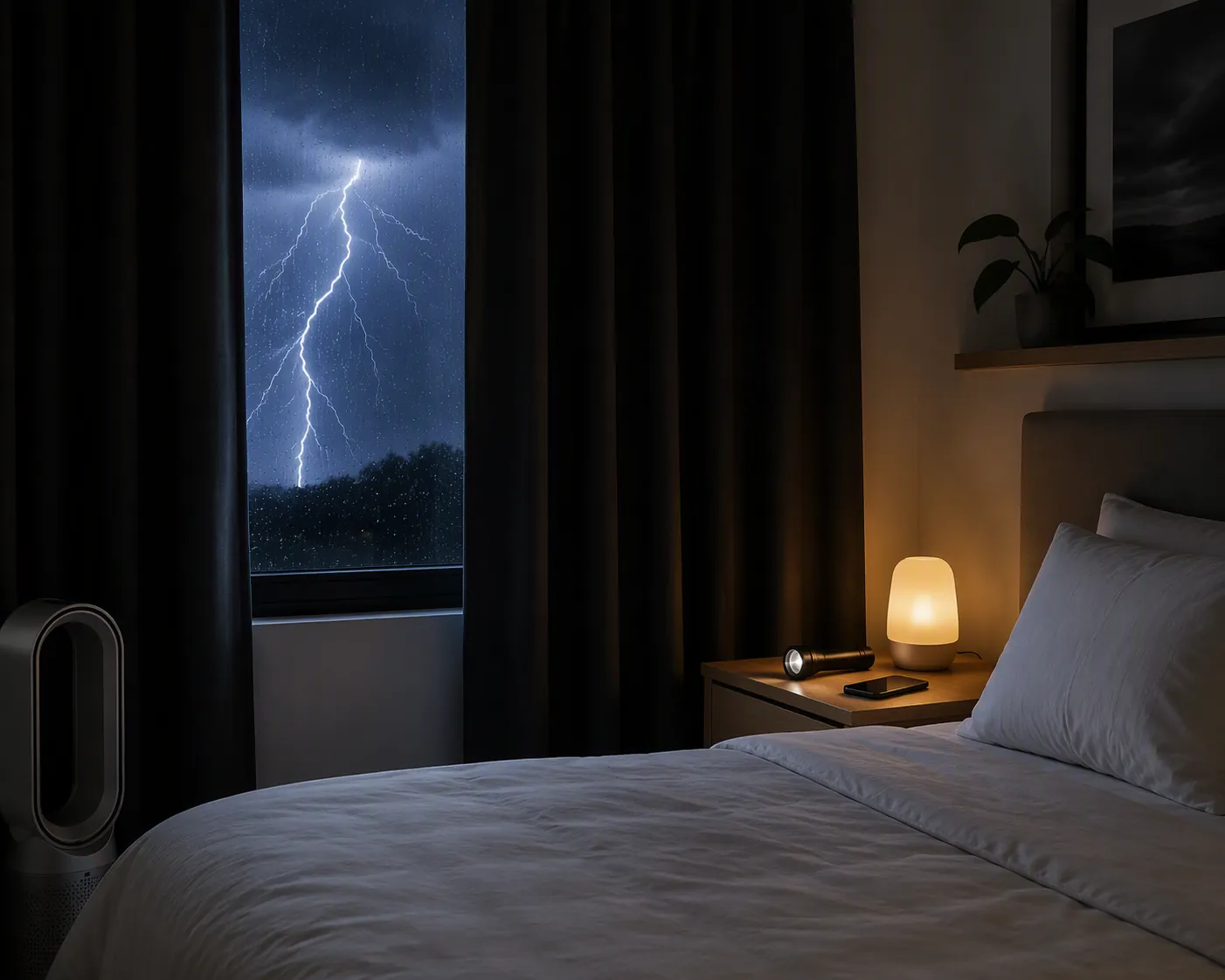
At one hour out, stop improving the whole house and make the bedroom easy to use in the dark. This is the point when a few visible objects can do more for sleep than another ten minutes of checking radar.
Control lightning before it becomes a wake-up cue
Draw blackout curtains or use the darkest window covering you have. WebMD notes that blackout curtains are used to reduce light exposure during sleep, and cites a Norwegian adult sample in which 63.3% reported using them for sleep. [2] The point tonight is not to create a perfect cave. It is to prevent every lightning flash from acting like a new signal that something is happening.
If you do not own blackout curtains, use what is available: close blinds, pull regular curtains fully across, and move reflective objects away from the window line. If air quality, wind, or rain requires closed windows, make that decision now; readers managing overlapping weather conditions can also use sleep guidance for an air quality health advisory.
Set sound masking, but do not ask it to defeat thunder
Choose one sound source now: a fan, white noise, pink noise, a steady rain track, or an app you can run without keeping the phone in your hand. Set it around conversation level. Loud enough to soften the contrast between silence and thunder is useful; loud enough to become the next irritant is not.
The evidence here deserves caution. Harvard Health describes mixed findings for white noise and notes that pink noise has shown promise in some research, including studies of older adults and deep sleep. [3] That supports a modest claim: sound masking may reduce startle by making thunder less abrupt. Do not expect it to erase severe thunder.
Make the power-outage plan visible
Put a flashlight, charged phone, charging cable or battery pack, water, and any needed nighttime medication on the nightstand or another fixed spot you can reach without crossing the room. If you use hearing aids, glasses, a cane, or a CPAP setup, place the related items deliberately instead of assuming you will remember where they are in the dark.
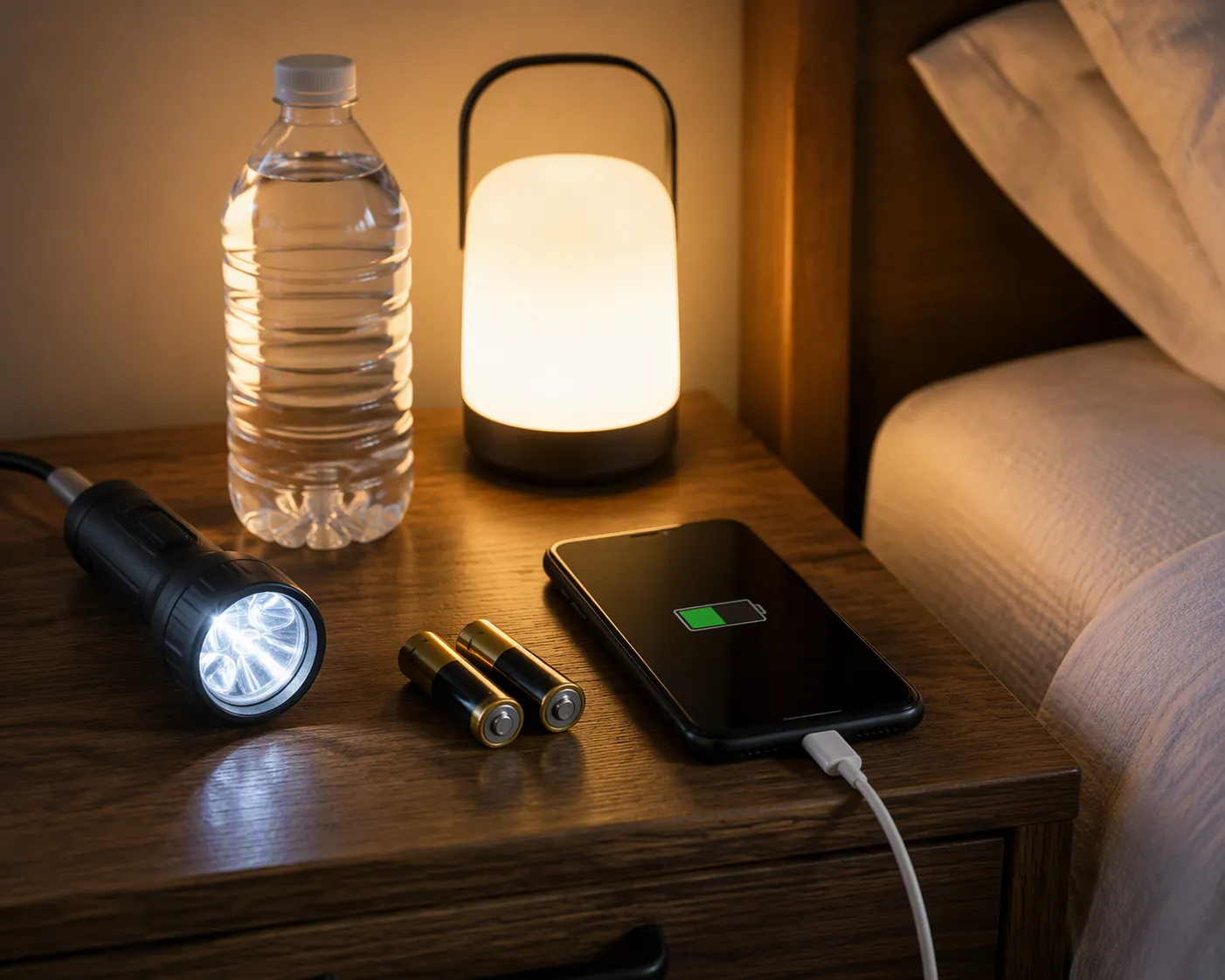
This is not a claim that a visible kit has been proven in a sleep lab to reduce storm wakefulness. It is a practical application of storm-anxiety guidance. The National Weather Service says advance preparation can put people in control and make storms less scary, while the Anxiety and Depression Association of America recommends reducing uncertainty through planning and limiting repeated weather checking. [4][5] For sleep, that matters because the mind often stays awake to keep solving unfinished safety questions.
T-30 Minutes: End the Weather Loop Before Bed
Half an hour before bed is when storm preparation should narrow, not expand. You do not need five more sources of information. You need one alert source, one plan for where you will go if conditions change, and one low-stimulation routine that does not keep putting your nervous system back on duty.
- Check the forecast or warning one final time, then close the radar unless conditions require active monitoring.
- Confirm that emergency alerts are enabled and loud enough to wake you.
- Tell yourself the next action in plain terms: "If I hear an alert, I go to the hallway" or "If power goes out, the flashlight is on the nightstand."
- Dim screens or put the phone face down where you can reach it without scrolling.
- Use a routine with a clear ending: brush teeth, bathroom, medication if prescribed, water, bed.
This step is especially important because storm fear is not rare enough to dismiss as overreaction. Cleveland Clinic estimates that about 8% of people have astraphobia, an intense fear of thunder and lightning. [6] Many more people fall short of a phobia diagnosis but still become alert, irritable, or unable to stop checking weather updates once the house gets loud.
For ADHD adults, the cue needs to be explicit rather than atmospheric. Set a named alarm for "final radar check" and another for "lights out," then let the routine carry you. If sensory cues help you transition, the same principle behind using a consistent sleep signal for ADHD adults applies here: the cue works because it tells the brain what mode comes next.
A soft nightlight can also help, especially for older adults or anyone who may need to move during a power outage. Dreams.co.uk's Sleep Matters Club recommends using a nightlight during storms so the room is not completely dark if you wake. [7] Keep it low and warm rather than bright. The goal is safe orientation, not lighting the room like morning.
Lights-Out: Make the Last Decision Once
At lights-out, do not keep renegotiating the setup. The room is cool or cooling, the windows are decided, the curtains are drawn, the phone is charged, the alert source is set, the flashlight is reachable, and the sound source is already playing if you chose one. That is enough to stop preparing.
If thunder wakes you, keep the response small unless an alert requires action. Notice whether you need to adjust the blanket, take a sip of water, or use the bathroom safely with the nightlight. Avoid opening the weather app just to confirm that the storm is still a storm. That single check often becomes ten minutes of light exposure, tension, and renewed scanning.
If the sound source starts bothering you, lower it or turn it off. If the room warms after the power goes out, shift to lighter bedding and body cooling rather than lying still under heat. If lightning is still leaking around the curtains, turn your body away from the window line. These are small corrections, not a reason to restart the whole night.
Adjust the Sequence for Your Body Tonight
Perimenopause can make the thermal step harder because hot flashes may arrive even in a cooled room. Keep layers adjustable and avoid overcommitting to heavy bedding. If heat, smoke, or another summer hazard is stacking on top of the storm, summer heat and wildfire smoke sleep guidance may be more relevant than a storm-only setup.
Pregnancy raises the stakes on overheating and nighttime movement. Prioritize cooling, hydration within reason, a clear path to the bathroom, and a flashlight you can reach without bending awkwardly. Older adults should make the path from bed to door or bathroom easy to navigate before the lights go out; sound masking may help some people, but it should never cover an alert you need to hear.
If tonight's storm is also a heat event, use this as the bedroom sequence and then follow the more specific heat plan in How to Sleep During a Heat Dome? The shared principle is the same as other timed sleep protocols, including routines for night shift workers: the sequence works because it removes decisions before the tired brain has to make them.
Sleeping better tonight is not about controlling the storm. It is about reducing the room-level and mind-level triggers that make the storm restart your night over and over.
References
- Effects of thermal environment on sleep and circadian rhythm, PMC, 2012.
- What to Know About Blackout Curtains: Benefits, Uses, and More, WebMD, 2024.
- Can white noise really help you sleep better?, Harvard Health, March 2025.
- Storm Stress and Anxiety, National Weather Service.
- Severe Storms: How to Reduce Your Anxiety, Anxiety and Depression Association of America.
- Astraphobia: Diagnosis, Causes & Treatment, Cleveland Clinic.
- How To Sleep Through A Storm, Dreams.co.uk Sleep Matters Club.
Read the full guide: What to Do Tonight to Sleep Through a Severe Thunderstorm