
Sleep begins with a thermal event, not with a vague preference for pleasant air. As the body moves toward sleep, core body temperature drops by about 0.5–1°C, supported by peripheral vasodilation: warm blood moves toward the skin, heat leaves the core, and the surrounding room has to accept that heat for the process to keep working.[1]
That is the useful entry point for understanding how humidity affects sleep. Humidity is not simply whether the bedroom feels “muggy” or “dry.” It changes the physics around a sleeping body. When the air is already holding a lot of water vapor, sweat evaporates less efficiently, and evaporative cooling weakens. When the air is too dry, the airway becomes the stressed system: nasal and throat tissues can dry out, airflow can feel more resistant, and sleep becomes easier to fragment.

Temperature and humidity need to be separated before they are put back together. Temperature tells you how warm the air is. Relative humidity tells you how saturated that air is with water vapor at that temperature. A warm room with moderate humidity and a warm room with high humidity may have the same thermostat reading, but they do not give the body the same chance to shed heat.
The sleeping body has to lose heat on schedule
The thermoregulation sequence is not extra background. It is the mechanism that turns humidity from a comfort complaint into a sleep variable. In the Okamoto-Mizuno and Mizuno review, the sleep period is tied to heat loss through the skin, a decline in core body temperature, and coordination with circadian rhythm.[1] If the room interferes with that heat loss, the problem is not only that the sleeper feels uncomfortable. The body is being asked to maintain sleep while one of sleep’s normal physiological supports is being obstructed.
Peripheral vasodilation moves heat outward. Skin temperature rises as the core gives up heat. From there, the room must take the heat away through radiation, convection, conduction, and evaporation. Humidity bears down most directly on the evaporative part of that chain. Sweat can sit on the skin without doing its cooling job if the air is too saturated to accept more moisture.
This is why advice about hot bedrooms can sound correct but still be incomplete. A fan, lighter bedding, or fewer clothes may help heat leave the skin, but humid air can still blunt the evaporative cooling that those changes are trying to exploit. For the broader cooling-system foundation, see how extreme heat hijacks your body's sleep cooling system; for body-cooling tactics when air conditioning is limited, the relevant extension is cooling your body instead of only cooling the room.
High humidity blocks the cooling route
The clearest experimental signal comes from humid heat. In Okamoto-Mizuno et al.’s 1999 study, healthy young male volunteers with a mean age of 22.7 slept under controlled conditions, including humid heat exposure at 35°C and 75% relative humidity. Compared with control conditions, humid heat suppressed slow-wave sleep in both the initial and later sleep segments.[2]
That finding matters because slow-wave sleep is not a vague marker of “good rest.” It is one of the sleep stages most visibly damaged when the body is placed in an environment that resists thermal regulation. The study does not prove that every sleeper in every humid bedroom will lose the same amount of slow-wave sleep. The sample was narrow, the exposure was controlled, and the conditions were more extreme than many bedrooms. But the direction of the result fits the mechanism: humid heat makes it harder for the body to lower core temperature, and sleep architecture responds.
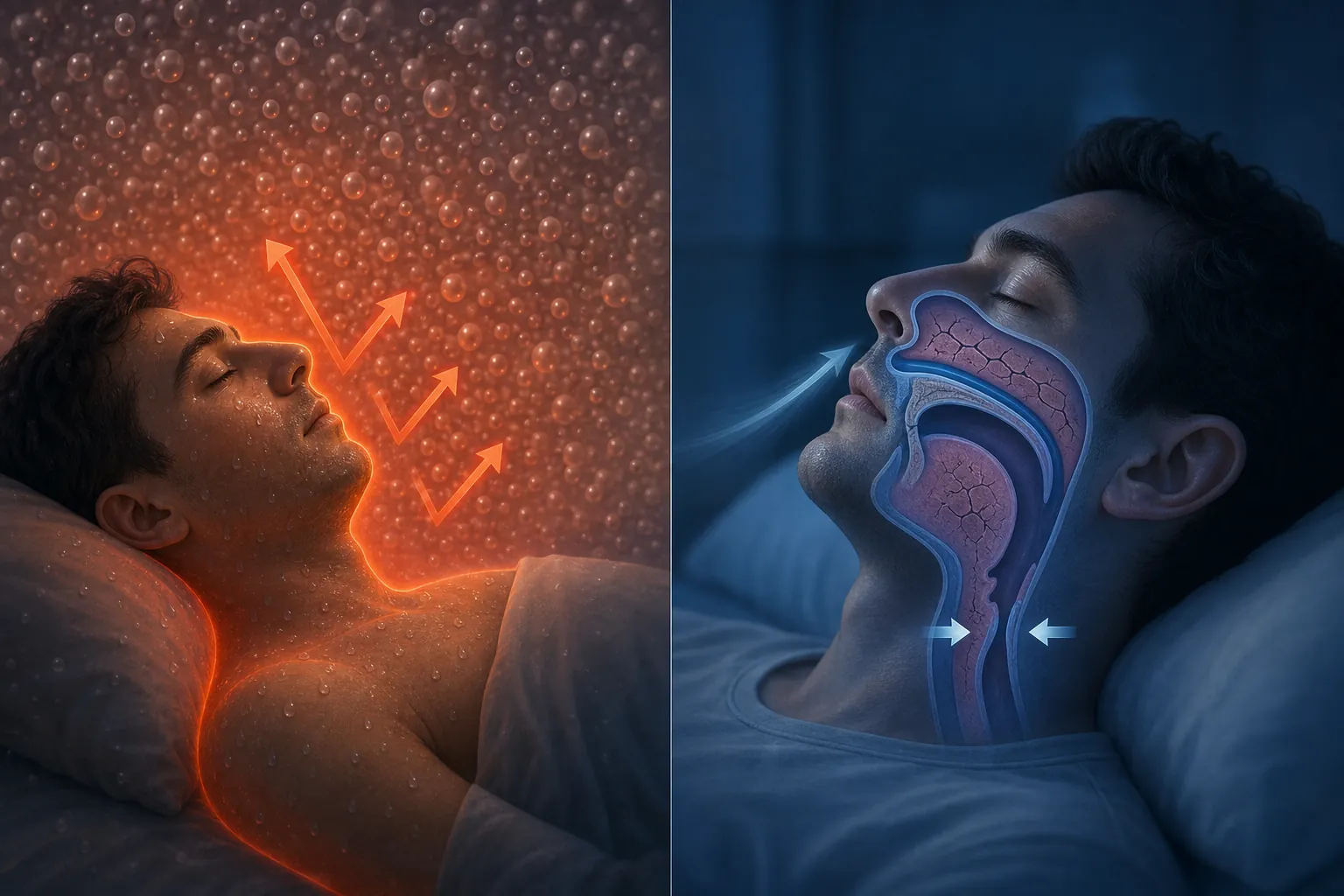
High humidity above 60% is therefore not best understood as an aesthetic defect in the room. It is a cooling bottleneck. Sweat is present, but evaporation is less effective. Skin may feel damp while heat remains difficult to unload. The sleeper can be lying still and still be doing unnecessary thermoregulatory work.
This distinction also prevents a common misreading of relative humidity. A bedroom at 60% relative humidity is not physiologically identical across temperatures. Warm, humid air is more punishing because the body is already trying to dump heat into an environment with less cooling capacity. Humidity is an independent variable, but it is rarely an isolated one.
Low humidity fails through the airway
Low humidity deserves its own explanation. It is not simply the opposite of high humidity. Below about 30% relative humidity, the concern shifts from blocked evaporative cooling to respiratory irritation. Dry air can dry the nasal passages, throat, and other mucosal surfaces, and Cleveland Clinic notes that dry air can negatively affect respiratory health.[3]
During sleep, that matters because the airway is already operating under looser muscle tone than it does during waking hours. If the nasal and pharyngeal tissues are dry or irritated, airflow may feel less smooth, mouth breathing may become more likely, and small arousals can accumulate. The result may not be remembered as “I woke because the humidity was low.” It may show up as a dry throat, congestion, snoring vulnerability, or sleep that feels lighter than it should.
Fan use can complicate this side of the problem. Moving air may help heat leave the skin, especially when the room is warm, but it can also increase dryness around the nose and throat for some sleepers. The tradeoff is covered more directly in what happens to your respiratory system when you sleep with a fan on.
Why 30–50% relative humidity is the defensible target
The often-cited bedroom target of 30–50% relative humidity is more useful after the mechanisms are visible. It sits between the two failure modes: not so humid that evaporative cooling is obviously burdened, and not so dry that the airway becomes the main source of irritation. Sleep Foundation identifies 30–50% relative humidity as a practical range for sleep environments.[4]
| Bedroom RH | Main physiological concern | Likely sleep consequence |
|---|---|---|
| Below 30% | Dry nasal and pharyngeal mucosa; higher airway irritation risk | More arousals, dry throat, congestion, or breathing discomfort |
| 30–50% | Better balance between heat loss and airway moisture | Most defensible operating range for routine sleep conditions |
| Above 60% | Reduced evaporative cooling, especially when the room is warm | Harder core temperature decline; possible disruption of restorative sleep stages |
A hygrometer reading is useful because it turns a vague bedroom complaint into a testable condition. If a sleeper wakes hot and damp while the room is warm and RH is above 60%, the cooling pathway deserves attention. If the room is cool but the sleeper wakes with a dry throat or irritated nose while RH is below 30%, the airway pathway is the better starting hypothesis.
Implementation is a separate job from diagnosis. Dehumidifiers, humidifiers, ventilation, bedding changes, and HVAC settings all change the room in different ways, and some fixes can create new problems if they overshoot. For a broader practical setup, including how humidity fits with temperature, light, and noise, use the data-driven sleep environment optimization guide.
Humidity does not act alone
The newer pressure test is the older-adult evidence. Yan et al.’s 2025 study, available as a ScienceDirect abstract, examined humidity and CO2 effects on older adults’ sleep. At 40% relative humidity versus 60% relative humidity, sleep efficiency dropped by 3.5% and wake after sleep onset increased by 14.4 minutes, with significant CO2 interaction effects.[5]
That result should sharpen the bedroom question, not overgeneralize it. The population was older adults, and the full text is not available here for closer inspection. It does, however, make one point difficult to ignore: humidity can interact with other indoor air conditions. A room can be thermally acceptable and still become physiologically harder to sleep in if ventilation is poor and CO2 rises.
This is where humidity advice should stop pretending to be a single-number solution. Relative humidity belongs in the same conversation as temperature and air exchange. During wildfire smoke, pollution episodes, sealed-window weather, or any situation where ventilation choices become constrained, the air-quality side of the bedroom may matter as much as the moisture reading. For that branch of the problem, see how to sleep during an air quality health advisory.
What to change first
The first useful move is measurement, not shopping. Read the bedroom’s relative humidity near the bed, at the time sleep is actually failing. A daytime number from another room is often too blunt to explain a nighttime problem.
- If RH is above 60% and the room is warm, prioritize heat removal and moisture reduction: lighter bedding, better ventilation when outdoor air allows, air conditioning, or dehumidification.
- If RH is below 30% and symptoms are dry throat, irritated nose, congestion, or mouth breathing, prioritize airway moisture without turning the room damp.
- If RH sits near 30–50% but sleep is still poor, look harder at temperature, CO2, airflow, noise, light, medications, sleep timing, or possible sleep-disordered breathing.
- If heat is extreme, treat humidity as part of a heat-risk problem rather than a normal comfort adjustment.
There is a disciplined humility in that sequence. Humidity control can help when humidity is actually the limiting factor. It cannot compensate for a bedroom that is too hot, bedding that traps heat, poor ventilation, or an untreated breathing disorder. It is one lever in the sleep environment, but it is a lever attached to real physiology.
The calibrated answer is this: humidity affects sleep by changing whether the sleeping body can shed heat and breathe with low resistance. The strongest evidence clusters around thermoregulation and humid heat; the narrower, newer evidence suggests that older adults may also be sensitive to humidity differences and CO2 interaction. The 30–50% RH range is not a luxury comfort tweak. It is the most defensible operating zone for keeping the body’s cooling system and airway from fighting the night.
References
- Effects of thermal environment on sleep and circadian rhythm, PMC
- Effects of humid heat exposure on human sleep stages and body temperature, PubMed
- Dry Air Can Negatively Impact Your Health, Cleveland Clinic
- Humidity and Sleep: Optimize Your Sleep Environment, Sleep Foundation
- How humidity and CO2 affect the sleep of older adults?, ScienceDirect, 2025
Comments
Join the discussion with an anonymous comment.