How to Sleep Better During Lollapalooza's Four Days
Lollapalooza 2026 is not built like an all-night camping festival. It runs July 30–Aug. 2 in Grant Park, gates open at 11 a.m., and the festival closes at 10 p.m. nightly.[1] That hard curfew matters. If you are sleeping in a Chicago hotel room or Airbnb, the sleep problem is less “How do I survive chaos until sunrise?” and more “How do I keep four long, hot, loud days from shaving off sleep in small pieces?”
The city describes the event as drawing “hundreds of thousands” across the four days, while Rush puts the daily crowd around 100,000.[2][3] Add 170-plus acts, July heat, walking, standing, drinks, after-show traffic, and friends who suddenly discover a second dinner at 11 p.m., and the curfew stops being a guarantee of rest. It is an opportunity. You still have to protect it.
Start with the sleep window Lolla actually gives you
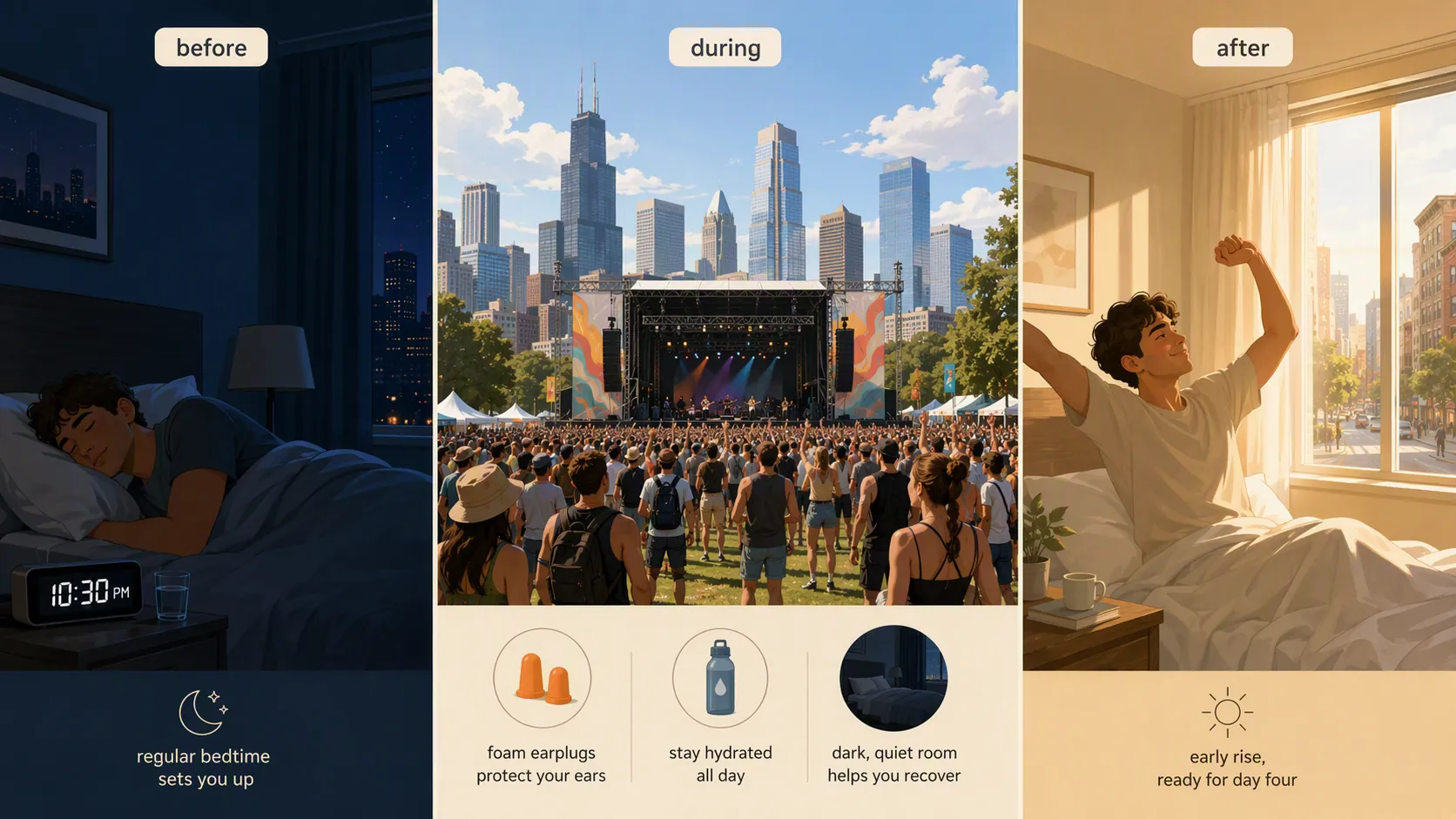
A realistic Lolla night is not “set ends at 10, asleep at 10:30.” It is more like: leave the park, find your group, move through crowds, get back to your room, shower, cool down, eat something if you need to, stop checking videos, and then sleep. For many attendees, that still leaves a plausible sleep opportunity before the next 11 a.m. gate time — but only if the hours after 10 p.m. are not treated as bonus festival.
Adults 18–64 generally need 7–9 hours of sleep, and adults 65 and older need about 7–8 hours.[4] The useful question is not whether every Lolla night will be perfect. It probably will not be. The question is whether you can keep the loss small enough that Friday does not borrow from Saturday, Saturday does not borrow from Sunday, and Monday is not handed the whole bill.
| When | What protects sleep most |
|---|---|
| The week before | Keep your wake time steady; extend time in bed modestly; do not treat sleep banking as a cure-all. |
| Festival days | Use earplugs, manage alcohol timing, hydrate steadily, cool the room, set a caffeine cutoff, and keep the hotel wind-down short. |
| Morning after each night | Get light, wake near your usual time, avoid extreme oversleeping, and use short naps carefully. |
| After the festival | Plan a recovery day; seek help if disrupted sleep persists or starts looking like insomnia rather than temporary schedule disruption. |
The week before: prepare without pretending you can prepay everything
The week before Lolla is where the least glamorous choices do the most work. Keep the same wake time you plan to use during the festival, or at least stop swinging wildly between workday and weekend schedules. A stable wake time anchors the body clock more reliably than a heroic early bedtime that lasts one night and collapses the next.
If you can, add a modest sleep extension for several nights before the festival. That means giving yourself a larger sleep opportunity — for example, getting into bed earlier or protecting the last hour of the evening — not lying awake in bed demanding sleep on command. This is where “sleep banking” has some evidence, but it deserves a careful read.
In one small study, 24 participants spent a week on either 7 or 9 hours in bed, then went through a period of restricted sleep at 3 hours per night; the 9-hour group showed more resilience and faster recovery.[5] Another study found that six days of extended time in bed improved performance during later total sleep deprivation.[6] Those findings support the practical idea that arriving at Lolla less sleep-deprived is better than arriving already short.
They do not prove that a few long nights erase four hard festival days. An editorial in SLEEP specifically flagged open questions about mechanism, dose, and how far sleep extension can be generalized.[7] So use sleep banking as a buffer, not a loophole. If you go into Thursday rested, skip the extra late-night scrolling, and protect the same wake time, you have given yourself a margin. You have not bought immunity.
A simple pre-Lolla sleep setup
- Pick a wake time you can live with during the festival, then start using it several days before.
- Move bedtime earlier only as much as your life will tolerate. Thirty calm minutes beats a two-hour plan you abandon immediately.
- Pack sleep gear with the same seriousness as your wristband: earplugs, eye mask if your room is bright, a refillable water bottle, and any medication or sleep-related device you normally use.
- Decide before Thursday what counts as “going home” after the headliner. The tired version of you is not the best negotiator.
This is also the point to make your room less hostile to sleep. If July heat tends to follow you indoors, check the thermostat, blinds, and bedding before the first night rather than at midnight. For a deeper look at room cooling mistakes, see how to fix hot-weather sleep problems.
During the festival: protect the night before it starts
The useful sleep work during Lolla does not begin when you are brushing your teeth. It starts in the park, because noise exposure, alcohol timing, heat, dehydration, caffeine, and crowd fatigue all follow you back to the room.
Wear earplugs before you need them for sleep
Earplugs are doing two jobs at Lolla. First, they reduce sound exposure at stages where festival sound can commonly exceed 100 dB. The American Academy of Otolaryngology–Head and Neck Surgery recommends that music venues stay below 100 dB as a 15-minute average, with peak limits; that is venue-management guidance, not a personal exposure guarantee.[8] NIOSH sets an 85 dBA recommended exposure limit over 8 hours for occupational noise, which gives useful context for how quickly loud environments can add up.[9]
Second, the same habit helps later. If your hotel hallway is loud, your Airbnb has street noise, or your friends are getting ready at different speeds, earplugs stop being a festival accessory and become part of the sleep plan. Bring a pair you can tolerate for hours, not the cheapest foam pair you will rip out at 2 a.m.
Treat alcohol as a sleep-quality issue
Alcohol can make falling asleep feel easier while still shortening and fragmenting sleep later in the night.[10] That is the part that matters after a 10 p.m. close: you may not notice the damage at bedtime, but you may notice it at 3:30 a.m., or when Friday’s tiredness stacks onto Saturday.
You do not need a moral drama around this. If you drink, give the last drink some distance from bed, alternate with water, and avoid turning the walk back to the hotel into another round. Some practitioner festival guidance suggests stopping alcohol 1–2 hours before bed; that is a practical rule of thumb, not a universal clinical cutoff.[11] If you want the mechanics behind why alcohol changes the night, Restful Ground has a fuller explainer on alcohol and sleep quality and a deeper stage-by-stage primer on sleep architecture.
Hydrate steadily, especially before the room feels hot
Rush’s Lollapalooza preparation guidance emphasizes heat precautions, hydration, and the reality that medical teams are part of the event infrastructure.[3] For sleep, the point is not only avoiding an acute heat problem in the park. Heat and dehydration can make the hotel night messier: thirst, headache, a racing feeling after a long walk back, or waking because the room never quite cools down.
The boring version works: drink water steadily during the day, use shade when you can, replace fluids after heavy sweating, and do not wait until the last set to start catching up. Then make the room easy to sleep in before you get too tired to care — blinds closed, temperature lowered if you control it, light sleepwear, and water nearby.
Set a caffeine cutoff you can actually follow
Caffeine is where precision often gets overclaimed. A practitioner quoted in festival sleep guidance suggests avoiding caffeine after about 2–3 p.m.; that is best treated as a conservative planning rule, not a universal biological threshold.[11] If you are caffeine-sensitive, make the cutoff earlier. If you are not, the more useful test is whether that late iced coffee reliably pushes your bedtime later once you are back in the room.
The bigger risk is using caffeine to cover Thursday’s short sleep, then needing more Friday, then arriving at Sunday with both fatigue and a shifted clock. CU Anschutz sleep guidance describes weekend schedule shifts as a kind of social jet lag and notes that night-sensitive people may need to vary bedtime by only about an hour.[12] Four festival days are enough time for that drift to become noticeable.
Keep the hotel wind-down short
After a long festival day, the best wind-down is not elaborate. Ten to 20 minutes is enough for a reset that does not become procrastination:
- Shower or wash off sweat and sunscreen.
- Set clothes, charger, bag, and water for the next morning.
- Dim the room and stop replaying videos in bed.
- Use earplugs or an eye mask before you are irritated, not after.
- Get into bed at roughly the same point in the night each day, even if sleep is imperfect.
That routine is basic sleep hygiene, but basic is the point when you have been standing in Grant Park for most of the day. For more on which sleep hygiene habits are actually supported, see what sleep hygiene really means.
The morning after: do not try to erase the night with one huge sleep-in
If you had a shorter night, the temptation is to sleep until the last possible second, stumble into the day, and let the schedule slide. Once or twice, that may feel harmless. Across four days, it can push bedtime later and make the next morning worse.
Aim for morning light, food, water, and a wake time close to the one you chose before the festival. You do not need to be rigid to the minute. You do need enough consistency that your body still understands when the day starts. That matters especially if you are already prone to weekend sleep drift or “social jet lag.”[12]
A short nap can help if you have a gap in the afternoon or early evening. Practitioner festival guidance often points to about 20 minutes as a way to restore energy without turning the nap into a second sleep period.[13] Keep it short, set an alarm, and avoid napping so late that it steals from the sleep window the 10 p.m. curfew gives you.
Plan Monday before Sunday night makes the decision for you
The cleanest Lolla sleep plan includes a recovery day or at least a softened Monday. That does not mean sleeping until midafternoon and hoping the body clock forgives it. It means fewer early obligations if you can arrange them, daylight in the morning, normal meals, hydration, and a bedtime that moves you back toward your usual schedule.
If Monday has to be a full workday, make Sunday night less ambitious. Leave promptly after the close, skip the extra drink, and let the last hotel routine be almost automatic. The point is not to make Lolla feel clinical. It is to keep the festival from quietly taking the first half of the following week.
When festival sleep trouble is no longer just festival sleep trouble
A few disrupted nights around Lollapalooza are not surprising. Loud music, heat, later meals, alcohol, crowd movement, and schedule drift can all disturb sleep without implying a sleep disorder. The boundary changes when the disruption outlasts the event.
Consider professional evaluation if you still cannot fall asleep or stay asleep after you have returned to your normal schedule, if daytime impairment keeps building, if anxiety about sleep becomes the main event, or if symptoms point to another sleep concern rather than a temporary festival hangover. Self-management is for a short, understandable disruption. Persistent insomnia deserves a clinician.
References
- What are the dates and hours for Lollapalooza 2026? — Lollapalooza Support
- Lollapalooza Returns To Grant Park July 30–August 2 — City of Chicago OEMC
- Prepping for Lollapalooza — Rush
- How Much Sleep Do You Really Need? — National Sleep Foundation
- Banking sleep: realization of benefits during subsequent sleep restriction and recovery — SLEEP, 2009
- Benefits of Sleep Extension on Sustained Attention and Sleep Pressure Before and During Total Sleep Deprivation and Recovery — SLEEP, 2015
- Sleep extension: getting as much sleep as possible? — SLEEP, 2015
- Mitigation of Noise-Induced Hearing Loss at Music Venues — American Academy of Otolaryngology–Head and Neck Surgery
- Noise and Occupational Hearing Loss — CDC/NIOSH
- Sleeping Well as We Age — American Association for Geriatric Psychiatry
- How to actually get some sleep at a festival — RTÉ
- Sleep expert explains how to avoid social jet lag — CU Anschutz
- How to sleep well at a music festival: 7 proven tips from a sleep editor — Louder