
Mechanism explainer
What Happens to Your Sleep When You Quit Alcohol?
Quitting alcohol often makes sleep feel worse at first — vivid dreams and early morning awakenings are normal. This article explains the week-by-week recovery timeline and when meaningful improvements in sleep quality and alertness emerge.
If you quit drinking and your sleep suddenly feels worse, that can be frightening in a very specific way. You expected deeper rest. Instead, you may be awake at 3 a.m., having vivid dreams, sweating through an early-morning wake-up, or feeling as if your brain has become louder since you stopped.
That first rough stretch does not mean quitting made your body worse. It often means your sleep is no longer being shaped by alcohol. Quitting alcohol tends to improve sleep quality through a repair sequence, not an instant switch: REM sleep rebounds first, the night may feel unstable, and only later do sleep quality and daytime alertness become more reliable.
Alcohol can make people feel sleepy, but it does not produce normal sleep. One commonly cited explanation is that a drinking night may include only 1–2 REM cycles instead of the usual 6–7, because alcohol suppresses REM sleep [1]. Alcohol also tends to increase slow-wave sleep in the first half of the night while increasing light sleep and wakefulness in the second half as blood alcohol levels fall [2]. If you want the fuller stage-by-stage explanation, this guide to sleep architecture and REM cycles is the better place to go deeper.
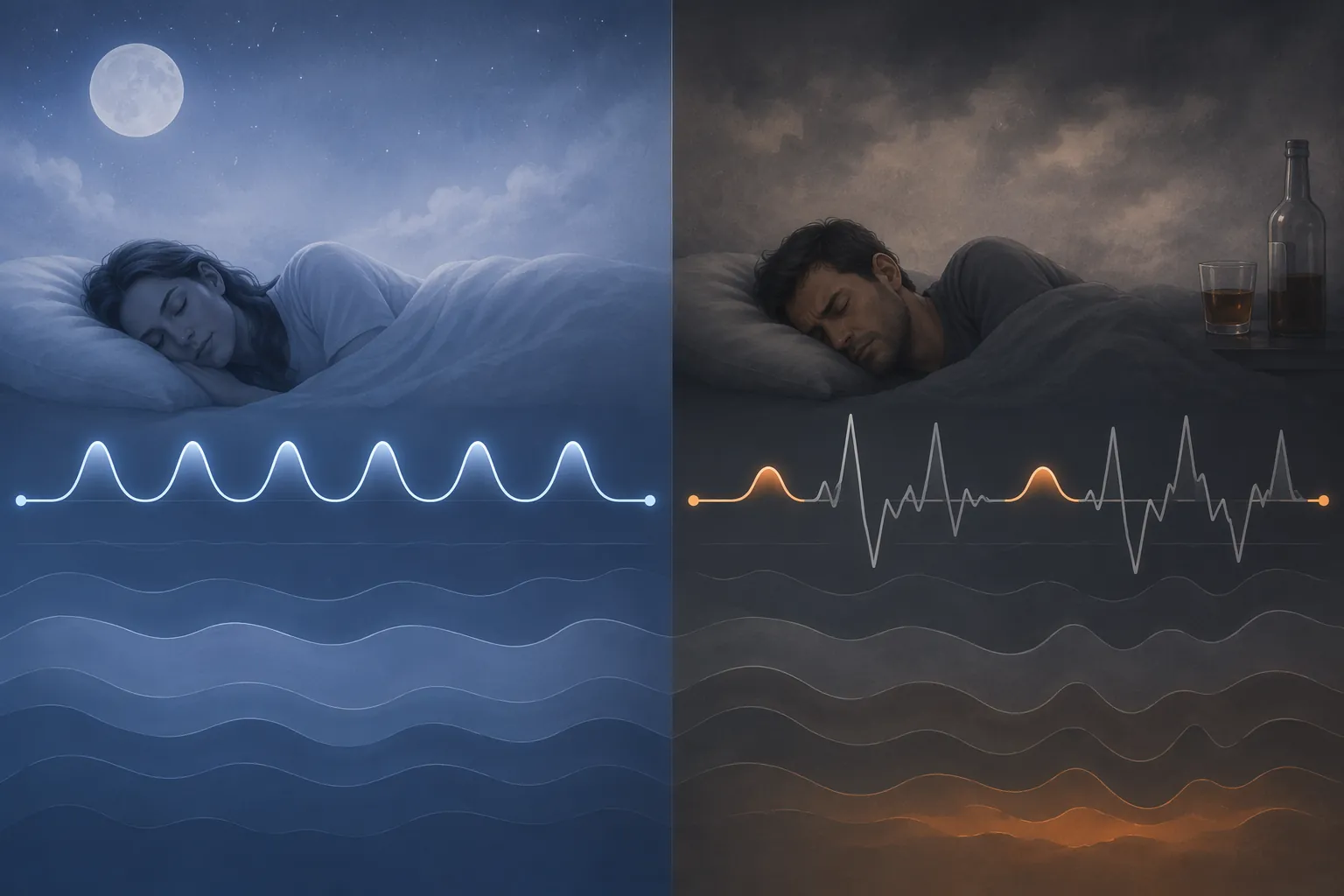
The first week: vivid dreams, lighter sleep, and the REM rebound problem
The first week is the part people most often misread. If alcohol has been suppressing REM, the brain may respond to abstinence with REM rebound. That can mean longer, more intense, or more memorable dreaming. In a 2024 Sleep Charity and Simba Sleep survey of Dry January participants, 20% reported vivid dreams or nightmares in the first week [3].
That number matters less as a prediction than as reassurance. Not everyone gets vivid dreams. Not everyone wakes at the same hour. But the symptom itself is familiar enough that it should not be treated as a private failure. A rough first week can be part of the nervous system trying to restore sleep stages that were being pushed out of shape.
The dreams are not the only issue. As alcohol leaves the nightly routine, you may also notice more trouble falling asleep, more awareness of normal awakenings, and more early-morning alertness. If alcohol had been your shortcut into sleep, the first alcohol-free nights can expose insomnia that was already there but partly masked.
The useful distinction is between uncomfortable sleep disruption and unsafe withdrawal. Vivid dreams, lighter sleep, and waking earlier than you want can fit the early recovery pattern. If you drank heavily, have alcohol dependence, or develop severe withdrawal symptoms, medical guidance matters.

A practical timeline for sleep after quitting alcohol
The timeline is not perfectly neat, but it is more legible if you separate the first anxious nights from the slower quality improvements that follow.
| Time after quitting | What you may notice | What it usually means |
|---|---|---|
| First week | Vivid dreams, nightmares, lighter sleep, early awakenings | REM rebound and loss of alcohol-shaped sedation may make sleep feel worse before it feels better [3] |
| Weeks 2–4 | Some settling of sleep timing; fewer alcohol-related second-half disruptions for many people | Circadian and sleep-stage patterns may begin normalizing; melatonin rhythmicity has been reported to restore after about two weeks of abstinence in alcohol-recovery research [4] |
| Weeks 4–8 | Sleep may still be imperfect, but quality often becomes noticeably better | In alcohol-recovery research, PSQI scores improved from about 11.7 at baseline to about 9.1 at 4 weeks and 7.3 at 8 weeks [4] |
| Weeks 8–12 | More consistent rest and improved daytime functioning may become easier to detect | PSQI scores improved to about 5.7 at 12 weeks, approaching the usual cutoff of 5 for normal sleep quality [4] |
| Beyond 12 weeks | Moderate drinkers may feel largely improved; some heavy drinkers may still have fragmented sleep | A subset of abstinent alcohol-dependent people show longer-lasting sleep continuity abnormalities, but the evidence comes from small longitudinal PSG studies and should be interpreted cautiously [4] |
Weeks 2 to 4: less alcohol-shaped sleep, not always “great” sleep
After the first week, the story often becomes less dramatic. The dreams may calm down. The night may stop feeling quite so unstable. But this is still early. If you used alcohol to fall asleep, your body has to relearn sleep onset without that sedating cue.
That cue is common enough to be worth naming. More than 1 in 10 individuals have been reported to use alcohol as a hypnotic, which means alcohol is functioning less like a beverage in the evening and more like an informal sleep drug [4]. When it is removed, the brain is not simply “missing a habit.” It may be missing the tool it had been using to force the first part of the night.
There is also a circadian piece. In alcohol-recovery research, melatonin secretion has been described as abnormal during withdrawal, with delayed rise time and delayed peak; normal rhythmicity may restore after about two weeks of abstinence [4]. That does not guarantee good sleep on day 14. It does help explain why weeks 2–4 can feel more like gradual settling than a clean switch.
Self-reported Dry January data point in the same direction, with an important caveat. After a month without alcohol, 34% of Sleep Charity survey participants reported improved overall sleep quality, and 36% said they woke feeling refreshed [3]. In a separate Healio report on a Sleep Foundation survey of 1,000 participants, 50% said they slept more soundly and 48% felt more refreshed upon waking after taking a break from alcohol [5]. Those are reports of how people felt, not lab measurements of sleep architecture.
For a moderate drinker, that one-month mark may be where the benefit becomes obvious: fewer 3 a.m. wake-ups, less morning fog, and a more predictable night. For someone who drank heavily or for years used alcohol as the main sleep aid, one month may still be early.

Weeks 4 to 12: when meaningful improvement is easier to see
The best evidence for the slower recovery curve comes from alcohol-recovery research using the Pittsburgh Sleep Quality Index, or PSQI. A higher PSQI score means worse sleep quality. In the trajectory cited in a review of sleep disturbances during alcohol recovery, scores improved from about 11.7 at baseline to 9.1 at 4 weeks, 7.3 at 8 weeks, and 5.7 at 12 weeks [4].
That curve is useful because it refuses two bad promises. It does not say sleep is fixed after a few nights. It also does not say poor sleep after quitting means nothing is improving. At four weeks, the score is still clearly in poor-sleep territory. By twelve weeks, it is much closer to the usual cutoff of 5 for normal sleep quality [4].
This is where “better sleep” needs to be defined carefully. It may not mean you fall asleep the second your head hits the pillow. It may mean fewer prolonged awakenings, less fragmented second-half sleep, more stable mornings, and less of the stale exhaustion that can follow alcohol-disrupted sleep.
The PSQI data are also not a perfect map for every reader. Much of the alcohol-recovery literature focuses on alcohol-dependent people in treatment settings. A moderate drinker taking a month off may improve faster, while a heavy drinker may need longer and may have other medical or psychological factors affecting sleep.
Why heavy drinking can make the timeline longer
It is tempting to turn the recovery timeline into a universal calendar. That would be unfair to heavy drinkers and misleading for moderate drinkers. The sleep of someone who drank two glasses of wine most nights is not necessarily recovering from the same level of disruption as the sleep of someone with alcohol dependence.
In heavier alcohol-use histories, sleep disturbance can last beyond the first month. Some longitudinal polysomnography studies have found sleep continuity abnormalities persisting for two or more years in abstinent alcoholics, but those findings come from very small samples and should not be treated as a forecast for everyone who quits [4].
The cautious takeaway is not that sleep damage is permanent. It is that prolonged insomnia after quitting deserves care rather than self-blame. If alcohol had been doing the work of sedation for a long time, the absence of alcohol may reveal a sleep problem that needs its own treatment.
What helps during the transition
The most important short-term move is not to treat one bad night as proof that you need alcohol to sleep. A drink may knock down anxiety about the night ahead, but it reintroduces the same REM suppression and second-half fragmentation that the brain is trying to recover from.
Keep the basics boring and consistent: a stable wake time, morning light, a wind-down period that does not imitate a drinking ritual, and enough patience not to keep changing the plan every night. If you need a practical reset, use the fundamentals in this evidence-based sleep hygiene routine rather than building a complicated protocol around the first bad week.
If insomnia persists, cognitive behavioral therapy for insomnia is the treatment to know about. In recovering alcoholics, CBT-I improved subjective sleep quality, reduced sleep onset latency, reduced awakenings, and maintained gains at 3- and 6-month follow-up [4]. This CBT-I explainer walks through how it works.
For perimenopausal readers, the alcohol timeline may overlap with hormonal sleep disruption. Night sweats, temperature changes, and more fragile sleep can make the first alcohol-free weeks feel especially messy. The separate guide to alcohol and sleep quality in perimenopause is more specific to that life stage, and this overview of perimenopause sleep disruption can help separate alcohol-related sleep changes from other causes.
What to expect, without pretending the first week is easy
The first week after quitting alcohol can be rough: vivid dreams, early awakenings, and lighter sleep are common enough to be recognized as part of the process. Weeks 2–4 often bring partial settling rather than perfect sleep. By weeks 4–12, meaningful improvements in sleep quality and waking alertness are easier to detect, especially for moderate drinkers.
Heavy drinkers, people with alcohol dependence, and anyone with severe withdrawal symptoms should get medical support. For everyone else lying awake and worried that quitting “broke” sleep, the more likely explanation is less dramatic and more survivable: the brain is no longer being pushed into alcohol-shaped sleep, and the repair phase can feel disorderly before it feels restorative.
References
- Benefits of Giving Up Alcohol for a Month — Priory Group.
- Alcohol and the sleeping brain — Handbook of Clinical Neurology, 2014.
- Navigating Sober Slumber — The Sleep Charity, 2024.
- Treatment Options for Sleep Disturbances During Alcohol Recovery — Journal of Addiction Medicine, 2007.
- Most people who participate in Dry January sleep more soundly, lose weight — Healio, January 2024.
Supports these guides
Spot an error or have clinical feedback?
Because this article covers clinical, medication, or safety information, we use a moderated correction channel instead of open public comments. Let us know if something about “What Happens to Your Sleep When You Quit Alcohol?” needs a closer look.
Send feedback on this article