
Does Spicy Food Before Bed Ruin Your Sleep?
Spicy food before bed can ruin sleep for some people, especially when it is eaten close to bedtime, but the evidence does not support a universal ban. The best direct sleep-lab clue comes from one very small study of six young healthy men; larger studies point to late eating in general rather than spice itself; and the reflux pathway is clinically plausible but often based on self-reported symptoms rather than controlled sleep trials. [1][2][3][4][5]
The practical answer is this: if a spicy dinner is also a late, heavy dinner, give yourself at least a three-hour eating-to-bed gap before deciding that the chili is the villain. Eating within three hours of bedtime has been associated with more nighttime awakenings in young adults, but that finding is about meal timing, not a spice-specific effect. [2]
| Evidence check | Current read |
|---|---|
| Last reviewed | August 1, 2026 |
| Direct spicy-meal sleep evidence | Limited experimental evidence: one polysomnography study in 6 young healthy men. [1] |
| Late-eating evidence | Stronger observational evidence, but not spice-specific. [2][3] |
| Reflux pathway | Clinically recognizable and supported by symptom reports and sleep guidance, but not proven by spicy-food sleep RCTs. [4][5] |
| Bottom line | Conditional: avoid spicy food close to bed if it reliably causes heat, reflux, or awakenings; otherwise test your own response rather than following a blanket rule. |
The three ways spicy food might disturb sleep
The cleaner way to think about spicy food before bed and sleep quality is by pathway. A spicy meal may make sleep worse because it raises heat load, because it triggers reflux once you lie down, or because it is part of a late meal that keeps the night more fragmented. Those are not the same claim, and they are not supported by the same level of evidence.
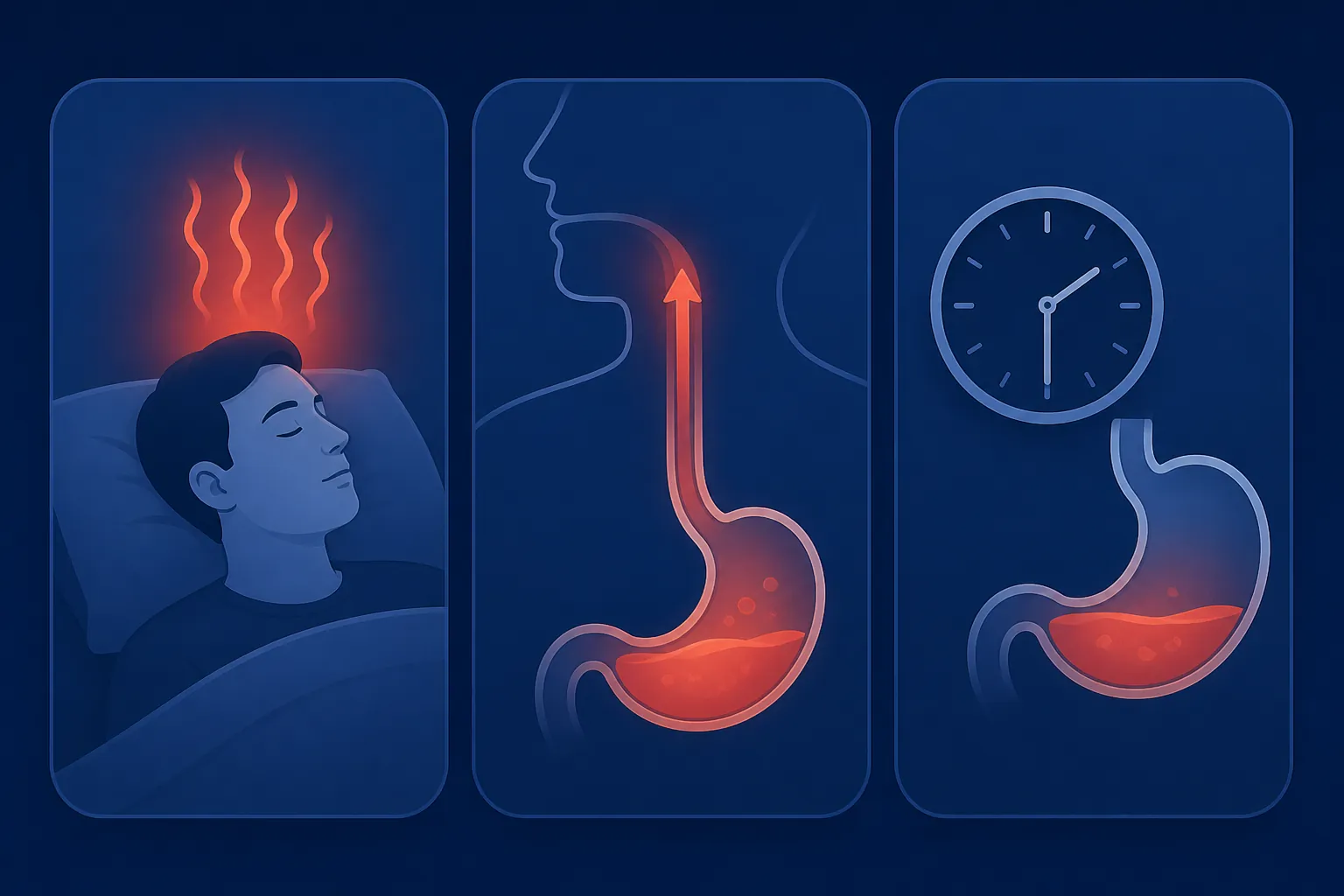
Heat: the best direct clue, but from a tiny study
The most relevant direct study is Edwards et al. 1992, which tested an evening meal containing Tabasco sauce and mustard in six young healthy men while their sleep was measured with polysomnography. After the spicy meal, the participants had less slow-wave sleep and stage 2 sleep, more total time awake, and a tendency toward longer sleep-onset latency. Their body temperature was also elevated during the first sleep cycle. [1]
That is real, measured sleep disruption. It is also a narrow finding. Six young healthy men cannot tell us what happens to everyone else, and the proposed thermoregulation explanation is the authors’ hypothesis, not proof that heat is the only cause. Still, it fits with a broader sleep principle: the body generally sleeps better when it can shed heat efficiently. If your spicy meal leaves you flushed, sweaty, or uncomfortably warm in the first part of the night, that symptom is worth taking seriously.
If heat seems to be the main problem, the useful comparison is not “spicy food versus virtue.” It is whether your night looks like other heat-disrupted nights. The same basic sleep physiology shows up during hot weather; Restful Ground’s guide to sleep during a heat wave may be more relevant than another list of foods to fear.
Reflux: the most recognizable reason spicy food wakes people up
For many people, the problem is not that spicy food has a mysterious sleep-destroying property. It is heartburn. In a Korean study of people with GERD, hot spicy stews were the most frequently reported symptom-inducing food, reported by 63% of GERD patients. That does not mean spicy stew causes reflux in everyone, and the result is population- and symptom-report specific, but it matches what many reflux sufferers can identify without a lab: certain meals burn on the way back up. [4]
Bedtime makes reflux more sleep-relevant because lying down removes the help gravity gives you when you are upright. The Sleep Foundation summarizes GERD-and-sleep guidance and cites a Gallup finding that about 60% of frequent heartburn sufferers say heartburn affects their sleep. That figure is self-report, not a spicy-food trial, but it explains why this pathway matters in real bedrooms. [5]
If spicy food reliably gives you burning, sour regurgitation, coughing, throat irritation, or an acid taste after you lie down, you do not need a perfect capsaicin study to justify changing dinner timing or content. Your own symptom pattern is already stronger evidence for you than a generic rule is for everyone.
Late digestion: probably a timing issue, not a spice issue
The larger late-eating studies are useful, but they should not be misread. Chung et al. studied 793 young adults and found that eating within three hours of bedtime was associated with higher odds of at least one nighttime awakening, with an odds ratio of 1.61 and a 95% confidence interval of 1.15 to 2.27. The study did not find a significant effect on sleep-onset latency or short sleep duration. It also did not isolate spicy food. [2]
Iao et al. used American Time Use Survey data from 2003 through 2018, with 124,239 adults. Eating or drinking within one hour of bed was associated with roughly doubled odds of wake after sleep onset of at least 30 minutes: odds ratio 2.03 for women and 2.64 for men. A four- to six-hour gap was associated with the best odds of optimal sleep. Again, this is late eating and drinking, not late hot sauce. [3]
So if your spicy dinner is also large, fatty, late, and followed by lying flat 40 minutes later, several things are changing at once. The sensible first test is timing. Move the same general meal earlier, keep the portion reasonable, and see whether the night improves before deciding that every spicy meal is off-limits.
The weak-link evidence: spicy-food associations are not bedtime proof
There are population findings that seem, at first glance, to make the rule look stronger. One cross-sectional study of adolescent girls in Iran reported an association between daily spicy food intake and insomnia, with an odds ratio of 4.73 and a 95% confidence interval of 1.09 to 20.56, but the association lost significance after full adjustment. It was also about daily intake, not spicy food before bed, and about adolescent girls, not adults in general. [6]
That kind of study is a reason to stay curious, not a reason to turn one dinner habit into a universal sleep law. People who eat spicy food every day may differ in many other ways: meal timing, stress, caffeine, sleep schedules, social eating, or underlying symptoms. Cross-sectional data can point to a pattern, but it cannot tell you that last night’s chili caused last night’s 3 a.m. awakening.
Who should be more cautious
A conditional answer does not mean everyone should be casual about it. Some sleepers have less room for experimentation because the likely pathway is already active.
- People with GERD or frequent heartburn: if spicy foods are one of your known triggers, the bedtime version is especially likely to matter because reflux and lying down are a bad pairing. [4][5]
- Pregnant people with indigestion or heartburn: NHS pregnancy guidance treats indigestion and heartburn as common pregnancy symptoms and includes food and eating-habit changes among the management steps. This does not prove spicy food disrupts sleep in pregnancy, but it does justify being more conservative if spicy meals trigger symptoms for you. [7]
- Perimenopausal readers with hot flashes or night sweats: if you already wake hot, flushed, or sweaty, a spicy late meal may be worth testing carefully. Cleveland Clinic’s hot-flash diet guidance treats food triggers as part of hot-flash management, and Restful Ground’s perimenopause heat-and-sleep guide goes deeper on why temperature swings can narrow the margin for sleep. [8]
- Anyone who wakes with heat, acid symptoms, coughing, or repeated awakenings after spicy late meals: your pattern matters even if the general evidence is imperfect.
The point is not to make vulnerable groups anxious about one ingredient. It is to stop pretending the average answer is equally useful for someone with nightly reflux, pregnancy heartburn, or hot flashes.
A two-week self-test for spicy dinners
If you like spicy food and do not have urgent symptoms, the fairest test is boring on purpose. For two weeks, separate spice from lateness. Keep a consistent eating-to-bed gap first, because the larger evidence is stronger for late eating than for spice itself. A three-hour gap is a practical baseline because eating within three hours of bedtime has been linked with more nighttime awakenings. [2]
| For 14 nights, track | What to write down |
|---|---|
| Dinner timing | Time you finished eating and time you got into bed. |
| Spice exposure | Mark the night as spicy, mildly spicy, or non-spicy. Do not worry about perfect scoring. |
| Meal size | Small, moderate, or large. A large late meal can confuse the result. |
| Heat symptoms | Flushed, sweaty, unusually warm, night sweats, or no heat symptoms. |
| Reflux symptoms | Heartburn, sour taste, regurgitation, coughing, throat irritation, or none. |
| Sleep disruption | Time to fall asleep, number of awakenings, long awake periods, and whether you felt restored the next day. |
| Other obvious confounders | Alcohol, caffeine later than usual, illness, stress spike, very late bedtime, or unusual room heat. |
Do not judge the whole habit by one dramatic night. Look for a repeatable pattern. If spicy nights are the ones with heat, reflux, or more awakenings while non-spicy nights are quieter, you have a useful personal answer. If the bad nights cluster around late meals regardless of spice, timing is probably the better first target. If nothing changes when you keep dinner earlier and moderate, there may be no good reason to ban spicy food from your evenings.
A simple decision rule works well enough:
- If spicy food close to bed reliably causes reflux, heat, sweating, or awakenings, move it earlier or save it for another meal.
- If late meals cause awakenings whether or not they are spicy, keep the eating-to-bed gap and reduce heavy late portions.
- If spicy food eaten earlier does not change your sleep, a universal “never spicy at night” rule is doing more work than the evidence can support.
For related heat-and-sleep questions, the Restful Ground FAQ on sleeping during an orange heat alert may help you tell food-related warmth from a room-temperature problem.
When to get medical advice
Do not keep self-testing if you have frequent reflux, chest pain-like symptoms, or sleep disruption that continues after you move dinner earlier and avoid obvious triggers. Chest pain-like symptoms should be treated as medical symptoms, not as a food experiment. Persistent reflux also deserves care because the issue may be GERD management, medication timing, pregnancy-related heartburn, or another condition rather than whether dinner had chili in it.
References
- Spicy meal disturbs sleep: an effect of thermoregulation? — PubMed, 1992
- Does the Proximity of Meals to Bedtime Influence the Sleep of Young Adults? — PMC, 2020
- Associations between bedtime eating or drinking, sleep duration and wake after sleep onset: findings from the American Time Use Survey — PMC, 2021
- Foods Inducing Typical Gastroesophageal Reflux Disease Symptoms in Korea — PMC, 2017
- GERD and Sleep — Sleep Foundation
- Association of spicy food consumption with sleep quality among Iranian adolescent girls — PubMed
- Indigestion and heartburn in pregnancy — NHS
- What To Eat When You Have Hot Flashes — Cleveland Clinic
Read the full guide: Which Meteor Shower Won't Ruin Your Sleep?