
If your doctor gave you sleeping pills and never mentioned cognitive behavioral therapy for insomnia, that omission can feel personal. It usually is not. It is more often the result of a care system where the recommended treatment is easier to endorse than to deliver.
The contradiction is sharp. The American College of Physicians and the American Academy of Sleep Medicine have supported CBT-I as a first-line treatment for chronic insomnia, yet it reaches only a small share of the people who might benefit from it.[1][2][3] In one Norwegian epidemiological study, 80% of respondents who had used sleeping medication said they would prefer non-drug treatment, but only 10% had been offered it.[1] That is not a minor communication problem. It is the beginning of an access problem.

Primary care is where many people first bring insomnia. It is also where time is shortest, referral options are uneven, and sleep training may be thin. In a Veterans Affairs survey, 82% of primary care providers had heard of CBT-I, but only 9.8% said they understood how it worked; 43% did not know it was available at their own facility.[3] A clinician can know the name of the treatment and still not be able to explain it, identify the right patient, or find someone nearby who provides it.
The treatment exists. The delivery system often does not.
CBT-I is not general sleep advice. It is a structured behavioral treatment for chronic insomnia, usually delivered over multiple sessions, that addresses the habits, schedules, thoughts, and conditioned arousal that keep insomnia going. The point here is not to walk through the protocol. The point is that it is a treatment requiring trained delivery, follow-up, and patient participation. Those requirements matter when the usual medical visit is built around faster decisions.
Medication often fits the appointment better than CBT-I does. A prescription can be explained, documented, and sent to the pharmacy in minutes. A referral to CBT-I requires that the clinician know the treatment, believe the patient can access it, know who provides it, and have some confidence insurance or cost will not make the referral meaningless. At each step, the path can break.
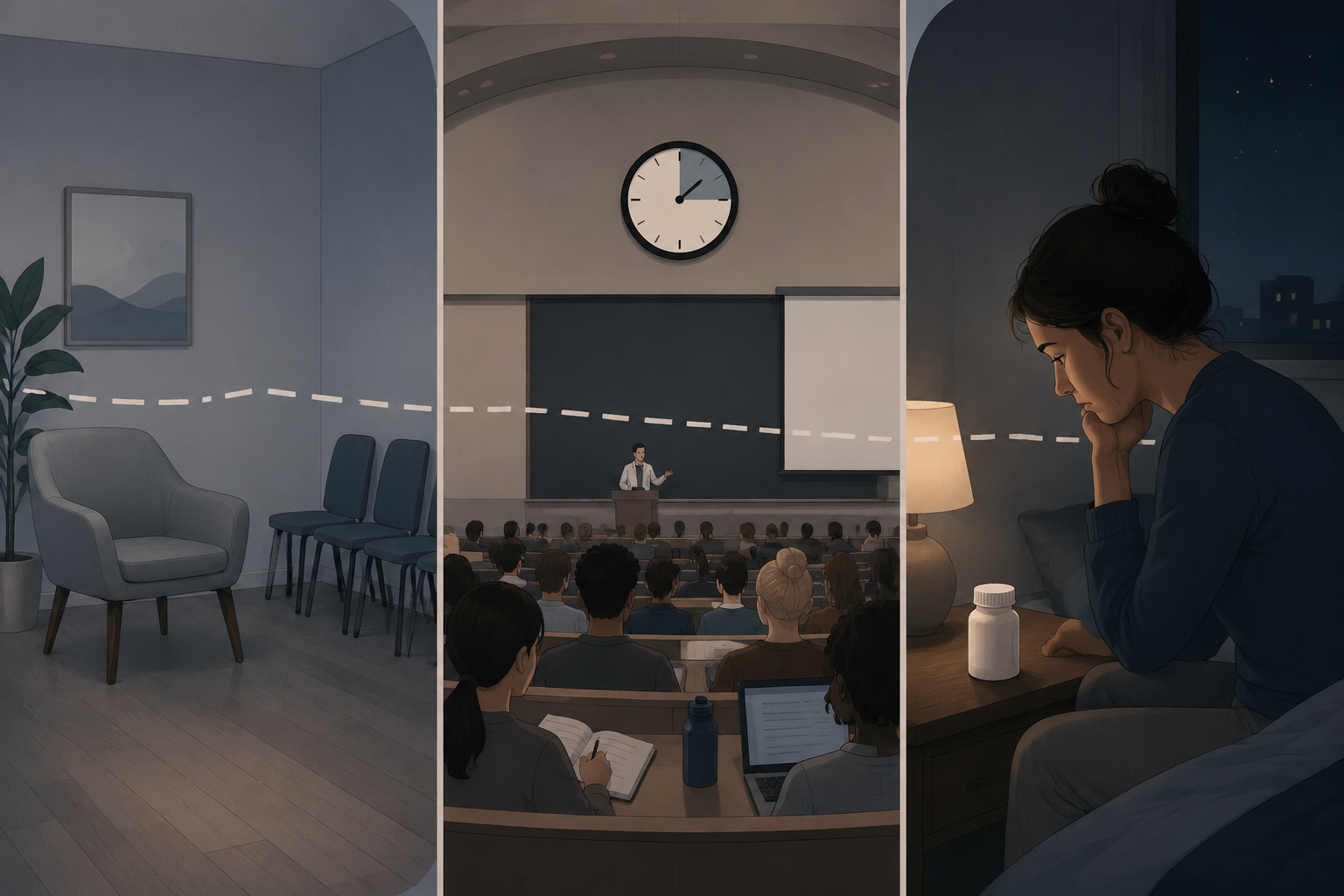
There are not enough trained CBT-I providers
The simplest version of patient advice is also the most frustrating: ask your doctor for CBT-I. That is reasonable, but it can still lead nowhere because the trained workforce is small.
A 2015 survey cited in a 2018 narrative review identified about 752 CBT-I specialists worldwide.[3] That number should be read with its date attached; provider counts can change. But later credentialing data does not suggest the shortage vanished. By 2022, only 205 people had been credentialed globally by the Board of Behavioral Sleep Medicine.[1] Credentialing is not the only way a clinician can be trained to deliver CBT-I, so it is not a complete count of all capable providers. It is still a useful signal: the specialty workforce is nowhere near the scale of chronic insomnia.
The shortage is not spread evenly. A study of behavioral sleep medicine provider distribution found that 58% of providers were located in just 12 U.S. states, and states including Hawaii, South Dakota, and Wyoming had no providers identified in that analysis.[4] That study was published in 2016, so it cannot describe every local market in 2026. But it captures the kind of geographic imbalance patients still recognize: one person has a university sleep center within driving distance, while another has a medication refill and a referral list that produces no appointments.
This is why “first-line” can sound hollow from the patient side. A guideline can put CBT-I first; a directory can still have no available clinician, no in-network clinician, or no clinician accepting new patients. The sleep psychologist’s waitlist then becomes part of the evidence. It is not proof that CBT-I is obscure. It is proof that the system has not staffed the treatment it recommends.
Primary care was not trained for this gap
Insomnia is common enough to land in primary care, but sleep medicine has not been treated as a major part of medical education. One review reported that medical schools spend an average of 2.5 hours on sleep education, and 27% of programs provide no sleep education at all.[1] Those figures help explain why insomnia visits so often narrow quickly to symptoms, safety cautions, and medication options.
This is not mainly a story of clinicians ignoring evidence. A primary care clinician may be managing diabetes, blood pressure, depression, pain, menopause symptoms, shift work, caregiving stress, and medication interactions in the same week, often in the same morning. If sleep training amounted to a few hours—or none—the provider may not have a confident script for CBT-I beyond “there is a therapy for sleep.”
That lack of confidence has consequences. If a clinician cannot describe what CBT-I involves, the patient may hear it as a vague suggestion rather than a serious treatment. If the clinician does not know whether it exists locally, medication becomes the plan that can actually be completed before the visit ends. The default is created less by one bad decision than by a chain of unfinished handoffs.
| Where the path breaks | What it can look like in a visit | What the patient may conclude |
|---|---|---|
| Too few trained providers | The clinician agrees CBT-I is appropriate but has no practical referral option. | “I asked, but there is nowhere to go.” |
| Limited sleep education | The clinician has heard of CBT-I but cannot explain it confidently. | “Maybe this is not a real treatment.” |
| Low patient awareness | The patient is offered medication and does not know to ask about behavioral treatment. | “Pills must be the only serious option.” |
Many patients do not know there was another option to ask for
The access gap is completed by silence on the patient side, but that silence is not the patient’s fault. People cannot request a treatment they have never heard of, especially when insomnia is often minimized as stress, aging, screen time, or a temporary bad patch.
A UK survey discussed by the ResMed Sleep Institute found that 52% of respondents with insomnia did not seek treatment because they thought sleeping pills were the only option, and 57% believed sleep problems were too trivial to treat.[5] The survey context matters: this is not the same kind of evidence as a randomized trial, and it describes reported beliefs rather than actual clinical behavior. Still, the finding matches a familiar pattern. When the public story about insomnia is “try harder to sleep” or “take something,” CBT-I remains invisible.
That invisibility changes the exam room. A patient who knows CBT-I exists may ask, “Can I be referred for cognitive behavioral therapy for insomnia?” A patient who does not know may ask only for something to help tonight. Both patients may be equally exhausted. Only one has the language that might open another route.
Digital CBT-I and training programs help, but they do not erase the bottleneck
Health systems know the bottleneck exists. The VA has trained 700 to 800 clinicians in CBT-I delivery, an unusually concrete response to a workforce problem.[5] Digital CBT-I platforms are also being used to extend access beyond the limited number of specialists, and the American Academy of Sleep Medicine has described multiple platform characteristics clinicians and patients may need to consider.[6]
These routes matter. A digital program may be more available than a sleep psychologist, especially in areas with few behavioral sleep medicine providers. A trained clinician embedded in a larger system may make CBT-I less dependent on a specialty referral. Germany’s app-on-prescription model has also been discussed as a reimbursement pathway that could make digital treatment more financially accessible.[5]
But these are partial answers, not a clean ending. Digital care still raises questions about fit, severity, comorbid conditions, patient preference, insurance coverage, and whether a person needs clinician support. Training hundreds of clinicians is meaningful inside a large system, but it does not automatically solve access for everyone outside that system. Implementation researchers have also emphasized that knowing CBT-I works is different from building routine pathways that actually deliver it.[7]
What to ask for when medication was the only option offered
A patient cannot repair a national workforce shortage from the exam table. Still, there are ways to make the next conversation more specific. The goal is not to refuse medication on principle; it is to ask whether the recommended behavioral treatment is available and appropriate for your situation.
- Ask directly: “Is cognitive behavioral therapy for insomnia appropriate for me?” Using the full name can help distinguish CBT-I from general counseling or sleep hygiene advice.
- Request a referral to behavioral sleep medicine, a sleep psychologist, or another clinician specifically trained in CBT-I.
- If no local provider is available, ask whether a validated digital CBT-I option or telehealth CBT-I is appropriate for your case.
- Check coverage before assuming the referral is usable. Insurance networks, visit limits, copays, and out-of-pocket fees can determine whether “available” is real.
- If you are using sleep medication, ask how it fits into a longer-term plan, including whether CBT-I could be added or used as an alternative over time.
If the answer is “we do not have anyone,” that answer is discouraging, but it is also information. It means the barrier may be structural rather than a sign that you asked for something unreasonable. It may justify looking beyond a single clinic directory, asking a sleep center, checking academic medical centers, or asking whether your health system contracts with digital programs.
The hard part is holding two truths at once. CBT-I is recommended because evidence and guidelines support it. It is hard to get because the healthcare system has not built enough routes from recommendation to appointment. That is how a patient can do what they were told, accept the prescription in front of them, and only later discover that the first-line treatment was sitting behind a door nobody pointed to.
References
- Examining the barriers and recommendations for integrating more equitable insomnia treatment options in primary care, Frontiers in Sleep, 2023
- New guideline supports behavioral, psychological treatments for insomnia, American Academy of Sleep Medicine
- Increasing access to and utilization of cognitive behavioral therapy for insomnia (CBT-I): a narrative review, PMC, 2018
- Where are the behavioral sleep medicine providers and where are they needed?, PubMed, 2016
- Reimbursement Gaps & Workforce Shortages Limit CBT-I Access, ResMed Sleep Institute
- Digital cognitive behavioral therapy for insomnia: Platforms and characteristics, American Academy of Sleep Medicine
- We know CBT-I works, now what?, PMC, 2022
Comments
Join the discussion with an anonymous comment.