
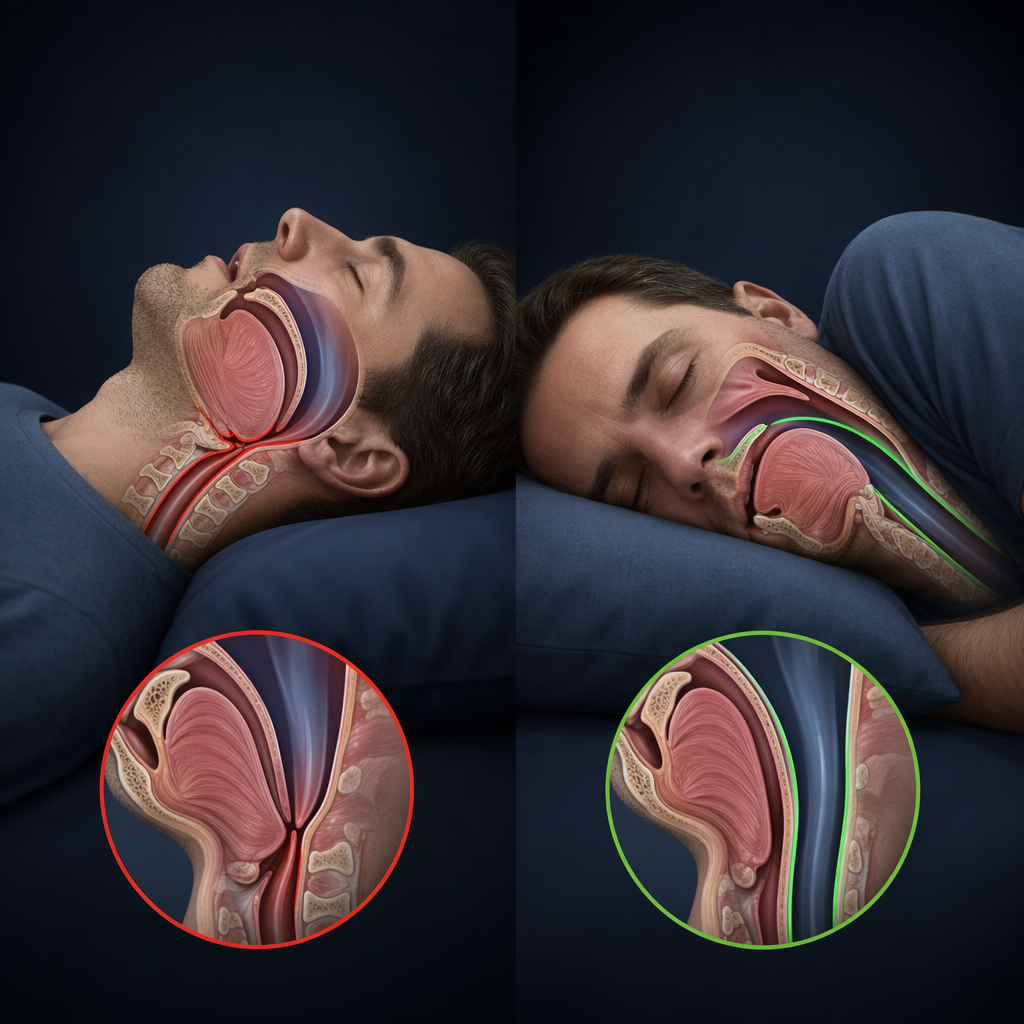
The best way to sleep with sleep apnea, when the apnea is position-dependent, is usually on your side or with the head of the bed elevated. That answer is narrow on purpose. Side sleeping is not a magic instruction for every person who snores, and head elevation is not a replacement for a diagnosis. These positions matter most when obstructive sleep apnea gets clearly worse on the back, because gravity can pull the tongue and soft tissues toward the airway and increase obstruction.
If your sleep study shows a much higher apnea-hypopnea index, or AHI, while supine than while on your side, positional therapy is worth taking seriously. If your AHI barely changes by position, sleeping on your side may still feel better, but it is less likely to carry the treatment. Severe OSA, often defined clinically as an AHI above 30, also should not be treated as a posture problem alone.
Who positional therapy helps most
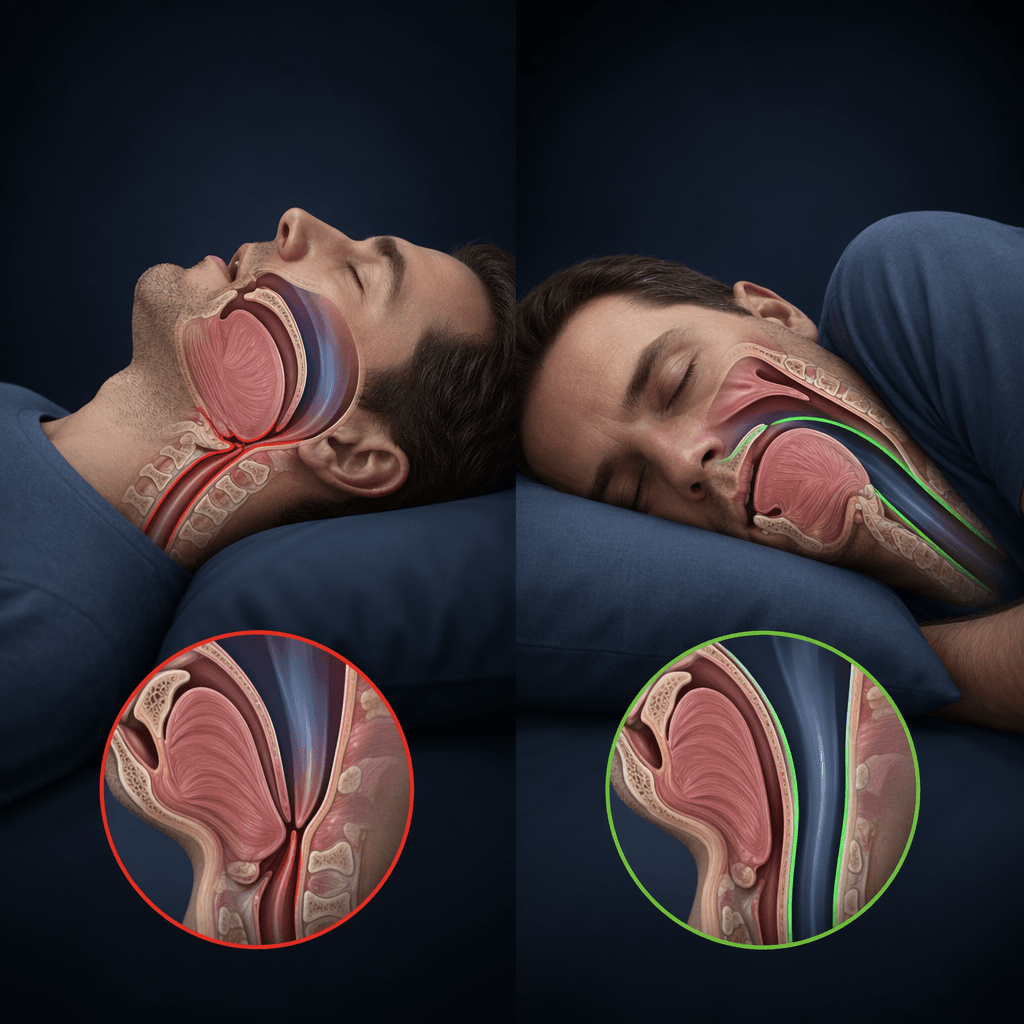
The useful dividing line is positional obstructive sleep apnea, often shortened to POSA. In this pattern, apnea events cluster when the person sleeps on the back and improve when the person avoids that position. Secondary clinical summaries estimate that up to 75% of people with OSA have position-dependent apnea, and another summary reports that nearly 62% have supine-predominant apnea. Those are broad estimates, not a guarantee about any one patient.
That distinction changes the quality of the advice. “Try side sleeping” is vague. “Your supine AHI is much higher than your non-supine AHI, so we are going to reduce time on your back” is a treatment plan. The first is a sleep-hygiene suggestion. The second is targeted positional therapy.
For someone still trying to understand symptoms, testing, or treatment thresholds, a broader diagnostic guide such as Sleep Apnea FAQ: Symptoms, Diagnosis, CPAP, and When to See a Doctor is the better starting point. Positional therapy becomes much clearer once there is an AHI number and a position breakdown.
What the strongest recent evidence actually shows
The best recent evidence is not just that people can be nudged off their backs for a few nights. A 2025 systematic review and network meta-analysis in Frontiers in Medicine pooled 19 randomized controlled trials with 1,231 participants and found that positional therapy reduced supine AHI by about 7.46 events per hour compared with placebo. [1]
That number needs to be read correctly. A reduction of about seven to eight supine events per hour can be clinically meaningful for a person whose apnea is mostly a back-sleeping problem, especially in the mild-to-moderate range. It is not the same thing as eliminating OSA. It also does not prove the same effect for someone whose apnea remains severe in every position.
The same evidence base is also interesting because adherence looks different from CPAP. An American Family Physician review reported that positional therapy had significantly lower complication rates than CPAP, with an odds ratio of 0.29, and better nightly adherence, averaging 4.9 hours compared with 2.5 hours for CPAP in the reviewed evidence. [2]
That is not a reason to rank positional therapy above CPAP for everyone. CPAP can be more powerful at controlling airway obstruction when it is used. The practical point is simpler: a lower-friction treatment that a patient actually uses may be a meaningful complement, and for selected mild-to-moderate POSA patients it may be enough to discuss as a standalone strategy with a clinician.
There is one caveat worth keeping in view. The 2025 meta-analysis reported substantial heterogeneity in some comparisons, and some subgroup analyses were based on small numbers of studies. [1] That does not erase the signal, but it does argue against sweeping claims such as “side sleeping treats sleep apnea” without asking which kind of sleep apnea is being treated.
Why side sleeping changes apnea events
In obstructive sleep apnea, the problem is not that breathing forgets to happen. The airway repeatedly narrows or closes during sleep. Back sleeping can make this worse because the tongue, soft palate, and surrounding tissues shift backward under gravity. Side sleeping changes that geometry. It does not make the airway immune to collapse, but in positional OSA it can reduce the pressure that encourages collapse.
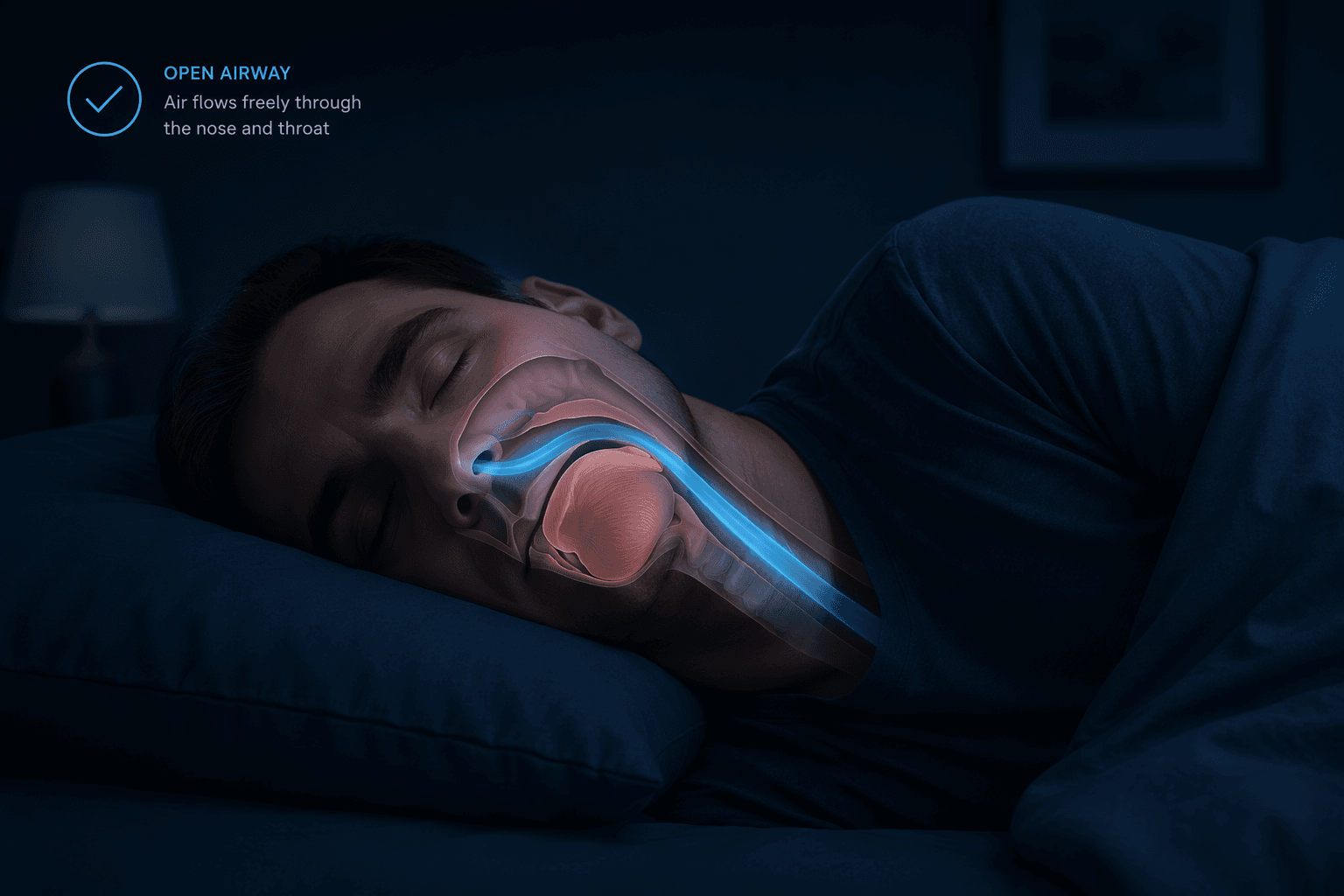
This is also why comfort advice can miss the point. A pillow that feels pleasant but lets the sleeper roll flat onto the back may not solve the positional problem. A less glamorous setup that reliably prevents long stretches of supine sleep may do more for AHI.
The practical options, from lowest friction to more structured
The goal is not to perform the “perfect” sleep position. The goal is to reduce time in the position that triggers more obstruction. These are the main ways people try to do that.
| Method | What it is trying to do | Best fit |
|---|---|---|
| Side-sleeping setup | Make the side position stable enough to last through the night | People who can fall asleep on the side but roll onto the back |
| Head-of-bed elevation | Use gravity to reduce backward airway collapse while sleeping elevated | People who tolerate incline sleep or also need reflux-friendly positioning |
| Tennis ball-style deterrent | Make back sleeping uncomfortable enough to interrupt the habit | Low-cost trial before buying a device |
| Positional pillow or body pillow | Support the torso, hips, or knees so side sleeping is easier | People whose barrier is comfort rather than motivation |
| Wearable vibration device | Detect supine position and prompt a shift without fully waking the sleeper | People who want a more structured positional therapy tool |
Side sleeping: make it stable, not heroic
For tonight, the simplest version is a side-sleeping arrangement that makes rolling onto the back less likely. A body pillow in front of the chest can keep the upper body from rotating. A pillow behind the back can act as a barrier. A pillow between the knees can reduce hip and low-back discomfort that otherwise pushes people back into a supine position.
This is where cheap methods are not automatically inferior. If a low-cost pillow setup keeps the sleeper off the back for more of the night, it is doing the relevant job. If it only works for the first hour, it is not positional therapy so much as a bedtime intention.
Head elevation: useful when flat-back sleeping is the problem
Head-of-bed elevation is the other serious positional tool. Elevating the upper body at roughly 30 to 60 degrees can reduce airway collapse by using gravity to keep tissues from blocking the airway, according to the evidence summarized in the research brief.
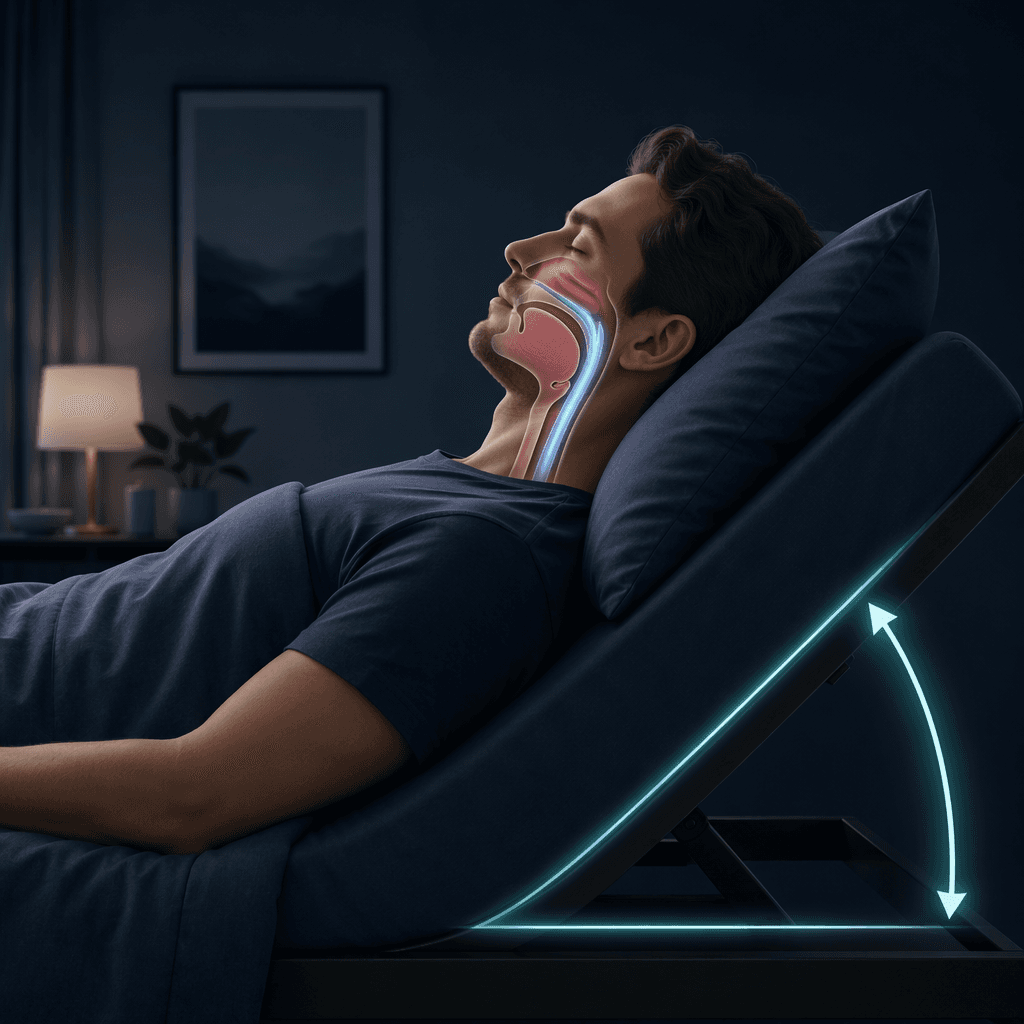
The implementation matters. Stacking soft pillows often bends the neck forward and collapses the space the person is trying to protect. A wedge pillow, adjustable base, or raised head of bed usually gives a cleaner incline. Readers comparing equipment can look at Does a Tempur-Pedic Adjustable Base Help with Back Pain, Snoring, and Sleep Quality? for a product-oriented angle, but the sleep-apnea question is still whether the incline reduces obstruction and is tolerable all night.
Tennis balls, backpacks, and other deterrents
The old tennis ball technique is crude but conceptually sound: attach something to the back of a shirt so that rolling supine becomes uncomfortable. Some people use a small backpack, foam insert, or commercial bumper belt instead. The point is not punishment. It is feedback. The body gets a prompt before spending a long stretch in the position most likely to worsen obstruction.
These methods are best treated as a trial. If they cause shoulder pain, repeated awakenings, or poor sleep, the AHI improvement may come at too high a cost. A method that reduces events but fragments sleep still deserves adjustment.
Wearable vibration devices: less primitive, still positional
Wearable devices such as NightBalance and Night Shift are designed to detect when the sleeper moves onto the back and deliver vibration prompts that encourage a position change. They are more structured than a tennis ball and may be easier to tolerate for some users. The American Family Physician review includes these devices among positional therapy options for OSA. [2]
The interesting question is whether the behavior lasts after the device is removed. A 2026 study presented at the American Thoracic Society International Conference, reported in a News-Medical summary, found that more than 66% of patients maintained side-sleeping behavior one year after stopping active positional therapy. [3]
That result is encouraging because it points to learned behavior rather than a temporary trick. It should still be held lightly until the full peer-reviewed paper is available. Conference summaries and press releases can accurately report findings, but they do not let readers inspect methods and limitations the way a full paper does.
Does left or right side matter?
For most sleep-apnea decisions, left versus right is a secondary issue. The larger change is getting off the back. Some summaries suggest right-side sleeping may be slightly better for OSA, while left-side sleeping may be preferable for people with GERD or during pregnancy. That is useful nuance, not a reason to turn the whole treatment plan into a left-right debate.
A practical approach is to start with the side that lets you sleep longer with fewer awakenings, then adjust for reflux, pregnancy, shoulder pain, or clinician advice. If one side keeps you off your back and the other does not, the stable side wins.
How to tell whether it is working
Snoring volume and morning tiredness can be clues, but they are not precise enough to prove treatment success. The cleanest way to judge positional therapy is with sleep-study data, especially a report that separates supine AHI from non-supine AHI. A home sleep apnea test or lab study may show whether the back-sleeping component is large enough to target.
- A strong fit: AHI is much worse on the back and drops substantially on the side.
- A partial fit: AHI improves off the back but remains high enough to need another treatment.
- A weak fit: AHI stays similar across positions.
- A poor standalone fit: OSA is severe, oxygen drops are significant, or symptoms remain despite avoiding the back.
For CPAP users, the question is often not replacement. It is optimization. A person who removes CPAP after a few hours, leaks more while supine, or has residual events on the back may benefit from adding positional therapy. That should be discussed with a clinician or sleep technologist, especially if pressure settings, mask type, or oxygen levels are part of the problem.
Readers looking at non-CPAP options more broadly may also want Can Home Remedies Replace CPAP? or Home Remedies for Sleep Apnea: A Severity-Based Guide. The important boundary is the same: home strategies are most defensible when they match the severity and mechanism of the apnea.
The bottom line on the best sleeping position for sleep apnea
For positional obstructive sleep apnea, the best sleeping position is usually side sleeping, with head-elevated sleeping as another credible option when it is done with a stable incline. The evidence is strong enough to treat this as more than a folk remedy: randomized trial data show meaningful reductions in supine AHI, adherence can be better than CPAP in some comparisons, and early 2026 follow-up data suggest that some patients may keep the side-sleeping habit after active therapy stops. [1][2][3]
The answer narrows there. Positional therapy is a viable standalone strategy mainly for mild-to-moderate positional OSA. It is a meaningful complement for CPAP users and for anyone whose apnea clearly worsens on the back. It is not enough by itself for severe OSA or for apnea that barely changes across sleeping positions.
References
- Comparative efficacy of sleep positional therapy, oral appliance therapy, and continuous positive airway pressure in reducing obstructive sleep apnea severity: a systematic review and network meta-analysis. Frontiers in Medicine, 2025.
- Positional Therapy for Obstructive Sleep Apnea. American Family Physician, 2021.
- Positional therapy trains sleep apnea patients for long-term recovery. News-Medical, 2026.
Comments
Join the discussion with an anonymous comment.