


Why Your Brain Won't Shut Off at Bedtime
You lie down. The lights are off. Your body is still. And then your brain decides this is the perfect moment to replay every conversation from the day, worry about tomorrow's meeting, and invent a hypothetical argument with someone you haven't spoken to in years. This experience — racing thoughts at bedtime — is one of the most common barriers to falling asleep.
Standard advice often falls short. Telling yourself to "just stop thinking" rarely works because the brain's default mode network doesn't have an off switch. Relaxation exercises can help some people, but for those whose primary barrier is rumination — the repetitive, worry-driven loop — relaxation alone often leaves the mental chatter intact. What you need is a way to redirect your brain's attention without engaging it in something stimulating enough to keep you awake.
That's where cognitive shuffling comes in. Developed over 15 years ago by cognitive scientist Dr. Luc Beaudoin at Simon Fraser University, this technique is designed to mimic the brain's natural transition into sleep by flooding your working memory with random, neutral images — effectively short-circuiting the worry loops that keep you awake.
What Is Cognitive Shuffling?
Cognitive shuffling is based on Beaudoin's theory of somnolent information-processing. The core idea is that the brain naturally drifts into sleep by generating scattered, random thoughts — a state called hypnagogic mentation. These micro-dreams are fragmented and nonsensical, and they help the brain transition from alert wakefulness into sleep. Cognitive shuffling artificially creates this same mental state by giving your brain a structured but random task to focus on.
Here is how to do it, step by step:
- Pick a neutral word that is 5 to 12 letters long. Good examples include blanket, garden, bedtime, or kitchen. Avoid words related to work, money, or any topic that might trigger a worry chain.
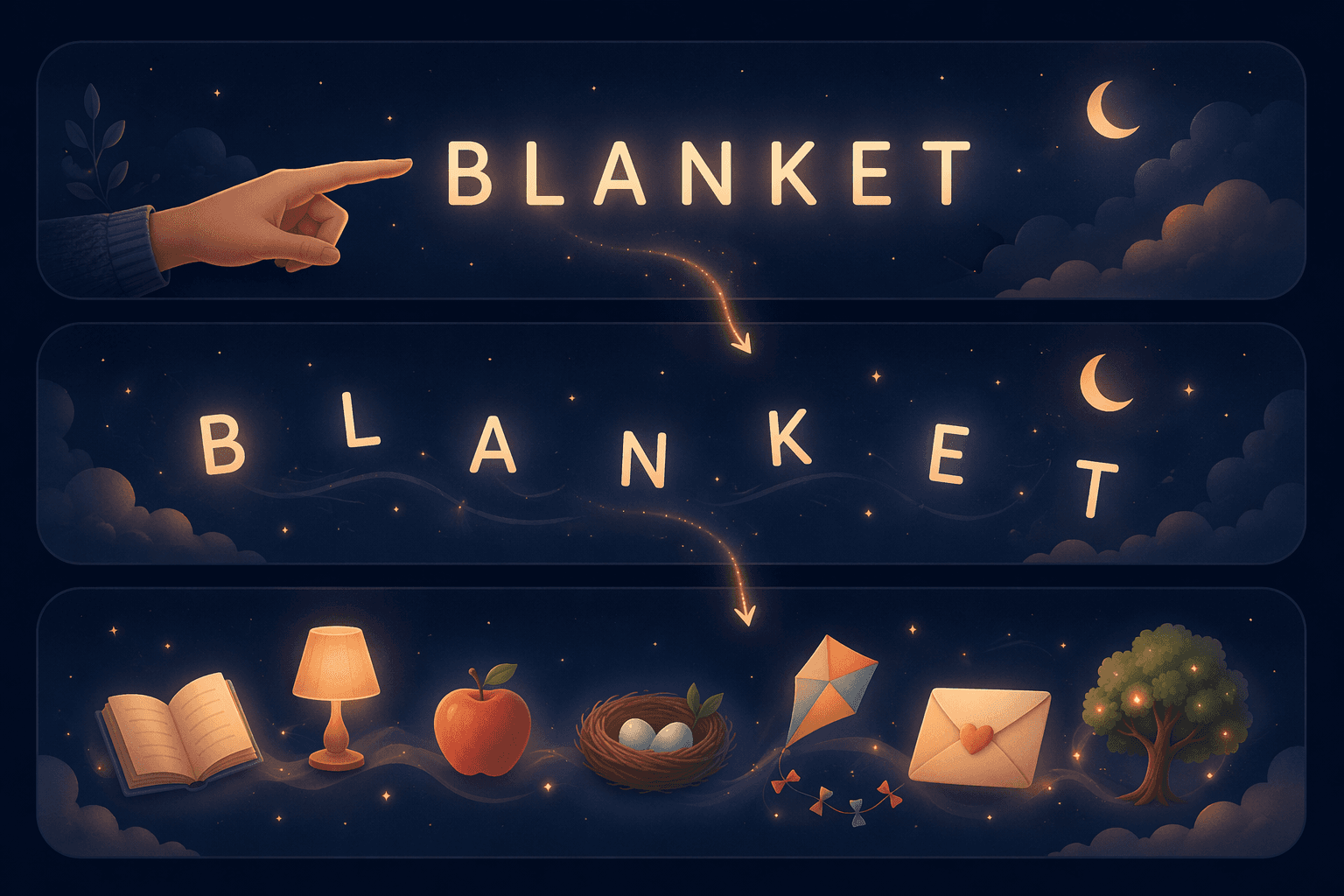
- Take the first letter of that word and think of a word that starts with that letter. For example, if your word is blanket, the first letter is B. Think of a word like book.
- Visualize that word briefly — just a quick mental image, not a detailed scene. Hold it for a second or two.
- Move to the next letter and repeat. For B-L-A-N-K-E-T, you might think: book, lamp, apple, nest, kite, envelope, tree.
- When you reach the end of the word, pick a new neutral word and start over. Continue until you fall asleep.
The key is that each word you generate should be unrelated to the previous one. The randomness is what makes the technique effective — it prevents your brain from building a coherent narrative that could lead back to worry.
Why It Works: The Neuroscience of Micro-Dreaming
To understand why cognitive shuffling works, you need to know what happens in your brain as you fall asleep. During wakefulness, your brain operates primarily in beta waves — fast, alerting patterns that support active thinking and problem-solving. As you transition into sleep, your brain shifts to slower, more meandering alpha and theta waves. This transition is accompanied by hypnagogic mentation: the random, fragmented thoughts and images that float through your mind just before you lose consciousness.
Cognitive shuffling accelerates this transition by giving your brain a task that mimics hypnagogic mentation. Dr. Sarah Gray, a psychologist and instructor at Harvard Medical School, explains that the technique helps the brain shift from fast brain waves to slower, more meandering ones. By flooding your working memory with random, neutral images, cognitive shuffling effectively diverts attention away from the "perturbing thought patterns" — the worry loops — that keep your brain locked in an alert state.
The technique also leverages a quirk of working memory: it has limited capacity. When you fill it with random images — book, lamp, apple, nest — there is simply less room left for the anxious thought about tomorrow's presentation. Dr. Eleni Kavaliotis, a registered psychologist and sleep researcher at Monash University, describes cognitive shuffling as a method that "mimics hypnagogic mentation" — the micro-dreams your brain naturally produces as it drifts off.
What the Research Says
The primary evidence for cognitive shuffling comes from a 2016 pilot study led by Beaudoin and presented at SLEEP 2016. The study followed 154 university students who experienced racing thoughts at bedtime. Participants were split into groups: one used cognitive shuffling, another used a structured problem-solving technique (similar to journaling), and a control group received no intervention.
The results showed that cognitive shuffling was just as effective as journaling at improving sleepiness before bed. Importantly, participants reported that cognitive shuffling was easier to perform — it could be done while lying in bed, without the need to get up and write. The technique also helped improve sleep throughout the semester, suggesting it has sustained benefits rather than being a one-night fix.
Sleep specialists have taken note. Dr. Alanna Hare, a consultant in sleep medicine at Royal Brompton Hospital, describes cognitive shuffling as "super somnolent" — a strong endorsement from a clinical sleep specialist. Beyond the study, experts at Harvard Medical School, Duke University, and Monash University have endorsed the technique for racing-mind insomnia, citing its grounding in sleep neuroscience and its practical advantages over other methods.
Who It Helps (and Who It Won't)
Cognitive shuffling is not a universal sleep solution. It works best for a specific reader profile: otherwise healthy sleepers whose primary barrier to falling asleep is racing thoughts, rumination, or anxiety. If you lie down and your brain immediately starts replaying the day's events, worrying about tomorrow, or generating hypothetical scenarios, cognitive shuffling is likely to help.
However, the technique has clear limitations:
- Chronic insomnia disorder: If you have persistent difficulty falling or staying asleep for three months or longer, cognitive shuffling alone is unlikely to resolve the underlying issue. The first-line treatment for chronic insomnia is Cognitive Behavioral Therapy for Insomnia (CBT-I), which addresses the behavioral and cognitive factors that maintain insomnia.
- Sleep apnea: If your sleep difficulties are caused by a medical condition like sleep apnea, cognitive shuffling will not address the root cause. You need a clinical evaluation and appropriate treatment.
- Aphantasia: If you have aphantasia — the inability to visualize mental images — cognitive shuffling may not be effective. The technique relies on generating and briefly holding visual images, which is difficult or impossible for people with this condition. If you cannot visualize, alternative techniques like progressive muscle relaxation or paced breathing may be more suitable.
How to Do Cognitive Shuffling Properly
Getting the most out of cognitive shuffling requires attention to a few key details. Here is how to practice it effectively:
Word Selection
Choose a word that is emotionally neutral. Dr. Patricia B. Pedreira, a health psychologist and postdoctoral associate at Duke University Medical Center, advises picking words like blanket, garden, bedtime, or kitchen. Avoid words like money or deadline that might "trigger worry chains." The word should be long enough to provide several rounds of visualization — 5 to 12 letters is ideal.
Visualization Tips
Keep each visualization brief. You are not trying to construct a detailed scene — just a quick mental flash of the object. For example, if you think of book, you might see a simple image of a book cover for a second or two. Do not try to imagine the book's title, author, or contents. The goal is to occupy your working memory without engaging your analytical brain.
When to Try It
Cognitive shuffling is most useful when you have been lying in bed awake for 15 to 20 minutes. It is also effective for middle-of-the-night awakenings when your mind starts racing. The technique works best when you are already in a relaxed state — it is not designed to force sleep, but to gently guide your brain into the hypnagogic transition.
Avoiding Perfectionism
Do not worry about doing it "right." If you lose track of the word, pick a new one. If you accidentally think of a word that is related to the previous one, that is fine. The technique is forgiving. The only real mistake is getting frustrated or trying too hard — that will keep you awake more than the technique itself.
Why It Beats Counting Sheep
Counting sheep is the classic folk remedy for sleeplessness, but it has a fundamental flaw: it is too monotonous. Dr. Sarah Gray explains that counting sheep is "too monotonous" to prevent intrusive thoughts from re-entering. Your brain can count sheep on autopilot while simultaneously running a worry loop in the background. The task does not occupy enough cognitive bandwidth to be effective.
Cognitive shuffling, by contrast, provides just enough cognitive engagement to keep your mind occupied without being stimulating enough to keep you awake. The randomness of the images — book, lamp, apple, nest — prevents your brain from building a coherent narrative, while the constant switching between letters and images keeps your working memory busy.
| Technique | Cognitive Engagement | Risk of Worry Loop | Ease of Use |
|---|---|---|---|
| Counting sheep | Very low (autopilot) | High — worry loops run in background | Easy but ineffective |
| Journaling | High (requires writing) | Low — thoughts are externalized | Requires getting out of bed |
| Relaxation exercises | Moderate (focus on breath/body) | Moderate — mind can wander | Easy but may not stop rumination |
| Cognitive shuffling | Moderate (random images) | Low — working memory is occupied | Easy — done in bed |
This balance is what makes cognitive shuffling unique. It is not a relaxation technique — it is a cognitive distraction technique that leverages the brain's natural sleep-onset mechanisms. By mimicking the random, fragmented thoughts of hypnagogic mentation, it effectively short-circuits the worry loops that keep you awake and guides your brain into the state it needs to fall asleep.
Comments
Join the discussion with an anonymous comment.