
Mechanism explainer
Sleep Restriction Therapy: A Complete Step-by-Step Guide to CBT-I Sleep Consolidation
Sleep restriction therapy (SRT) is the most mechanistically specific component of CBT-I, using a titrated sleep window to build homeostatic sleep pressure and consolidate fragmented sleep into durable, restorative rest. This guide explains the adenosine-based mechanism, walks through the two-week diary baseline, the initial window calculation, the weekly SE titration decision rules, safety contraindications, and what to realistically expect across the first weeks of treatment.
What Sleep Restriction Therapy Is — and What It Is Not
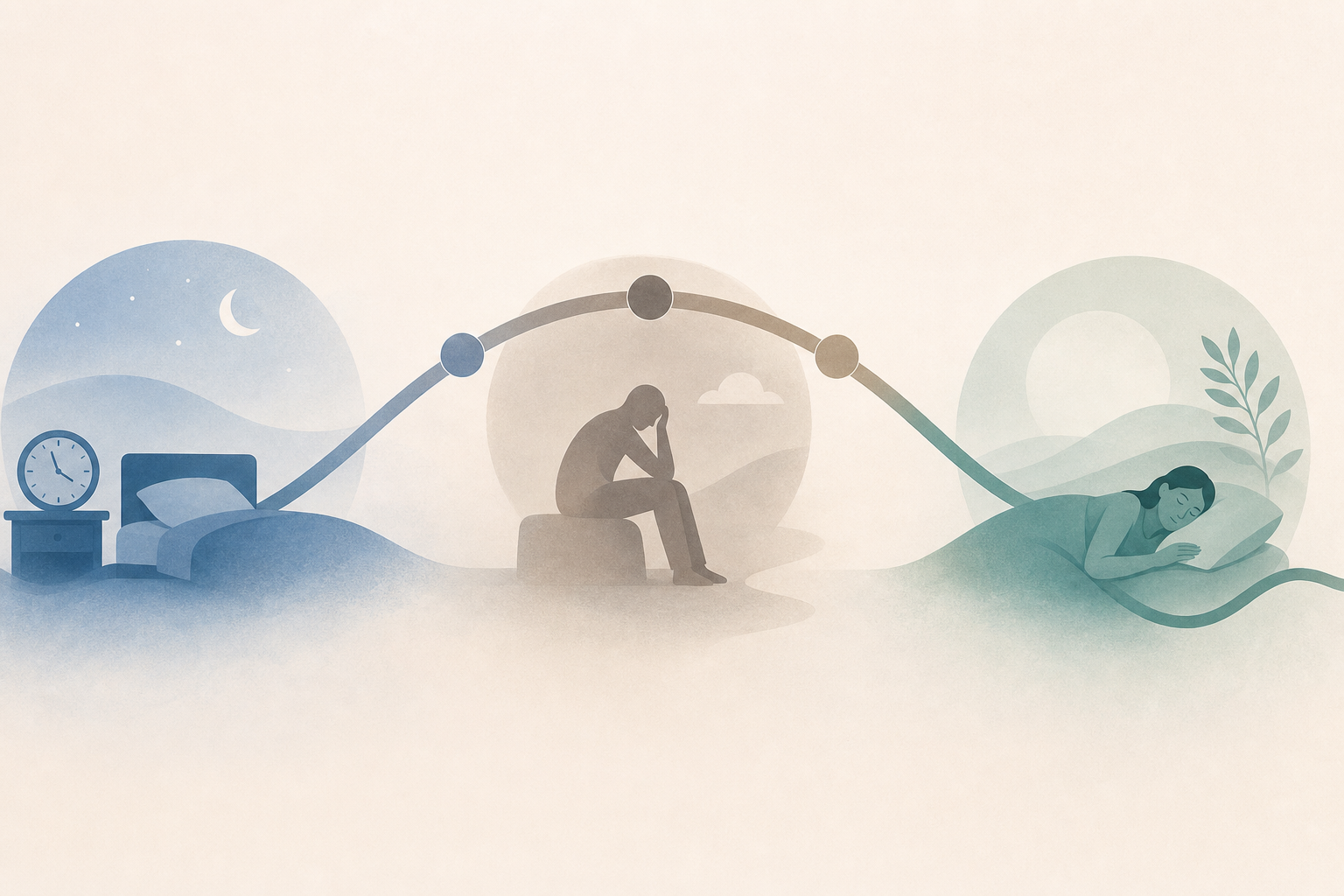
Sleep restriction therapy (SRT) is a structured behavioral intervention that temporarily limits the amount of time you spend in bed to match your actual average sleep time — then gradually expands that window as your sleep consolidates. It was developed by Dr. Arthur Spielman and remains one of the most evidence-supported behavioral treatments for chronic insomnia.
The name creates a predictable misunderstanding. SRT is not sleep deprivation therapy. The critical distinction is this: your prescribed time in bed is matched to the sleep you are already getting, not reduced below it. If you are averaging five and a half hours of actual sleep inside an eight-hour window, the protocol sets your window to five and a half hours — it does not cut you to four. The goal is consolidation, not deprivation.
SRT is also one component within the broader CBT-I protocol, which also includes stimulus control, cognitive restructuring, and relaxation techniques. This guide focuses exclusively on SRT as its own subject — its mechanism, its protocol steps, its titration logic, and its safety requirements. Readers who want the full CBT-I overview should start with that parent article.
Why SRT Works: The Two-Process Model and Adenosine Sleep Pressure
Sleep is regulated by two interacting biological systems. Process S is the homeostatic drive — a pressure that builds continuously during wakefulness and dissipates during sleep. Process C is the circadian signal — a roughly 24-hour oscillation that promotes alertness during the day and sleep during the night. Healthy sleep occurs when both systems align: high homeostatic pressure meets the circadian window for sleep.
In chronic insomnia with fragmented sleep, the homeostatic drive is often insufficient at bedtime — partly because extended time in bed while awake dilutes sleep pressure across too wide a window. The result is shallow, fragmented sleep that does not feel restorative.
The neurochemical substrate of Process S is adenosine. During wakefulness, adenosine accumulates in the extracellular space of the brain. As it builds, it stimulates adenosine A1 and A2A receptors, progressively increasing the drive toward NREM slow-wave sleep. Under conditions of extended wakefulness, adenosine accumulation is associated with increased NREM sleep duration and EEG slow-wave activity — the deepest, most restorative phase of sleep. This is the same mechanism that caffeine disrupts by blocking A2A receptors, temporarily masking the pressure without clearing it. (Reichert, Deboer, and Landolt, 2022)
SRT deliberately exploits this mechanism. By extending your waking period and concentrating sleep into a narrower window, it allows adenosine to accumulate to a level that drives deeper, more consolidated sleep when the window finally opens. The fixed wake anchor time reinforces the circadian signal simultaneously — keeping the timing of the sleep window predictable for your body clock. Over successive nights, this combination re-establishes the homeostatic and circadian alignment that fragmented insomnia disrupts.
For deeper background on the circadian component, see the article on circadian rhythm mechanisms. For an explanation of what consolidated sleep looks like at the level of NREM and REM architecture, see the article on sleep architecture.
Who Should Not Start SRT Without Clinical Guidance: Contraindications and Safety Screening
SRT is not appropriate for everyone. Because the protocol deliberately extends wakefulness to build sleep pressure, it carries specific risks for people with certain conditions. The following contraindications are confirmed across clinical sources including Cleveland Clinic and the Sleep Foundation. Review this screen before attempting self-implementation.
| Contraindication | Reason SRT Is Unsafe Without Clinical Supervision |
|---|---|
| Untreated bipolar disorder | Sleep deprivation is a documented trigger for manic episodes. The extended wakefulness in early SRT can destabilize mood in people with bipolar history, even when the overall sleep restriction is modest. |
| Uncontrolled seizure disorder | Sleep restriction lowers seizure threshold. People with epilepsy or other seizure conditions require clinical evaluation before any protocol that deliberately extends waking periods. |
| Untreated obstructive sleep apnea (OSA) | SRT cannot consolidate sleep when airway obstruction is fragmenting it regardless of the time-in-bed window. Treating OSA first is a prerequisite. See the article on obstructive sleep apnea for symptoms and diagnosis. |
| Safety-critical occupations | Transportation workers, construction workers, healthcare professionals, and others in roles where impaired alertness creates acute safety risk cannot tolerate the transient performance impairment documented in early SRT weeks. These individuals require clinical supervision and may need occupational accommodations. |
| Major acute illness or recent surgery | Physical recovery demands may conflict with intentional sleep restriction. Clinical judgment is required to determine timing. |
Phase 1 — The Two-Week Sleep Diary Baseline
SRT requires a stable estimate of how much sleep you are actually getting — not how much you think you should be getting, and not a single night's data. Two weeks of daily sleep diary entries provide the average that the protocol is built on.
Each morning, immediately after waking, record the following for the previous night:
- Time you got into bed (TIB start)
- Time you got out of bed (TIB end)
- Estimated time it took to fall asleep (sleep onset latency, or SOL)
- Estimated total time awake during the night after initially falling asleep (wake after sleep onset, or WASO)
- Estimated total sleep time (TST) — calculated as: TIB minus SOL minus WASO
- Subjective sleep quality rating (1–10 or a simple poor/fair/good scale)
After two weeks, calculate your averages:
| Metric | How to Calculate |
|---|---|
| Average TST | Sum all 14 nightly TST values, divide by 14 |
| Average TIB | Sum all 14 nightly TIB durations, divide by 14 |
| Sleep Efficiency (SE) | (Average TST ÷ Average TIB) × 100 |
The threshold for proceeding with SRT is a sleep efficiency below 85%. If your SE is already at or above 85%, your sleep is reasonably consolidated and SRT may not be the right intervention — other CBT-I components or a clinical evaluation may be more appropriate.
Phase 2 — Calculating and Setting Your Initial Sleep Window
Your initial prescribed sleep window is set equal to your average TST from the baseline diary. If your diary shows an average of six hours of actual sleep inside an eight-hour window, your initial window is six hours — not eight.
There is a minimum floor. Clinical protocols vary slightly on the exact number: the original Spielman protocol and studies including Kyle et al. (2014) and Cheng et al. (2020) used a five-hour minimum; the Sleep Foundation and Sleep Health Solutions cite 5.5 to 6 hours. The accepted clinical range is five to six hours depending on protocol variant and clinician judgment. The floor exists because the objective-subjective discrepancy means some patients may actually be sleeping more than their diary suggests — assigning a window significantly below true sleep need could be counterproductive and unsafe.
To set your window:
- Choose a fixed wake anchor time. This should be a time you can maintain consistently, including weekends — typically aligned with work, family, or other morning obligations.
- Count backward from your wake time by the number of hours in your prescribed window (your average TST, with the minimum floor applied). This gives you your prescribed bedtime.
- Do not go to bed before this prescribed bedtime, even if you feel sleepy earlier. Staying awake until the window opens is how adenosine accumulation is preserved.
- Maintain the fixed wake time regardless of how the night went. Sleeping in after a poor night dissipates the homeostatic pressure the protocol is trying to build.
Phase 3 — The Weekly Sleep Efficiency Titration Loop
The titration loop is the core control mechanism of SRT. Each week, you calculate your sleep efficiency from the past seven nights of diary data and adjust your window based on the result. This is not a one-time calculation — it repeats every week until sleep is fully consolidated.
The titration thresholds were established in the original Spielman (1987) research and confirmed in subsequent protocols including Kyle et al. (2014) and the Sleep Foundation's clinical protocol:
| Weekly SE | Action | Mechanism Rationale |
|---|---|---|
| Below 85% | Reduce TIB by 15 minutes (tighten the window) | Sleep pressure is still insufficient to consolidate sleep. Tightening the window increases adenosine accumulation and drives deeper sleep on subsequent nights. |
| 85–89% | Hold the current window unchanged | Sleep is consolidating at an acceptable rate. Maintaining the window allows the homeostatic recalibration to continue without disruption. |
| 90% or above | Extend TIB by 15 minutes (widen the window) | The homeostatic drive has been successfully recalibrated. The window can be safely expanded because sleep pressure is now strong enough to fill a slightly larger window with consolidated sleep. |
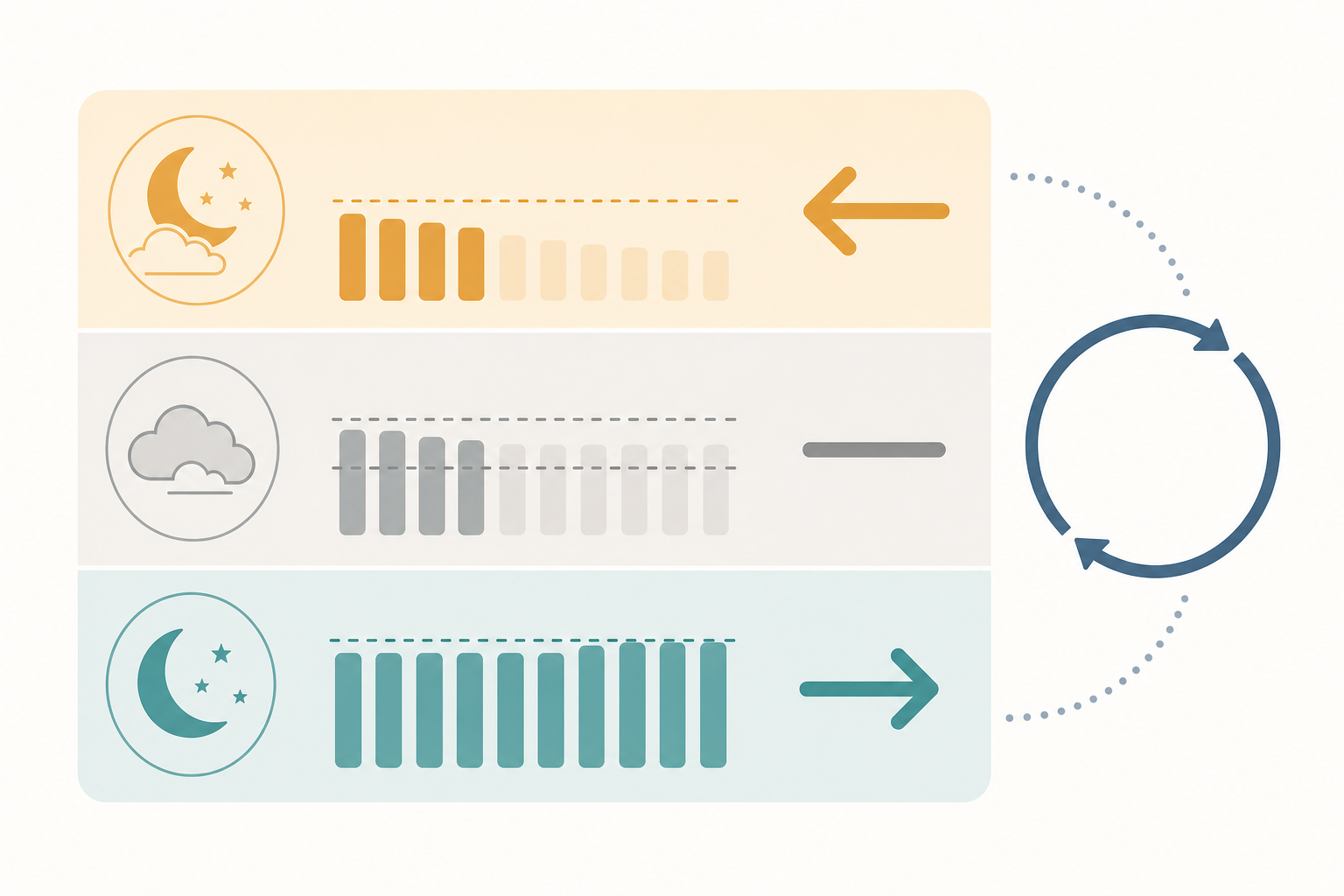
Continue the weekly titration loop until two conditions are both met: sleep efficiency is consistently at or above 90%, and you feel adequately rested during the day. At that point, the window has been expanded to match your actual sleep need and the consolidation process is complete.
Weeks 1–3: Managing the Difficult Early Phase
The early weeks of SRT are genuinely hard. Understanding what is normal — and what is not — is essential for staying the course safely.
A 2014 study by Kyle and colleagues provided the first systematic objective evidence of SRT-related impairment. In 16 patients with psychophysiological insomnia, PSG-measured total sleep time dropped by approximately 91 minutes on the first night of SRT. Attentional lapses and slowed reaction times were significantly elevated at days 8, 21, and 22. Epworth Sleepiness Scale scores — a measure of daytime sleepiness — were significantly elevated at weeks 1, 2, and 3. (Kyle et al., 2014)
These findings should be understood in context. The study had a small sample of 16 participants and no untreated control group. They represent the first systematic objective documentation of early SRT effects, not definitive population-level data. Separately, a randomized controlled trial by Cheng et al. (2020) in 150 postmenopausal women found that SRT did not confer statistically higher risk of excessive sleepiness relative to CBT-I — suggesting that for many patients, the subjective experience of early tiredness does not translate into clinically significant sleepiness. (Cheng et al., 2020) Note that the Cheng et al. findings were in postmenopausal women specifically, which limits how broadly they generalize.
What is normal in weeks 1–3:
- Feeling tired earlier than your prescribed bedtime — this is the adenosine accumulation working as intended. Stay awake until your window opens.
- Increased daytime sleepiness compared to your pre-SRT baseline.
- Difficulty concentrating or slower reaction times, particularly in the first two weeks.
- Frustration and the urge to go to bed early or sleep in — both of which would undermine the protocol.
Practical strategies for staying awake until your prescribed bedtime:
- Keep lights on and stay in well-lit rooms until bedtime.
- Engage in light physical activity — a short walk, gentle stretching, household tasks — rather than sitting passively.
- Social engagement or phone conversations can help maintain alertness without stimulating the nervous system excessively.
- Avoid the bedroom and bed until your prescribed bedtime. Stimulus control — associating the bed only with sleep — reinforces SRT's effects.
Warning signs that require clinical contact rather than protocol continuation:
- Significant mood instability, elevated energy, reduced need for sleep, or racing thoughts — these may suggest a mood episode in someone with an unrecognized bipolar history.
- Any seizure activity.
- Sleepiness so severe that basic daily functioning or safety is compromised beyond what you can manage with behavioral strategies.
SRT as a Standalone Treatment vs. Within Full CBT-I
A practical question for anyone considering SRT is whether to pursue it as a standalone intervention or within the full CBT-I protocol.
The Cheng et al. (2020) RCT provides useful data here. SRT delivered in approximately two sessions produced outcomes comparable to CBT-I delivered in six sessions in the study population of postmenopausal women with chronic insomnia. This suggests SRT alone can be a time-efficient option for uncomplicated chronic insomnia where the primary driver is fragmented, low-efficiency sleep rather than significant cognitive or emotional hyperarousal.
Full CBT-I — which Cleveland Clinic notes typically runs four to eight weekly or biweekly sessions — adds cognitive restructuring, stimulus control, and relaxation training. These components address sleep-related anxiety, dysfunctional beliefs about sleep (such as catastrophizing a single poor night), and the conditioned arousal that often develops when someone has spent months or years lying awake in bed. For patients whose insomnia has a strong cognitive or hyperarousal component, the additional CBT-I components add meaningful value that SRT alone does not provide.
SRT vs. Sleep Compression Therapy: What the 2026 Evidence Shows
Sleep compression therapy (SCT) is a related but distinct approach. Rather than immediately setting a restricted window matched to average TST, SCT reduces time in bed gradually over several weeks — narrowing the window incrementally rather than all at once. The rationale is that a slower reduction may produce fewer early side effects and better adherence, at the cost of a slower response.
A 2026 randomized controlled trial by Jernelöv and colleagues at the Karolinska Institutet provided the first large-scale, well-controlled direct comparison of the two approaches. The trial enrolled 234 adults with chronic insomnia and randomized them to either SRT or SCT via a 10-week therapist-guided online program. Both therapies produced significant reductions in insomnia symptoms. However, SCT did not meet non-inferiority criteria: SRT produced faster and slightly greater improvements in insomnia severity. SCT showed fewer early side effects and better adherence. Treatment satisfaction and daytime functioning at the end of treatment were similar between groups. (Jernelöv, ESRS 2026) Note that the ESRS source is a secondary summary by the researcher; the full peer-reviewed journal citation should be verified independently.
| Dimension | Sleep Restriction Therapy (SRT) | Sleep Compression Therapy (SCT) |
|---|---|---|
| Window reduction approach | Immediate: window set to average TST from baseline | Gradual: window reduced incrementally over weeks |
| Speed of response | Faster improvement in insomnia severity | Slower improvement |
| Insomnia severity reduction | Greater reduction (non-inferiority not met by SCT) | Significant but smaller reduction |
| Early side effects | More pronounced (daytime sleepiness, performance impairment) | Fewer early side effects |
| Adherence | More difficult in early weeks | Better adherence reported |
| End-of-treatment satisfaction | Similar to SCT | Similar to SRT |
| Clinical status | First-line treatment | Valid alternative for patients who cannot tolerate SRT intensity |
Expected Timeline and Realistic Outcomes
Setting accurate expectations is part of the protocol. SRT produces real, durable improvements — but not overnight, and not in every patient.
In the Kyle et al. (2014) study, the Insomnia Severity Index decreased from approximately 17 (moderate-to-severe insomnia) to approximately 8 (subthreshold) by week 4 of the protocol. Sleep efficiency moved from 68% at baseline to 90.7% by week 4. Subjective sleep onset latency and wake after sleep onset improved substantially and were maintained at three-month follow-up. All objective performance impairments documented in the early weeks had resolved by the three-month follow-up assessment.
The original Spielman (1987) study, which established SRT as a clinical treatment, demonstrated significant improvements across total sleep time, sleep latency, total wake time, sleep efficiency, and subjective insomnia ratings by the end of an eight-week program. These gains remained significant at a mean follow-up of 36 weeks — indicating durable remission, not temporary improvement. (Spielman, Saskin, and Thorpy, 1987)
At the population level, Cleveland Clinic reports that seven to eight out of ten adults show significant improvement with CBT-I incorporating SRT. That means approximately 20–30% of patients do not achieve meaningful improvement from the protocol alone. Non-response is real, and patients who complete a full protocol course without adequate improvement should seek clinical evaluation rather than continuing indefinitely.
- Weeks 1–3: Transient daytime sleepiness and performance impairment are expected and documented. Sleep is beginning to consolidate.
- Week 4: Most patients see meaningful improvement in subjective sleep quality, ISI scores, and sleep efficiency.
- Weeks 4–8: Titration loop continues; window expands as SE stabilizes above 90%.
- 3-month follow-up: Gains are maintained without pharmacological dependency; objective performance normalizes completely.
- 36-week follow-up (Spielman 1987): Improvements remain statistically significant in the majority of completers.
Supports these guides
Spot an error or have clinical feedback?
Because this article covers clinical, medication, or safety information, we use a moderated correction channel instead of open public comments. Let us know if something about “Sleep Restriction Therapy: A Complete Step-by-Step Guide to CBT-I Sleep Consolidation” needs a closer look.
Send feedback on this article