
Mechanism explainer
Sleep Restriction Therapy Not Working? A Troubleshooting Guide for Common Stalls
For adults with chronic insomnia who have started sleep restriction therapy but are not seeing results, this guide identifies the six most common implementation errors, explains how to read your sleep diary for early progress signals, and provides clear criteria for when to escalate to supervised CBT-I.

If you have been following sleep restriction therapy for a week or two and feel worse than when you started, you are not alone — and you have not necessarily failed. SRT is one of the most effective behavioral treatments for chronic insomnia, but it is also one of the most counterintuitive. The therapy deliberately creates short-term discomfort to produce long-term consolidation. That discomfort is not a sign something is wrong. The question is whether what you are experiencing is the expected early difficulty or a genuine protocol stall.
Normal Early Difficulty vs. Genuine Protocol Failure
In the first one to two weeks of SRT, most people experience some combination of increased daytime sleepiness, difficulty staying awake in the evening before their prescribed bedtime, and occasionally worse nighttime sleep than before they started. This is not failure. It is the therapy working as intended — the restricted time in bed is building homeostatic sleep pressure, and the pressure has not yet translated into consolidated, efficient sleep.
A genuine protocol stall looks different. It is three to four weeks of consistent, careful adherence with no measurable movement in any direction — sleep onset is not getting faster, middle-of-the-night waking is not decreasing, and daytime sleepiness is intensifying rather than stabilizing. That pattern warrants systematic troubleshooting, not just more time.
- Normal early difficulty: daytime sleepiness in weeks 1–2, difficulty staying awake before your prescribed bedtime, occasional nights that feel worse than your pre-treatment baseline.
- Genuine stall: no improvement in sleep onset latency (SOL) or wake after sleep onset (WASO) after 3–4 weeks of genuine, consistent adherence, with sleepiness worsening rather than plateauing.
- Premature abandonment: stopping before week 4 because the first two weeks felt hard — this is the most common reason SRT appears to fail when it has not actually been given a real trial.
How to Read Your Sleep Diary to Tell If SRT Is Actually Working
Sleep efficiency (SE) crossing the 85% threshold is the most commonly cited marker of SRT progress, but it is a lagging indicator. Early positive signals appear in the diary before efficiency climbs. If you know what to look for, you can distinguish a therapy that is working slowly from one that is genuinely stalled.
In days 3 through 7, look for two specific changes: falling asleep faster after lights out (even by 10–15 minutes), and waking fewer times during the night. These shifts in sleep onset latency and WASO often precede any change in total sleep time or efficiency score. They signal that homeostatic pressure is beginning to consolidate your sleep — the mechanism is engaging even if your efficiency number has not moved yet.
| Diary Signal | What It Means | Typical Timing |
|---|---|---|
| Falling asleep faster (SOL decreasing) | Homeostatic pressure is consolidating sleep onset | Days 3–7 |
| Fewer nighttime awakenings (WASO decreasing) | Sleep architecture is consolidating | Days 5–10 |
| Sleep efficiency crossing 80% | Protocol is working; hold or increase window per titration rules | Week 2–3 |
| Sleep efficiency consistently above 85–90% | Window expansion is warranted | Week 3–4 |
| No change in SOL, WASO, or SE after 3–4 weeks | Genuine stall — review adherence and implementation errors | Week 3–4+ |
Meaningful change — efficiency consistently above 85%, noticeably shorter time to fall asleep, sleeping through the night more often — typically appears by week 4 for adherent practitioners. If your diary shows no movement in any of these markers after four weeks of genuine, consistent effort, that is the signal to systematically review what may have gone wrong.
The Six Most Common Implementation Errors — and How to Fix Each One
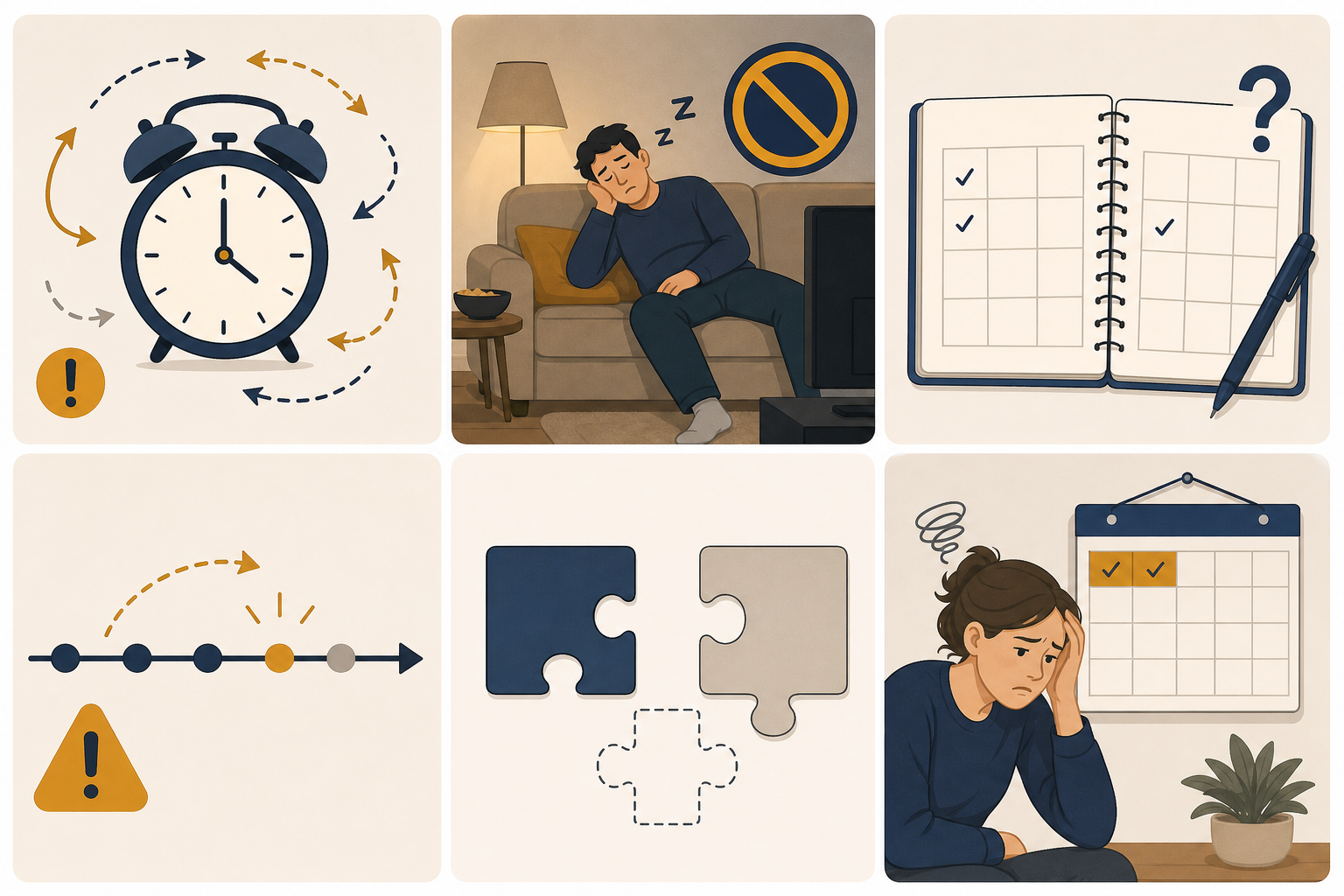
Error 1: Inconsistent Wake Time
This is the single most damaging implementation error in self-guided SRT. The fixed morning rise time is not a preference — it is the anchor of the entire protocol. SRT works partly by training your circadian system to expect wakefulness at a consistent time, which in turn drives stronger, more predictable sleep pressure the following night. Varying your wake time by even 45 to 60 minutes across days disrupts this entrainment process and substantially weakens the therapy's effect.
The fix is non-negotiable: set your rise time first, before anything else, and hold it absolutely — including weekends, days off, and mornings after a particularly bad night. The urge to sleep in after a rough night is understandable, but doing so resets the circadian signal you have been building.
Error 2: Napping and Accidental Evening Dozing
Every minute of sleep outside your prescribed window — including a 20-minute sofa nap at 7 p.m. — bleeds the homeostatic sleep pressure the therapy is deliberately building. SRT depends on arriving at your prescribed bedtime with a high sleep drive. Napping reduces that drive, making it harder to fall asleep quickly and stay asleep through the night.
Evening dozing is particularly common and particularly damaging because it happens passively — you sit down after dinner, the television is on, and you fall asleep without intending to. The fix requires active countermeasures in the hours before your prescribed bedtime: stay upright, use bright overhead lighting rather than lamps, and engage in light activity (washing dishes, light stretching, a short walk) during the high-risk window. If you find yourself nodding off, stand up.
Error 3: Inaccurate Baseline from Insufficient Diary Data
Your initial sleep window is calculated from your average total sleep time (TST) across the diary baseline period. If that baseline was only three or four nights, the average is unreliable — a single unusually good or unusually bad night skews the calculation significantly. A window derived from too few nights is either too wide (producing low sleep pressure and poor consolidation) or too narrow (creating unnecessary severity without therapeutic benefit).
The fix is to complete or reconstruct a full seven-night diary before making any window adjustments. If you cannot remember enough detail to reconstruct seven nights accurately, start fresh with a new seven-night baseline before resuming titration.
Error 4: Premature Window Expansion
Expanding your sleep window before your sleep efficiency consistently meets the threshold resets the progress you have built. The titration rules exist for a reason: efficiency must be reliably high before the window grows. Expanding too early — because you feel tired, because you want more sleep, or because you misread one good night as a trend — dilutes the sleep pressure and typically causes efficiency to drop back below the threshold.
The standard titration framework from the Cheng and Drake RCT protocol uses SE ≥ 90% to justify a 30-minute increase, SE of 85–89% to justify a 15-minute increase, SE of 80–84% as a hold signal, and SE below 80% as a signal to reduce the window by 15 minutes. These thresholds apply to your weekly average, not a single night.
Error 5: Attempting SRT Without Stimulus Control
SRT and stimulus control address different parts of the insomnia cycle and are mechanistically complementary. SRT builds sleep pressure through time-in-bed restriction. Stimulus control breaks the conditioned association between the bed and wakefulness — the learned arousal response that keeps many people awake even when they are tired. Doing one without the other leaves part of the problem unaddressed.
If you are lying in bed for 20 minutes or more without falling asleep, stimulus control requires you to get up, go to another room, and return only when sleepy. This feels counterproductive when you are already sleep-deprived, but it prevents the bed from continuing to signal wakefulness. If you are practicing SRT without this component, adding it is likely to produce a meaningful improvement in sleep onset latency.
Error 6: Catastrophizing Early Sleepiness and Abandoning Before Week 4
Early daytime sleepiness in weeks one and two is not a side effect to be eliminated — it is a sign the therapy is working. Research examining the physiological mechanisms of SRT found that nighttime sleepiness in treatment responders was positively correlated with higher sleep efficiency and shorter wake time, confirming that the feeling of being sleepy is a direct marker of the homeostatic pressure building that drives consolidation.
The common pattern is: sleepiness peaks in weeks one and two, then gradually resolves as sleep consolidates and the window expands. Abandoning at the two-week mark — when sleepiness is at its worst and sleep improvement has not yet fully materialized — means stopping at exactly the point where the therapy is working hardest. Most practitioners who stick with the protocol through week four report meaningful improvement.
Managing Daytime Sleepiness Without Defeating the Therapy
The goal in early SRT weeks is to manage sleepiness enough to function safely without eliminating the sleep pressure that makes the therapy work. These strategies help you stay awake and alert during the day without napping or dosing off in ways that undermine your evening sleep drive.
- Morning bright light exposure: Get outside or sit near a bright window within 30 minutes of your rise time. Bright light suppresses residual melatonin and reinforces the circadian signal that supports your fixed wake time. It also provides a short-term alerting effect that helps you get through the groggiest part of the morning.
- Upright rest instead of lying down: If you need to rest during the day, sit upright in a chair with your eyes closed for 10–15 minutes. Do not lie down. Lying down substantially increases the likelihood of crossing into light sleep, which reduces homeostatic pressure. Upright rest provides some recovery benefit without the same risk.
- Strategic activity scheduling: Schedule moderately engaging tasks — light exercise, social interaction, tasks requiring light concentration — during your highest-sleepiness windows, typically mid-afternoon. Passive activities (watching television, sitting in a quiet room) increase the risk of accidental dozing.
- Wind-down routine as a boundary signal: A consistent pre-bed routine helps signal to your body that sleep is approaching and reduces the arousal that can make it hard to fall asleep even when you are tired. For guidance on structuring this, see the evidence-based evening wind-down routine guide.
Protocol Adjustments for Specific Populations
Standard SRT parameters work well for most adults, but three populations benefit from specific modifications to the protocol settings. These adjustments are about SRT parameter calibration, not general CBT-I efficacy — the therapy remains appropriate, but the specific numbers need to be adapted.
| Population | Parameter Modification | Rationale |
|---|---|---|
| Older adults (65+) | Minimum TIB floor of 5.5–6 hours (not 5 hours); 15-minute expansion increments (not 30-minute) | Fall risk from excessive sleepiness; fragmented sleep physiology means aggressive restriction carries higher safety risk |
| Comorbid anxiety or depression | SRT alone is less sufficient; cognitive restructuring components are more important | Hyperarousal is more severe; cognitive patterns maintaining insomnia require direct treatment alongside restriction |
| Shift workers and irregular schedules | Anchor timing to the scheduled shift pattern; standard fixed-time SRT requires significant modification | A fixed rise time is meaningless if your shift pattern changes; window timing must align with your actual scheduled work hours |
Older Adults
The standard minimum TIB floor of five hours is appropriate for most adults, but clinical guidance suggests raising this to 5.5 to 6 hours for adults over 65. The reasoning is twofold: first, fall risk from excessive daytime sleepiness is a serious safety concern in this age group; second, fragmented sleep architecture is a normal physiological feature of aging, not a pathology to be aggressively corrected. Overly restrictive windows can produce unnecessary harm without proportional benefit.
Window expansion increments should also be smaller — 15 minutes rather than 30 — to allow gradual adjustment and reduce the risk of efficiency dropping sharply after an expansion. Slower titration takes longer but is safer and more sustainable.
Comorbid Anxiety or Depression
When insomnia co-occurs with anxiety or depression, the hyperarousal component of insomnia is typically more severe and more resistant to restriction alone. SRT can still be effective, but the cognitive patterns that maintain insomnia — catastrophizing about sleep loss, monitoring for sleep-related threat, safety behaviors — need to be addressed alongside the behavioral restriction. SRT in isolation is less likely to produce full remission in this group.
If you have comorbid anxiety or depression and SRT is not producing results after three to four weeks of genuine adherence, the most likely explanation is not a protocol error — it is that you need the full CBT-I package, including cognitive restructuring, not just the behavioral component. For a broader look at how CBT-I works across comorbidities, see the guide to CBT-I for comorbid insomnia.
Shift Workers and Irregular Schedules
Standard SRT depends on a fixed rise time to anchor circadian entrainment. If your work schedule rotates or changes week to week, a fixed rise time is not consistently achievable, and the standard protocol breaks down. The modification is to anchor your sleep window to your scheduled shift pattern rather than to a single fixed clock time. This requires more active planning and ideally some professional guidance, since the titration rules become more complex when your schedule is variable.
When Self-Guided SRT Is Not Enough: Escalation Criteria and Next Steps
Self-guided SRT works for many people, but it has a ceiling. The clearest escalation criterion is sleep efficiency consistently below 80% after three to four weeks of genuine, consistent adherence — combined with no improvement in sleep onset latency or wake after sleep onset. If you have reviewed all six implementation errors above, corrected what applied to you, and still see no movement after a full month, that is a clear signal that self-guided SRT alone is not sufficient.
The evidence for adding professional guidance is strong. The HABIT randomized controlled trial (n=642) tested nurse-delivered SRT in NHS primary care — a relatively minimal intervention of four sessions, two in-person and two by phone. Even that modest level of professional support produced a Cohen's d of 0.74 on the Insomnia Severity Index at six months and 0.72 at twelve months, compared to sleep hygiene alone. The intervention was also cost-effective at £2,075 per quality-adjusted life year gained. The implication is direct: if self-guided SRT is stalling, adding even brief professional guidance produces substantially better outcomes.
Supervised CBT-I adds three things that self-guided SRT cannot fully provide: formal cognitive restructuring to address the thought patterns maintaining insomnia, a structured review of stimulus control adherence, and therapist accountability that improves protocol fidelity. The full protocol is described in the complete CBT-I protocol guide. For readers who want to understand the broader therapy before seeking a provider, the CBT-I FAQ covers what to expect and how to find qualified providers.
- The Society of Behavioral Sleep Medicine (SBSM) maintains a provider directory at behavioralsleep.org — this is the most reliable starting point for finding a qualified CBT-I therapist in the United States.
- Digital CBT-I programs (Sleepio, Somryst) have demonstrated efficacy in RCTs and are available without a referral in many regions. They provide more structure than self-guided SRT but less than in-person therapy.
- Primary care providers trained in brief behavioral sleep interventions — as in the HABIT trial — are an increasingly available option and may be accessible through your existing care team.
Red Flags: When to Seek Medical Evaluation Before Continuing
Most SRT difficulties are implementation problems, not medical emergencies. But certain patterns warrant pausing the protocol and seeking medical evaluation before troubleshooting further. These are not reasons to never use SRT — they are reasons to get clinical input first.
- Suspected untreated sleep apnea: If you or a bed partner have noticed loud snoring, gasping, or observed breathing pauses during sleep, SRT will not address the underlying cause of your sleep disruption. Untreated obstructive sleep apnea needs evaluation before behavioral therapy is appropriate.
- Emerging or worsening mood episodes: Sleep restriction can precipitate mood changes in individuals with bipolar disorder. If you notice elevated mood, decreased need for sleep without fatigue, racing thoughts, or significant depressive worsening during SRT, stop the protocol and contact your mental health provider.
- Significant fall risk in older adults: If you are 65 or older and experiencing balance difficulties, dizziness, or near-falls during the early sleepiness weeks, discuss the protocol with your physician. The conservative TIB floor described above may need to be adjusted further.
- Worsening occupational safety concerns: If early-week sleepiness is creating genuine safety risks at work — microsleeps while driving, difficulty staying alert on a job site, impaired clinical judgment — pause the protocol and seek provider guidance on timing and safety planning before restarting.
Supports these guides
Spot an error or have clinical feedback?
Because this article covers clinical, medication, or safety information, we use a moderated correction channel instead of open public comments. Let us know if something about “Sleep Restriction Therapy Not Working? A Troubleshooting Guide for Common Stalls” needs a closer look.
Send feedback on this article